Page 293 of 435
�µ
�µ �µ
�µ
Fuel economy is not a f ixed number.
It varies based on driving conditions,
driving habits, and vehicle condition.
Theref ore, it is not possible f or one
set of estimates to predict f uel
economy precisely f or all drivers in
all environments.
Provides an estimated annual f uel
cost, based on 15,000 miles (20,000
km) per year multiplied by the cost
pergallon(basedonEPAfuelcost
data) divided by the combined f uel
economy.
For more inf ormation on f uel
economy ratings and factors that
af f ect f uel economy, visit(Canada: Visit
)
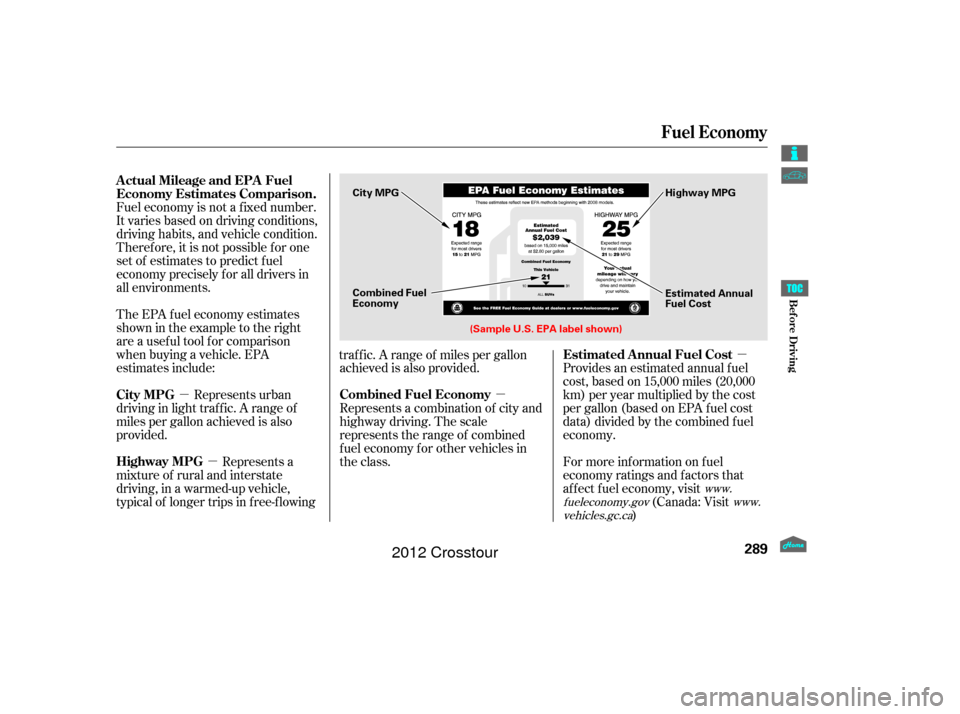
Represents urban
driving in light traf f ic. A range of
miles per gallon achieved is also
provided. The EPA f uel economy estimates
shownintheexampletotheright
are a usef ul tool f or comparison
when buying a vehicle. EPA
estimates include:
Represents a combination of city and
highway driving. The scale
represents the range of combined
f uel economy f or other vehicles in
the class.
Represents a
mixture of rural and interstate
driving, in a warmed-up vehicle,
typical of longer trips in f ree-f lowing traf f ic. A range of miles per gallon
achieved is also provided.
www.
fueleconomy.gov www.
vehicles.gc.ca
Actual Mileage and EPA Fuel
Economy Estimates Comparison.
Estimated Annual Fuel Cost
City MPG Combined Fuel Economy
Highway MPG
Fuel Economy
289
Combined Fuel
Economy (Sample U.S. EPA label shown) Estimated Annual
Fuel Cost
City MPG
Highway MPG
Bef ore Driving
2012 Crosstour
Page 294 of 435

�µ�µ
�µ
�µ�µ �µ
Aggressive driving (hard
acceleration and braking)
Excessive idling, accelerating and
braking in stop-and-go traf f ic
Cold engine operation (engines
aremoreefficientwhenwarmed
up)
Driving with a heavy load or the
air conditioner running
Improperly inf lated tires
The f ollowing f actors can lower your
vehicle’s f uel economy:
A properly maintained vehicle
maximizes f uel economy. Poor
maintenance can signif icantly reduce
f uel economy. Always maintain your
vehicle according to the maintenance messages displayed on the
inf ormation display (see
on page ).
For example: Rapid
acceleration, abrupt cornering,
and hard braking increase fuel
consumption.
Aerodynamic drag has a big ef f ect
on f uel economy at speeds above
45 mph (75 km/h). Reduce your
speed and you reduce the drag.
Trailers, car top carriers, roof
racks and bike racks are also big
contributors to increased drag.
An underinf lated tire increases
‘‘rolling resistance,’’ which reduces
f uel economy.
It puts a heavier
load on the engine, increasing f uel
consumption.
In
particular, a build-up of snow or
mud on your vehicle’s underside
adds weight and rolling resistance.
Frequent cleaning helps your f uel
economy. Idling
results in 0 miles per gallon (0 kms
per liter).
330
Fuel Economy Factors
Use the recommended viscosity
motor oil, displaying the API
Certif ication Seal (see page ).
Improving Fuel Economy Owner’s
Maintenance Checks Drive moderately
Observe the speed limit
Maintain proper tire inf lation
A void carrying excess weight in
your vehicle
K eep your vehicle clean A void excessive idling
334
Vehicle Maint enance Drive Ef f icient ly
Fuel Economy
290
Bef ore Driving
2012 Crosstour
Page 295 of 435
�µ�µ
Fill the f uel tank until the nozzle automatically clicks of f .
Reset trip counter to zero.
Record the total gallons (liters) needed to ref ill.
Follow one of the simple calculations above.
The A/C
puts an extra load on the engine
which makes it use more f uel. Use
the f resh-air ventilation when
possible.
Combine several short trips into
one. A warmed-up engine is more
f uel ef f icient than a cold one.
Direct calculation is the
recommended source of inf ormation
about your actual f uel economy.
Using f requency of f ill-ups or taking
f uel gauge readings are NOT
accurate measures of f uel economy.
Fuel economy may improve over the
f irst several thousand miles
(kilometers). 1)
2)
3)
4)
Checking Your Fuel Economy
Measuring T echniquesMinimize the use of the air
conditioning system
Plan and combine trips
Calculating Fuel Economy
Fuel Economy
291
Miles driven Gallons of
fuel Miles per
Gallon
100 KilometersL per 100 km
Liter
Bef ore Driving
2012 Crosstour
Page 334 of 435

�µ�µ�µ
�µ
�µ
�µ
�Ì
Engine oil level Check every
time you fill the fuel tank. See
page .
Engine coolant level Check the
radiator reserve tank every time
you f ill the f uel tank. See page .
Automatic transmission
Check the f luid level monthly.
See page .
Brakes Check the f luid level
monthly. See page .
Tires Check the tire pressure
monthly. Examine the tread f or
wear and foreign objects. See .
Lights Check the operation
.
However, service at a dealer is not
mandatory to keep your warranties
in effect. Maintenance may be done
by any qualif ied service f acility or
person who is skilled in this type of
automotive service. Make sure to
have the service f acility or person
reset the display as previously
described. Keep all receipts as proof
of completion, and have the person
who does the work f ill out your
Honda Service History or Canadian
Maintenance Log. Check your
warranty booklet f or more
inf ormation.
We recommend using Honda parts
and fluids whenever you have
maintenance done. These are
manuf actured to the same high
quality standards as the original
components, so you can be conf ident
of their perf ormance and durability.
According to state and federal
regulations, f ailure to perf orm
maintenance on the items marked
with will not void your emissions
warranties. However, all
maintenance services should be
perf ormed in accordance with the
intervals indicated by the
inf ormation display.
Youshouldcheckthefollowing
items at the specif ied intervals. If
you are unsure of how to perf orm
any check, turn to the appropriate
page listed. U.S. Vehicles:
288
288
340 342
359
344
Maintenance Minder
Owner’s Maintenance Checks
330
TM
Maint enance
page
of all the lights monthly. See page
2012 Crosstour
Page 335 of 435

�Î
�Î
�Ì �Ì
�µ
�µ
�Ì�Î
Maintenance Minder
331
Maintenance Main Items
Replace engine oil
Replace engine oil and oil filter
Inspect front and rear brakes
Check parking brake adjustment
Inspect these items: Tie rod ends, steering gear box, and boots
Suspension components
Driveshaft boots
Brake hoses and lines (including ABS/VSA)
All fluid levels and condition of fluids
Exhaust system
Fuel lines and connections Maintenance Sub Items
Rotate tires
Replace air cleaner element
Replace dust and pollen filter
Inspect drive belt
Replace transmission and transfer fluid (4WD only)
Replace spark plugs
Replace timing belt and inspect water pump
Inspect valve clearance
Replace engine coolant
Replace rear differential fluid (4WD only)
:
A
B
Symbol
1
2
3
4
Symbol
6 51
1
Inspect idle speed every 160,000 miles (256,000 km).
If the message ‘‘SERVICE’’ does not appear more than 12 months after the
display is reset, change the engine oil every year.
See information on maintenance and emissions warranty in the center
column on page .
Adjust the valves during services A, B, 1, 2, or 3 if they are noisy. Independent of the Maintenance Minder information, replace the brake
fluid every 3 years.
NOTE: 1:
330
TM
If you drive in dusty conditions, replace every 15,000
miles (24,000 km).
If you drive primarily in urban areas that have high
concentrations of soot in the air from industry and from
diesel-powered vehicles, replace every 15,000 miles
(24,000 km).
If you drive regularly in very high temperatures (over
110°F, 43°C), in very low temperatures (under 20°F,29°C) or tow a trailer, replace every 60,000 miles
(U.S.)/100,000 km (Canada).
Maintenance Minder
2012 Crosstour
Page 363 of 435

Keeping the tires properly inf lated
provides the best combination of
handling, tread lif e, and riding
comf ort.Underinf lated tires wear unevenly,
adversely affect handling and fuel
economy, and are more likely to
fail from being overheated.
To saf ely operate your vehicle, your
tires must be the proper type and
size, in good condition with adequate
tread, and correctly inf lated.
The f ollowing pages give more
detailed inf ormation on how to take
care of your tires and what to do
when they need to be replaced.
Overinf lated tires can make your
vehiclerideharshly,aremore
prone to damage f rom road
hazards, and wear unevenly.
Thetirepressuremonitoringsystem
(TPMS) warns you when a tire
pressure is low. See page f or
more inf ormation. Use a gauge to measure the air
pressure in each tire at least once a
month. Even tires that are in good
condition may lose 1 to 2 psi (10 to
20 kPa, 0.1 to 0.2 kgf /cm ) per
month. Remember to check the
sparetireatthesametime. Even though your vehicle is
equipped with TPMS, we
recommend that you visually check
your tires every day. If you think a
tire might be low, check it
immediately with a tire gauge.
Check the air pressures when the
tires are cold. This means the
vehicle has been parked f or at least 3
hours, or driven less than 1 mile (1.6
km). Add or release air, if needed, to
match the recommended cold tire
pressures on the next page.
313
CONT INUED
Inf lation Guidelines
Tires
359
Using tires that are excessively
worn or improperly inflated can
cause a crash in which you can
be seriously hurt or killed.
Follow all instructions in this
owner’s manual regarding tire
inflation and maintenance.
Maint enance
2012 Crosstour
Page 375 of 435

This section covers the more
common problems that motorists
experience with their vehicles. It
gives you inf ormation about how to
safely evaluate the problem and what
to do to correct it. If the problem has
stranded you on the side of the road,
you may be able to get going again.
If not, you will also f ind instructions
on getting your vehicle towed.......................
Compact Spare Tire .372
....................
Changing a Flat Tire .373
.............
If the Engine Won’t Start . 380
................................
Jump Starting .382
..............
If the Engine Overheats . 384
.........
Low Oil Pressure Indicator . 386
..........
Charging System Indicator . 386
.......
Malf unction Indicator Lamp . 387
...............
Brake System Indicator . 388
Opening the Fuel Fill Door ....................................
Manually .389
..............................................
Fuses .390
..............................
Fuse Locations .394
......................
Emergency Towing .397
Taking Care of the Unexpected
T aking Care of t he Unexpect ed
371
2012 Crosstour
Page 393 of 435
If there is a problem with the power
door lock system and you cannot
unlock the driver’s door, use the
release lever.
If you cannot also unlock the tailgate
due to the power door lock system
malf unction, see page and open
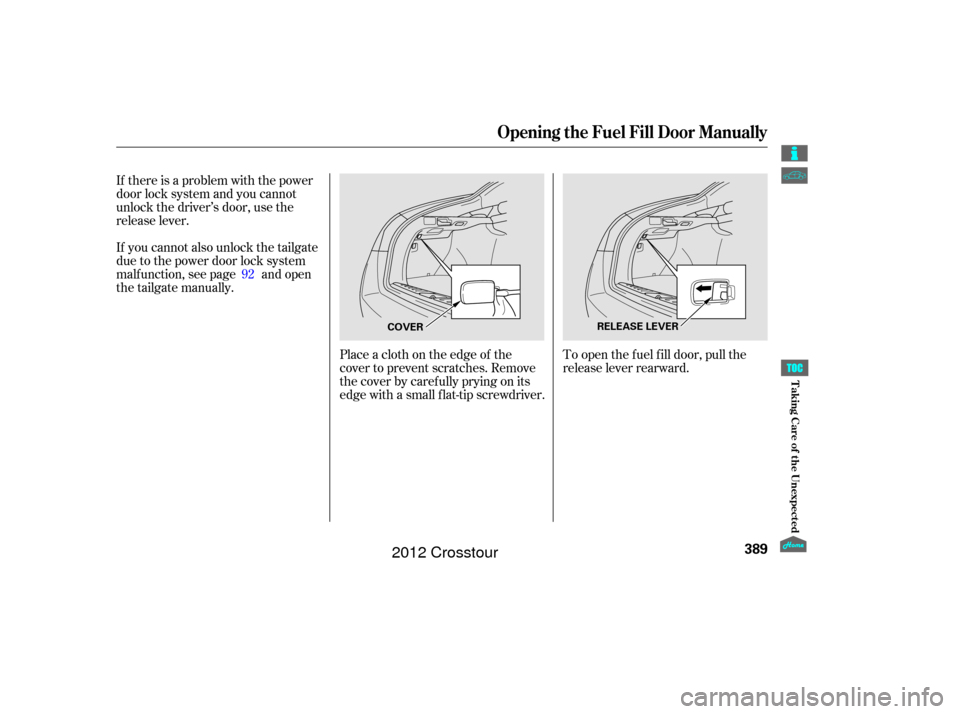
the tailgate manually.To open the f uel f ill door, pull the
release lever rearward.
Place a cloth on the edge of the
cover to prevent scratches. Remove
the cover by caref ully prying on its
edge with a small f lat-tip screwdriver.
92
Opening the Fuel Fill Door Manually
389
COVER
RELEASE LEVER
T aking Care of t he Unexpect ed
2012 Crosstour