Page 229 of 333

228
uuParking Your VehicleuAuto Idle Stop
Driving
Auto Idle Stop
To help maximize fuel economy, the engine automatically stops when the vehicle
comes to a stop, depending on environmental and vehicle operating conditions. The
AUTO STOP indicator blinks at this time. The engine then restarts once the vehicle is
about to move again when you depress the clutch pedal fully, and the indicator goes
off.
If the driver’s door is opened while the
indicator is blinking, a buzzer sounds to notify
you that the Auto Idle Stop function is in operation.
Manual transmission models
1Auto Idle Stop
If the Auto Idle Stop operating time lasts long enough
to lower the 12 volt battery charge or the IMA battery charge, the engine may not restart automatically.
Manually turn off the engine when you leave your
vehicle.
The duration of Auto Idle Stop operation:• Increases in the ECON mode, compared to normal
or sport mode, with climate control in use.
• Decreases if you operate the wipers and climate
control simultaneously.
Page 230 of 333

Continued229
uuParking Your VehicleuAuto Idle Stop
Driving
Stopping with the brake, the clutch pedal is fully depressed, and the shift lever is in
(N.
uTo restart the engine automatically, depress the clutch pedal.
■ Auto idle stop does not activate when:
• The low temperature indicator is on.
• The IMA battery charge is low.
• The bars of the ASST/CHRG indicators do not move when accelerating or
decelerating.
• The vehicle comes to a stop again before the vehicle speed reaches 9 mph
(15 km/h) after the engine starts.
• The shift lever is in
(R .
• Airflow from the climate control system increases. (Except when in ECON mode)
uIf you have selected the fan speed manually:
The display shows more than five vertical bars.
• is on (the indicator is on).
■ Auto idle stop may not activate when:
• The climate control system is in use, and there is a significant difference between
the set temperature and the actual interior temperature. (Except when in ECON
mode).
• When humidity in the interior is high.
• The vehicle is stopped by braking suddenly.
■Auto Idle Stop Activates When:1Auto Idle Stop Activates When:
The brake pedal is depressed, the vehicle slows down
to a speed below 19 mph (30 km/h), and the clutch
pedal is fully pressed.
The engine may not stop or restart automatically if
you fail to fully depress the clutch pedal.
Keeping the proper driving positions makes it easier
for you to depress the clutch pedal fully.
2 Adjusting the Seats P. 119
Page 231 of 333

uuParking Your VehicleuAuto Idle Stop
230
Driving
The clutch pedal is fully depressed, and the shift lever is moved to a position other
than
(N .
■ The engine automatically resta rts when the clutch pedal is fully depressed
even if the shift lever is in
(N when:
• The low temperature indicator comes on.
• The accelerator pedal is pressed.
• The IMA battery charge becomes low.
• The climate control system is in use, and the difference between the set
temperature and actual interior temperature becomes significant.
• The climate control system is being used to dehumidify the interior.
The engine automatically restarts when the pressure on the brake pedal is
repeatedly applied and released slightly during a stop. This applies even if the clutch
pedal is not fully depressed.
Fully depress the clutch pedal.
uThe engine automatically restarts.
■The Engine Automatically Restarts When:
■When the Auto Idle Stop Indicator Starts Blinking Rapidly1When the Auto Idle Stop Indicator Starts Blinking Rapidly
The indicator starts blinking rapidly under the
following conditions: • The (windshield defogger) button is pressed.
• When the climate control system is in use and
moisture builds up inside the vehicle.
• When the climate control system is in use and the
difference between the set temperature and the
actual temperature inside the vehicle becomes
significant.
Page 240 of 333

239
uuBefore Performing MaintenanceuSafety When Performing Maintenance
Maintenance
Safety When Performing Maintenance
Some of the most important safety precautions are given here.
However, we cannot warn you of every conceivable hazard that can arise in
performing maintenance. Only you can decide whether or not you should perform
a given task. • To reduce the possibility of fire or explosion, keep cigarettes, sparks, and flames
away from the battery and all fuel related parts.
• To clean parts, use a commercially available degreaser or parts cleaner, not
gasoline.
• Wear eye protection and protective clothing when working with the 12 volt
battery or compressed air.
• Engine exhaust contains carbon monoxide, which is poisonous and can kill you.
uOnly operate the engine if there is sufficient ventilation.
• The vehicle must be in a stationary condition.
uMake sure your vehicle is parked on level ground, the parking brake is set, and
the engine is off.
• Be aware that hot parts can burn you.
uMake sure to let the engine and exhau st system cool thoroughly before
touching vehicle parts.
• Be aware that moving parts can injure you.
uDo not start the engine unless instructed, and keep your hands and limbs away from moving parts.
• Do not touch the IMA battery and wiring (orange).
■Maintenance Safety
■Vehicle Safety
1Safety When Performing Maintenance
3WARNING
Improperly maintaining this vehicle or
failing to correct a problem before driving
can cause a crash in which you can be
seriously hurt or killed.
Always follow the inspection and
maintenance recommendations according
to the schedules in this owner's manual.
3WARNING
Failure to properly fol low maintenance
instructions and precautions can cause you
to be seriously hurt or killed.
Always follow the procedures and
precautions in this owner's manual.
Page 246 of 333
245
Maintenance
Maintenance Under the Hood
Maintenance Items Under the Hood
Brake Fluid
(Black Cap)
Manual Transmission model:
Clutch Fluid (Light Gray Cap)
Washer Fluid
(Blue Cap)
Engine Oil Dipstick
(Orange Loop) Radiator Cap
Engine Oil Fill Cap
Automatic Transmission (CVT) Fluid Dipstick (Yellow Loop)
Engine Coolant Reservoir 12 Volt Battery
Page 279 of 333
278
Maintenance
12 Volt Battery
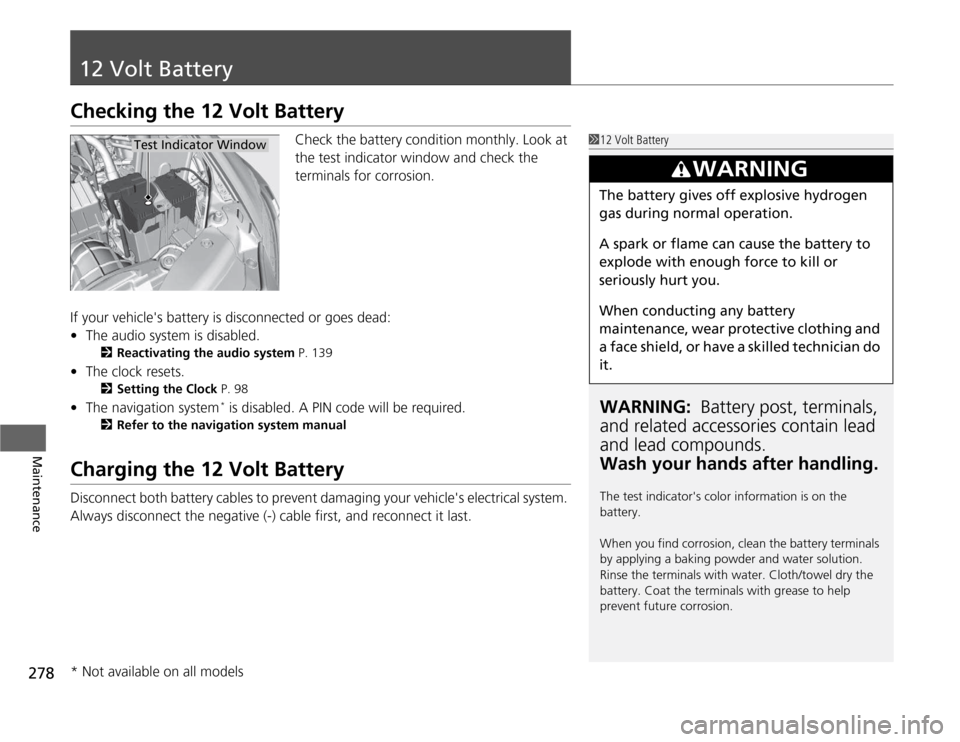
Checking the 12 Volt BatteryCheck the battery condition monthly. Look at
the test indicator window and check the
terminals for corrosion.
If your vehicle's battery is disconnected or goes dead: • The audio system is disabled.
2 Reactivating the audio system P. 139
• The clock resets.
2 Setting the Clock P. 98
• The navigation system *
is disabled. A PIN code will be required.
2 Refer to the navigation system manual
Charging the 12 Volt Battery
Disconnect both battery cables to prevent damaging your vehicle's electrical system.
Always disconnect the negative (-) cable first, and reconnect it last.
112 Volt Battery
WARNING: Battery post, terminals,
and related accessori es contain lead
and lead compounds. Wash your hands after handling.
The test indicator's color information is on the
battery.
When you find corrosion, clean the battery terminals
by applying a baking powder and water solution.
Rinse the terminals with water. Cloth/towel dry the
battery. Coat the terminals with grease to help
prevent future corrosion.
3WARNING
The battery gives off explosive hydrogen
gas during normal operation.
A spark or flame can cause the battery to
explode with enough force to kill or seriously hurt you.
When conducting any battery
maintenance, wear protective clothing and
a face shield, or have a skilled technician do
it.
Test Indicator Window
* Not available on all models
Page 280 of 333
279
Maintenance
Remote Transmitter Care
Replacing the Battery
If the indicator does not come on when the button is pressed, replace the battery.
1.Unscrew the cover with a small Phillips- head screwdriver. Press a button to pry
open the transmitter.
2. Open the keypad.
uWrap the small flat-tip screwdriver with a
cloth to prevent scratching the transmitter.
3. Make sure to replace the battery with the
correct polarity.
1Replacing the Battery
NOTICE
An improperly disposed of battery can damage the
environment. Always confirm local regulations for
battery disposal.
Replacement batteries are commercially available or
at a dealer.
Screw
Battery type: CR1616
BatteryKeypad
Page 285 of 333

uuCleaninguExterior Care
284
Maintenance
A good coat of automotive body wax helps protect your vehicle’s paint from the
elements. Wax will wear off over time and expose your vehicle’s paint to the
elements, so reapply as necessary.
If you get gasoline, oil, engine coolant, or battery fluid on resin coated parts, they
may be stained or the coating may peel. Promptly wipe it away using a soft cloth and clean water.
Wipe using a glass cleaner.
Aluminum is susceptible to deterio ration caused by salt and other road
contaminants. Use a sponge and mild de tergent to wipe away promptly.
Be careful not to use harsh chemicals (including some commercial wheel cleaners) or
a stiff brush. They can damage the clear coat of the aluminum alloy wheels that
helps keep the aluminum from corroding and tarnishing.
■Applying Wax
■Maintaining the Bumpers and Other Resin Coated Parts
■Cleaning the Window
■Maintaining Aluminum Wheels
1Applying Wax
NOTICE
Chemical solvents and strong cleaners can damage
the paint, metal, and plastic on your vehicle. Wipe up
spills immediately.
1Maintaining the Bumpers and Other Resin Coated Parts
Ask a dealer about the correct coating material when
you want to repair the painted surface of the parts made of resin.
1Cleaning the Window
Wires are mounted to the inside of the rear window.
Wipe along the same direction as the wires with a
soft cloth so as not to damage them.

