2012 GMC SAVANA instrument panel
[x] Cancel search: instrument panelPage 23 of 424

Black plate (17,1)GMC Savana Owner Manual - 2012 - 2nd - 11/11/11
In Brief 1-17
Satellite Radio
XM is a satellite radio service based
in the 48 contiguous United States
and 10 Canadian provinces.
XM satellite radio has a wide
variety of programming and
commercial-free music, coast to
coast, and in digital-quality sound.
A fee is required to receive the
XM service.
For more information, refer to:
.www.xmradio.com or call
1-800-929-2100 (U.S.)
.www.xmradio.ca or call
1-877-438-9677 (Canada)
See Satellite Radio on page 7‑9.
Portable Audio Devices
This vehicle may have an auxiliary
input located on the radio faceplate
and a USB port located on the
instrument panel. External devices
such as an iPod
®, laptop computer,
MP3 player, CD changer, or USB
storage device can be connected to
the auxiliary port using a 3.5 mm
(1/8 in) input cable or the USB port
depending on the audio system.
See "Using the Auxiliary Input Jack"
and "Using the USB Port" in
Auxiliary Devices on page 7‑17.
Bluetooth®
For vehicles with a Bluetooth
system, it allows users with a
Bluetooth‐enabled cell phone to
make and receive hands-free calls
using the vehicle’ s audio system
and controls.
The Bluetooth‐enabled cell phone
must be paired with the Bluetooth
system before it can be used in the
vehicle. Not all phones will support
all functions. For more information,
visit www.gm.com/bluetooth.
For more information, see Bluetooth
on page 7‑22.
Page 25 of 424
Black plate (19,1)GMC Savana Owner Manual - 2012 - 2nd - 11/11/11
In Brief 1-19
[:Press to disengage cruise
control without erasing the set
speed from memory.
For more information, see Cruise
Control on page 9‑37.
Power Outlets
The accessory power outlets can be
used to plug in electrical equipment,
such as a cell phone or an MP3
player.
The vehicle may have two
accessory power outlets located on
the instrument panel.
Remove the cover to access and
replace when not in use.
See Power Outlets on page 5‑9.
Performance and
Maintenance
StabiliTrak®System
The vehicle may have a traction
control system that limits wheel spin
and the StabiliTrak system that
assists with directional control of the
vehicle in difficult driving conditions.
Both systems turn on automatically
every time the vehicle is started.
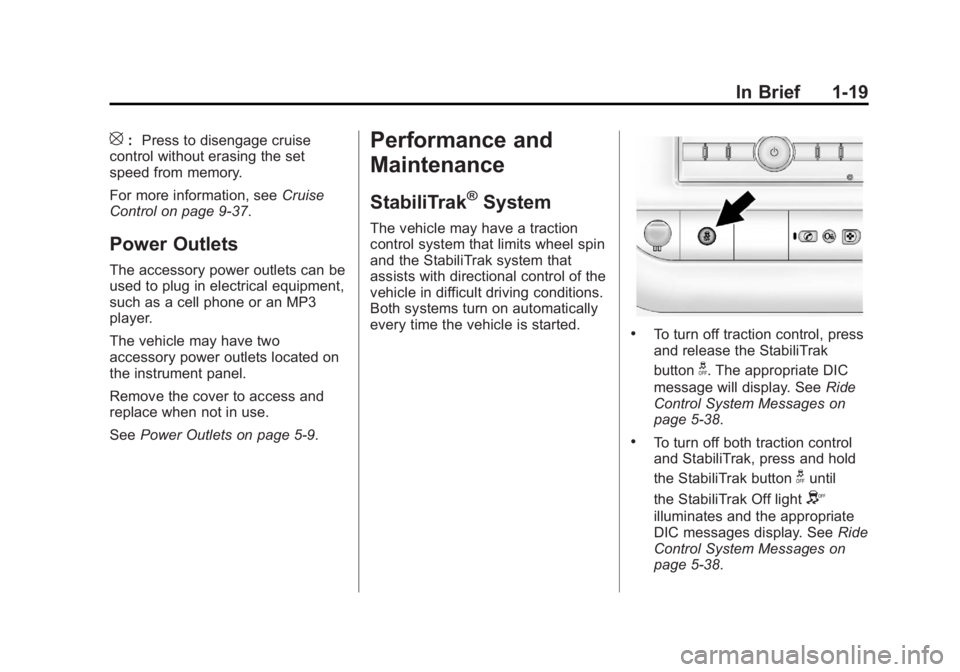
.To turn off traction control, press
and release the StabiliTrak
button
g. The appropriate DIC
message will display. See Ride
Control System Messages on
page 5‑38.
.To turn off both traction control
and StabiliTrak, press and hold
the StabiliTrak button
guntil
the StabiliTrak Off light
Y
illuminates and the appropriate
DIC messages display. See Ride
Control System Messages on
page 5‑38.
Page 41 of 424

Black plate (13,1)GMC Savana Owner Manual - 2012 - 2nd - 11/11/11
Keys, Doors, and Windows 2-13
Vehicle Security
This vehicle has theft-deterrent
features; however, they do not make
it impossible to steal.
Immobilizer
SeeRadio Frequency Statement on
page 13‑16 for information
regarding Part 15 of the Federal
Communications Commission (FCC)
rules and Industry Canada
Standards RSS-GEN/210/220/310.
Immobilizer Operation
This vehicle is equipped with the
PASS-Key®III+ (Personalized
Automotive Security System)
theft-deterrent system.
PASS-Key III+ is a passive
theft deterrent system. The system is automatically armed
when the key is removed from the
ignition.
You do not have to manually arm or
disarm the system.
The security light will come on if
there is a problem with arming or
disarming the theft-deterrent
system.
When the PASS-Key III+ system
senses that someone is using the
wrong key, it shuts down the
vehicle's starter and fuel systems.
The starter will not work and fuel will
stop being delivered to the engine.
Anyone using a trial-and-error
method to start the vehicle will be
discouraged because of the high
number of electrical key codes.
If the engine does not start and the
security message comes on, the
key may have a damaged
transponder. Turn the ignition off
and try again.If the engine still does not start, and
the key appears to be undamaged,
try another ignition key. At this time,
you may also want to check the
instrument panel PASS KEY fuse.
If the engine still does not start with
the other key, the vehicle needs
service. If the vehicle does start, the
first key may be faulty. See your
dealer or a locksmith who can
service the PASS-Key III+ to have a
new key made. See
Fuses and
Circuit Breakers on page 10‑43.
It is possible for the PASS-Key III+
decoder to learn the transponder
value of a new or replacement key.
Up to 10 keys may be programmed
for the vehicle. This procedure is for
learning additional keys only. If all
the currently programmed keys are
lost or do not operate, you must see
your dealer or a locksmith who can
service PASS-Key III+ to have keys
made and programmed to the
system.
Page 57 of 424
Black plate (9,1)GMC Savana Owner Manual - 2012 - 2nd - 11/15/11
Seats and Restraints 3-9
Safety Belts
This section of the manual
describes how to use safety belts
properly. It also describes some
things not to do with safety belts.
{WARNING
Do not let anyone ride where a
safety belt cannot be worn
properly. In a crash, if you or your
passenger(s) are not wearing
safety belts, injuries can be much
worse than if you are wearing
safety belts. You can be seriously
injured or killed by hitting things
inside the vehicle harder or by
being ejected from the vehicle. In
addition, anyone who is not
buckled up can strike other
passengers in the vehicle.(Continued)
WARNING (Continued)
It is extremely dangerous to ride
in a cargo area, inside or outside
of a vehicle. In a collision,
passengers riding in these areas
are more likely to be seriously
injured or killed. Do not allow
passengers to ride in any area of
the vehicle that is not equipped
with seats and safety belts.
Always wear a safety belt, and
check that all passenger(s) are
restrained properly too.
This vehicle has indicators as a
reminder to buckle the safety belts.
See Safety Belt Reminders on
page 5‑16.
Why Safety Belts Work
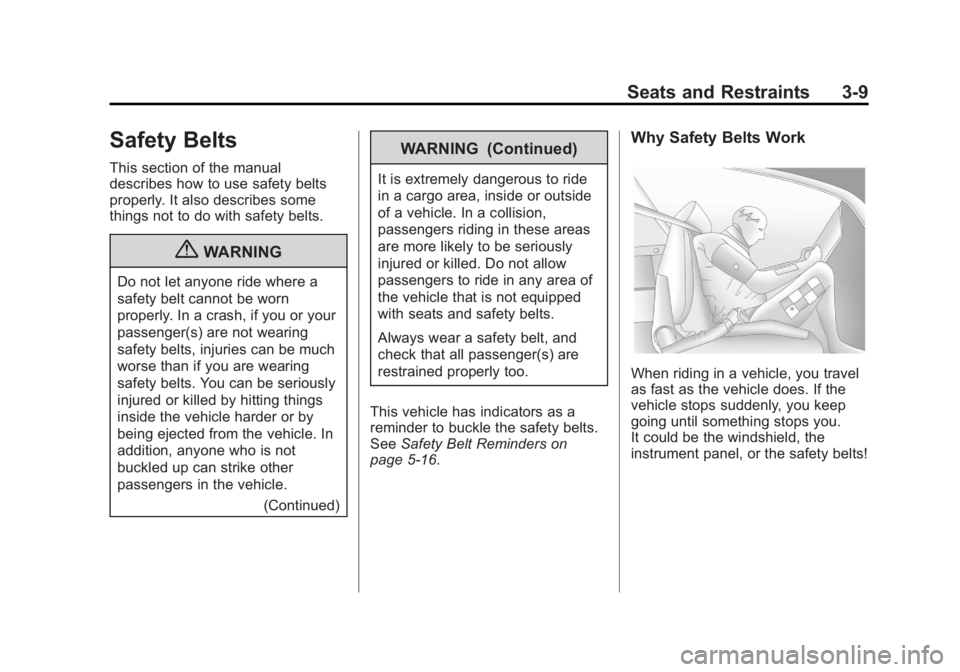
When riding in a vehicle, you travel
as fast as the vehicle does. If the
vehicle stops suddenly, you keep
going until something stops you.
It could be the windshield, the
instrument panel, or the safety belts!
Page 67 of 424
Black plate (19,1)GMC Savana Owner Manual - 2012 - 2nd - 11/15/11
Seats and Restraints 3-19
Airbag System
The vehicle has the following
airbag:
.A frontal airbag for the driver.
The vehicle may have the following
airbags:
.A frontal airbag for the right front
passenger.
.A roof-rail airbag for the driver
(cargo van).
.A roof-rail airbag for the right
front passenger position
(cargo or passenger van
equipped with a sliding door).
If you have a passenger van
with a right front passenger
roof-rail airbag and a sliding
door, you will also have a
separate roof-rail airbag for the
passenger seated directly
behind the right front passenger
and the third row outboard
passenger position.
.A roof-rail airbag for the driver,
the passenger seated directly
behind the driver, and the third
row outboard passenger position
(passenger van equipped with a
sliding or hinged door).
.A roof-rail airbag for the right
front passenger, the passenger
seated directly behind the right
front passenger, and the
third row outboard passenger
position (passenger van
equipped with a hinged door).
All of the airbags in the vehicle will
have the word AIRBAG embossed
in the trim or on an attached label
near the deployment opening.
For frontal airbags, the word
AIRBAG will appear on the middle
part of the steering wheel for the
driver and on the instrument panel
for the right front passenger.
With roof-rail airbags, the word
AIRBAG will appear along the
headliner or trim. Here are the most important things
to know about the airbag system:
{WARNING
You can be severely injured or
killed in a crash if you are not
wearing your safety belt
—even if
you have airbags. Airbags are
designed to work with safety
belts, but do not replace them.
Also, airbags are not designed to
deploy in every crash. In some
crashes safety belts are your only
restraint. See When Should an
Airbag Inflate? on page 3‑22.
Wearing your safety belt during a
crash helps reduce your chance
of hitting things inside the vehicle
or being ejected from it. Airbags
are “supplemental restraints” to
the safety belts. Everyone in your
vehicle should wear a safety belt
properly —whether or not there is
an airbag for that person.
Page 68 of 424
Black plate (20,1)GMC Savana Owner Manual - 2012 - 2nd - 11/15/11
3-20 Seats and Restraints
{WARNING
Airbags inflate with great force,
faster than the blink of an eye.
Anyone who is up against, or very
close to, any airbag when it
inflates can be seriously injured
or killed. Do not sit unnecessarily
close to the airbag, as you would
be if you were sitting on the edge
of your seat or leaning forward.
Safety belts help keep you in
position before and during a
crash. Always wear your safety
belt, even with airbags. The driver
should sit as far back as possible
while still maintaining control of
the vehicle.
Occupants should not lean on or
sleep against the door or side
windows in seating positions with
roof-rail airbags.
{WARNING
Children who are up against,
or very close to, any airbag
when it inflates can be seriously
injured or killed. Airbags plus
lap-shoulder belts offer protection
for adults and older children, but
not for young children and infants.
Neither the vehicle safety belt
system nor its airbag system is
designed for them. Young
children and infants need the
protection that a child restraint
system can provide. Always
secure children properly in the
vehicle. To read how, seeOlder
Children on page 3‑38 orInfants
and Young Children on
page 3‑40.
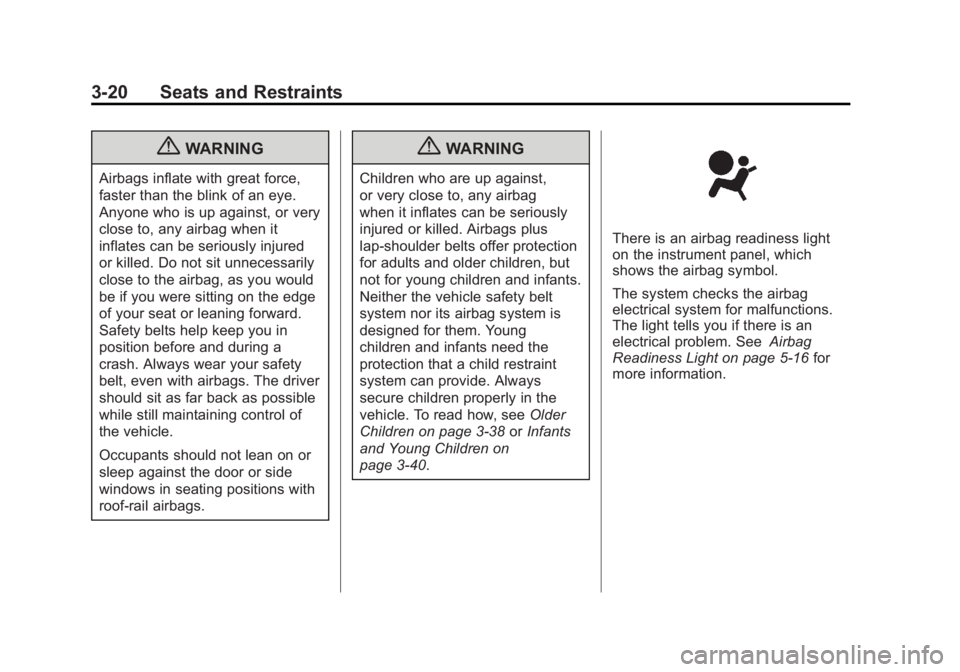
There is an airbag readiness light
on the instrument panel, which
shows the airbag symbol.
The system checks the airbag
electrical system for malfunctions.
The light tells you if there is an
electrical problem. See Airbag
Readiness Light on page 5‑16 for
more information.
Page 69 of 424
Black plate (21,1)GMC Savana Owner Manual - 2012 - 2nd - 11/15/11
Seats and Restraints 3-21
Where Are the Airbags?
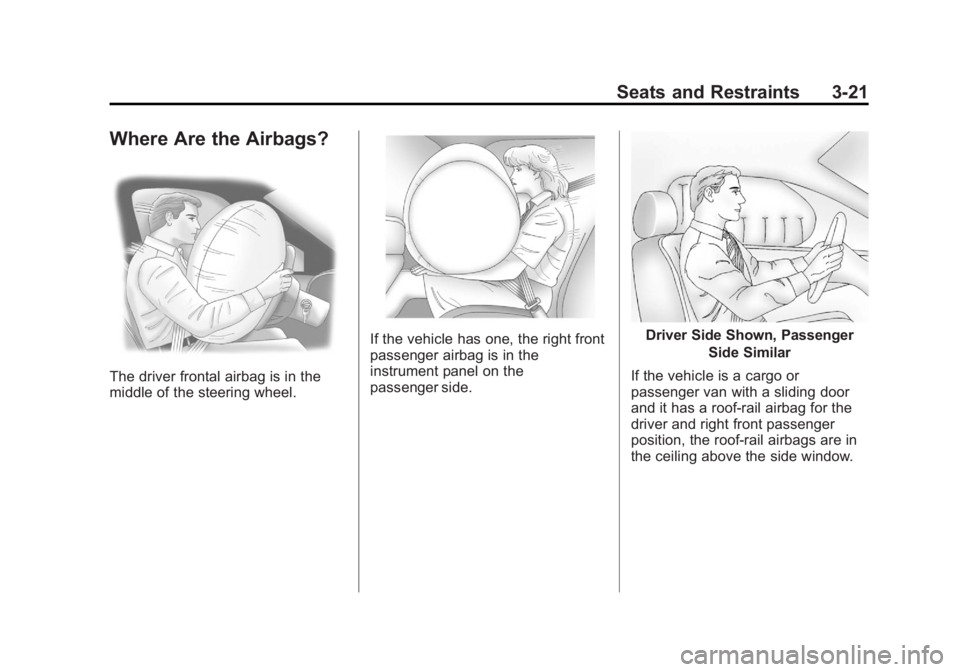
The driver frontal airbag is in the
middle of the steering wheel.
If the vehicle has one, the right front
passenger airbag is in the
instrument panel on the
passenger side.Driver Side Shown, PassengerSide Similar
If the vehicle is a cargo or
passenger van with a sliding door
and it has a roof-rail airbag for the
driver and right front passenger
position, the roof-rail airbags are in
the ceiling above the side window.
Page 72 of 424
Black plate (24,1)GMC Savana Owner Manual - 2012 - 2nd - 11/15/11
3-24 Seats and Restraints
Roof-rail airbags are not intended to
inflate in frontal impacts, near-frontal
impacts, or rear impacts. All roof-rail
airbags will deploy when either side
of the vehicle is struck.
In any particular crash, no one can
say whether an airbag should have
inflated simply because of the
damage to a vehicle or because of
what the repair costs were.
For frontal airbags, inflation is
determined by what the vehicle hits,
the angle of the impact, and how
quickly the vehicle slows down.
For roof-rail airbags, deployment is
determined by the location and
severity of the side impact.
In a rollover event, roof‐rail airbag
deployment is determined by the
direction of the roll.What Makes an Airbag
Inflate?
In a deployment event, the sensing
system sends an electrical signal
triggering a release of gas from the
inflator. Gas from the inflator fills the
airbag causing the bag to break out
of the cover and deploy. The inflator,
the airbag, and related hardware are
all part of the airbag module.
Frontal airbag modules are located
inside the steering wheel and
instrument panel. For vehicles with
roof-rail airbags, there are airbag
modules in the ceiling of the vehicle,
near the side windows for the first,
second, and third rows (if equipped).
SeeWhere Are the Airbags? on
page 3‑21 for more information.
How Does an Airbag
Restrain?
In moderate to severe frontal or
near frontal collisions, even belted
occupants can contact the steering
wheel or the instrument panel. In
moderate to severe side collisions,
even belted occupants can contact
the inside of the vehicle.
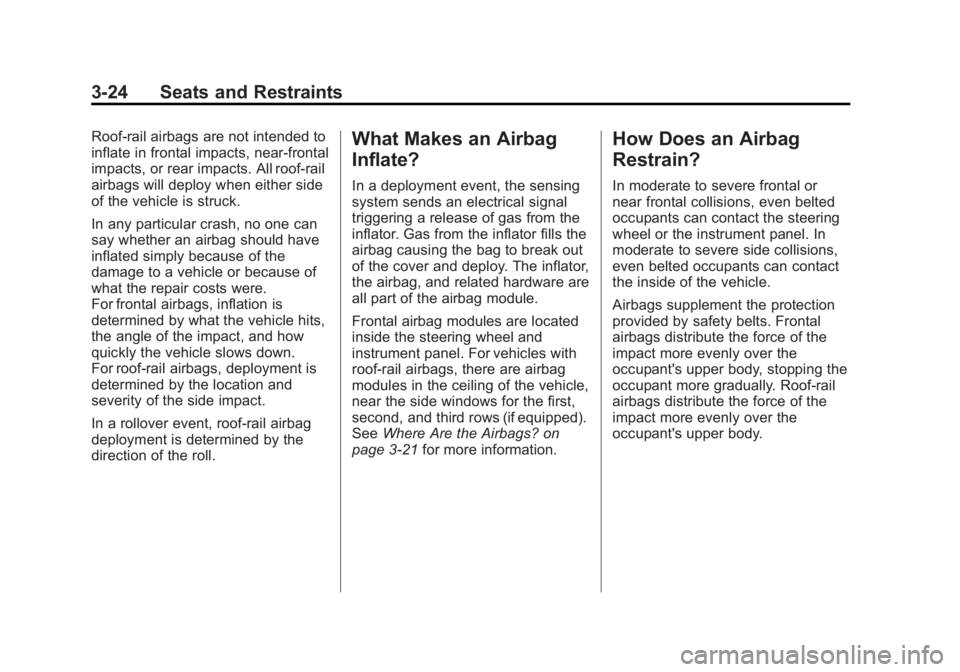
Airbags supplement the protection
provided by safety belts. Frontal
airbags distribute the force of the
impact more evenly over the
occupant's upper body, stopping the
occupant more gradually. Roof-rail
airbags distribute the force of the
impact more evenly over the
occupant's upper body.