Page 191 of 299

DRIVING THROUGH WATER
If driving through deep or standing
water is unavoidable, proceed very
slowly. Never drive through water
that is higher than the bottom of
the wheel rims (for cars) or the
bottom of the hubs (for trucks).
When driving through water, traction or brake capability may be limited.
Also, water may enter your engine’s air intake and severely damage your
engine or your vehicle may stall.Driving through deep water where
the transmission vent tube is submerged may allow water into the
transmission and cause internal transmission damage.
Once through the water, always dry the brakes by moving your
vehicle slowly while applying light pressure on the brake pedal.
Wet brakes do not stop the vehicle as quickly as dry brakes.
Electric vehicles
For specific information on the Transit Connect Electric, refer to the
Azure Dynamics TC-E Owner’s GuideSupplement.
Driving
191
2012 Transit Connect(tst)
Owners Guide, 1st Printing
USA(fus)
PAGE POSITION:191JOB:@zeta.tweddle.com/ford_pdm/ford/own2002/835536-en-tst/og pubnum:
Page 197 of 299

Fuse/Relay
LocationFuse Amp
RatingProtected Circuits
128 — Battery saver relay (modified
vehicle)
130 15A Hazard flashers
131 5A Power mirrors
132 10A Light switch, Exterior lighting
133 — Not used
134 — Not used
135 — Not used
136 15A Horn
137 7.5A Tire pressure monitoring system
(TPMS), Radio, Instrument
cluster
138 10A Reverse lamp
139 20A Ignition supply (modified vehicle)
140 — Not used
141 7.5A Front/rear fog lamps
142 15A Brake lamps
143 20A Cigar lighter, Front power point
144 10A Ignition supply (modified vehicle)
145 — Not used
146 20A Windshield wipers, Wiper switch
147 15A Front fog lamps
148 7.5A Recirculation, Instrument cluster
149 10A Ignition supply/Battery supply
(modified vehicle)
150 — Not used
151 15A Radio, Bluetooth�/Voice command
module
152 7.5A A/C switch, Park aid module
153 7.5A Interior lamps, Battery saver
154 15A Roof lamp (modified vehicle)
155 10A Battery saver (modified vehicle)
Roadside Emergencies
197
2012 Transit Connect(tst)
Owners Guide, 1st Printing
USA(fus)
PAGE POSITION:197JOB:@zeta.tweddle.com/ford_pdm/ford/own2002/835536-en-tst/og pubnum:
Page 198 of 299
Fuse/Relay
LocationFuse Amp
RatingProtected Circuits
156 7.5A Right parking lamp/tail lamps
157 7.5A License plate lamps
158 10A Light switch
159 20A Rear heater blower fan (modified
vehicle)
160 — Not used
161 7.5A Anti-lock brake system
(ABS)/RSC, Steering angle sensor
162 7.5A Airbag module, Passenger airbag
off indicator
163 20A Locks
164 20A TPMS module
165 — Not used
166 25A Front power windows
167 7.5A Rear window defroster/heated
mirror switch
168 — Not used
169 20A Second power point
170 — Not used
171 — Not used
172 10A Right rear turn signal (modified
vehicle)
173 10A Left rear turn signal (modified
vehicle)
174 20A Rear power point, Rear center
console power point (modified
vehicle)
175 7.5A Left park lamps/tail lamps
176 — Not used
177 — Not used
178 25A Rear window defroster
Roadside Emergencies
198
2012 Transit Connect(tst)
Owners Guide, 1st Printing
USA(fus)
PAGE POSITION:198JOB:@zeta.tweddle.com/ford_pdm/ford/own2002/835536-en-tst/og pubnum:
Page 200 of 299

The high-current fuses are coded as follows:
Fuse/Relay
LocationFuse Amp
RatingProtected circuits
1 7.5A* Heated windshield telltale
2 40A** Right heated windshield, Modified
vehicle — Rear heater blower fan,
Ignition supply
3 50A** Left heated windshield, Modified
vehicle — Battery supply
4 20A** Fuel pump
5 10A* Powertrain control module (PCM)
keep alive power, Canister
solenoid
6 15A* PCM, Data link connector
7 20A* Ignition switch
8 15A* Headlamps
9 40A** Passenger compartment fuse
panel II
10 25A** Modified vehicle — Rear turn
signal, Battery supply
11 40A** Ignition overload, Passenger
compartment fuse panel
12 30A** Anti-lock brake system (ABS)/Roll
stability control (RSC) pump
motor
13 30A* Heater blower motor
14 10A* PCM relay
15 20A** ABS/RSC valves
16 30A** Cooling fan – low
17 50A** Cooling fan – high
18 25A** Daytime running lamps (DRL),
Low beam interrupt relay
19 50A** Passenger compartment fuse
panel III
Roadside Emergencies
200
2012 Transit Connect(tst)
Owners Guide, 1st Printing
USA(fus)
PAGE POSITION:200JOB:@zeta.tweddle.com/ford_pdm/ford/own2002/835536-en-tst/og pubnum:
Page 201 of 299
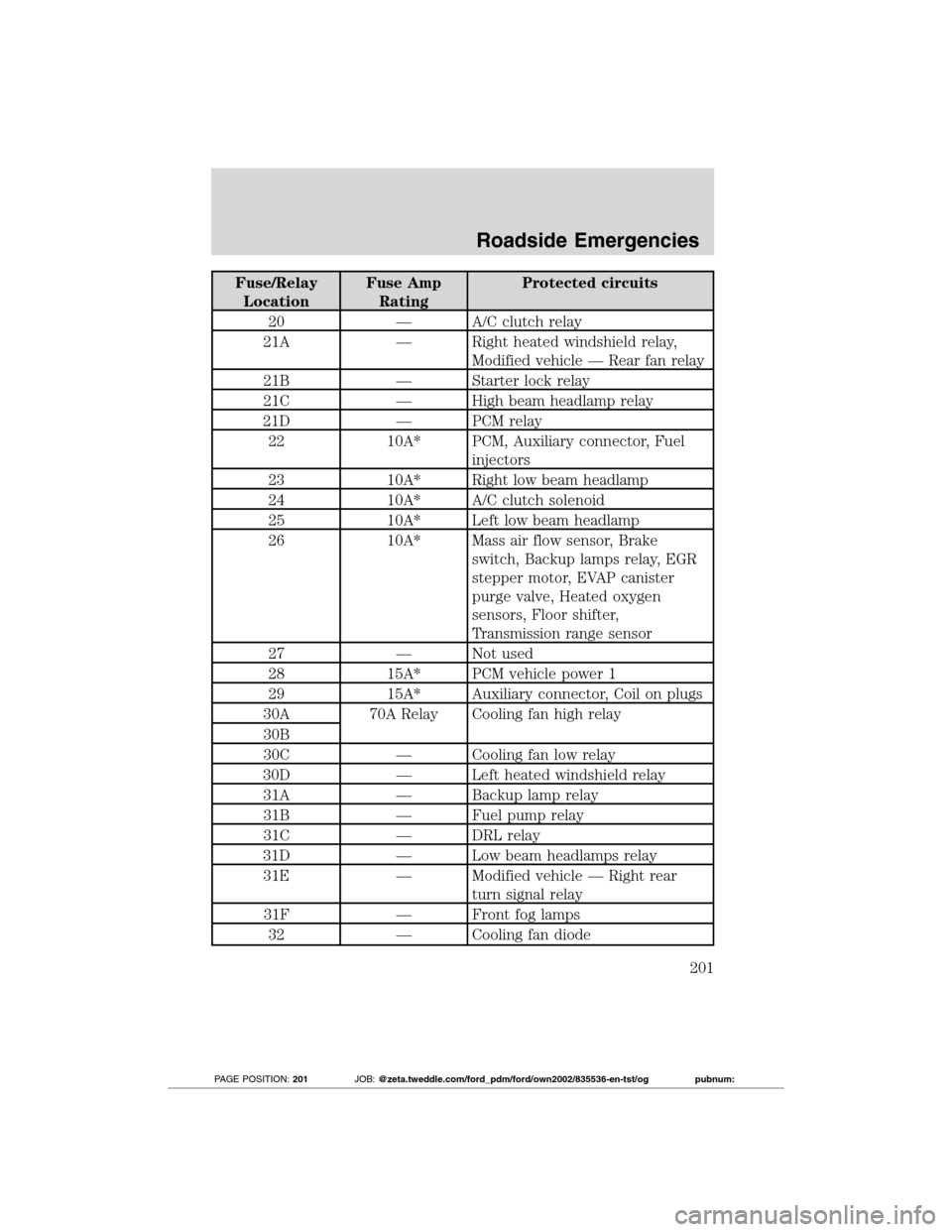
Fuse/Relay
LocationFuse Amp
RatingProtected circuits
20 — A/C clutch relay
21A — Right heated windshield relay,
Modified vehicle — Rear fan relay
21B — Starter lock relay
21C — High beam headlamp relay
21D — PCM relay
22 10A* PCM, Auxiliary connector, Fuel
injectors
23 10A* Right low beam headlamp
24 10A* A/C clutch solenoid
25 10A* Left low beam headlamp
26 10A* Mass air flow sensor, Brake
switch, Backup lamps relay, EGR
stepper motor, EVAP canister
purge valve, Heated oxygen
sensors, Floor shifter,
Transmission range sensor
27 — Not used
28 15A* PCM vehicle power 1
29 15A* Auxiliary connector, Coil on plugs
30A 70A Relay Cooling fan high relay
30B
30C — Cooling fan low relay
30D — Left heated windshield relay
31A — Backup lamp relay
31B — Fuel pump relay
31C — DRL relay
31D — Low beam headlamps relay
31E — Modified vehicle — Right rear
turn signal relay
31F — Front fog lamps
32 — Cooling fan diode
Roadside Emergencies
201
2012 Transit Connect(tst)
Owners Guide, 1st Printing
USA(fus)
PAGE POSITION:201JOB:@zeta.tweddle.com/ford_pdm/ford/own2002/835536-en-tst/og pubnum:
Page 202 of 299

Fuse/Relay
LocationFuse Amp
RatingProtected circuits
33 — Fuel pump relay diode
34 — Gear shifter diode
35 30A* Start lock relay
36 — Modified vehicle — Left rear turn
signal relay
*Mini fuse **Cartridge fuse
CHANGING THE TIRES
If you get a flat tire while driving, do not apply the brake heavily.
Instead, gradually decrease your speed. Hold the steering wheel firmly
and slowly move to a safe place on the side of the road.
Note:The tire pressure monitoring system (TPMS) indicator light will
illuminate when the spare tire is in use. To restore the full functionality
of the monitoring system, all road wheels equipped with tire pressure
monitoring sensors must be mounted on the vehicle.
Have a flat serviced by an authorized dealer in order to prevent damage
to the TPMS sensors, refer toTire pressure monitoring system
(TPMS)in theTires, Wheels and Loadingchapter. Replace the spare
tire with a road tire as soon as possible. During repairing or replacing of
the flat tire, have the authorized dealer inspect the TPMS sensor for
damage.
WARNING:The use of tire sealants may damage your tire
pressure monitoring system (TPMS) and should not be used.
However, if you must use a sealant, the TPMS sensor and valve stem
on the wheel must be replaced by an authorized Ford dealer.
WARNING:Refer toTire pressure monitoring system (TPMS)
in theTires, Wheels and Loadingchapter for important
information. If the tire pressure monitor sensor becomes damaged, it
will no longer function.
Dissimilar spare tire/wheel information
WARNING:Failure to follow these guidelines could result in an
increased risk of loss of vehicle control, injury or death.
Roadside Emergencies
202
2012 Transit Connect(tst)
Owners Guide, 1st Printing
USA(fus)
PAGE POSITION:202JOB:@zeta.tweddle.com/ford_pdm/ford/own2002/835536-en-tst/og pubnum:
Page 204 of 299

•Use more than one dissimilar spare tire/wheel at a time
•Use commercial car washing equipment
•Use snow chains on the end of the vehicle with the dissimilar spare
tire/wheel
The usage of a full-size dissimilar spare tire/wheel can lead to
impairment of the following:
•Handling, stability and braking performance
•Comfort and noise
•Ground clearance and parking at curbs
•Winter weather driving capability
•Wet weather driving capability
•All-wheel driving capability (if applicable)
•Load leveling adjustment (if applicable)
When driving with the full-size dissimilar spare tire/wheel additional
caution should be given to:
•Towing a trailer
•Driving vehicles equipped with a camper body
•Driving vehicles with a load on the cargo rack
Drive cautiously when using a full-size dissimilar spare tire/wheel and
seek service as soon as possible.
Stopping and securing the vehicle
1. Park on a level surface, set the
parking brake and activate hazard
flashers.
2. Place gearshift lever in P (Park)
and turn engine off.
Removing the spare tire
The jack and tools are located behind a cover in the sidewall at the left
rear of the cargo area. The retention straps and wing nut need to be
removed before removing the jack.
Roadside Emergencies
204
2012 Transit Connect(tst)
Owners Guide, 1st Printing
USA(fus)
PAGE POSITION:204JOB:@zeta.tweddle.com/ford_pdm/ford/own2002/835536-en-tst/og pubnum:
Page 206 of 299

Tire change procedure
WARNING:When one of the front wheels is off the ground, the
transmission alone will not prevent the vehicle from moving or
slipping off the jack, even if the vehicle is in P (Park).
WARNING:To help prevent the vehicle from moving when you
change a tire, be sure the parking brake is set, then block (in
both directions) the wheel that is diagonally opposite (other side and
end of the vehicle) to the tire being changed.
WARNING:If the vehicle slips off the jack, you or someone else
could be seriously injured.
WARNING:Do not attempt to change a tire on the side of the
vehicle close to moving traffic. Pull far enough off the road to
avoid the danger of being hit when operating the jack or changing the
wheel.
Note:Passengers should not remain in the vehicle when the vehicle is
being jacked.
1. Block the diagonally opposite
wheel.
2. Insert the wrench end between
the rim and the wheel cover through
the gaps and carefully remove the
cover.
Roadside Emergencies
206
2012 Transit Connect(tst)
Owners Guide, 1st Printing
USA(fus)
PAGE POSITION:206JOB:@zeta.tweddle.com/ford_pdm/ford/own2002/835536-en-tst/og pubnum:
