Page 241 of 406
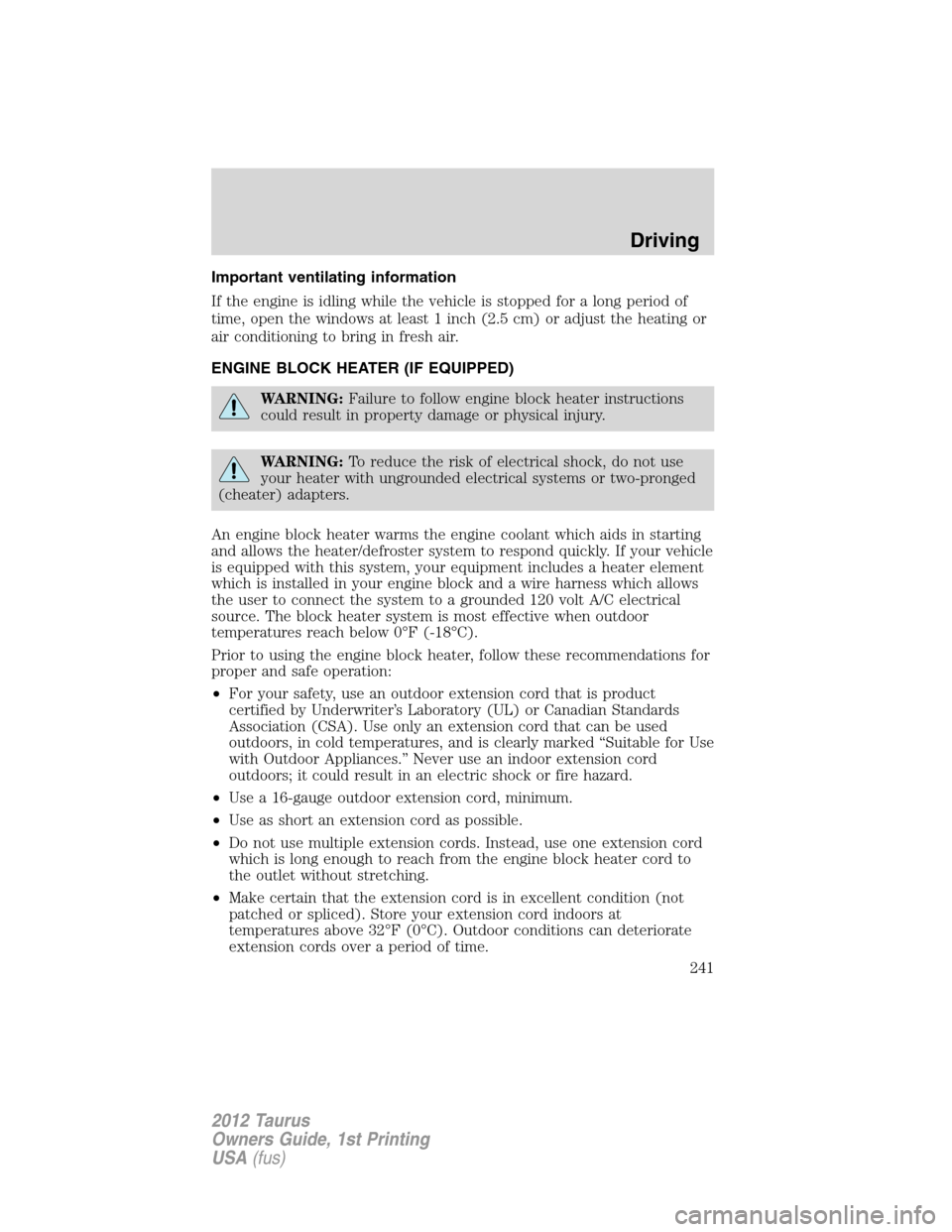
Important ventilating information
If the engine is idling while the vehicle is stopped for a long period of
time, open the windows at least 1 inch (2.5 cm) or adjust the heating or
air conditioning to bring in fresh air.
ENGINE BLOCK HEATER (IF EQUIPPED)
WARNING:Failure to follow engine block heater instructions
could result in property damage or physical injury.
WARNING:To reduce the risk of electrical shock, do not use
your heater with ungrounded electrical systems or two-pronged
(cheater) adapters.
An engine block heater warms the engine coolant which aids in starting
and allows the heater/defroster system to respond quickly. If your vehicle
is equipped with this system, your equipment includes a heater element
which is installed in your engine block and a wire harness which allows
the user to connect the system to a grounded 120 volt A/C electrical
source. The block heater system is most effective when outdoor
temperatures reach below 0°F (-18°C).
Prior to using the engine block heater, follow these recommendations for
proper and safe operation:
•For your safety, use an outdoor extension cord that is product
certified by Underwriter’s Laboratory (UL) or Canadian Standards
Association (CSA). Use only an extension cord that can be used
outdoors, in cold temperatures, and is clearly marked “Suitable for Use
with Outdoor Appliances.” Never use an indoor extension cord
outdoors; it could result in an electric shock or fire hazard.
•Use a 16-gauge outdoor extension cord, minimum.
•Use as short an extension cord as possible.
•Do not use multiple extension cords. Instead, use one extension cord
which is long enough to reach from the engine block heater cord to
the outlet without stretching.
•Make certain that the extension cord is in excellent condition (not
patched or spliced). Store your extension cord indoors at
temperatures above 32°F (0°C). Outdoor conditions can deteriorate
extension cords over a period of time.
Driving
241
2012 Taurus
Owners Guide, 1st Printing
USA(fus)
Page 284 of 406
Passenger compartment fuse panel
The fuse panel is located under the instrument panel to the left of the
steering wheel.
The fuses are coded as follows.
Fuse/Relay
LocationFuse Amp
RatingProtected Circuits
1 30A Left front power window, Smart
window motor
2 15A Brake on/off switch
3 15A Driver power seat
4 30A Right front power window, Smart
window motor
5 10A Transmission shifter solenoid,
Keyless keypad
6 20A Turn signals, Hazard flashers
7 10A Low beam headlamps (left)
Roadside Emergencies
284
2012 Taurus
Owners Guide, 1st Printing
USA(fus)
Page 285 of 406

Fuse/Relay
LocationFuse Amp
RatingProtected Circuits
8 10A Low beam headlamps (right)
9 15A Interior lights, Cargo lamps
10 15A Switch illumination, Puddle lamps
11 10A All- wheel drive (AWD) module
12 7.5A Intelligent access (IA) module
13 5A Memory seats, Mirrors, Keypad,
IA receiver, Driver’s door module
14 10A Navigation display, Memory seat,
SYNC�, Center information
display, GPS, Driver seat
15 10A Climate control
16 15A Electronic finish panel, Ambient
lighting
17 20A Trunk release, Moon roof, Smart
windows, Lock/unlock
18 20A Rear heated seats
19 25A Audio amplifier
20 15A Diagnostic connector (OBDII),
Adjustable pedal motor
21 15A Daytime running lamps (DRL)
control
22 15A Park lamps, License plate lamps,
Auxiliary lamps
23 15A High beam headlamps
24 20A Horn
25 10A Demand lighting (battery saver)
26 10A Instrument panel cluster,
Heads-up display
27 20A Ignition switch, IA, Front wipers,
One-touch integrated start (OTIS)
28 5A Start relay/Audio mute
Roadside Emergencies
285
2012 Taurus
Owners Guide, 1st Printing
USA(fus)
Page 286 of 406

Fuse/Relay
LocationFuse Amp
RatingProtected Circuits
29 5A Instrument panel cluster,
Heads-up display
30 5A Not used (spare)
31 10A Not used (spare)
32 10A Airbag module
33 10A Not used (spare)
34 5A Anti-lock brake system (ABS),
Electronic power steering
35 10A Rear heated seats, AWD, Rear
park assist, Steering angle sensor,
Blind spot information system,
Multi-contour seats
36 5A Passive anti-theft system (PATS)
37 10A Not used (spare)
38 20A Subwoofer, Speaker amplifier
39 20A Radio/navigation
40 20A Not used (spare)
41 15A Delayed accessory feeds
42 10A Not used (spare)
43 10A Rear window defroster, Front
wipers, Automatic high beam
controller, Rain sensor
44 10A Not used (spare)
45 5A Front wiper relay, Blower motor
relay
46 7.5A Occupant classification sensor
(OCS), Passenger airbag
deactivation indicator (PADI)
47 30A Circuit
BreakerFront passenger power window,
Rear power windows
48 — Delayed accessory relay
Roadside Emergencies
286
2012 Taurus
Owners Guide, 1st Printing
USA(fus)
Page 288 of 406
Fuse/Relay
LocationFuse Amp
RatingPower Circuits
4 30A** Front wiper
5 30A** Passenger seat
6 20A** Cigar lighter
7 60A** Engine cooling fan (non-SHO
engine)
8 30A** Moon roof
9 40A** Anti-lock brake system (ABS)
pump
10 30A** Starter relay
11 30A** Powertrain Control Module (PCM)
relay
12 20A** ABS valve
13 15A* Adaptive cruise control
14 — Not used
15 — Not used
16 20A* Left headlamp
17 10A* Alternator
18 — Not used
19 20A** Instrument panel power point
20 40A** Rear window defroster
21 20A** Console power point
22 30A** Front heated or heated/cooled
seats
23 7.5A* Powertrain control module (PCM)
(keep alive power), Canister vent
24 10A* A/C clutch
25 20A* Right headlamp
26 10A* Backup relay
27 25A* Fuel pump
28 80A** Engine cooling fan (SHO engine)
29 — Not used
30 — Not used
Roadside Emergencies
288
2012 Taurus
Owners Guide, 1st Printing
USA(fus)
Page 289 of 406
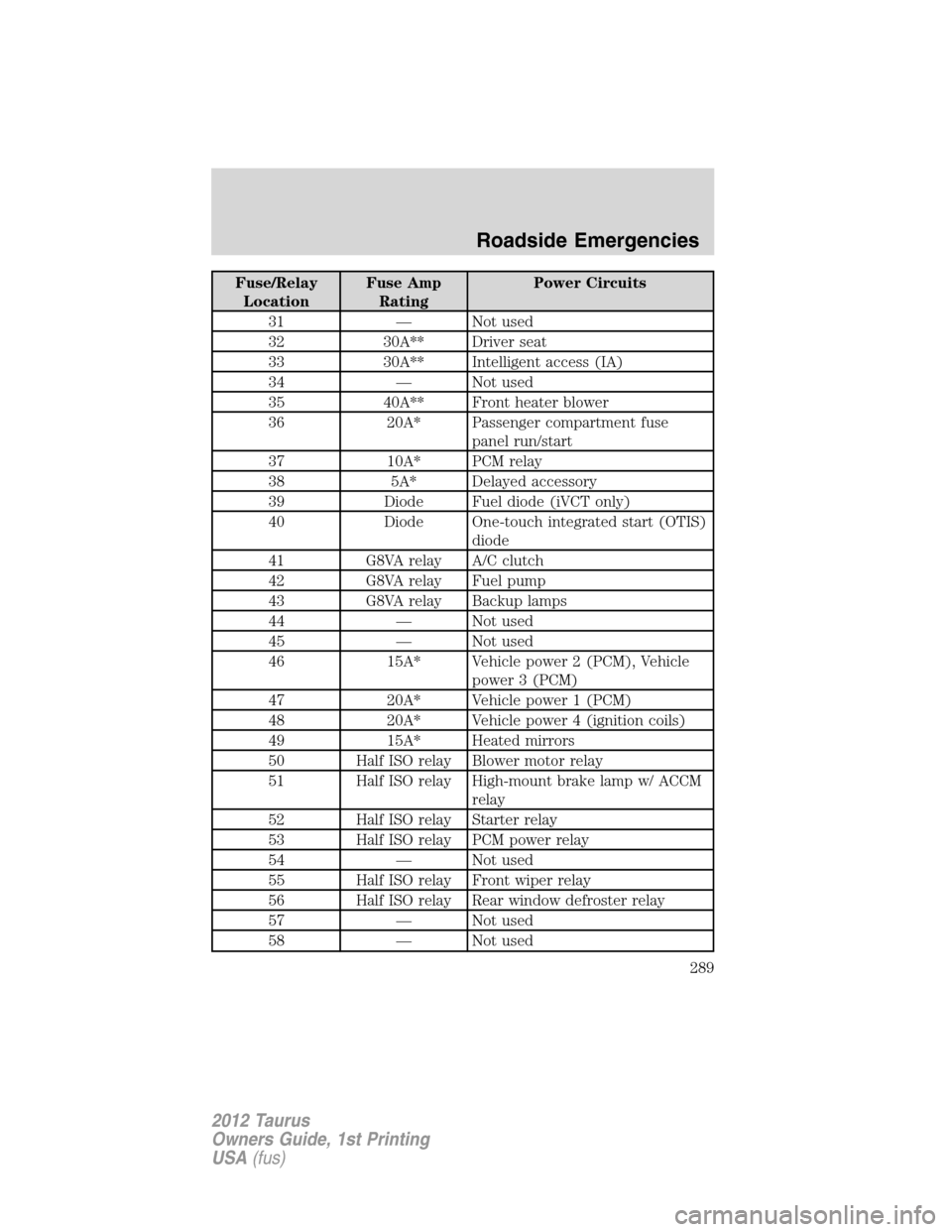
Fuse/Relay
LocationFuse Amp
RatingPower Circuits
31 — Not used
32 30A** Driver seat
33 30A** Intelligent access (IA)
34 — Not used
35 40A** Front heater blower
36 20A* Passenger compartment fuse
panel run/start
37 10A* PCM relay
38 5A* Delayed accessory
39 Diode Fuel diode (iVCT only)
40 Diode One-touch integrated start (OTIS)
diode
41 G8VA relay A/C clutch
42 G8VA relay Fuel pump
43 G8VA relay Backup lamps
44 — Not used
45 — Not used
46 15A* Vehicle power 2 (PCM), Vehicle
power 3 (PCM)
47 20A* Vehicle power 1 (PCM)
48 20A* Vehicle power 4 (ignition coils)
49 15A* Heated mirrors
50 Half ISO relay Blower motor relay
51 Half ISO relay High-mount brake lamp w/ ACCM
relay
52 Half ISO relay Starter relay
53 Half ISO relay PCM power relay
54 — Not used
55 Half ISO relay Front wiper relay
56 Half ISO relay Rear window defroster relay
57 — Not used
58 — Not used
Roadside Emergencies
289
2012 Taurus
Owners Guide, 1st Printing
USA(fus)
Page 324 of 406
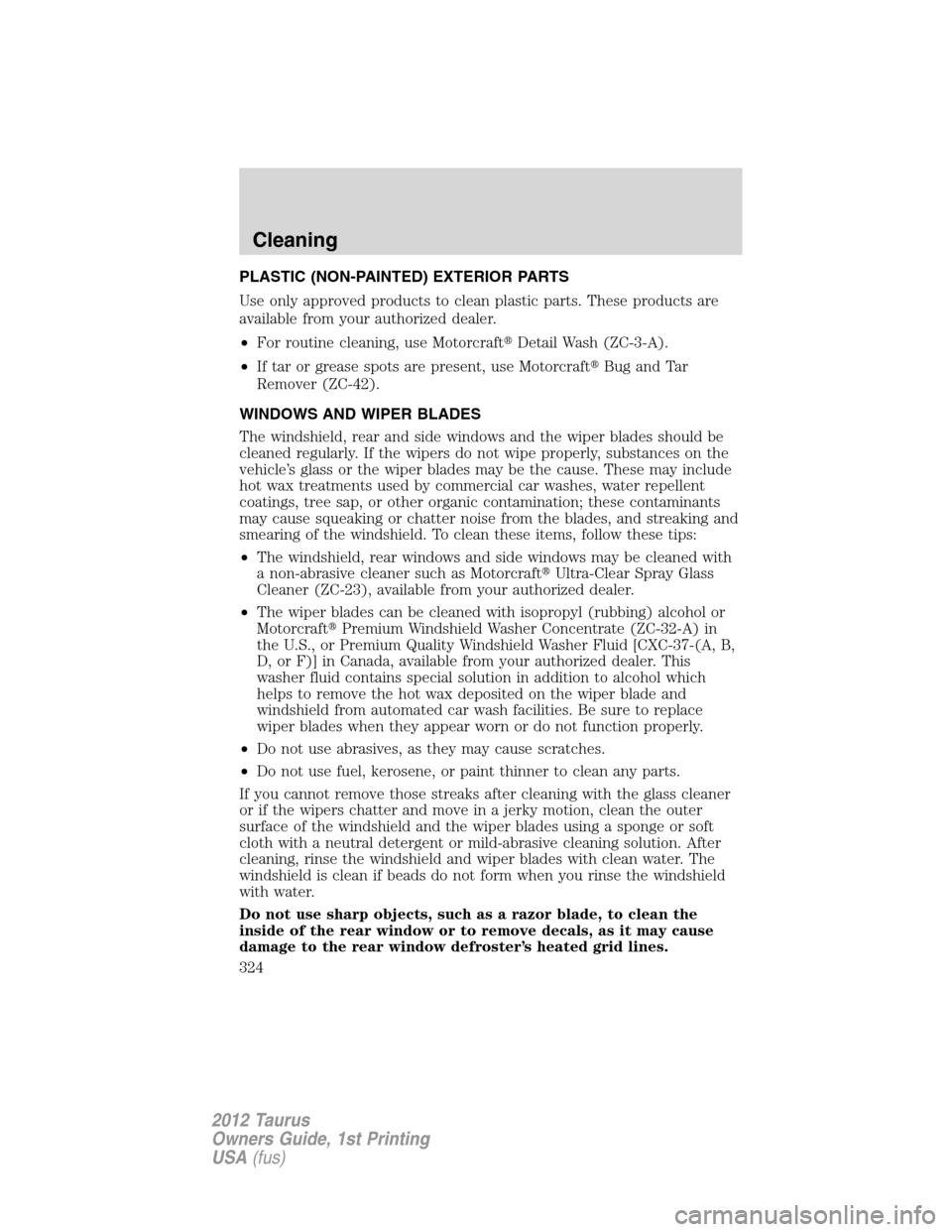
PLASTIC (NON-PAINTED) EXTERIOR PARTS
Use only approved products to clean plastic parts. These products are
available from your authorized dealer.
•For routine cleaning, use Motorcraft�Detail Wash (ZC-3-A).
•If tar or grease spots are present, use Motorcraft�Bug and Tar
Remover (ZC-42).
WINDOWS AND WIPER BLADES
The windshield, rear and side windows and the wiper blades should be
cleaned regularly. If the wipers do not wipe properly, substances on the
vehicle’s glass or the wiper blades may be the cause. These may include
hot wax treatments used by commercial car washes, water repellent
coatings, tree sap, or other organic contamination; these contaminants
may cause squeaking or chatter noise from the blades, and streaking and
smearing of the windshield. To clean these items, follow these tips:
•The windshield, rear windows and side windows may be cleaned with
a non-abrasive cleaner such as Motorcraft�Ultra-Clear Spray Glass
Cleaner (ZC-23), available from your authorized dealer.
•The wiper blades can be cleaned with isopropyl (rubbing) alcohol or
Motorcraft�Premium Windshield Washer Concentrate (ZC-32-A) in
the U.S., or Premium Quality Windshield Washer Fluid [CXC-37-(A, B,
D, or F)] in Canada, available from your authorized dealer. This
washer fluid contains special solution in addition to alcohol which
helps to remove the hot wax deposited on the wiper blade and
windshield from automated car wash facilities. Be sure to replace
wiper blades when they appear worn or do not function properly.
•Do not use abrasives, as they may cause scratches.
•Do not use fuel, kerosene, or paint thinner to clean any parts.
If you cannot remove those streaks after cleaning with the glass cleaner
or if the wipers chatter and move in a jerky motion, clean the outer
surface of the windshield and the wiper blades using a sponge or soft
cloth with a neutral detergent or mild-abrasive cleaning solution. After
cleaning, rinse the windshield and wiper blades with clean water. The
windshield is clean if beads do not form when you rinse the windshield
with water.
Do not use sharp objects, such as a razor blade, to clean the
inside of the rear window or to remove decals, as it may cause
damage to the rear window defroster’s heated grid lines.
Cleaning
324
2012 Taurus
Owners Guide, 1st Printing
USA(fus)
Page 333 of 406
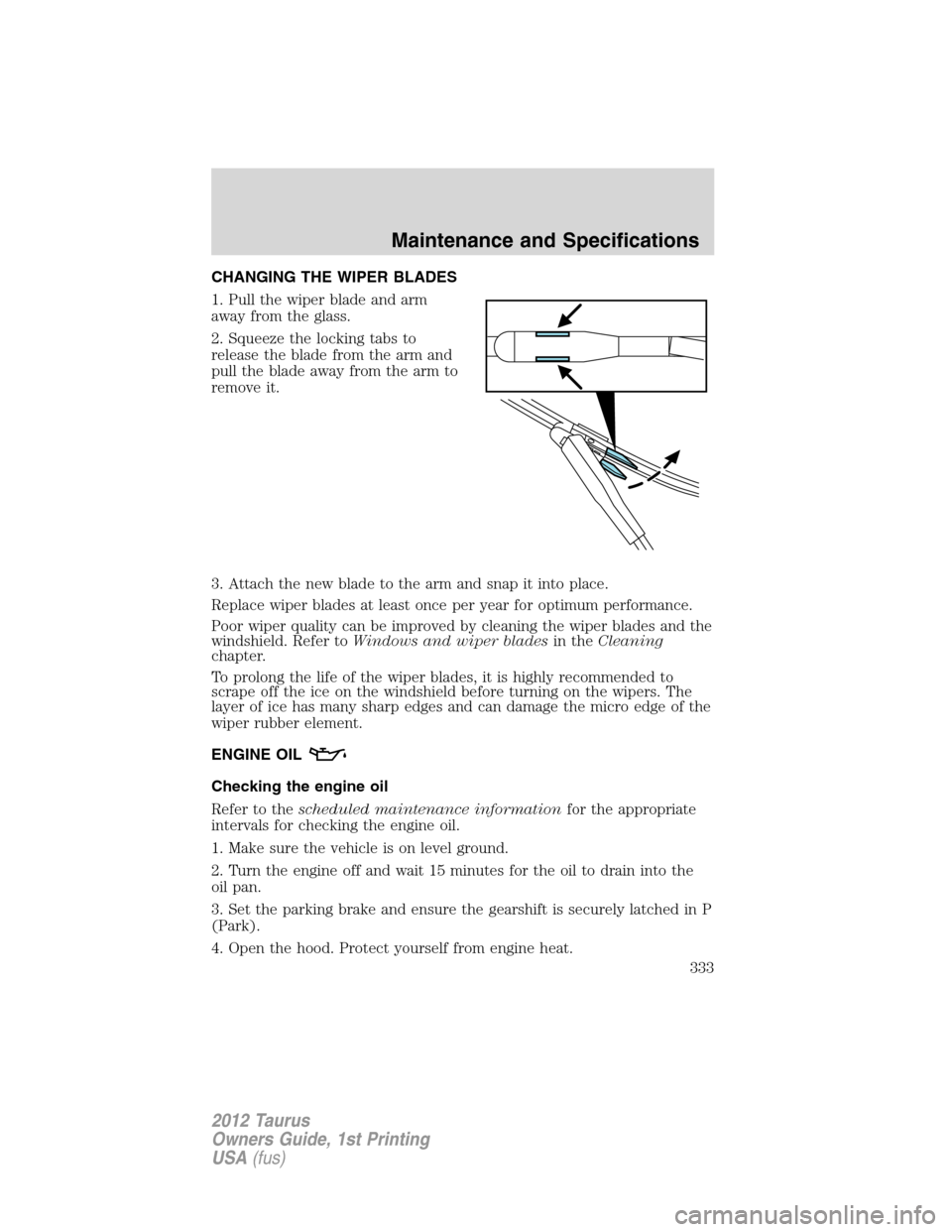
CHANGING THE WIPER BLADES
1. Pull the wiper blade and arm
away from the glass.
2. Squeeze the locking tabs to
release the blade from the arm and
pull the blade away from the arm to
remove it.
3. Attach the new blade to the arm and snap it into place.
Replace wiper blades at least once per year for optimum performance.
Poor wiper quality can be improved by cleaning the wiper blades and the
windshield. Refer toWindows and wiper bladesin theCleaning
chapter.
To prolong the life of the wiper blades, it is highly recommended to
scrape off the ice on the windshield before turning on the wipers. The
layer of ice has many sharp edges and can damage the micro edge of the
wiper rubber element.
ENGINE OIL
Checking the engine oil
Refer to thescheduled maintenance informationfor the appropriate
intervals for checking the engine oil.
1. Make sure the vehicle is on level ground.
2. Turn the engine off and wait 15 minutes for the oil to drain into the
oil pan.
3. Set the parking brake and ensure the gearshift is securely latched in P
(Park).
4. Open the hood. Protect yourself from engine heat.
Maintenance and Specifications
333
2012 Taurus
Owners Guide, 1st Printing
USA(fus)