Page 353 of 406

Keep a record for at least one month and record the type of driving (city
or highway). This will provide an accurate estimate of the vehicle’s fuel
economy under current driving conditions. Additionally, keeping records
during summer and winter will show how temperature impacts fuel
economy. In general, lower temperatures give lower fuel economy.
Driving style — good driving and fuel economy habits
Give consideration to the lists that follow and you may be able to change
a number of variables and improve your fuel economy.
Habits
•Smooth, moderate operation can yield up to 10% savings in fuel.
•Steady speeds without stopping will usually give the best fuel
economy.
•Idling for long periods of time (greater than one minute) may waste
fuel.
•Anticipate stopping; slowing down may eliminate the need to stop.
•Sudden or hard accelerations may reduce fuel economy.
•Slow down gradually.
•Driving at reasonable speeds (traveling at 55 mph [88 km/h] uses 15%
less fuel than traveling at 65 mph [105 km/h]).
•Revving the engine before turning it off may reduce fuel economy.
•Using the air conditioner or defroster may reduce fuel economy.
•You may want to turn off the speed control in hilly terrain if
unnecessary shifting between the top gears occurs. Unnecessary
shifting of this type could result in reduced fuel economy.
•Warming up a vehicle on cold mornings is not required and may
reduce fuel economy.
•Resting your foot on the brake pedal while driving may reduce fuel
economy.
•Combine errands and minimize stop-and-go driving.
Maintenance
•Keep tires properly inflated and use only recommended size.
•Operating a vehicle with the wheels out of alignment will reduce fuel
economy.
•Use recommended engine oil. Refer toMaintenance product
specifications and capacitiesin this chapter.
Maintenance and Specifications
353
2012 Taurus
Owners Guide, 1st Printing
USA(fus)
Page 364 of 406
4. Wipe the air filter housing and cover clean to remove any dirt or
debris and to ensure good sealing.
5. Install a new air filter element. Be careful not to crimp the filter
element edges between the air filter housing and cover. This could cause
filter damage and allow unfiltered air to enter the engine if not properly
seated.
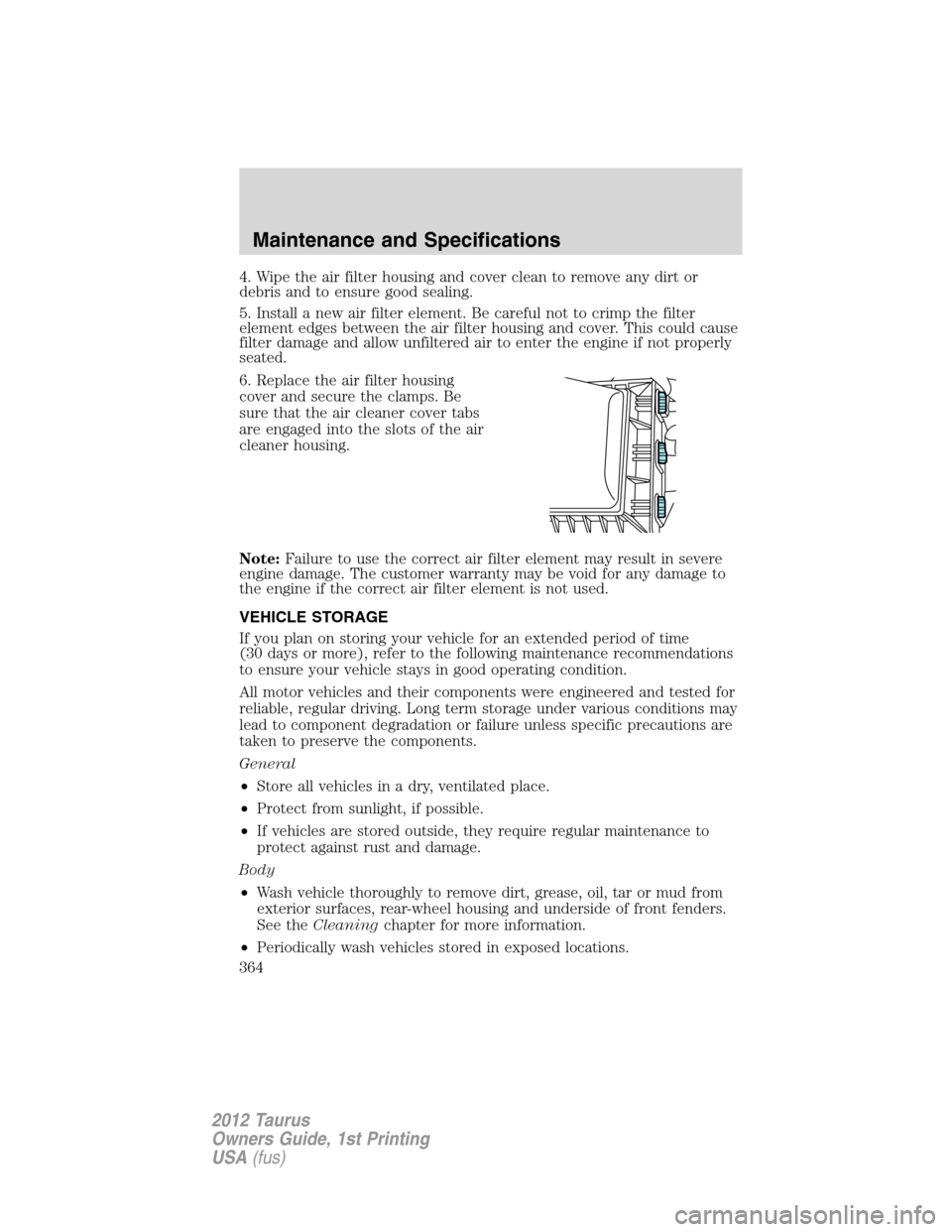
6. Replace the air filter housing
cover and secure the clamps. Be
sure that the air cleaner cover tabs
are engaged into the slots of the air
cleaner housing.
Note:Failure to use the correct air filter element may result in severe
engine damage. The customer warranty may be void for any damage to
the engine if the correct air filter element is not used.
VEHICLE STORAGE
If you plan on storing your vehicle for an extended period of time
(30 days or more), refer to the following maintenance recommendations
to ensure your vehicle stays in good operating condition.
All motor vehicles and their components were engineered and tested for
reliable, regular driving. Long term storage under various conditions may
lead to component degradation or failure unless specific precautions are
taken to preserve the components.
General
•Store all vehicles in a dry, ventilated place.
•Protect from sunlight, if possible.
•If vehicles are stored outside, they require regular maintenance to
protect against rust and damage.
Body
•Wash vehicle thoroughly to remove dirt, grease, oil, tar or mud from
exterior surfaces, rear-wheel housing and underside of front fenders.
See theCleaningchapter for more information.
•Periodically wash vehicles stored in exposed locations.
Maintenance and Specifications
364
2012 Taurus
Owners Guide, 1st Printing
USA(fus)
Page 365 of 406
•Touch-up raw or primed metal to prevent rust.
•Cover chrome and stainless steel parts with a thick coat of auto wax
to prevent discoloration. Re-wax as necessary when the vehicle is
washed. See theCleaningchapter for more information.
•Lubricate all hood, door and trunk lid hinges, and latches with a light
grade oil. See theCleaningchapter for more information.
•Cover interior trim to prevent fading.
•Keep all rubber parts free from oil and solvents.
Engine
•The engine oil and filter should be changed prior to storage, as used
engine oil contain contaminates that may cause engine damage.
•Start the engine every 15 days. Run at fast idle until it reaches normal
operating temperature.
•With your foot on the brake, shift through all the gears while the
engine is running.
Fuel system
•Fill the fuel tank with high-quality fuel until the first automatic shutoff
of the fuel pump nozzle.
Note:During extended periods of vehicle storage (30 days or more),
fuel may deteriorate due to oxidation. Add a quality gas stabilizer
product to the vehicle fuel system whenever actual or expected storage
periods exceed 30 days. Follow the instructions on the additive label.
The vehicle should then be operated at idle speed to circulate the
additive throughout the fuel system.
Cooling system
•Protect against freezing temperatures.
•When removing vehicle from storage, check coolant fluid level.
Confirm there are no cooling system leaks, and fluid is at the
recommended level.
Battery
•Check and recharge as necessary. Keep connections clean.
•If storing your vehicle for more than 30 days without recharging the
battery, it may be advisable to disconnect the battery cables to ensure
battery charge is maintained for quick starting.
Note:If battery cables are disconnected, it will be necessary to reset
memory features.
Maintenance and Specifications
365
2012 Taurus
Owners Guide, 1st Printing
USA(fus)
Page 366 of 406
Brakes
•Make sure brakes and parking brake are fully released.
Tires
•Maintain recommended air pressure.
Miscellaneous
•Make sure all linkages, cables, levers and pins under vehicle are
covered with grease to prevent rust.
•Move vehicles at least 25 feet (8 m) every 15 days to lubricate
working parts and prevent corrosion.
Removing vehicle from storage
When your vehicle is ready to come out of storage, do the following:
•Wash your vehicle to remove any dirt or grease film build-up on
window surfaces.
•Check windshield wipers for any deterioration.
•Check under the hood for any foreign material that may have collected
during storage (mice/squirrel nests).
•Check the exhaust for any foreign material that may have collected
during storage.
•Check tire pressures and set tire inflation per the Tire Label.
•Check brake pedal operation. Drive the vehicle 15 ft (4.5 meters) back
and forth to remove rust build-up.
•Check fluid levels (including coolant, oil and gas) to make sure there
are no leaks, and fluids are at recommended levels.
•If the battery was removed, clean the battery cable ends and inspect.
If you have any concerns or issues, contact your authorized dealer.
Maintenance and Specifications
366
2012 Taurus
Owners Guide, 1st Printing
USA(fus)
Page 367 of 406
MOTORCRAFT PART NUMBERS
Component 3.5L V6 Engine 3.5L V6 SHO engine
Air filter element FA-1884 FA-1884
Battery BXT-59 BXT-65–650
Oil filter FL-500-S FL-500-S
Spark plugs SP-411
1SP-5281
Cabin air filter FP68 FP68
Windshield wiper
bladeWW-2601-PF (driver side)
WW-2001-PF (passenger side)
1Refer toscheduled maintenance informationfor the appropriate
intervals for changing the spark plugs.
Replace the spark plugs with ones that meet Ford material and
design specifications for your vehicle, such as Motorcraft�or
equivalent replacement parts. The customer warranty may be
void for any damage to the engine if such spark plugs are not
used.
Maintenance and Specifications
367
2012 Taurus
Owners Guide, 1st Printing
USA(fus)
Page 369 of 406
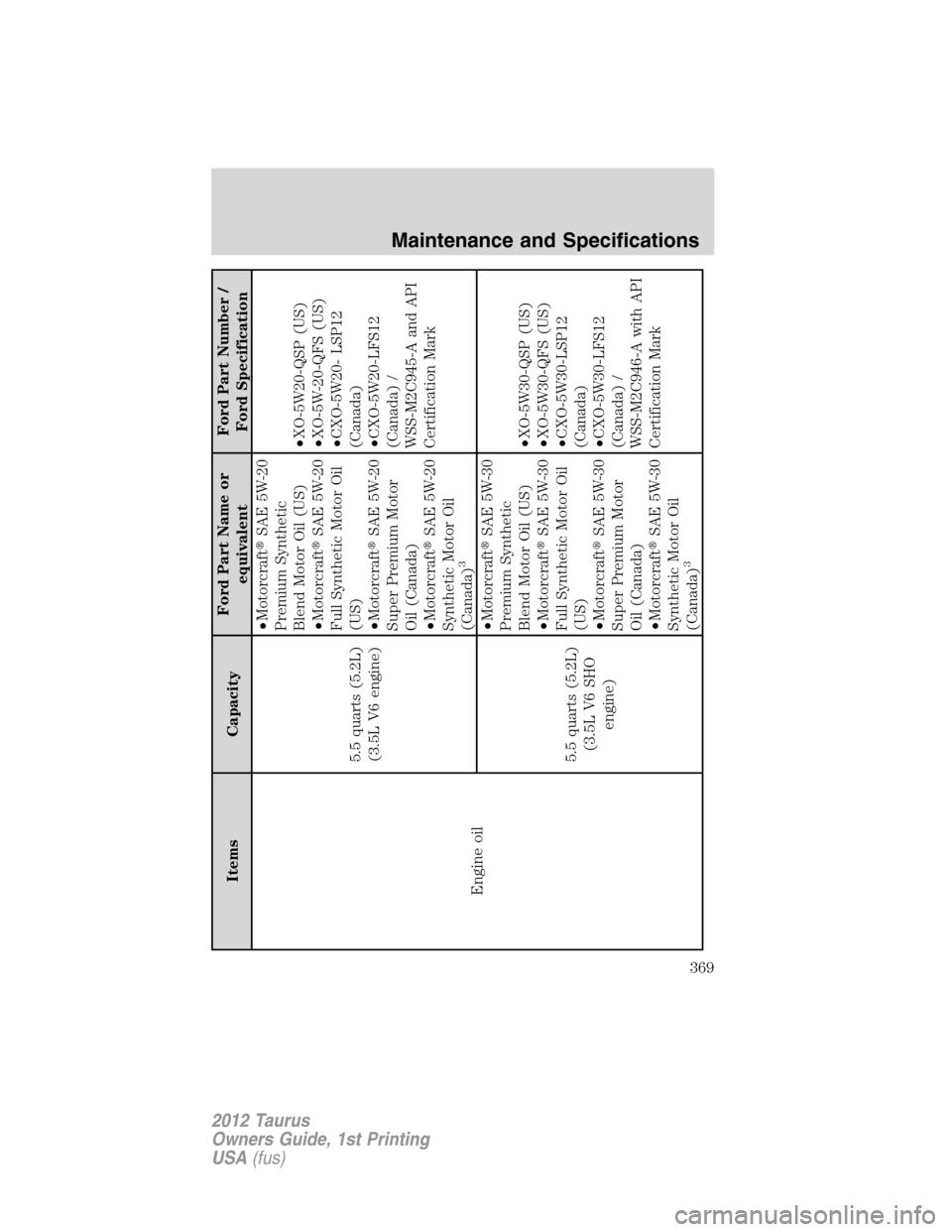
Items CapacityFord Part Name or
equivalentFord Part Number /
Ford Specification
Engine oil5.5 quarts (5.2L)
(3.5L V6 engine)•Motorcraft�SAE 5W-20
Premium Synthetic
Blend Motor Oil (US)
•Motorcraft�SAE 5W-20
Full Synthetic Motor Oil
(US)
•Motorcraft�SAE 5W-20
Super Premium Motor
Oil (Canada)
•Motorcraft�SAE 5W-20
Synthetic Motor Oil
(Canada)
3
•XO-5W20-QSP (US)
•XO-5W-20-QFS (US)
•CXO-5W20- LSP12
(Canada)
•CXO-5W20-LFS12
(Canada) /
WSS-M2C945-A and API
Certification Mark
5.5 quarts (5.2L)
(3.5L V6 SHO
engine)•Motorcraft�SAE 5W-30
Premium Synthetic
Blend Motor Oil (US)
•Motorcraft�SAE 5W-30
Full Synthetic Motor Oil
(US)
•Motorcraft�SAE 5W-30
Super Premium Motor
Oil (Canada)
•Motorcraft�SAE 5W-30
Synthetic Motor Oil
(Canada)
3
•XO-5W30-QSP (US)
•XO-5W30-QFS (US)
•CXO-5W30-LSP12
(Canada)
•CXO-5W30-LFS12
(Canada) /
WSS-M2C946-A with API
Certification Mark
Maintenance and Specifications
369
2012 Taurus
Owners Guide, 1st Printing
USA(fus)
Page 371 of 406
Items CapacityFord Part Name or
equivalentFord Part Number /
Ford Specification
Fuel tank19.0 gallons
(71.9 L)——
1Approximate dry fill capacity. Actual amount may vary during fluid changes.2Automatic transmissions that require MERCON�LV should only use MERCON�LV fluid. Refer to
scheduled maintenance informationto determine the correct service interval. Use of any fluid
other than the recommended fluid may cause transmission damage.3Use of synthetic or synthetic blend motor oil is not mandatory. Engine oil need only meet the
requirements of Ford specification WSS-M2C946-A (3.5L V6 SHO engine) or WSS-M2C945 -A (3.5L
V6 engine) and the API Certification mark.4Add the coolant type originally equipped in your vehicle.5See your authorized dealer for fluid level checking or filling.
Maintenance and Specifications
371
2012 Taurus
Owners Guide, 1st Printing
USA(fus)
Page 372 of 406
ENGINE DATA
Engine 3.5L V6 engine 3.5L V6 SHO engine
Cubic inches 214 214
FuelSeeOctane
recommendations
earlier in this chapter.SeeOctane
recommendationsearlier
in this chapter.
Firing order 1–4–2–5–3–6 1–4–2–5–3–6
Ignition system Coil on plug Coil on plug
Spark plug gap0.052–0.056 inch
(1.32–1.42 mm)0.033–0.037 inch
(.84–.94 mm)
Compression
ratio10.3:1 10.0:1
Engine drivebelt routing
3.5L V6 engine
1. Short drivebelt is on first pulley groove closest to engine (except
vehicles with electric power assisted steering).
2. Long drivebelt is on second pulley groove farthest from engine.
Maintenance and Specifications
372
2012 Taurus
Owners Guide, 1st Printing
USA(fus)