2012 FORD SUPER DUTY cooling
[x] Cancel search: coolingPage 388 of 454
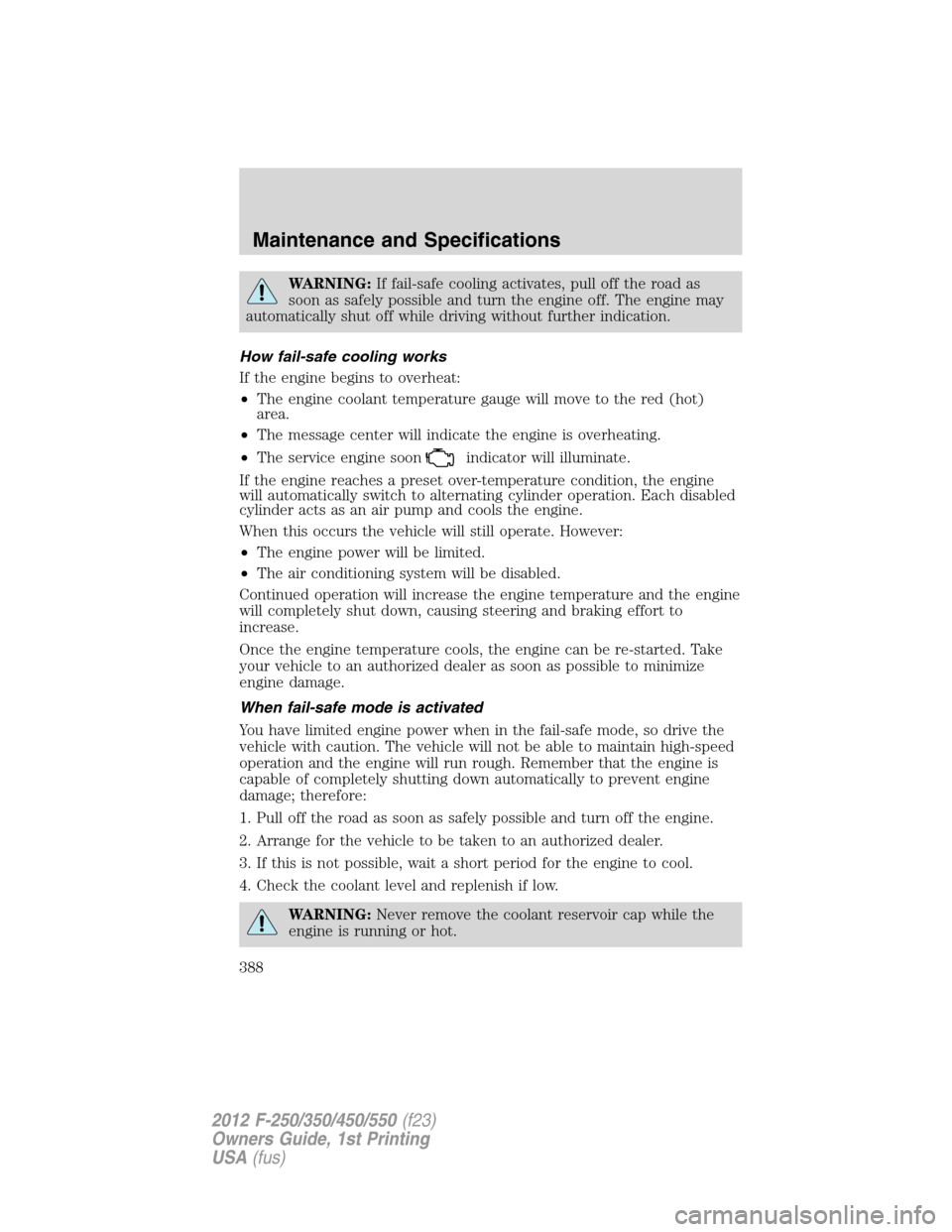
WARNING:If fail-safe cooling activates, pull off the road as
soon as safely possible and turn the engine off. The engine may
automatically shut off while driving without further indication.
How fail-safe cooling works
If the engine begins to overheat:
•The engine coolant temperature gauge will move to the red (hot)
area.
•The message center will indicate the engine is overheating.
•The service engine soon
indicator will illuminate.
If the engine reaches a preset over-temperature condition, the engine
will automatically switch to alternating cylinder operation. Each disabled
cylinder acts as an air pump and cools the engine.
When this occurs the vehicle will still operate. However:
•The engine power will be limited.
•The air conditioning system will be disabled.
Continued operation will increase the engine temperature and the engine
will completely shut down, causing steering and braking effort to
increase.
Once the engine temperature cools, the engine can be re-started. Take
your vehicle to an authorized dealer as soon as possible to minimize
engine damage.
When fail-safe mode is activated
You have limited engine power when in the fail-safe mode, so drive the
vehicle with caution. The vehicle will not be able to maintain high-speed
operation and the engine will run rough. Remember that the engine is
capable of completely shutting down automatically to prevent engine
damage; therefore:
1. Pull off the road as soon as safely possible and turn off the engine.
2. Arrange for the vehicle to be taken to an authorized dealer.
3. If this is not possible, wait a short period for the engine to cool.
4. Check the coolant level and replenish if low.
WARNING:Never remove the coolant reservoir cap while the
engine is running or hot.
Maintenance and Specifications
388
2012 F-250/350/450/550(f23)
Owners Guide, 1st Printing
USA(fus)
Page 390 of 454
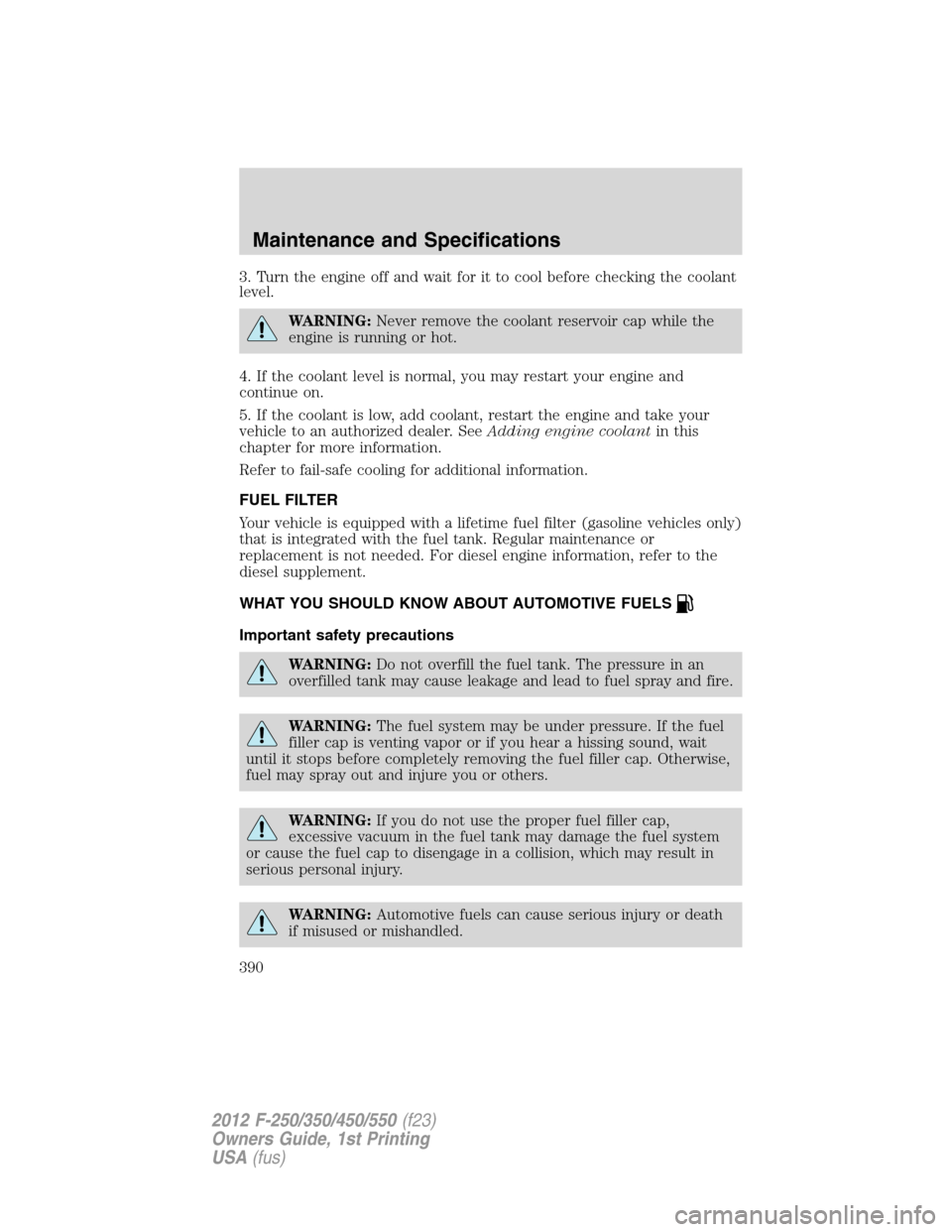
3. Turn the engine off and wait for it to cool before checking the coolant
level.
WARNING:Never remove the coolant reservoir cap while the
engine is running or hot.
4. If the coolant level is normal, you may restart your engine and
continue on.
5. If the coolant is low, add coolant, restart the engine and take your
vehicle to an authorized dealer. SeeAdding engine coolantin this
chapter for more information.
Refer to fail-safe cooling for additional information.
FUEL FILTER
Your vehicle is equipped with a lifetime fuel filter (gasoline vehicles only)
that is integrated with the fuel tank. Regular maintenance or
replacement is not needed. For diesel engine information, refer to the
diesel supplement.
WHAT YOU SHOULD KNOW ABOUT AUTOMOTIVE FUELS
Important safety precautions
WARNING:Do not overfill the fuel tank. The pressure in an
overfilled tank may cause leakage and lead to fuel spray and fire.
WARNING:The fuel system may be under pressure. If the fuel
filler cap is venting vapor or if you hear a hissing sound, wait
until it stops before completely removing the fuel filler cap. Otherwise,
fuel may spray out and injure you or others.
WARNING:If you do not use the proper fuel filler cap,
excessive vacuum in the fuel tank may damage the fuel system
or cause the fuel cap to disengage in a collision, which may result in
serious personal injury.
WARNING:Automotive fuels can cause serious injury or death
if misused or mishandled.
Maintenance and Specifications
390
2012 F-250/350/450/550(f23)
Owners Guide, 1st Printing
USA(fus)
Page 412 of 454
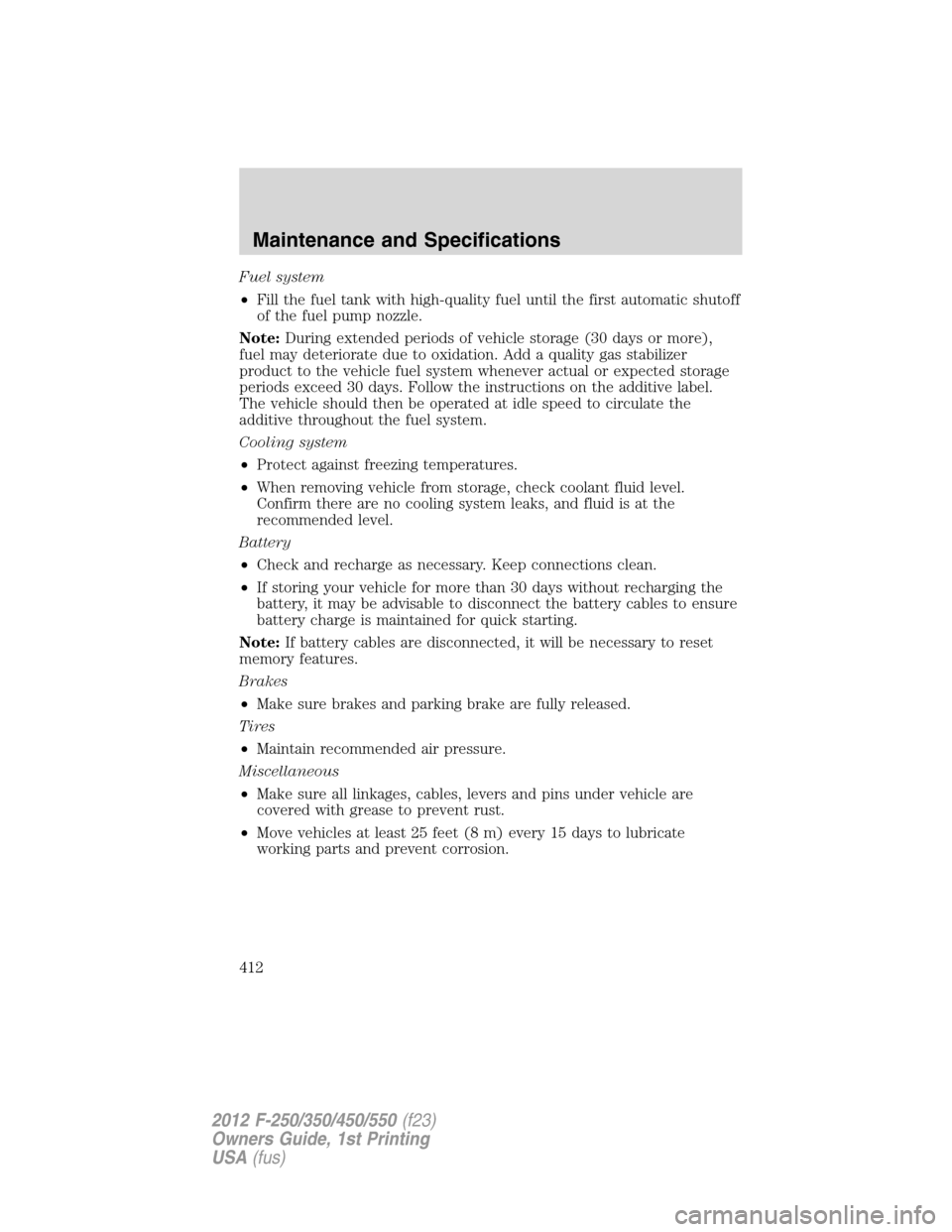
Fuel system
•Fill the fuel tank with high-quality fuel until the first automatic shutoff
of the fuel pump nozzle.
Note:During extended periods of vehicle storage (30 days or more),
fuel may deteriorate due to oxidation. Add a quality gas stabilizer
product to the vehicle fuel system whenever actual or expected storage
periods exceed 30 days. Follow the instructions on the additive label.
The vehicle should then be operated at idle speed to circulate the
additive throughout the fuel system.
Cooling system
•Protect against freezing temperatures.
•When removing vehicle from storage, check coolant fluid level.
Confirm there are no cooling system leaks, and fluid is at the
recommended level.
Battery
•Check and recharge as necessary. Keep connections clean.
•If storing your vehicle for more than 30 days without recharging the
battery, it may be advisable to disconnect the battery cables to ensure
battery charge is maintained for quick starting.
Note:If battery cables are disconnected, it will be necessary to reset
memory features.
Brakes
•Make sure brakes and parking brake are fully released.
Tires
•Maintain recommended air pressure.
Miscellaneous
•Make sure all linkages, cables, levers and pins under vehicle are
covered with grease to prevent rust.
•Move vehicles at least 25 feet (8 m) every 15 days to lubricate
working parts and prevent corrosion.
Maintenance and Specifications
412
2012 F-250/350/450/550(f23)
Owners Guide, 1st Printing
USA(fus)
Page 431 of 454
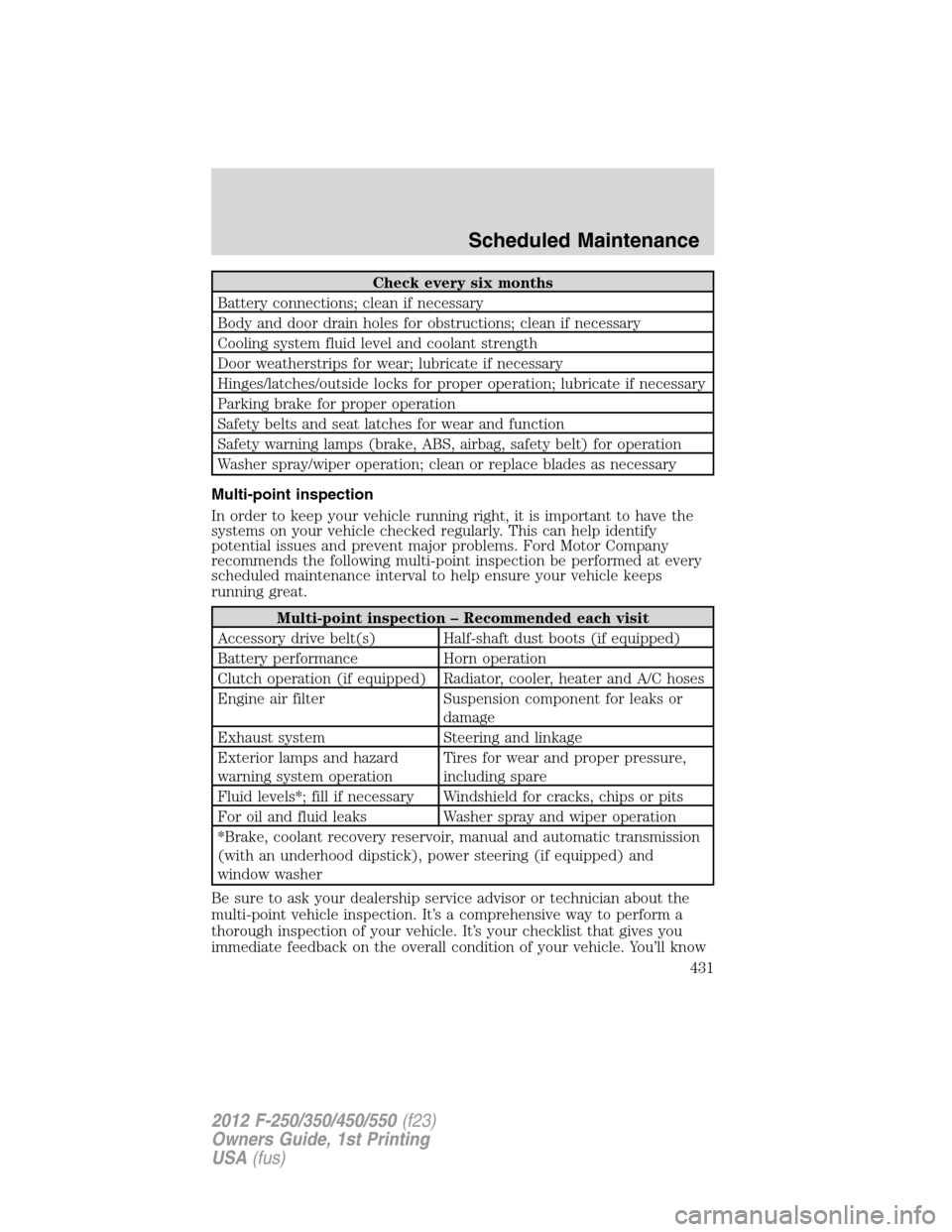
Check every six months
Battery connections; clean if necessary
Body and door drain holes for obstructions; clean if necessary
Cooling system fluid level and coolant strength
Door weatherstrips for wear; lubricate if necessary
Hinges/latches/outside locks for proper operation; lubricate if necessary
Parking brake for proper operation
Safety belts and seat latches for wear and function
Safety warning lamps (brake, ABS, airbag, safety belt) for operation
Washer spray/wiper operation; clean or replace blades as necessary
Multi-point inspection
In order to keep your vehicle running right, it is important to have the
systems on your vehicle checked regularly. This can help identify
potential issues and prevent major problems. Ford Motor Company
recommends the following multi-point inspection be performed at every
scheduled maintenance interval to help ensure your vehicle keeps
running great.
Multi-point inspection – Recommended each visit
Accessory drive belt(s) Half-shaft dust boots (if equipped)
Battery performance Horn operation
Clutch operation (if equipped) Radiator, cooler, heater and A/C hoses
Engine air filter Suspension component for leaks or
damage
Exhaust system Steering and linkage
Exterior lamps and hazard
warning system operationTires for wear and proper pressure,
including spare
Fluid levels*; fill if necessary Windshield for cracks, chips or pits
For oil and fluid leaks Washer spray and wiper operation
*Brake, coolant recovery reservoir, manual and automatic transmission
(with an underhood dipstick), power steering (if equipped) and
window washer
Be sure to ask your dealership service advisor or technician about the
multi-point vehicle inspection. It’s a comprehensive way to perform a
thorough inspection of your vehicle. It’s your checklist that gives you
immediate feedback on the overall condition of your vehicle. You’ll know
Scheduled Maintenance
431
2012 F-250/350/450/550(f23)
Owners Guide, 1st Printing
USA(fus)
Page 434 of 454
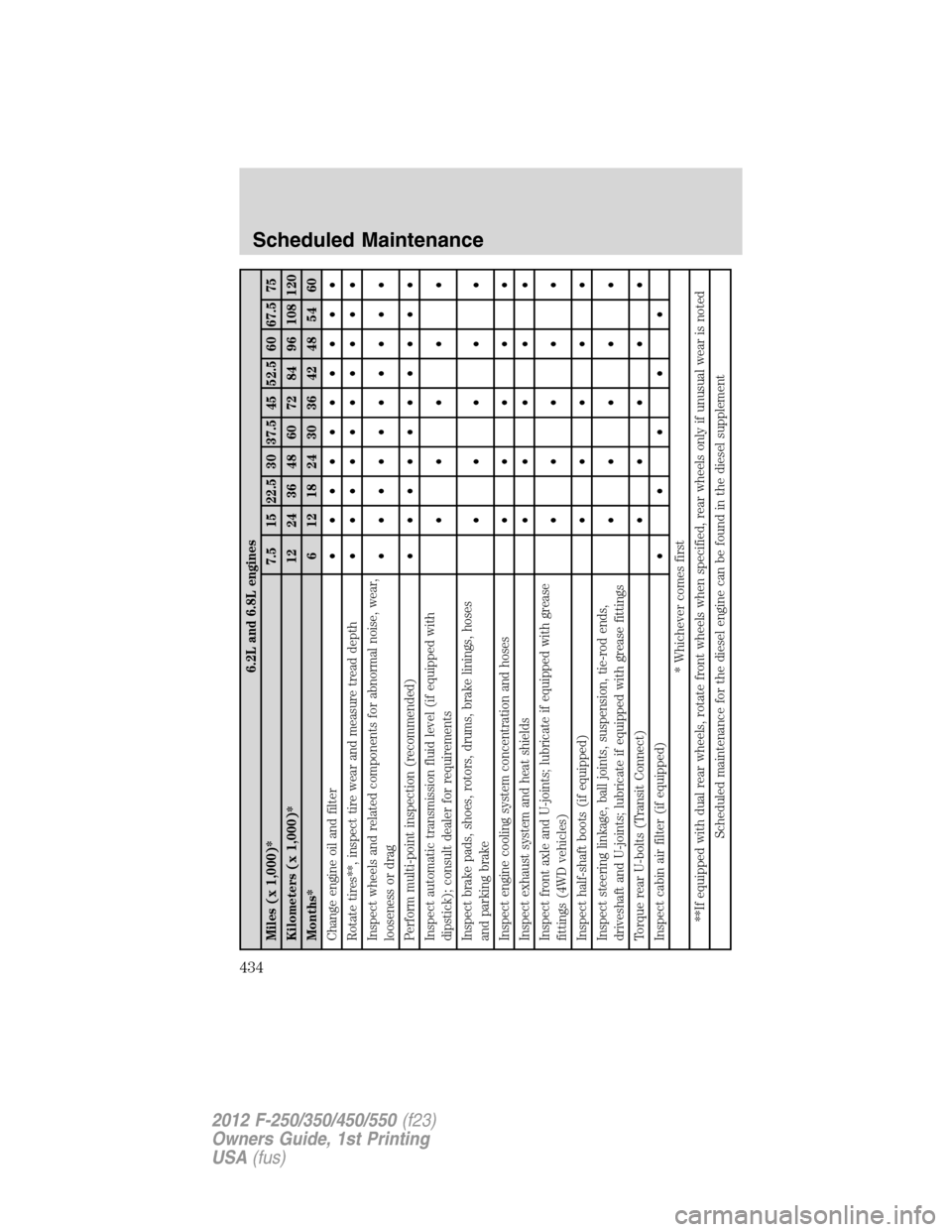
6.2L and 6.8L engines
Miles (x 1,000)* 7.5 15 22.5 30 37.5 45 52.5 60 67.5 75
Kilometers (x 1,000)* 12 24 36 48 60 72 84 96 108 120
Months* 6 12 18 24 30 36 42 48 54 60
Change engine oil and filter• •••••••••
Rotate tires**, inspect tire wear and measure tread depth• •••••••••
Inspect wheels and related components for abnormal noise, wear,
looseness or drag• •••••••••
Perform multi-point inspection (recommended)• •••••••••
Inspect automatic transmission fluid level (if equipped with
dipstick); consult dealer for requirements•••••
Inspect brake pads, shoes, rotors, drums, brake linings, hoses
and parking brake•••••
Inspect engine cooling system concentration and hoses•••••
Inspect exhaust system and heat shields•••••
Inspect front axle and U-joints; lubricate if equipped with grease
fittings (4WD vehicles)•••••
Inspect half-shaft boots (if equipped)•••••
Inspect steering linkage, ball joints, suspension, tie-rod ends,
driveshaft and U-joints; lubricate if equipped with grease fittings•••••
Torque rear U-bolts (Transit Connect)•••••
Inspect cabin air filter (if equipped)• ••••
* Whichever comes first
**If equipped with dual rear wheels, rotate front wheels when specified, rear wheels only if unusual wear is noted
Scheduled maintenance for the diesel engine can be found in the diesel supplement
Scheduled Maintenance
434
2012 F-250/350/450/550(f23)
Owners Guide, 1st Printing
USA(fus)
Page 435 of 454
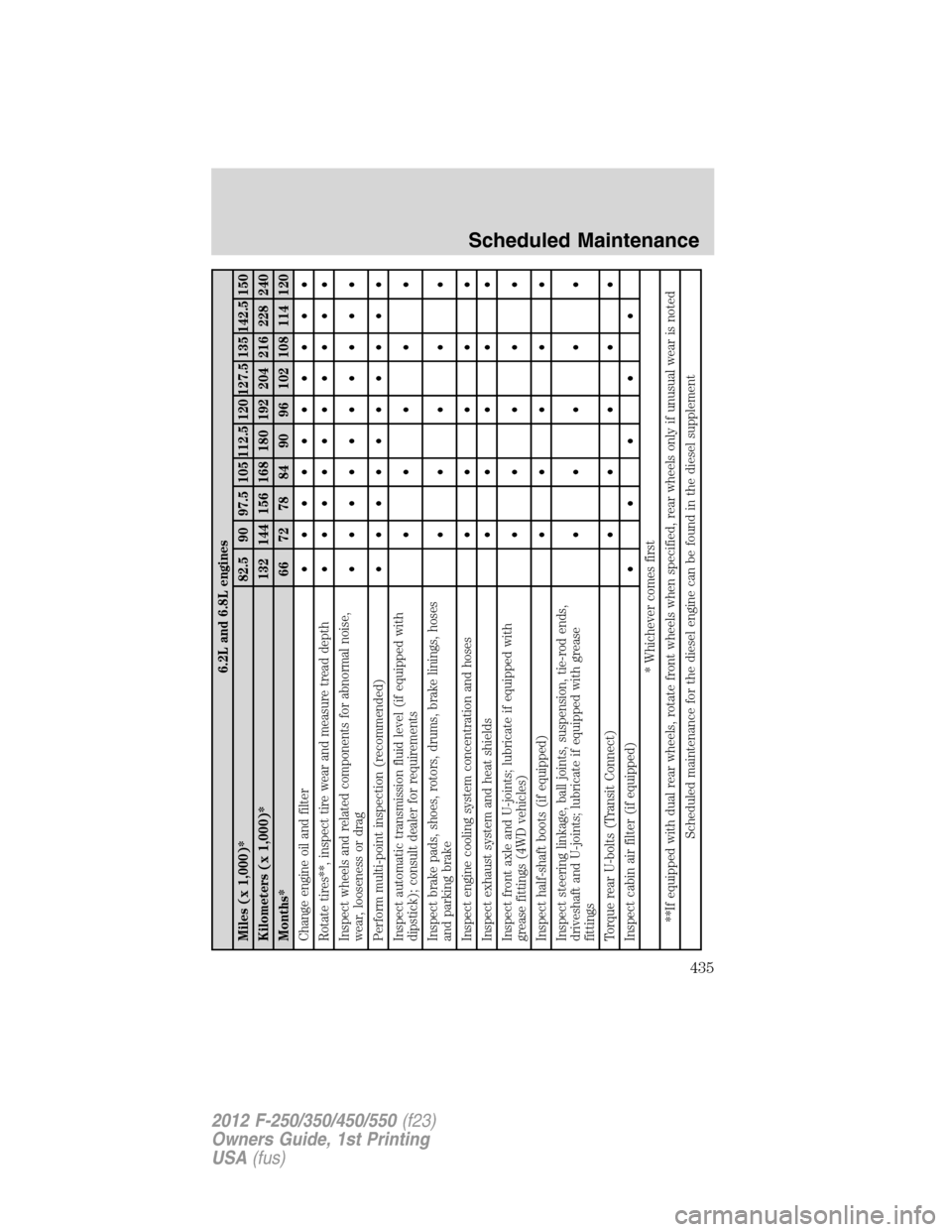
6.2L and 6.8L engines
Miles (x 1,000)* 82.5 90 97.5 105 112.5 120 127.5 135 142.5 150
Kilometers (x 1,000)* 132 144 156 168 180 192 204 216 228 240
Months* 66 72 78 84 90 96 102 108 114 120
Change engine oil and filter• •••••••••
Rotate tires**, inspect tire wear and measure tread depth• •••••••••
Inspect wheels and related components for abnormal noise,
wear, looseness or drag• •••••••••
Perform multi-point inspection (recommended)• •••••••••
Inspect automatic transmission fluid level (if equipped with
dipstick); consult dealer for requirements•••••
Inspect brake pads, shoes, rotors, drums, brake linings, hoses
and parking brake•••••
Inspect engine cooling system concentration and hoses•••••
Inspect exhaust system and heat shields•••••
Inspect front axle and U-joints; lubricate if equipped with
grease fittings (4WD vehicles)•••••
Inspect half-shaft boots (if equipped)•••••
Inspect steering linkage, ball joints, suspension, tie-rod ends,
driveshaft and U-joints; lubricate if equipped with grease
fittings•••••
Torque rear U-bolts (Transit Connect)•••••
Inspect cabin air filter (if equipped)• ••••
* Whichever comes first
**If equipped with dual rear wheels, rotate front wheels when specified, rear wheels only if unusual wear is noted
Scheduled maintenance for the diesel engine can be found in the diesel supplement
Scheduled Maintenance
435
2012 F-250/350/450/550(f23)
Owners Guide, 1st Printing
USA(fus)
Page 449 of 454
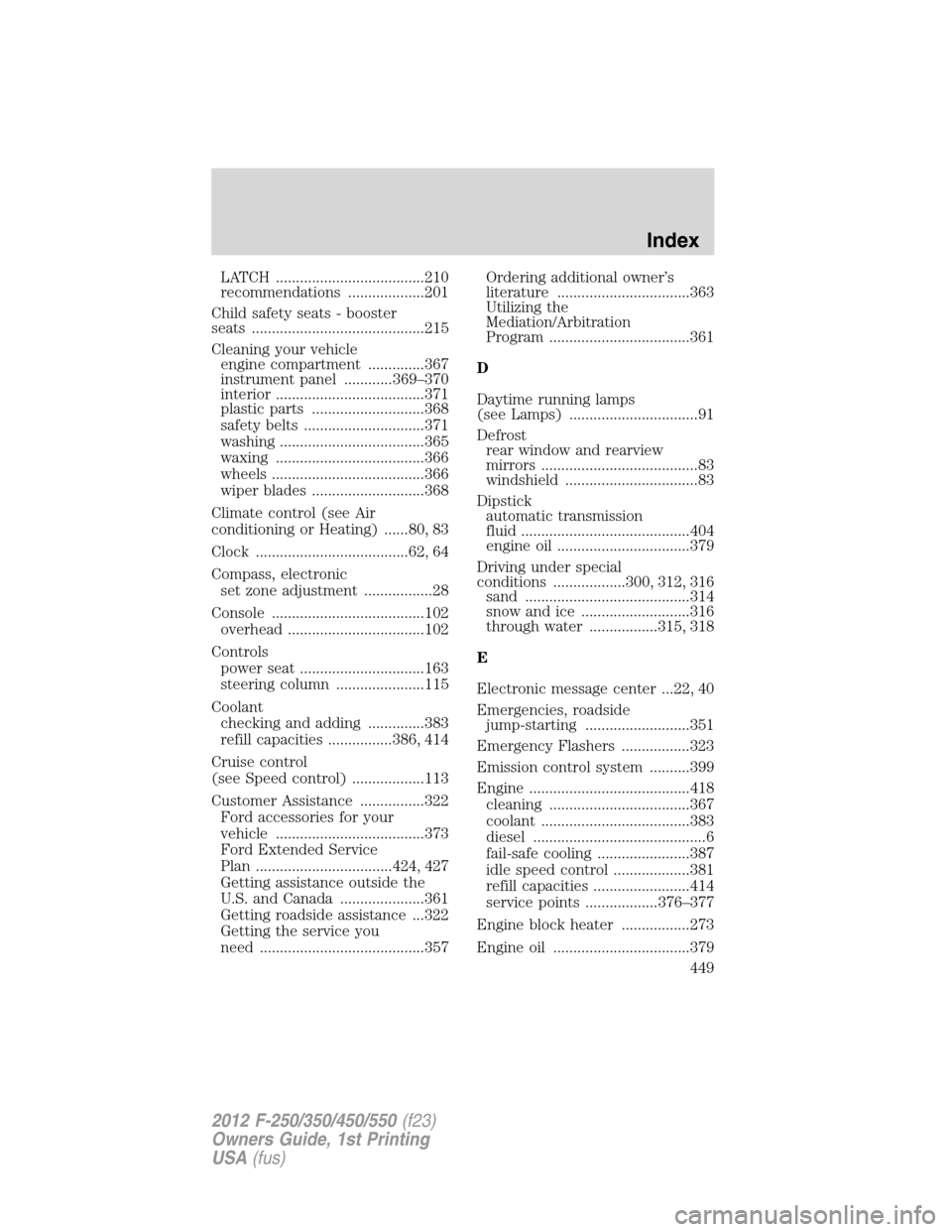
LATCH .....................................210
recommendations ...................201
Child safety seats - booster
seats ...........................................215
Cleaning your vehicle
engine compartment ..............367
instrument panel ............369–370
interior .....................................371
plastic parts ............................368
safety belts ..............................371
washing ....................................365
waxing .....................................366
wheels ......................................366
wiper blades ............................368
Climate control (see Air
conditioning or Heating) ......80, 83
Clock ......................................62, 64
Compass, electronic
set zone adjustment .................28
Console ......................................102
overhead ..................................102
Controls
power seat ...............................163
steering column ......................115
Coolant
checking and adding ..............383
refill capacities ................386, 414
Cruise control
(see Speed control) ..................113
Customer Assistance ................322
Ford accessories for your
vehicle .....................................373
Ford Extended Service
Plan ..................................424, 427
Getting assistance outside the
U.S. and Canada .....................361
Getting roadside assistance ...322
Getting the service you
need .........................................357Ordering additional owner’s
literature .................................363
Utilizing the
Mediation/Arbitration
Program ...................................361
D
Daytime running lamps
(see Lamps) ................................91
Defrost
rear window and rearview
mirrors .......................................83
windshield .................................83
Dipstick
automatic transmission
fluid ..........................................404
engine oil .................................379
Driving under special
conditions ..................300, 312, 316
sand .........................................314
snow and ice ...........................316
through water .................315, 318
E
Electronic message center ...22, 40
Emergencies, roadside
jump-starting ..........................351
Emergency Flashers .................323
Emission control system ..........399
Engine ........................................418
cleaning ...................................367
coolant .....................................383
diesel ...........................................6
fail-safe cooling .......................387
idle speed control ...................381
refill capacities ........................414
service points ..................376–377
Engine block heater .................273
Engine oil ..................................379
Index
449
2012 F-250/350/450/550(f23)
Owners Guide, 1st Printing
USA(fus)
Page 450 of 454
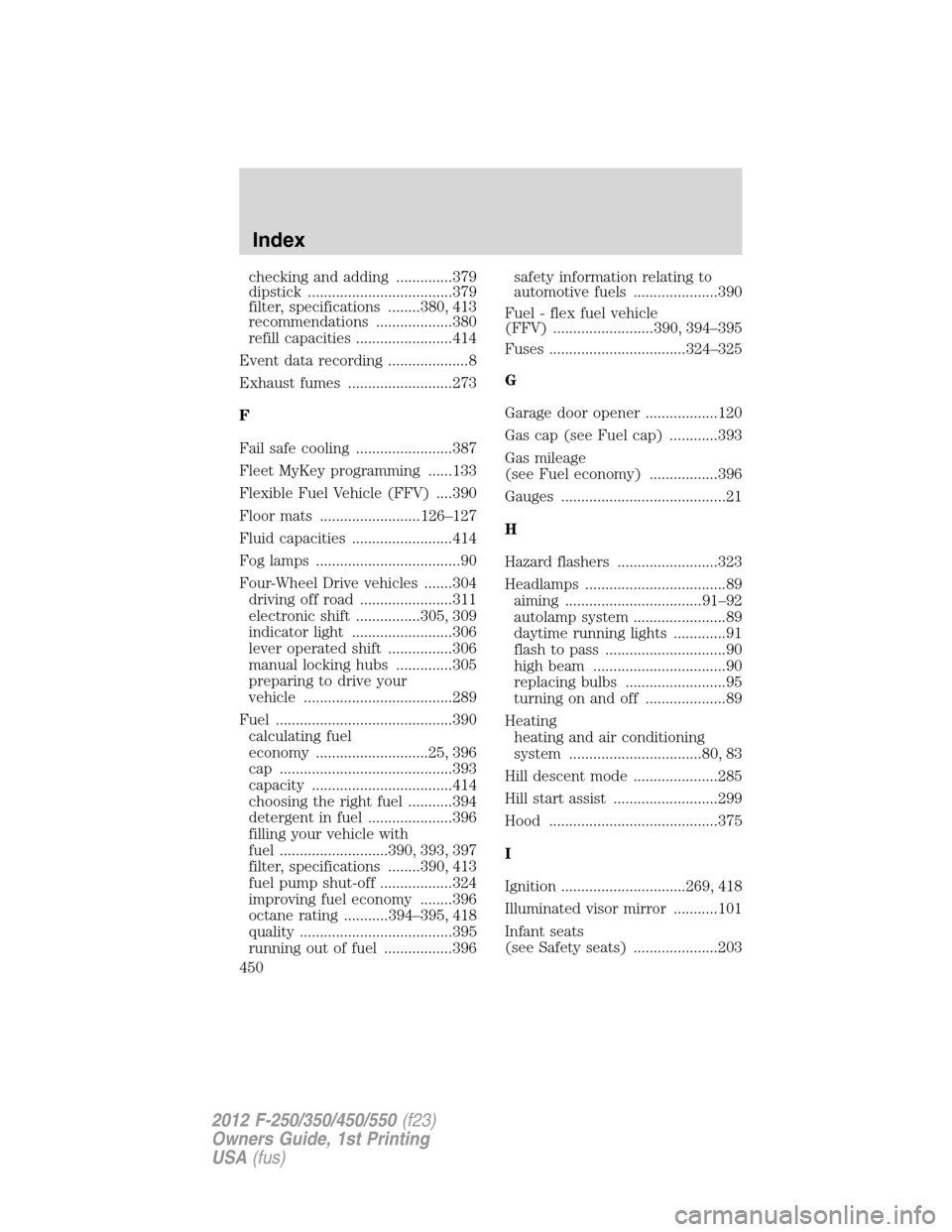
checking and adding ..............379
dipstick ....................................379
filter, specifications ........380, 413
recommendations ...................380
refill capacities ........................414
Event data recording ....................8
Exhaust fumes ..........................273
F
Fail safe cooling ........................387
Fleet MyKey programming ......133
Flexible Fuel Vehicle (FFV) ....390
Floor mats .........................126–127
Fluid capacities .........................414
Fog lamps ....................................90
Four-Wheel Drive vehicles .......304
driving off road .......................311
electronic shift ................305, 309
indicator light .........................306
lever operated shift ................306
manual locking hubs ..............305
preparing to drive your
vehicle .....................................289
Fuel ............................................390
calculating fuel
economy ............................25, 396
cap ...........................................393
capacity ...................................414
choosing the right fuel ...........394
detergent in fuel .....................396
filling your vehicle with
fuel ...........................390, 393, 397
filter, specifications ........390, 413
fuel pump shut-off ..................324
improving fuel economy ........396
octane rating ...........394–395, 418
quality ......................................395
running out of fuel .................396safety information relating to
automotive fuels .....................390
Fuel - flex fuel vehicle
(FFV) .........................390, 394–395
Fuses ..................................324–325
G
Garage door opener ..................120
Gas cap (see Fuel cap) ............393
Gas mileage
(see Fuel economy) .................396
Gauges .........................................21
H
Hazard flashers .........................323
Headlamps ...................................89
aiming ..................................91–92
autolamp system .......................89
daytime running lights .............91
flash to pass ..............................90
high beam .................................90
replacing bulbs .........................95
turning on and off ....................89
Heating
heating and air conditioning
system .................................80, 83
Hill descent mode .....................285
Hill start assist ..........................299
Hood ..........................................375
I
Ignition ...............................269, 418
Illuminated visor mirror ...........101
Infant seats
(see Safety seats) .....................203
Index
450
2012 F-250/350/450/550(f23)
Owners Guide, 1st Printing
USA(fus)