Page 375 of 454
Working with the engine on
WARNING:To reduce the risk of vehicle damage and/or
personal burn injuries, do not start your engine with the air
cleaner removed and do not remove it while the engine is running.
1. Set the parking brake and shift to P (Park).
2. Block the wheels.
OPENING THE HOOD
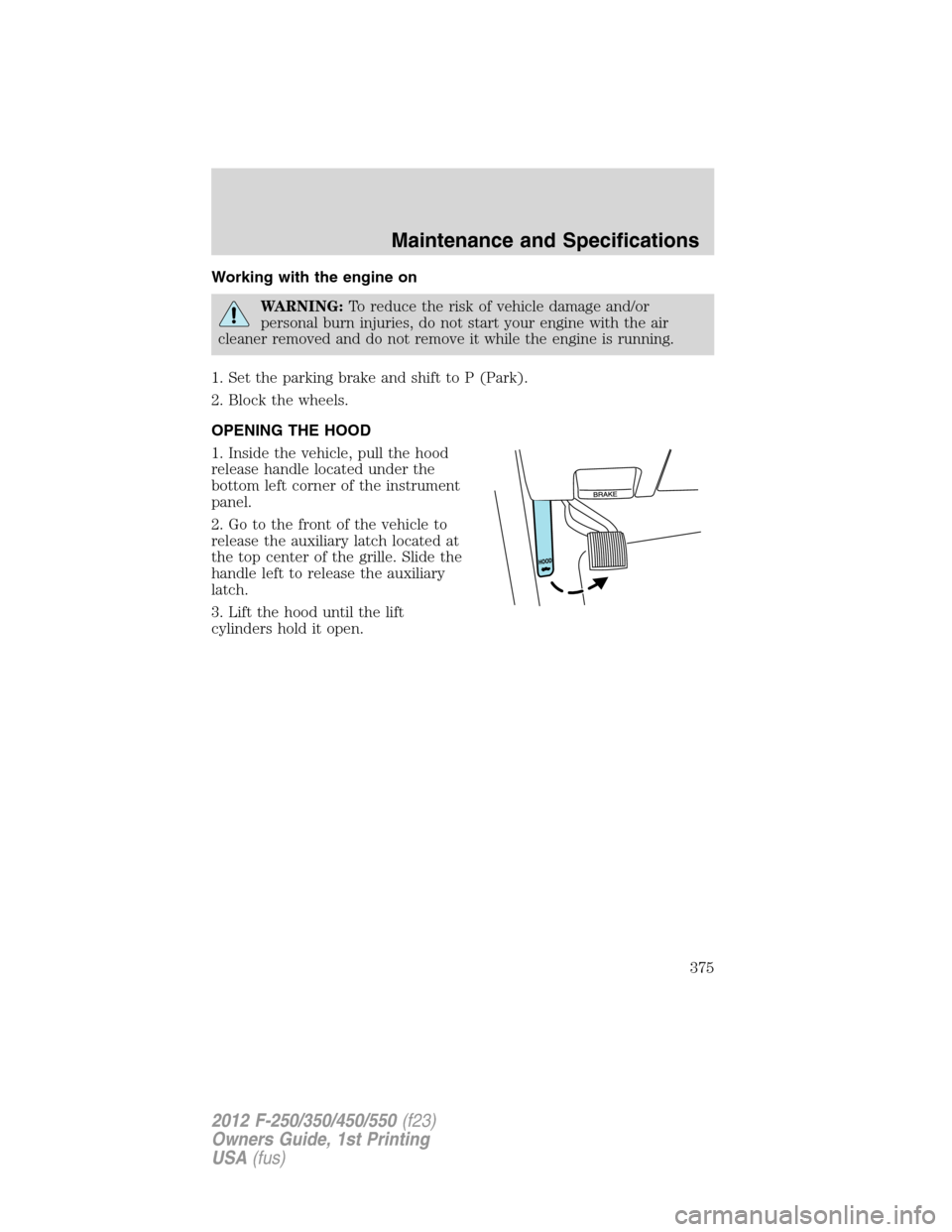
1. Inside the vehicle, pull the hood
release handle located under the
bottom left corner of the instrument
panel.
2. Go to the front of the vehicle to
release the auxiliary latch located at
the top center of the grille. Slide the
handle left to release the auxiliary
latch.
3. Lift the hood until the lift
cylinders hold it open.
Maintenance and Specifications
375
2012 F-250/350/450/550(f23)
Owners Guide, 1st Printing
USA(fus)
Page 376 of 454
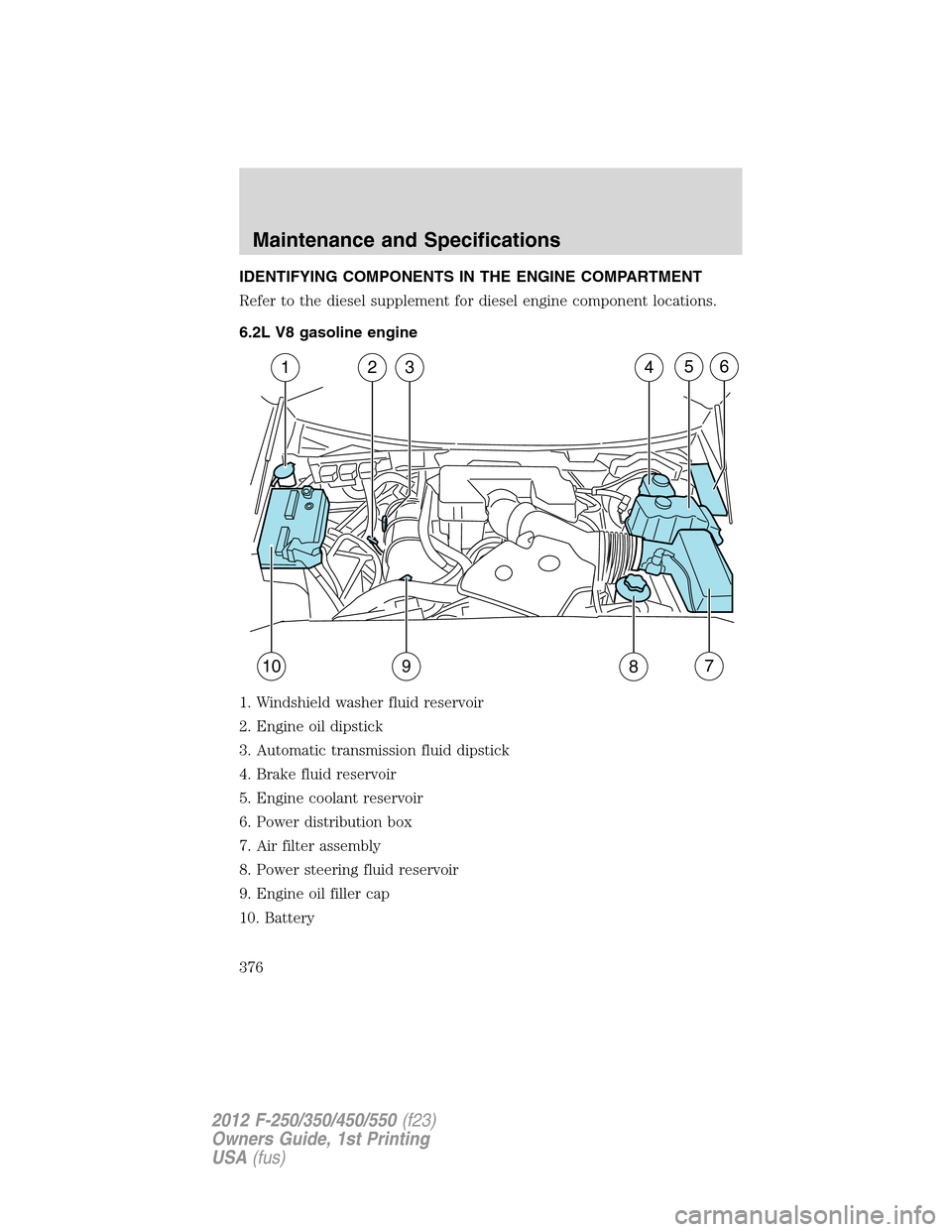
IDENTIFYING COMPONENTS IN THE ENGINE COMPARTMENT
Refer to the diesel supplement for diesel engine component locations.
6.2L V8 gasoline engine
1. Windshield washer fluid reservoir
2. Engine oil dipstick
3. Automatic transmission fluid dipstick
4. Brake fluid reservoir
5. Engine coolant reservoir
6. Power distribution box
7. Air filter assembly
8. Power steering fluid reservoir
9. Engine oil filler cap
10. Battery
123456
10987
Maintenance and Specifications
376
2012 F-250/350/450/550(f23)
Owners Guide, 1st Printing
USA(fus)
Page 377 of 454
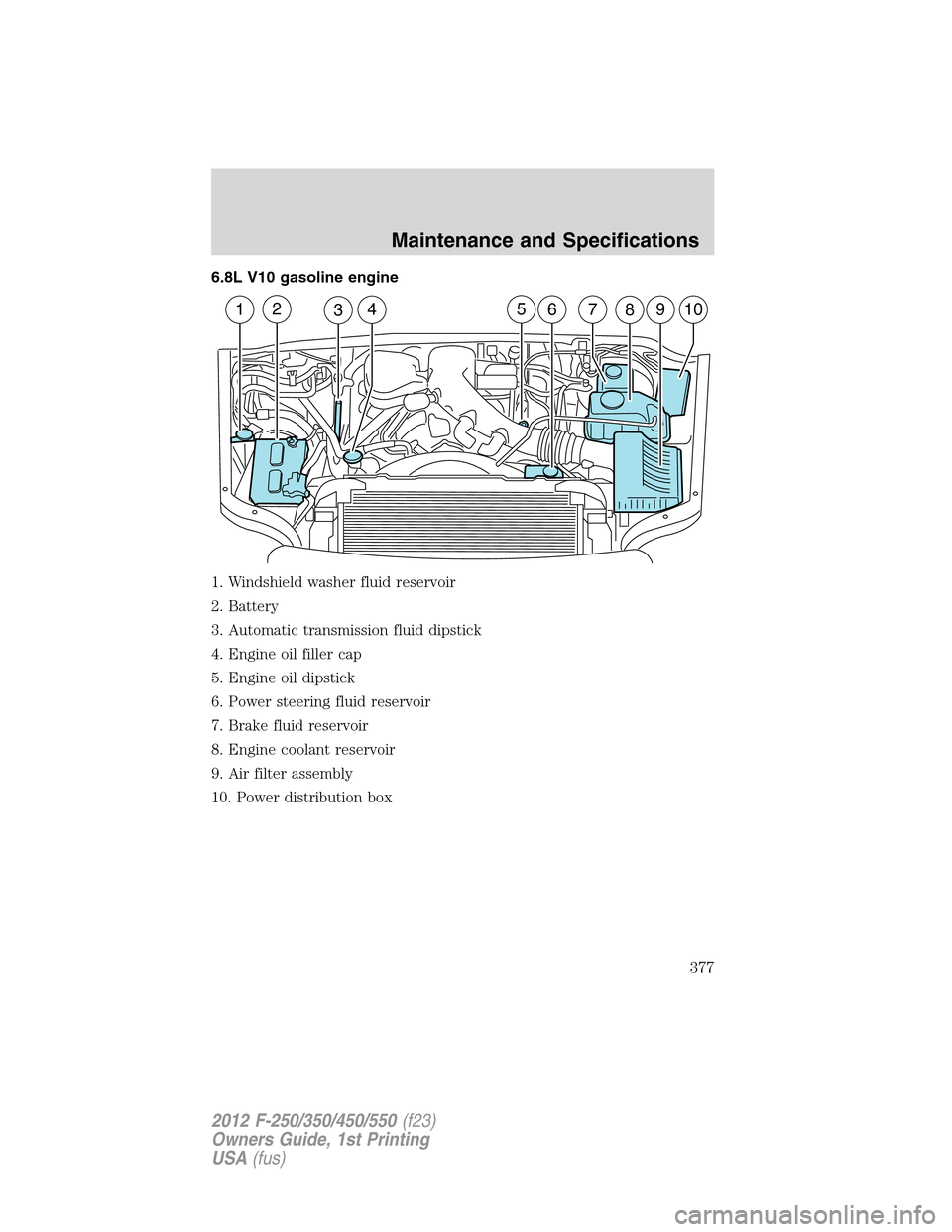
6.8L V10 gasoline engine
1. Windshield washer fluid reservoir
2. Battery
3. Automatic transmission fluid dipstick
4. Engine oil filler cap
5. Engine oil dipstick
6. Power steering fluid reservoir
7. Brake fluid reservoir
8. Engine coolant reservoir
9. Air filter assembly
10. Power distribution box
12356789104
Maintenance and Specifications
377
2012 F-250/350/450/550(f23)
Owners Guide, 1st Printing
USA(fus)
Page 379 of 454
To prolong the life of the wiper blades, it is highly recommended to
scrape off the ice on the windshield before turning on the wipers. The
layer of ice has many sharp edges and can damage the micro edge of the
wiper rubber element.
ENGINE OIL
Checking the engine oil
Refer to thescheduled maintenance informationfor the appropriate
intervals for checking the engine oil.
1. Make sure the vehicle is on level ground.
2. Turn the engine off and wait 15 minutes for the oil to drain into the
oil pan.
3. Set the parking brake and ensure the gearshift is securely latched in P
(Park).
4. Open the hood. Protect yourself from engine heat.
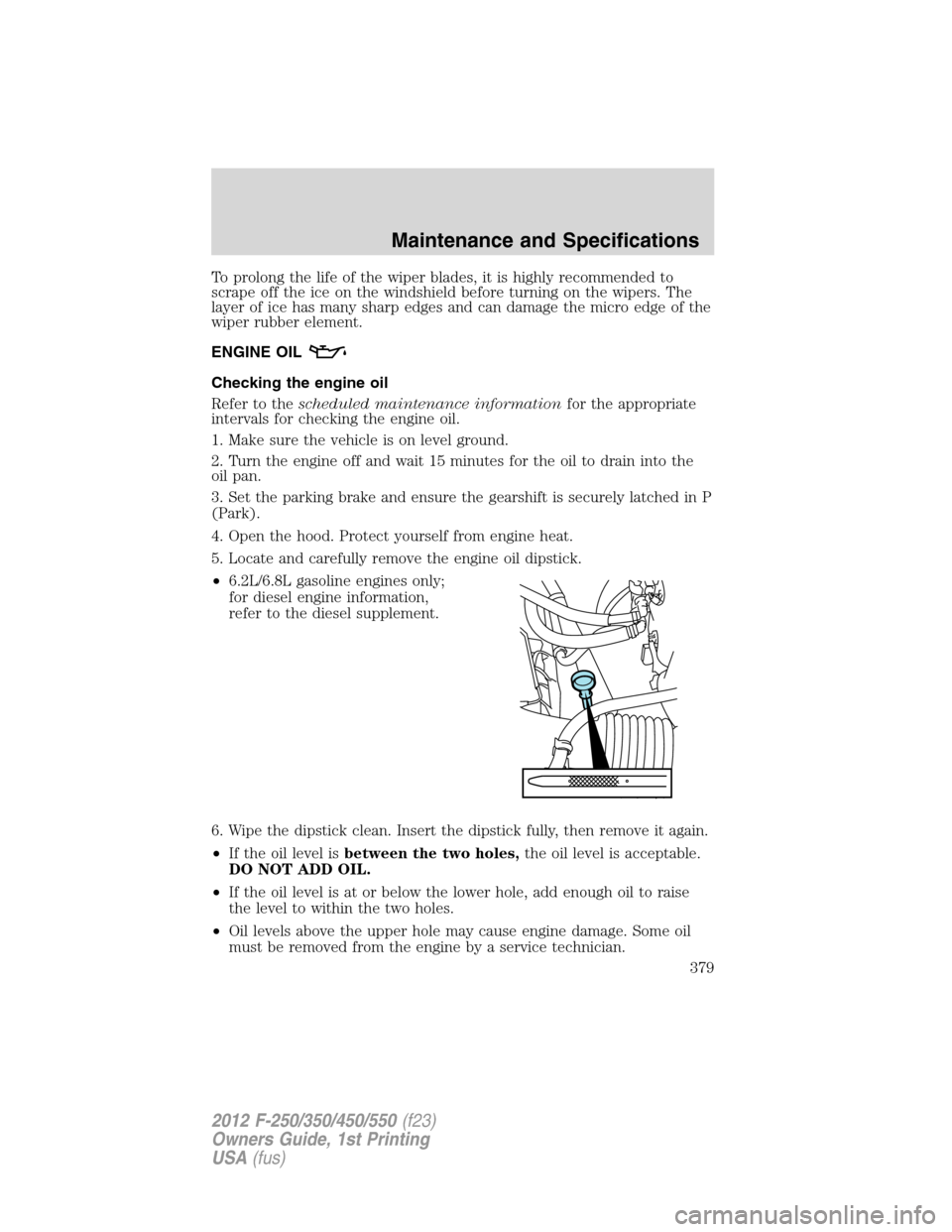
5. Locate and carefully remove the engine oil dipstick.
•6.2L/6.8L gasoline engines only;
for diesel engine information,
refer to the diesel supplement.
6. Wipe the dipstick clean. Insert the dipstick fully, then remove it again.
•If the oil level isbetween the two holes,the oil level is acceptable.
DO NOT ADD OIL.
•If the oil level is at or below the lower hole, add enough oil to raise
the level to within the two holes.
•Oil levels above the upper hole may cause engine damage. Some oil
must be removed from the engine by a service technician.
Maintenance and Specifications
379
2012 F-250/350/450/550(f23)
Owners Guide, 1st Printing
USA(fus)
Page 383 of 454
Because your vehicle’s engine is electronically controlled by a computer,
some control conditions are maintained by power from the battery. When
the battery is disconnected or a new battery is installed, the engine must
relearn its idle and fuel trim strategy for optimum driveability and
performance. To begin this process:
1. With the vehicle at a complete stop, set the parking brake.
2. Put the gearshift in P (Park), turn off all accessories and start the
engine.
3. Run the engine until it reaches normal operating temperature.
4. Allow the engine to idle for at least one minute.
5. Turn the A/C on and allow the engine to idle for at least one minute.
6. Drive the vehicle to complete the relearning process.
•The vehicle may need to be driven 10 miles (16 km) or more to
relearn the idle and fuel trim strategy.
•If you do not allow the engine to relearn its idle trim, the idle
quality of your vehicle may be adversely affected until the idle
trim is eventually relearned.
If the battery has been disconnected or a new battery has been installed,
the clock and radio settings must be reset once the battery is
reconnected.
ENGINE COOLANT
Checking engine coolant
The concentration and level of engine coolant should be checked at the
intervals listed inscheduled maintenance information.The coolant
concentration should be maintained at 50/50 coolant and distilled water.
For best results, coolant concentration should be tested with a
refractometer such as Rotunda tool 300-ROB75240E available from your
dealer. Ford does not recommend the use of hydrometers or coolant test
strips for measuring coolant concentration. The level of coolant should
be maintained at the FULL COLD level or within the COLD FILL RANGE
in the coolant reservoir. If the level falls below, add coolant per the
instructions in theAdding engine coolantsection.
Your vehicle was factory-filled with a 50/50 engine coolant and water
concentration. If the concentration of coolant falls below 40% or above
60%, the engine parts could become damaged or not work properly.A
50/50 mixture of coolant and water provides the following:
•Improved freeze protection.
Maintenance and Specifications
383
2012 F-250/350/450/550(f23)
Owners Guide, 1st Printing
USA(fus)
Page 398 of 454
Calculation 2:Multiply liters used by 100, then divide by total
kilometers traveled.
Keep a record for at least one month and record the type of driving (city
or highway). This will provide an accurate estimate of the vehicle’s fuel
economy under current driving conditions. Additionally, keeping records
during summer and winter will show how temperature impacts fuel
economy. In general, lower temperatures give lower fuel economy.
Driving style — good driving and fuel economy habits
Give consideration to the lists that follow and you may be able to change
a number of variables and improve your fuel economy.
Habits
•Smooth, moderate operation can yield up to 10% savings in fuel.
•Steady speeds without stopping will usually give the best fuel
economy.
•Idling for long periods of time (greater than one minute) may waste
fuel.
•Anticipate stopping; slowing down may eliminate the need to stop.
•Sudden or hard accelerations may reduce fuel economy.
•Slow down gradually.
•Driving at reasonable speeds (traveling at 55 mph [88 km/h] uses 15%
less fuel than traveling at 65 mph [105 km/h]).
•Revving the engine before turning it off may reduce fuel economy.
•Using the air conditioner or defroster may reduce fuel economy.
•You may want to turn off the speed control in hilly terrain if
unnecessary shifting between the top gears occurs. Unnecessary
shifting of this type could result in reduced fuel economy.
•Warming up a vehicle on cold mornings is not required and may
reduce fuel economy.
•Resting your foot on the brake pedal while driving may reduce fuel
economy.
•Combine errands and minimize stop-and-go driving.
Maintenance
•Keep tires properly inflated and use only recommended size.
•Operating a vehicle with the wheels out of alignment will reduce fuel
economy.
Maintenance and Specifications
398
2012 F-250/350/450/550(f23)
Owners Guide, 1st Printing
USA(fus)
Page 403 of 454
2. If the fluid level is low. Add fluid to bring fluid level up to be between
the MIN and MAX range.
3. Start the engine.
4. While the engine idles, turn the steering wheel left and right several
times.
5. Turn the engine off.
6. Recheck the fluid level in the reservoir. Do not add fluid if the level is
between the MIN and MAX range.
7. If the fluid is low, add fluid in small amounts, continuously checking
the level until it is between the MIN and MAX range. Refer to
Maintenance products specifications and capacitiesin this chapter for
the proper fluid type. Be sure to put the cap back on the reservoir.
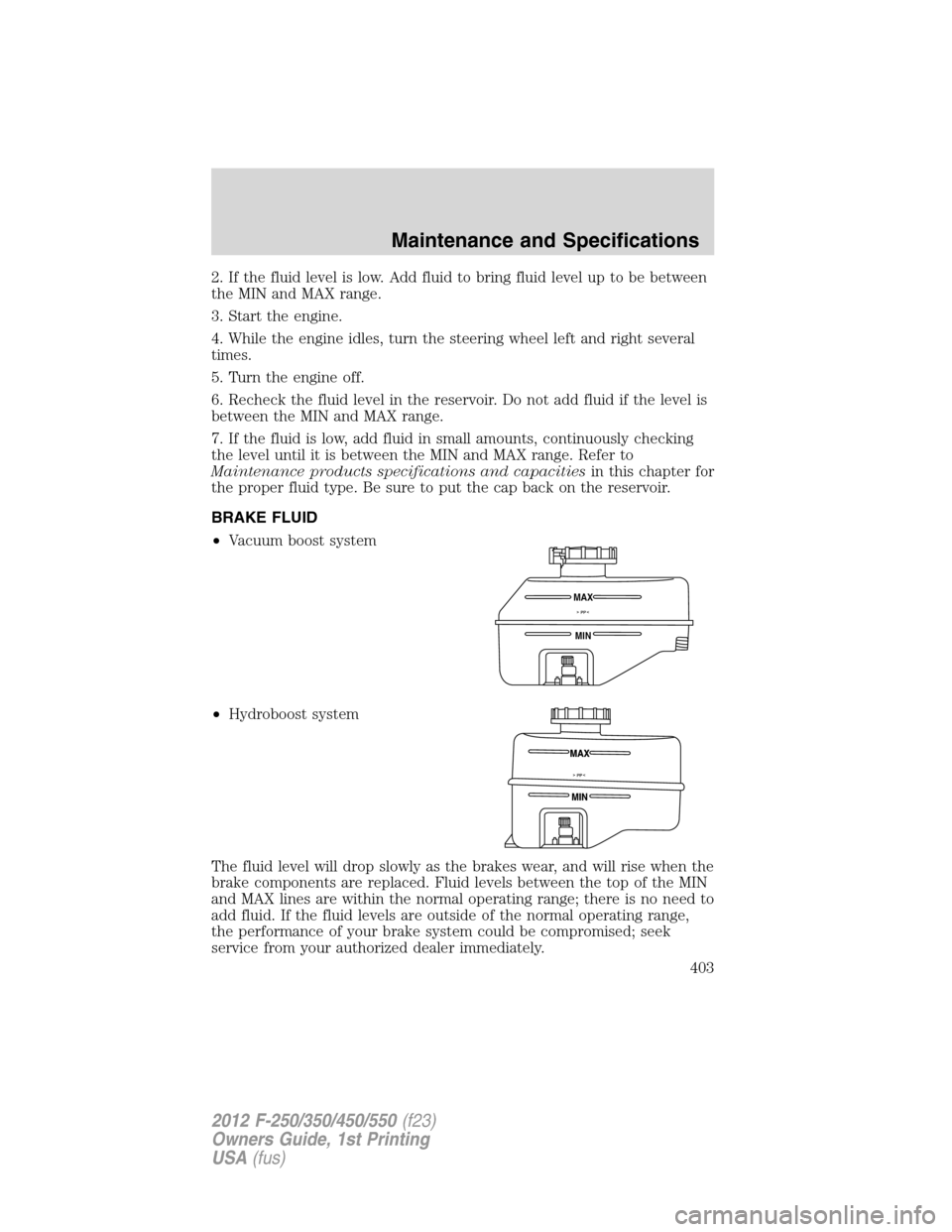
BRAKE FLUID
•Vacuum boost system
•Hydroboost system
The fluid level will drop slowly as the brakes wear, and will rise when the
brake components are replaced. Fluid levels between the top of the MIN
and MAX lines are within the normal operating range; there is no need to
add fluid. If the fluid levels are outside of the normal operating range,
the performance of your brake system could be compromised; seek
service from your authorized dealer immediately.
MIN MAX
Maintenance and Specifications
403
2012 F-250/350/450/550(f23)
Owners Guide, 1st Printing
USA(fus)
Page 404 of 454
TRANSMISSION FLUID
Checking automatic transmission fluid (if equipped)
Refer to yourscheduled maintenance informationfor scheduled
intervals for fluid checks and changes. Your transmission does not
consume fluid. However, the fluid level should be checked if the
transmission is not working properly, i.e., if the transmission slips or
shifts slowly or if you notice some sign of fluid leakage.
Automatic transmission fluid expands when warmed. To obtain an
accurate fluid check, drive the vehicle until it is at normal operating
temperature (approximately 20 miles [30 km]). Verify that the
transmission fluid temperature gauge, located on the instrument cluster,
is within normal range.
1. Drive the vehicle 20 miles (30 km) or until it reaches normal operating
temperature.
2. Park the vehicle on a level surface and engage the parking brake.
3. With the engine running, parking brake engaged and your foot on the
brake pedal, move the gearshift lever through all of the gear ranges.
Allow sufficient time for each gear to engage.
4. Latch the gearshift lever in P (Park) and leave the engine running.
5. Remove the dipstick, wiping it clean with a clean, dry lint free rag. If
necessary, refer toIdentifying components in the engine compartment
in this chapter for the location of the dipstick.
6. Install the dipstick making sure it is fully seated in the filler tube.
7. Remove the dipstick and inspect the fluid level. The fluid should be in
the designated area for normal operating temperature or ambient
temperature.
Your vehicle is equipped with one of the following dipsticks.
Maintenance and Specifications
404
2012 F-250/350/450/550(f23)
Owners Guide, 1st Printing
USA(fus)