Page 213 of 346

If the TCS is activated excessively in a short period of time, the braking
portion of the system may become temporarily disabled to allow the
brakes to cool down. In this situation, the TCS will use only engine
power reduction or transfer to help control the wheels from
over-spinning. When the brakes have cooled down, the system will regain
all features. Anti-lock braking, and ESC are not affected by this condition
and will continue to function during the cool-down period.
The engine traction control and brake traction control system may be
deactivated in certain situations. See theSwitching off AdvanceTrac�
section below.
If you should become stuck in snow or ice or on a very slippery road
surface, try switching the TCS off. This may allow excess wheel spin to
“dig” the vehicle out and enable a successful “rocking” maneuver.
Electronic stability control (ESC)
Electronic stability control (ESC) may enhance your vehicle’s directional
stability during adverse maneuvers, for example when cornering severely
or avoiding objects in the roadway. ESC operates by applying brakes to
one or more of the wheels individually and, if necessary, reducing engine
power if the system detects that the vehicle is about to skid or slide
laterally.
During ESC events, the stability control light in the instrument cluster
will flash.
Certain adverse driving maneuvers may activate the ESC system, which
include but are not limited to:
•Taking a turn too fast
•Maneuvering quickly to avoid an accident, pedestrian or obstacle
•Driving over a patch of ice or other slippery surfaces
•Changing lanes on a snow-rutted road
•Entering a snow-free road from a snow-covered side street, or vice
versa
•Entering a paved road from a gravel road, or vice versa
•Cornering while towing a heavily loaded trailer (refer toTrailer
towingin theTires, Wheels and Loadingchapter).
Switching off AdvanceTrac�
If the vehicle is stuck in snow, mud or sand, and seems to lose engine
power, switching off certain features of the AdvanceTrac�system may be
beneficial because the wheels are allowed to spin. This will restore full
engine power and will enhance momentum through the obstacle.
Driving
213
2012 05+ Mustang(197)
Owners Guide, 1st Printing
USA(fus)
Page 214 of 346
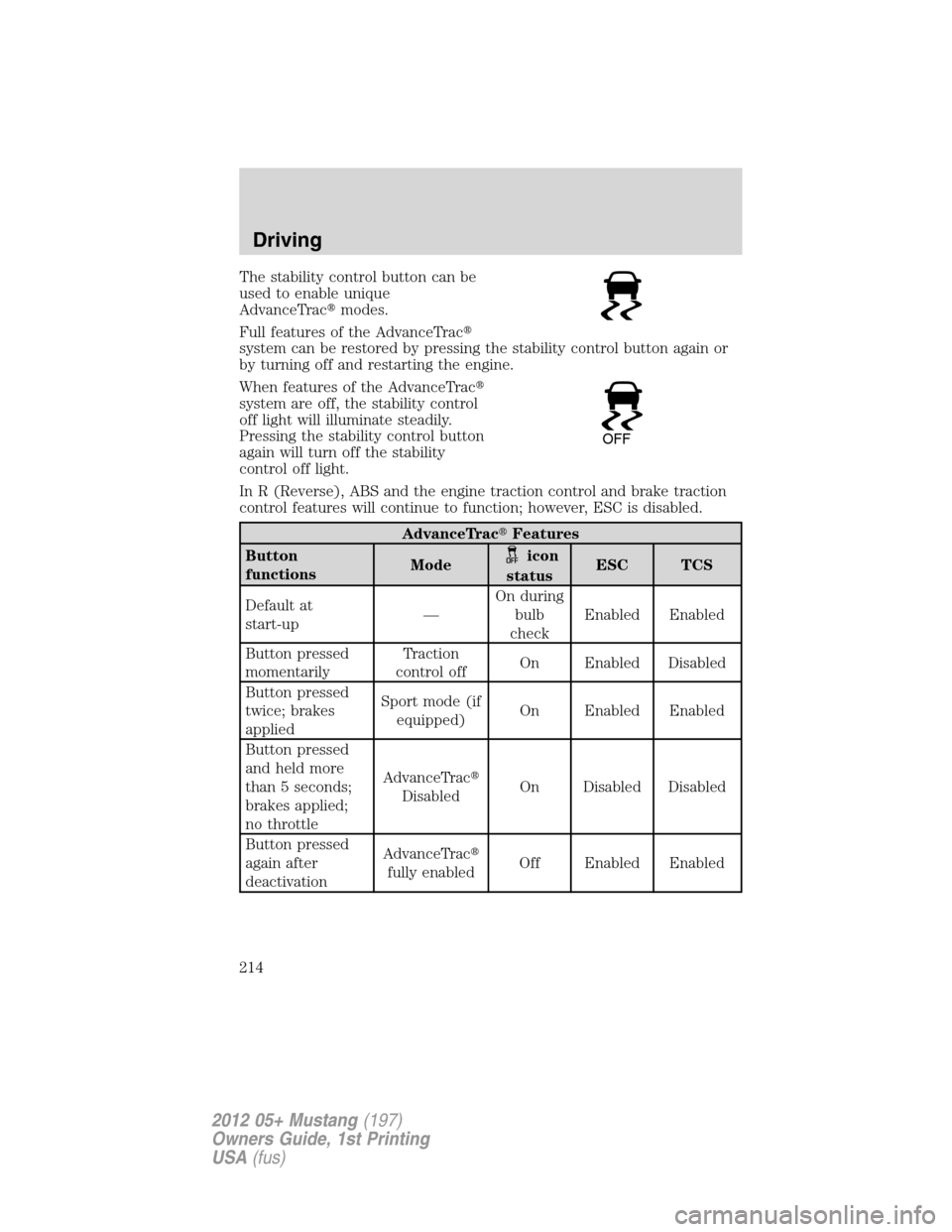
The stability control button can be
used to enable unique
AdvanceTrac�modes.
Full features of the AdvanceTrac�
system can be restored by pressing the stability control button again or
by turning off and restarting the engine.
When features of the AdvanceTrac�
system are off, the stability control
off light will illuminate steadily.
Pressing the stability control button
again will turn off the stability
control off light.
In R (Reverse), ABS and the engine traction control and brake traction
control features will continue to function; however, ESC is disabled.
AdvanceTrac�Features
Button
functionsMode
icon
statusESC TCS
Default at
start-up—On during
bulb
checkEnabled Enabled
Button pressed
momentarilyTraction
control offOn Enabled Disabled
Button pressed
twice; brakes
appliedSport mode (if
equipped)On Enabled Enabled
Button pressed
and held more
than 5 seconds;
brakes applied;
no throttleAdvanceTrac�
DisabledOn Disabled Disabled
Button pressed
again after
deactivationAdvanceTrac�
fully enabledOff Enabled Enabled
OFF
Driving
214
2012 05+ Mustang(197)
Owners Guide, 1st Printing
USA(fus)
Page 215 of 346

AdvanceTrac�Sport Mode (if equipped)
The AdvanceTrac�system provides an available sport mode on some
models. This can be selected utilizing the stability off button as shown in
the table above.
Sport mode is not intended for use on public roadways as this mode
provides less AdvanceTrac�system intervention than when the default
ESC and traction control systems are on. Sport mode will allow more
spirited driving while the AdvanceTrac�system is still enabled.
STEERING
Your vehicle is equipped with an electric power-assisted steering (EPAS)
system. There is no fluid reservoir to check or fill.
If your vehicle loses electrical power while you are driving (or if the
ignition is turned off), you can steer the vehicle manually, but it takes
more effort. Under extreme usage conditions, the steering effort may
increase. This occurs to prevent overheating and permanent damage to
your steering system. If this should occur, you will neither lose the ability
to steer the vehicle manually nor will it cause permanent damage.
Typical steering and driving maneuvers will allow the system to cool and
steering assist will return to normal.
If the steering wanders or pulls, check for:
•an improperly inflated tire.
•uneven tire wear.
•loose or worn suspension components.
•loose or worn steering components.
•improper steering alignment.
A high crown in the road or high crosswinds may also make the steering
seem to wander/pull.
Selectable steering
You can select the desired steering feel through the message center. The
settings are:
•Standard: Default factory setting.
•Sport: Slightly higher effort required for steering with more road force
felt through the steering wheel.
•Comfort: Slightly less effort required for steering with less road force
felt through the steering wheel.
After selecting the desired setting, you may feel a soft feedback bump in
the steering wheel when the changeover occurs.
Driving
215
2012 05+ Mustang(197)
Owners Guide, 1st Printing
USA(fus)
Page 346 of 346

Steering wheel
controls ......................................79
tilting .........................................69
Stereo
6-CD in dash .............................28
CD-MP3 .....................................28
SYNC�..........................................45
T
Temporary mobility kit .............244
Tilt steering wheel ......................69
Tire Pressure Monitoring
System (TPMS)
Tires, Wheels and Loading ....186
Tires ...........................171–172, 239
alignment ................................179
care ..........................................175
changing ..........................239, 241
checking the pressure ............175
inflating ...................................173
label .........................................185
replacing ..................................177
rotating ....................................179
safety practices .......................178
sidewall information ...............180
snow tires and chains ............191
spare tire .................................239
Temporary mobility kit ..........244
terminology .............................172
tire grades ...............................172
treadwear ........................171, 176
Towing .......................................199
recreational towing .................202
trailer towing ..........................199
wrecker ....................................257
Traction Control Sport Mode ...215
Traction-lok rear axle ...............216Transmission
automatic operation ...............218
brake-shift interlock (BSI) ....216
fluid, checking and adding
(automatic) .............................303
fluid, checking and adding
(manual) .................................304
fluid, refill capacities ..............309
lubricant specifications ..........309
manual operation ....................220
Trunk .........................................103
remote release ..................92, 106
Turn signal ..................................59
U
Universal garage door opener ....80
USB port ......................................39
V
Vehicle Identification Number
(VIN) ..........................................313
Vehicle loading ..........................192
Ventilating your vehicle ...........207
Visor storage system ..................70
W
Warning lights (see Lights) .......12
Washer fluid ..............................279
Water, Driving through .............228
Windows
power .........................................73
Windshield washer fluid and
wipers ..........................................68
checking and adding fluid .....279
replacing wiper blades ...........280
Wrecker towing .........................257
Index
346
2012 05+ Mustang(197)
Owners Guide, 1st Printing
USA(fus)