2012 FORD FUSION HYBRID wheel
[x] Cancel search: wheelPage 85 of 347
Replacing tail/brake/turn signal/backup lamp bulbs
The tail/brake/turn signal and backup lamp bulbs are located in the tail
lamp assembly. Follow the same steps to replace either bulb.
1. Make sure the headlamp switch is in the off position and open the
trunk.
2. Lift out trunk floor carpeting panel to access a luggage scuff plate
(hard molding) and a trunk side panel (dark grey, soft wheelhouse side
trim panel) at the lamp area.
3. Carefully pull/push the trunk side panel (dark grey, soft wheelhouse
side trim panel) outboard to expose the lamp assembly. The most
effective point to grasp the trunk side panel when pulling it out from the
luggage scuff plate is at it’s bottom edge where that edge meets the
exposed sheet metal of the trunk floor.
Note:Do not allow the trunk side panel to remain bent and untucked
from the luggage scuff plate (hard molding) for a long period of time.
Doing so may result in permanent deformation.
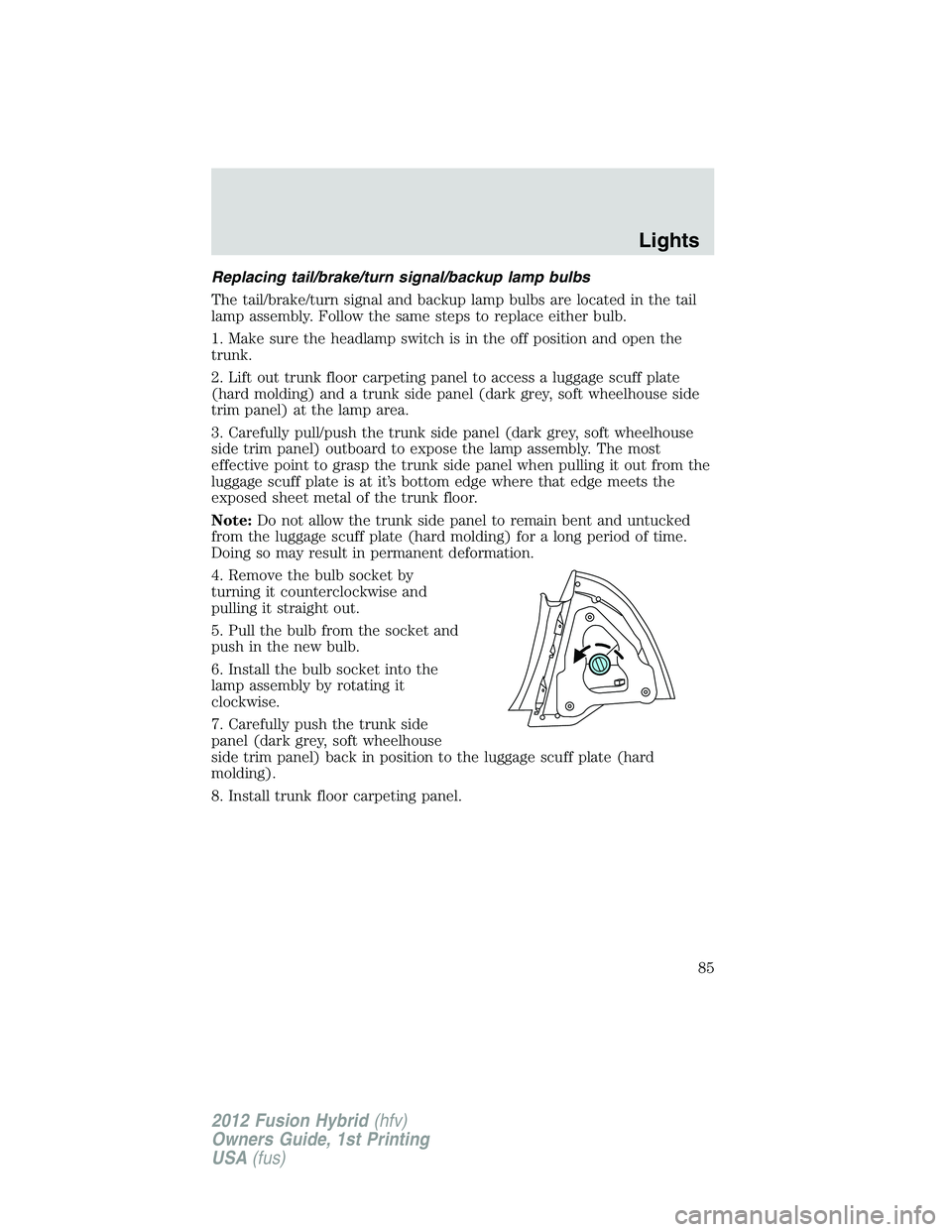
4. Remove the bulb socket by
turning it counterclockwise and
pulling it straight out.
5. Pull the bulb from the socket and
push in the new bulb.
6. Install the bulb socket into the
lamp assembly by rotating it
clockwise.
7. Carefully push the trunk side
panel (dark grey, soft wheelhouse
side trim panel) back in position to the luggage scuff plate (hard
molding).
8. Install trunk floor carpeting panel.
Lights
85
2012 Fusion Hybrid(hfv)
Owners Guide, 1st Printing
USA(fus)
Page 89 of 347
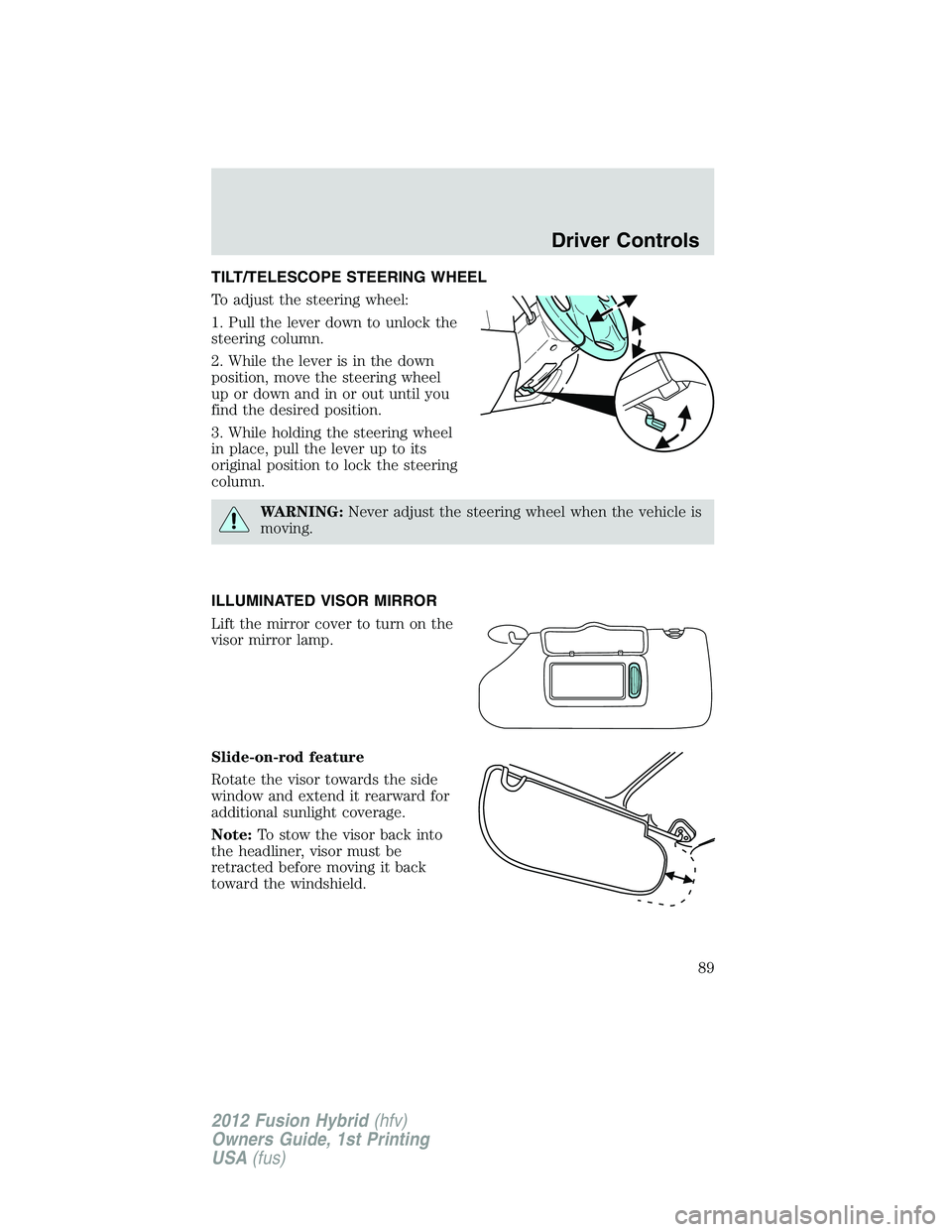
TILT/TELESCOPE STEERING WHEEL
To adjust the steering wheel:
1. Pull the lever down to unlock the
steering column.
2. While the lever is in the down
position, move the steering wheel
up or down and in or out until you
find the desired position.
3. While holding the steering wheel
in place, pull the lever up to its
original position to lock the steering
column.
WARNING:Never adjust the steering wheel when the vehicle is
moving.
ILLUMINATED VISOR MIRROR
Lift the mirror cover to turn on the
visor mirror lamp.
Slide-on-rod feature
Rotate the visor towards the side
window and extend it rearward for
additional sunlight coverage.
Note:To stow the visor back into
the headliner, visor must be
retracted before moving it back
toward the windshield.
Driver Controls
89
2012 Fusion Hybrid(hfv)
Owners Guide, 1st Printing
USA(fus)
Page 99 of 347

Using speed control
The speed controls are located on the steering wheel. The following
buttons work with speed control:
– SET +:Press to increase or
decrease the set speed.
CNCL (Cancel)/RSM (Resume):
Press to cancel or resume a set
speed.
ON/OFF:Press to turn speed
control on or off.
Setting speed control
To set speed control:
1. Press and release ON. The indicator
light on the instrument
cluster will turn on amber.
2. Accelerate to the desired speed.
3. Press and release SET +. The indicator
light on the instrument
cluster will turn green.
4. Take your foot off the accelerator pedal.
Note:
•Vehicle speed may vary momentarily when driving up and down a
steep hill.
•If the vehicle speed increases above the set speed on a downhill, you
may want to select low gear to maintain the set speed or apply the
brakes to reduce the speed.
•If the vehicle speed decreases more than 10 mph (16 km/h) below
your set speed on an uphill, your speed control will disengage.
Disengaging speed control
To disengage speed control, tap the brake pedal or press CNCL. The
indicator
light on the instrument cluster will turn amber.
Disengaging the speed control will not erase the previous set speed.
Resuming a set speed
Press and release RSM. This will automatically return the vehicle to the
previously set speed.
Driver Controls
99
2012 Fusion Hybrid(hfv)
Owners Guide, 1st Printing
USA(fus)
Page 100 of 347
Increasing speed while using speed control
To increase the set speed:
•Press and hold SET + until you get to the desired speed, then release.
You can also use SET + to operate the tap-up function. Press and
release SET + to increase the vehicle set speed in 1 mph (1.6 km/h)
increments.
•Use the accelerator pedal to get to the desired speed then press and
release SET +.
Reducing speed while using speed control
To reduce the set speed:
•Press and hold – SET until you get to the desired speed, then release.
You can also use – SET to operate the tap-down function. Press and
release – SET to decrease the vehicle set speed by 1 mph (1.6 km/h)
increments.
•Press the brake pedal until the desired vehicle speed is reached then
press SET +.
Turning off speed control
To turn off the speed control, press OFF or turn off the ignition.
Note:When you turn off the speed control or the ignition, your speed
control set speed memory is erased.
STEERING WHEEL CONTROLS
Radio control features
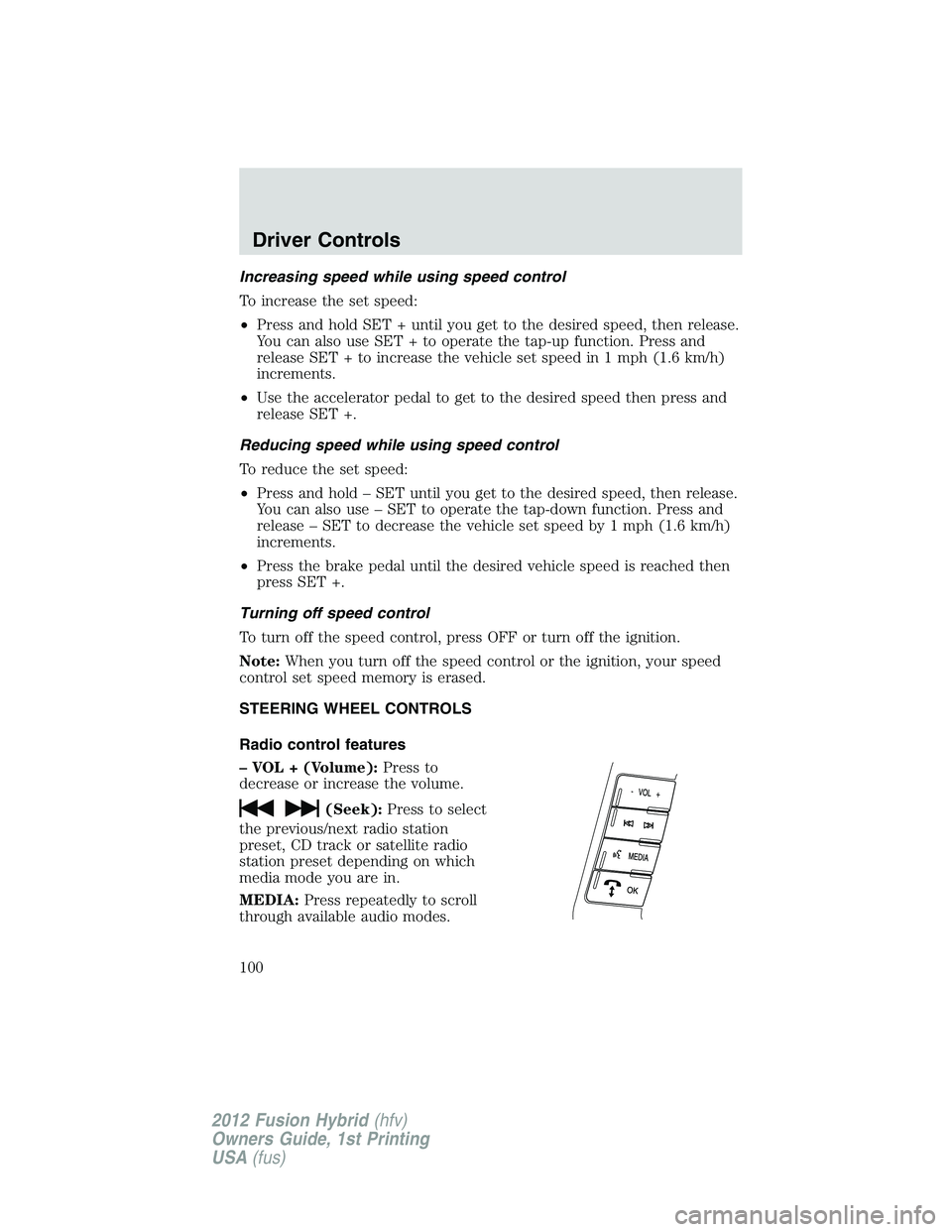
– VOL + (Volume):Press to
decrease or increase the volume.
(Seek):Press to select
the previous/next radio station
preset, CD track or satellite radio
station preset depending on which
media mode you are in.
MEDIA:Press repeatedly to scroll
through available audio modes.
Driver Controls
100
2012 Fusion Hybrid(hfv)
Owners Guide, 1st Printing
USA(fus)
Page 111 of 347
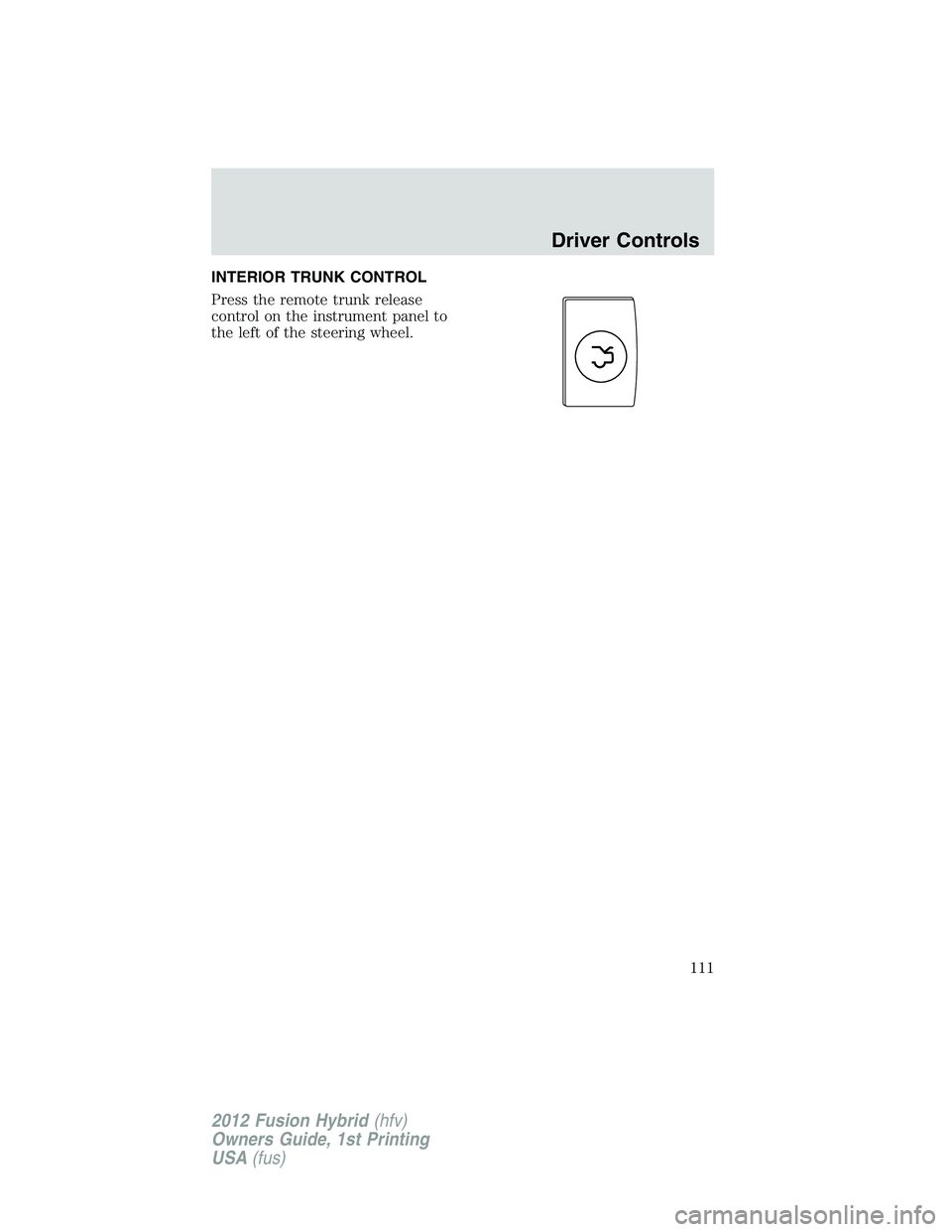
INTERIOR TRUNK CONTROL
Press the remote trunk release
control on the instrument panel to
the left of the steering wheel.
Driver Controls
111
2012 Fusion Hybrid(hfv)
Owners Guide, 1st Printing
USA(fus)
Page 171 of 347

How does the side air-curtain system work?
The design and development of the
side air curtain system included
recommended testing procedures
that were developed by a group of
automotive safety experts known as
the Side Airbag Technical Working
Group. These recommended testing
procedures help reduce the risk of
injuries related to the deployment of
side airbags (including side air
curtain systems).
The side air curtain system consists
of the following:
•An inflatable curtain with a gas
generator concealed behind the
headliner and above the doors.
•The headliner will flex to open
above the side doors to allow air
curtain deployment.
•The same warning light, electronic control and diagnostic unit as used
for the front airbags.
•Two crash sensors located under the outboard side of the front seats,
attached near the floor.
•Two crash sensors located at the base of the “C” pillars above the
wheel house.
Side air curtains and side airbags, in combination with safety belts, can
help reduce the risk of severe injuries in the event of a significant side
impact collision.
Children 12 years old and under should always be properly restrained in
the rear seats. The side air curtain will not interfere with children
restrained using a properly installed child or booster seat because it is
designed to inflate downward from the headliner above the doors along
the side window openings.
The side air curtains are mounted to the sheet metal above the first and
second row seats. In certain lateral collisions, the air curtain and
seat-mounted side airbag on the side affected by the collision will be
inflated, except that the passenger sensing system will deactivate the
passenger seat-mounted side airbag if it detects an empty unbuckled
Seating and Safety Restraints
171
2012 Fusion Hybrid(hfv)
Owners Guide, 1st Printing
USA(fus)
Page 193 of 347

INFORMATION ABOUT UNIFORM TIRE QUALITY GRADING
Tire Quality Grades apply to new
pneumatic passenger car tires. The
Quality grades can be found where
applicable on the tire sidewall
between tread shoulder and
maximum section width. For
example:
•Treadwear 200 Traction AA Temperature A
These Tire Quality Grades are determined by standards that the United
States Department of Transportation has set.
Tire Quality Grades apply to new pneumatic passenger car tires. They do
not apply to deep tread, winter-type snow tires, space-saver or
temporary use spare tires, light truck or “LT” type tires, tires with
nominal rim diameters of 10 to 12 inches or limited production tires as
defined in Title 49 Code of Federal Regulations Part 575.104(c)(2).
U.S. Department of Transportation-Tire quality grades:The U.S.
Department of Transportation requires Ford Motor Company to give you
the following information about tire grades exactly as the government
has written it.
Treadwear
The treadwear grade is a comparative rating based on the wear rate of
the tire when tested under controlled conditions on a specified
government test course. For example, a tire graded 150 would wear one
and one-half (1
12) times as well on the government course as a tire
graded 100. The relative performance of tires depends upon the actual
conditions of their use, however, and may depart significantly from the
norm due to variations in driving habits, service practices, and
differences in road characteristics and climate.
Traction AA A B C
The traction grades, from highest to lowest are AA, A, B, and C. The
grades represent the tire’s ability to stop on wet pavement as measured
under controlled conditions on specified government test surfaces of
asphalt and concrete. A tire marked C may have poor traction
performance.
Tires, Wheels and Loading
193
2012 Fusion Hybrid(hfv)
Owners Guide, 1st Printing
USA(fus)
Page 194 of 347

WARNING:The traction grade assigned to this tire is based on
straight-ahead braking traction tests, and does not include
acceleration, cornering, hydroplaning or peak traction characteristics.
Temperature A B C
The temperature grades are A (the highest), B and C, representing the
tire’s resistance to the generation of heat and its ability to dissipate heat
when tested under controlled conditions on a specified indoor laboratory
test wheel. Sustained high temperature can cause the material of the tire
to degenerate and reduce tire life, and excessive temperature can lead to
sudden tire failure. The grade C corresponds to a level of performance
which all passenger car tires must meet under the Federal Motor Vehicle
Safety Standard No. 139. Grades B and A represent higher levels of
performance on the laboratory test wheel than the minimum required by
law.
WARNING:The temperature grade for this tire is established
for a tire that is properly inflated and not overloaded. Excessive
speed, underinflation, or excessive loading, either separately or in
combination, can cause heat buildup and possible tire failure.
TIRES
Tires are designed to give many thousands of miles of service, but they
must be maintained in order to get the maximum benefit from them.
Glossary of tire terminology
•Tire label:A label showing the OE (Original Equipment) tire sizes,
recommended inflation pressure and the maximum weight the vehicle
can carry.
•Tire Identification Number (TIN):A number on the sidewall of
each tire providing information about the tire brand and
manufacturing plant, tire size and date of manufacture. Also referred
to as DOT code.
•Inflation pressure:A measure of the amount of air in a tire.
•Standard load:A class of P-metric or Metric tires designed to carry a
maximum load at 35 psi [37 psi (2.5 bar) for Metric tires]. Increasing
the inflation pressure beyond this pressure will not increase the tire’s
load carrying capability.
Tires, Wheels and Loading
194
2012 Fusion Hybrid(hfv)
Owners Guide, 1st Printing
USA(fus)