2012 FORD FOCUS trailer
[x] Cancel search: trailerPage 310 of 406
The usage of a full-size dissimilar spare tire/wheel can lead to
impairment of the following:
•Handling, stability and braking performance
•Comfort and noise
•Ground clearance and parking at curbs
•Winter weather driving capability
•Wet weather driving capability
•All-wheel driving capability (if applicable)
•Load leveling adjustment (if applicable)
When driving with the full-size dissimilar spare tire/wheel additional
caution should be given to:
•Towing a trailer
•Driving vehicles equipped with a camper body
•Driving vehicles with a load on the cargo rack
Drive cautiously when using a full-size dissimilar spare tire/wheel and
seek service as soon as possible.
Stopping and securing the vehicle
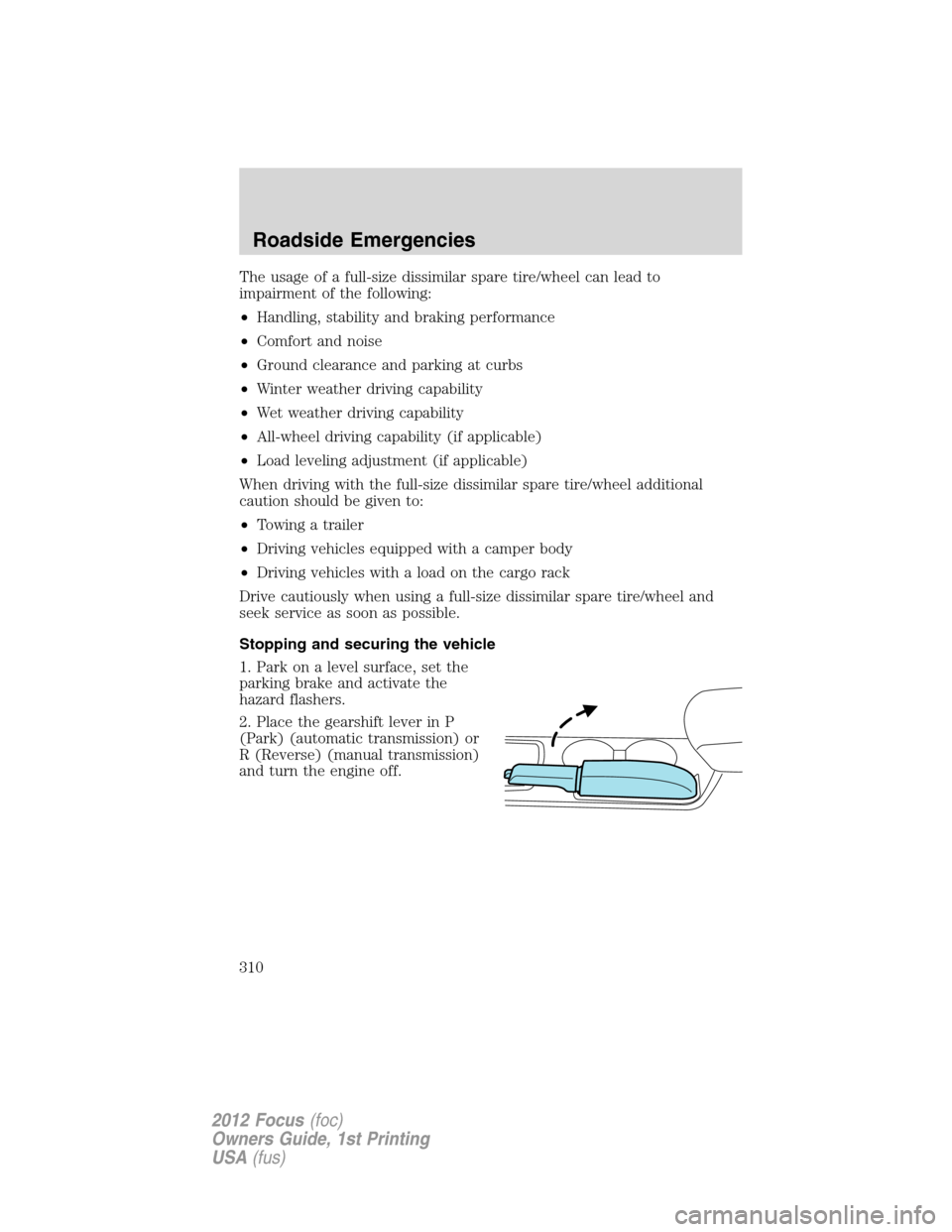
1. Park on a level surface, set the
parking brake and activate the
hazard flashers.
2. Place the gearshift lever in P
(Park) (automatic transmission) or
R (Reverse) (manual transmission)
and turn the engine off.
Roadside Emergencies
310
2012 Focus(foc)
Owners Guide, 1st Printing
USA(fus)
Page 319 of 406
Emergency towing
In case of a roadside emergency with a disabled vehicle (without access
to wheel dollies, car hauling trailer, or flatbed transport vehicle) your
vehicle (regardless of transmission powertrain configuration) can be flat
towed (all wheels on the ground) under the following conditions:
•Vehicle is facing forward so that it is being towed in a forward
direction.
•Place the transmission in N (Neutral). Refer toBrake-shift interlock
in theDrivingchapter for specific instructions if you cannot move the
gear shift lever into N (Neutral).
•Maximum speed is not to exceed 35 mph (56 km/h).
•Maximum distance is 50 miles (80 km).
Roadside Emergencies
319
2012 Focus(foc)
Owners Guide, 1st Printing
USA(fus)
Page 360 of 406

Habits
•Smooth, moderate operation can yield up to 10% savings in fuel.
•Steady speeds without stopping will usually give the best fuel
economy.
•Idling for long periods of time (greater than one minute) may waste
fuel.
•Anticipate stopping; slowing down may eliminate the need to stop.
•Sudden or hard accelerations may reduce fuel economy.
•Slow down gradually.
•Driving at reasonable speeds (traveling at 55 mph [88 km/h] uses 15%
less fuel than traveling at 65 mph [105 km/h]).
•Revving the engine before turning it off may reduce fuel economy.
•Using the air conditioner or defroster may reduce fuel economy.
•You may want to turn off the speed control in hilly terrain if
unnecessary shifting between the top gears occurs. Unnecessary
shifting of this type could result in reduced fuel economy.
•Warming up a vehicle on cold mornings is not required and may
reduce fuel economy.
•Resting your foot on the brake pedal while driving may reduce fuel
economy.
•Combine errands and minimize stop-and-go driving.
Maintenance
•Keep tires properly inflated and use only recommended size.
•Operating a vehicle with the wheels out of alignment will reduce fuel
economy.
•Use recommended engine oil. Refer toMaintenance product
specifications and capacitiesin this chapter.
•Perform all regularly scheduled maintenance items. Follow the
recommended maintenance schedule and owner maintenance checks
found inscheduled maintenance information.
Conditions
•Heavily loading a vehicle or towing a trailer may reduce fuel economy
at any speed.
•Carrying unnecessary weight may reduce fuel economy (approximately
1 mpg [0.4 km/L] is lost for every 400 lb [180 kg] of weight carried).
Maintenance and Specifications
360
2012 Focus(foc)
Owners Guide, 1st Printing
USA(fus)
Page 393 of 406
SPECIAL OPERATING CONDITIONS
If you operate your vehicleprimarilyin any of the following conditions,
you need to perform additional maintenance as indicated. If you
occasionallyoperate your vehicle under any of these conditions, it is
not necessary to perform the additional maintenance. For specific
recommendations, see your dealership service advisor or technician.
Towing a trailer or using a camper or car-top carrier
As required Change engine oil and filter as indicated by
message center and perform services listed in
Normal Scheduled Maintenance chart
Inspect frequently,
service as requiredInspect and lubricate U-joints
See axle maintenance items underExceptions
Every 30,000 miles
(48,000 km)Change automatic transmission fluid (except
6R80 transmission)
Every 60,000 miles
(96,000 km)Change manual transmission fluid
Change transfer case fluid (4WD trucks)
Perform the services in the preceding table when specified or within
3,000 miles (4,800 km) of the OIL CHANGE REQUIRED message
appearing in the message center.
Example #1:The OIL CHANGE REQUIRED message comes on at
28,751 miles (46,270 km); perform the 30,000 mile (48,000 km)
automatic transmission fluid replacement.
Example #2:The OIL CHANGE REQUIRED message hasnotcome on
but the odometer reads 30,000 miles (48,000 km); perform the engine air
filter replacement. (i.e., Intelligent Oil Life Monitor™ was reset at
25,000 miles [40,000 km].)
Scheduled Maintenance
393
2012 Focus(foc)
Owners Guide, 1st Printing
USA(fus)
Page 398 of 406

EXCEPTIONS
There are several exceptions to the Normal Schedule. They are listed below:
Normal vehicle axle maintenance:Rear axles and power take-off
(PTO) units with synthetic fluid and light-duty trucks equipped with
Ford-design axles are lubricated for life; do not check or change fluid
unless a leak is suspected, service is required or the assembly has been
submerged in water. During long periods of trailer towing with outside
temperatures above 70°F (21°C) and at wide-open throttle for long
periods above 45 mph (72 km/h), non-synthetic rear axle fluids should
be changed every 3,000 miles (4,800 km) or three months, whichever
comes first. This interval can be waived if the axle is filled with 75W140
synthetic gear fluid meeting Ford specification WSL-M2C192-A, part
number F1TZ-19580-B or equivalent. Add friction modifier XL-3
(EST-M2C118-A) or equivalent for complete refill of Traction-Lok rear
axles (refer toMaintenance product specifications and capacitiesin
theMaintenance and Specificationschapter for details).
Police/Taxi/Livery vehicle axle maintenance:Change rear axle fluid
every 100,000 miles (160,000 km). Rear axle fluid change may be waived
if the axle was filled with 75W140 synthetic gear fluid meeting Ford
specification WSL-M2C192-A, part number FITZ-19580-B or equivalent.
Add four ounces (118 mL) of additive friction modifier XL-3
(EST-M2C118-A) or equivalent for complete refill of Traction-Lok rear
axles. The axle fluid should be changed anytime the axle has been
submerged in water
California fuel filter replacement:If the vehicle is registered in
California, the California Air Resources Board has determined that the
failure to perform this maintenance item will not nullify the emission
warranty or limit recall liability prior to the completion of the vehicle’s
useful life. Ford Motor Company, however, urges you to have all
recommended maintenance services performed at the specified intervals
and to record all vehicle service.
Class A Motorhome:Change brake fluid every two years.
Hot climate oil change intervals:If operating conditions are normal
and you drive your vehicle under typical, everyday conditionsandyou
are using an API performance category oil of SL or later (for example
SM, etc.) then you can follow the 7,500 mile (12,000 km) normal service
oil change intervals schedule. Vehicles operating in the Middle East,
North Africa, Sub-Saharan Africa or locations with similar climates must
follow the oil change interval of 3,000 mile (4,800 km) if the owner is
using oils defined by the American Petroleum Institute (API)
performance category of API SK or earlier (for example SJ, etc).
Scheduled Maintenance
398
2012 Focus(foc)
Owners Guide, 1st Printing
USA(fus)
Page 406 of 406
terminology .............................230
tire grades ...............................229
treadwear ........................229, 233
Towing .......................................255
recreational towing .................255
trailer towing ..........................255
wrecker ....................................318
Traffic, Directions and
Information ..................................81
Transmission
automatic operation ...............274
brake-shift interlock (BSI) ....272
fluid, checking and adding
(automatic) .............................364
fluid, checking and adding
(manual) .................................365
fluid, refill capacities ..............369
lubricant specifications ..........369
manual operation ....................278
Trunk
remote release ........................165
Turn signal ................................126
U
Universal garage door opener ..146
USB port ......................................51
Using privacy mode ....................68V
Vehicle health report ..................86
Vehicle Identification Number
(VIN) ..........................................374
Vehicle loading ..........................249
Ventilating your vehicle ...........264
Voice commands in media
mode ............................................90
Voice commands in phone
mode ............................................65
W
Warning lights (see Lights) .......12
Washer fluid ..............................338
Water, Driving through .............295
Windows
power .......................................137
rear wiper/washer ...................135
Windshield washer fluid and
wipers
checking and adding fluid .....338
operation .................................134
replacing wiper blades ...339–340
Wrecker towing .........................318
Index
406
2012 Focus(foc)
Owners Guide, 1st Printing
USA(fus)