Page 2 of 306
Seating and Safety Restraints 69
Seating 69
Rear seats 78
Safety restraints 80
Child restraints 89
Driving 103
Starting 103
Brakes 110
Air suspension 129
Transmission operation 132
Vehicle loading 146
Roadside Emergencies 152
Hazard flasher switch 153
Fuses and relays 153
Jump starting 162
Wrecker towing 166
Customer Assistance 170
Getting assistance outside the U.S. and Canada 172
Reporting safety defects (U.S. only) 174
Reporting safety defects (Canada only) 174
Cleaning 175
Underbody preservation 179
Maintenance and Specifications 181
Hood 189
Engine oil 192
Battery 195
Engine coolant 197
Fuel information 204
Diesel Exhaust Fluid (DEF) 210
Wheel lug nut torque 237
Tire information 238
Lubricant specifications 245
Refill capacities 259
Engine data 262
Table of Contents
2
2012 F-650/750(f67)
Supplement, 2nd Printing
USA(fus)
Page 48 of 306
Recirculated air engages automatically when MAX A/C is selected or can
be engaged manually in any airflow mode except
(defrost). When
the ignition switch is turned off and back on, the climate system returns
to the recirculated air mode only if the A/C button LED is illuminated
and the air distribution selection is either
(panel) or
(panel/floor).
6.MAX A/C (if equipped):Distributes recirculated air through the
instrument panel vents to cool the vehicle. This re-cooling of the interior
air is more economical and efficient than normal A/C mode. Recirculated
air may also help reduce undesirable odors from entering the vehicle.
Press the MAX A/C button again for normal A/C operation.
7.Temperature control:Controls the temperature of the airflow in the
vehicle.
8.
Fan speed adjustment:Controls the volume of air circulated in
the vehicle.
9.
Power:Press to activate/deactivate the climate control system.
When the system is off, outside air is prevented from entering the
vehicle.
Operating tips
•To reduce fog build-up on the windshield during humid weather,
select
(defrost) or(floor/defrost). Temperature and/or fan
speed can also be increased to improve clearing.
•To reduce humidity build-up inside the vehicle: do not drive with the
system off or with recirculated air engaged and A/C off.
•Do not put objects under the front seats that will interfere with the
airflow to the back seats.
•Remove any snow, ice or leaves from the air intake area at the base of
the windshield.
•To improve the A/C cool down, drive with the windows slightly open
for 2-3 minutes after start up or until the vehicle has been “aired out.”
•A small amount of air may be felt from the floor vent regardless of the
air distribution setting that is selected.
If you are driving during extreme high ambient temperatures and idling
for extended periods of time in gear, it is recommended to run the A/C
in the MAX A/C position, adjust the blower fan speed to the lowest
setting and put the vehicle’s transmission into the P (Park) position to
continue to receive cool air from your A/C system.
Climate Controls
48
2012 F-650/750(f67)
Supplement, 2nd Printing
USA(fus)
Page 69 of 306
FRONT SEATS
WARNING:Reclining the seatback can cause an occupant to
slide under the seat’s safety belt, resulting in severe personal
injuries in the event of a collision.
WARNING:Do not pile cargo higher than the seatbacks to
reduce the risk of injury in a collision or sudden stop.
WARNING:Before returning the seatback to its original
position, make sure that cargo or any objects are not trapped
behind the seatback. After returning the seatback to its original
position, pull on the seatback to ensure that it has fully latched. An
unlatched seat may become dangerous in the event of a sudden stop or
collision.
WARNING:Never adjust the driver’s seat or seatback when the
vehicle is moving.
WARNING:Always drive and ride with your seatback upright
and the lap belt snug and low across the hips.
Adjustable head restraints (if equipped)
Your vehicle is equipped with front row outboard head restraints that are
vertically adjustable.
WARNING:To minimize the risk of neck injury in the event of a
crash, the driver and passenger occupants should not sit in
and/or operate the vehicle, until the head restraint is placed in its
proper position. The driver should never adjust the head restraint
while the vehicle is in motion.
Seating and Safety Restraints
69
2012 F-650/750(f67)
Supplement, 2nd Printing
USA(fus)
Page 73 of 306
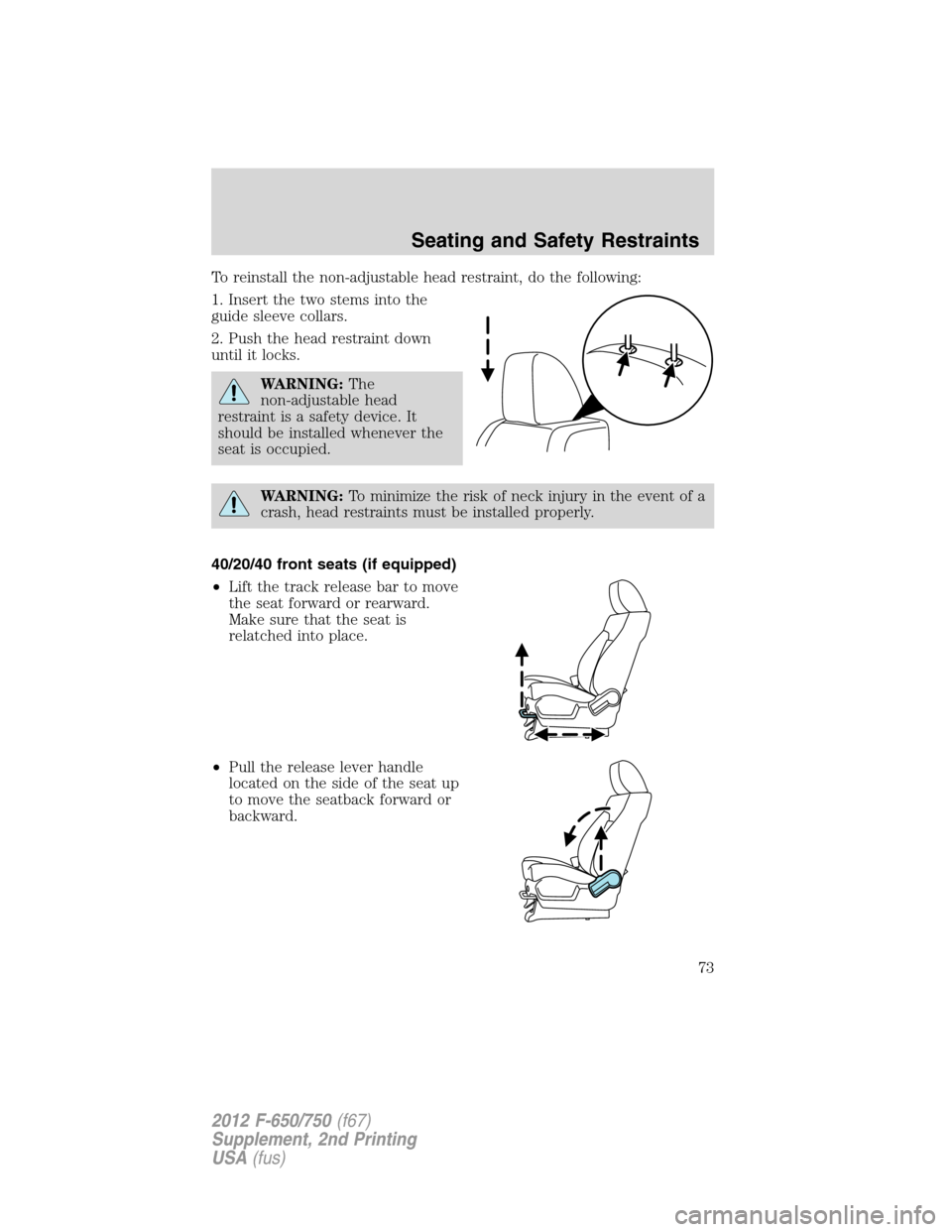
To reinstall the non-adjustable head restraint, do the following:
1. Insert the two stems into the
guide sleeve collars.
2. Push the head restraint down
until it locks.
WARNING:The
non-adjustable head
restraint is a safety device. It
should be installed whenever the
seat is occupied.
WARNING:To minimize the risk of neck injury in the event of a
crash, head restraints must be installed properly.
40/20/40 front seats (if equipped)
•Lift the track release bar to move
the seat forward or rearward.
Make sure that the seat is
relatched into place.
•Pull the release lever handle
located on the side of the seat up
to move the seatback forward or
backward.
Seating and Safety Restraints
73
2012 F-650/750(f67)
Supplement, 2nd Printing
USA(fus)
Page 76 of 306
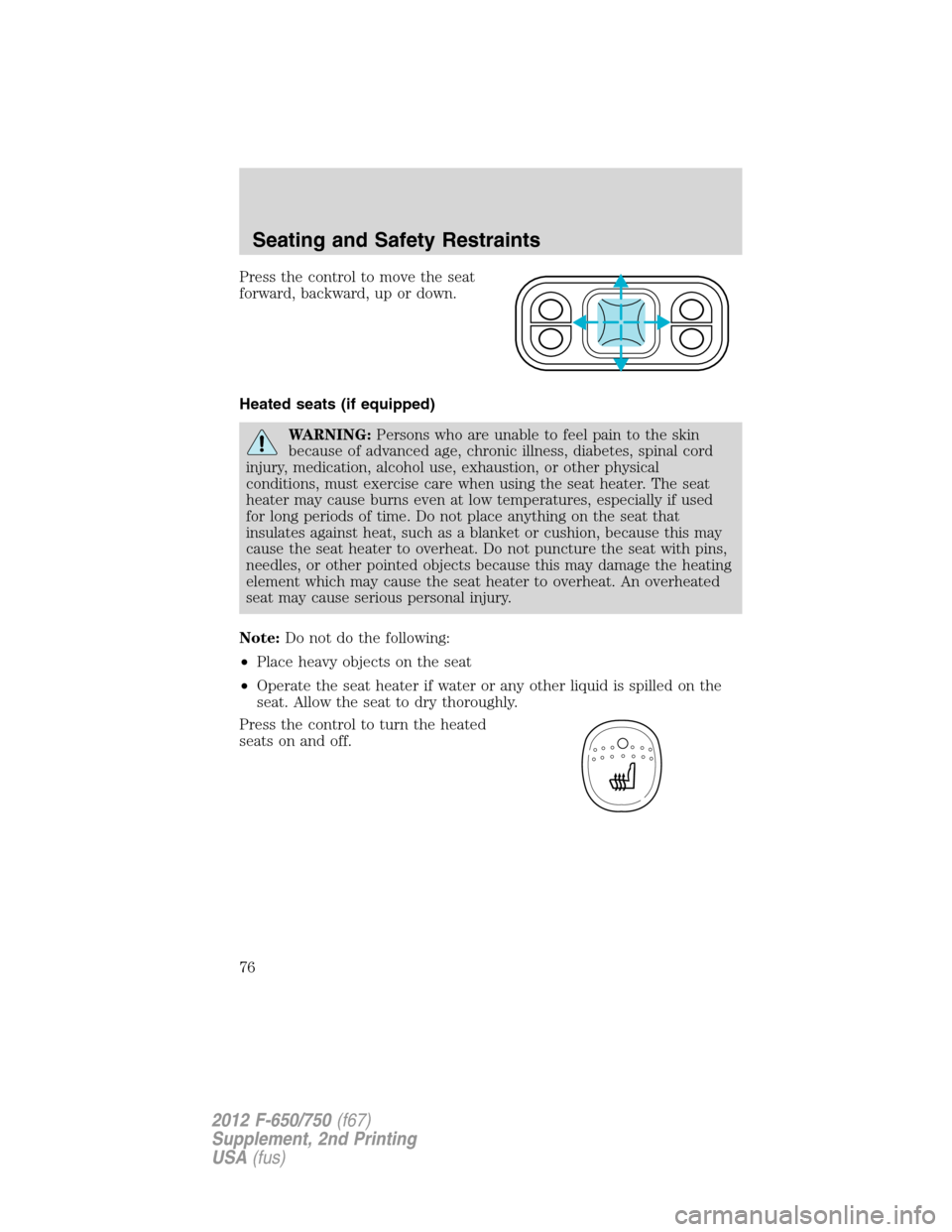
Press the control to move the seat
forward, backward, up or down.
Heated seats (if equipped)
WARNING:Persons who are unable to feel pain to the skin
because of advanced age, chronic illness, diabetes, spinal cord
injury, medication, alcohol use, exhaustion, or other physical
conditions, must exercise care when using the seat heater. The seat
heater may cause burns even at low temperatures, especially if used
for long periods of time. Do not place anything on the seat that
insulates against heat, such as a blanket or cushion, because this may
cause the seat heater to overheat. Do not puncture the seat with pins,
needles, or other pointed objects because this may damage the heating
element which may cause the seat heater to overheat. An overheated
seat may cause serious personal injury.
Note:Do not do the following:
•Place heavy objects on the seat
•Operate the seat heater if water or any other liquid is spilled on the
seat. Allow the seat to dry thoroughly.
Press the control to turn the heated
seats on and off.
Seating and Safety Restraints
76
2012 F-650/750(f67)
Supplement, 2nd Printing
USA(fus)
Page 78 of 306
REAR SEATS
Non-adjustable second-row head restraints
Your vehicle is equipped with second row outboard head restraints that
are non-adjustable.
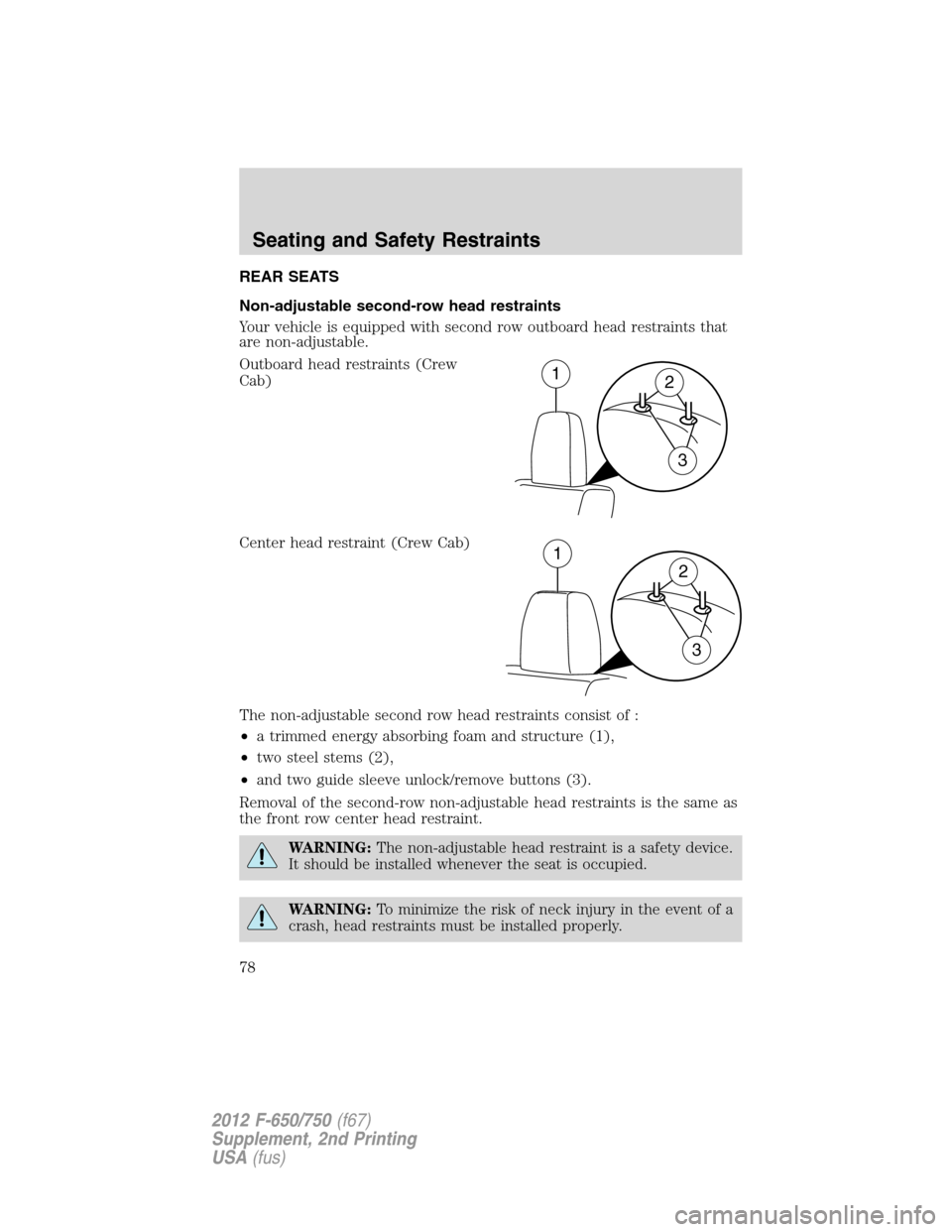
Outboard head restraints (Crew
Cab)
Center head restraint (Crew Cab)
The non-adjustable second row head restraints consist of :
•a trimmed energy absorbing foam and structure (1),
•two steel stems (2),
•and two guide sleeve unlock/remove buttons (3).
Removal of the second-row non-adjustable head restraints is the same as
the front row center head restraint.
WARNING:The non-adjustable head restraint is a safety device.
It should be installed whenever the seat is occupied.
WARNING:To minimize the risk of neck injury in the event of a
crash, head restraints must be installed properly.
12
3
1
2
3
Seating and Safety Restraints
78
2012 F-650/750(f67)
Supplement, 2nd Printing
USA(fus)
Page 79 of 306
Note:The SuperCab has rear outboard head restraints that are not
removable and are bolted to the back wall.
Rear flip-up seat (if equipped)
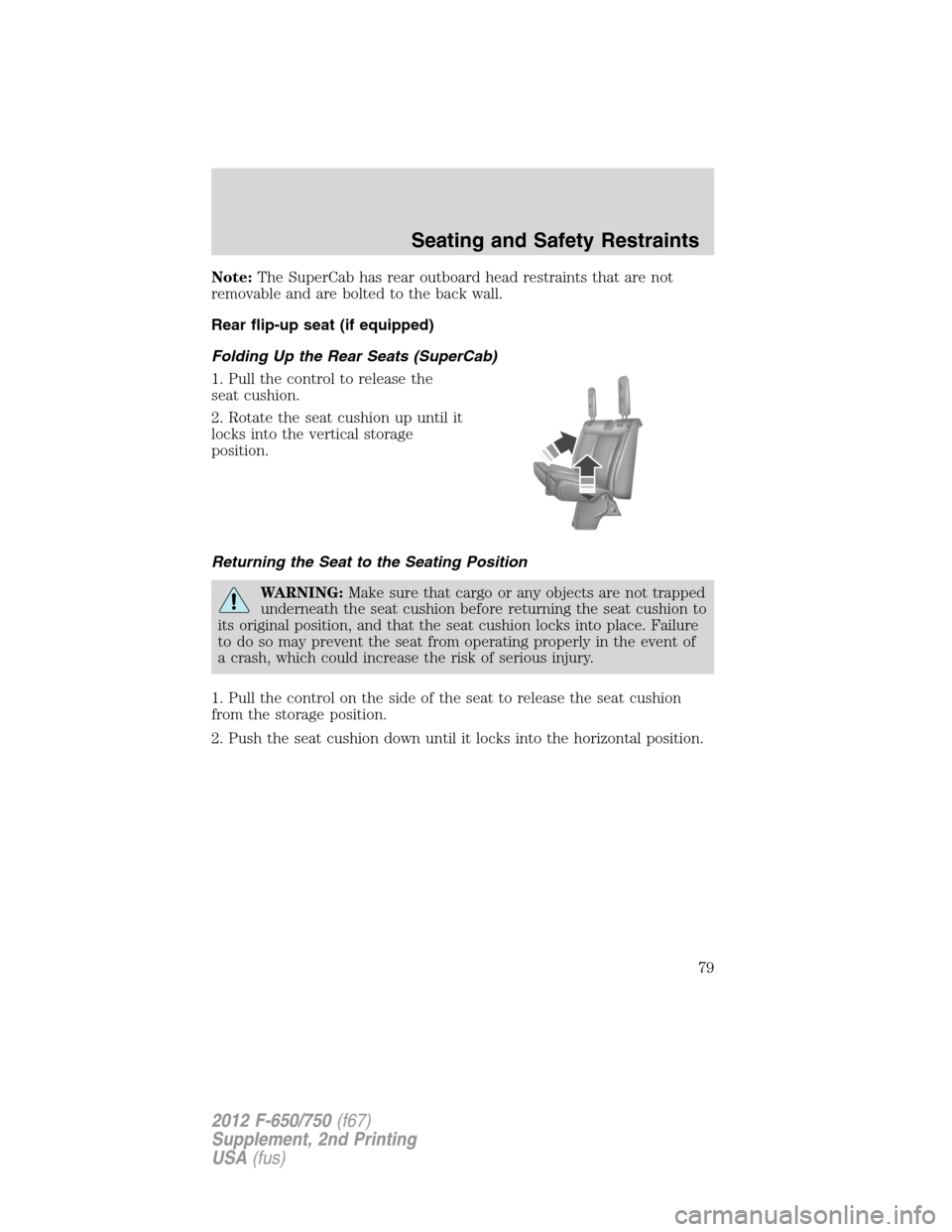
Folding Up the Rear Seats (SuperCab)
1. Pull the control to release the
seat cushion.
2. Rotate the seat cushion up until it
locks into the vertical storage
position.
Returning the Seat to the Seating Position
WARNING:Make sure that cargo or any objects are not trapped
underneath the seat cushion before returning the seat cushion to
its original position, and that the seat cushion locks into place. Failure
to do so may prevent the seat from operating properly in the event of
a crash, which could increase the risk of serious injury.
1. Pull the control on the side of the seat to release the seat cushion
from the storage position.
2. Push the seat cushion down until it locks into the horizontal position.
Seating and Safety Restraints
79
2012 F-650/750(f67)
Supplement, 2nd Printing
USA(fus)
Page 81 of 306
WARNING:Never let a passenger hold a child on his or her lap
while the vehicle is moving. The passenger cannot protect the
child from injury in a collision.
WARNING:It is extremely dangerous to ride in a cargo area,
inside or outside of a vehicle. In a collision, people riding in
these areas are more likely to be seriously injured or killed. Do not
allow people to ride in any area of your vehicle that is not equipped
with seats and safety belts. Be sure everyone in your vehicle is in a
seat and using a safety belt properly.
WARNING:In a rollover crash, an unbelted person is
significantly more likely to die than a person wearing a safety
belt.
WARNING:Each seating position in your vehicle has a specific
safety belt assembly which is made up of one buckle and one
tongue that are designed to be used as a pair. 1) Use the shoulder belt
on the outside shoulder only. Never wear the shoulder belt under the
arm. 2) Never swing the safety belt around your neck over the inside
shoulder. 3) Never use a single belt for more than one person.
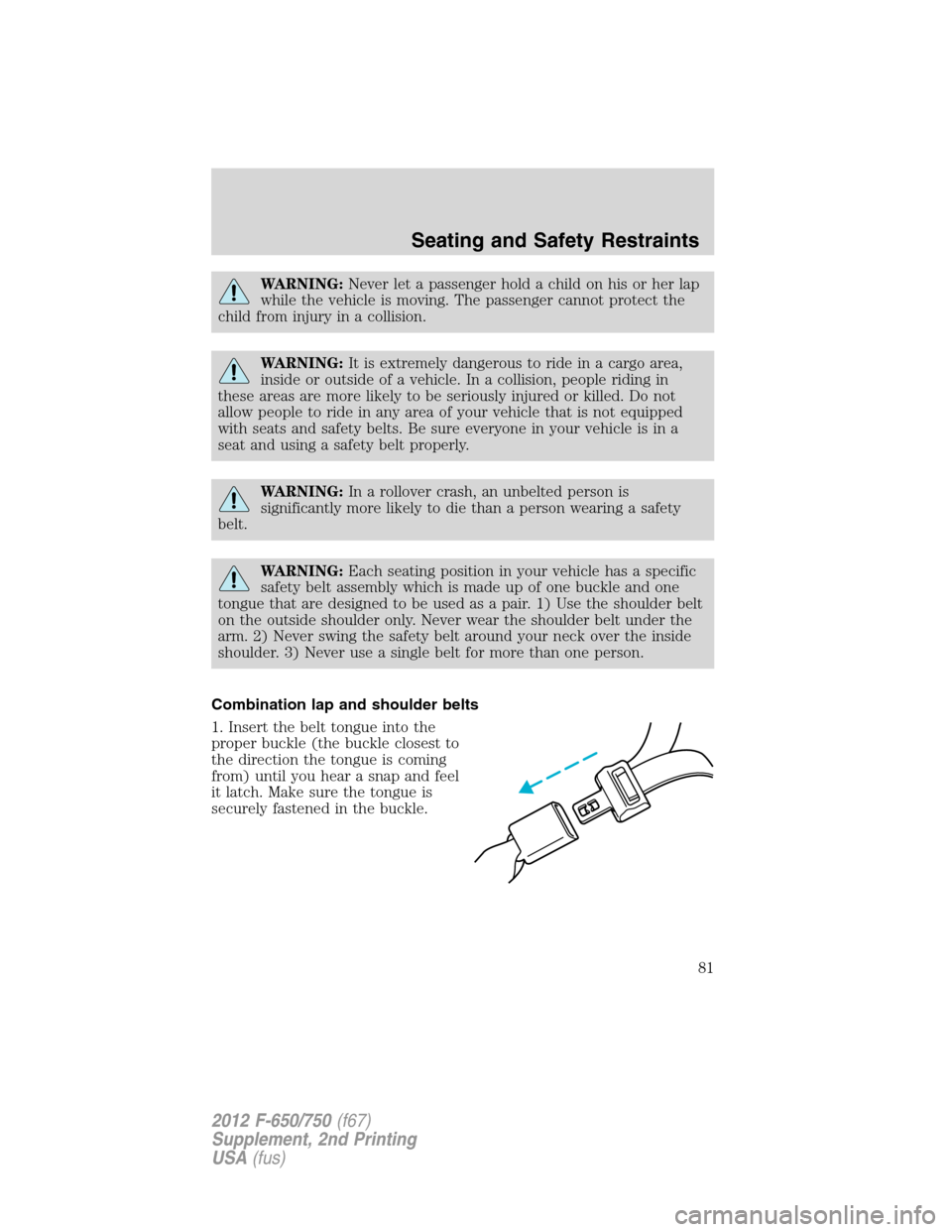
Combination lap and shoulder belts
1. Insert the belt tongue into the
proper buckle (the buckle closest to
the direction the tongue is coming
from) until you hear a snap and feel
it latch. Make sure the tongue is
securely fastened in the buckle.
Seating and Safety Restraints
81
2012 F-650/750(f67)
Supplement, 2nd Printing
USA(fus)