Page 56 of 306
TILT STEERING
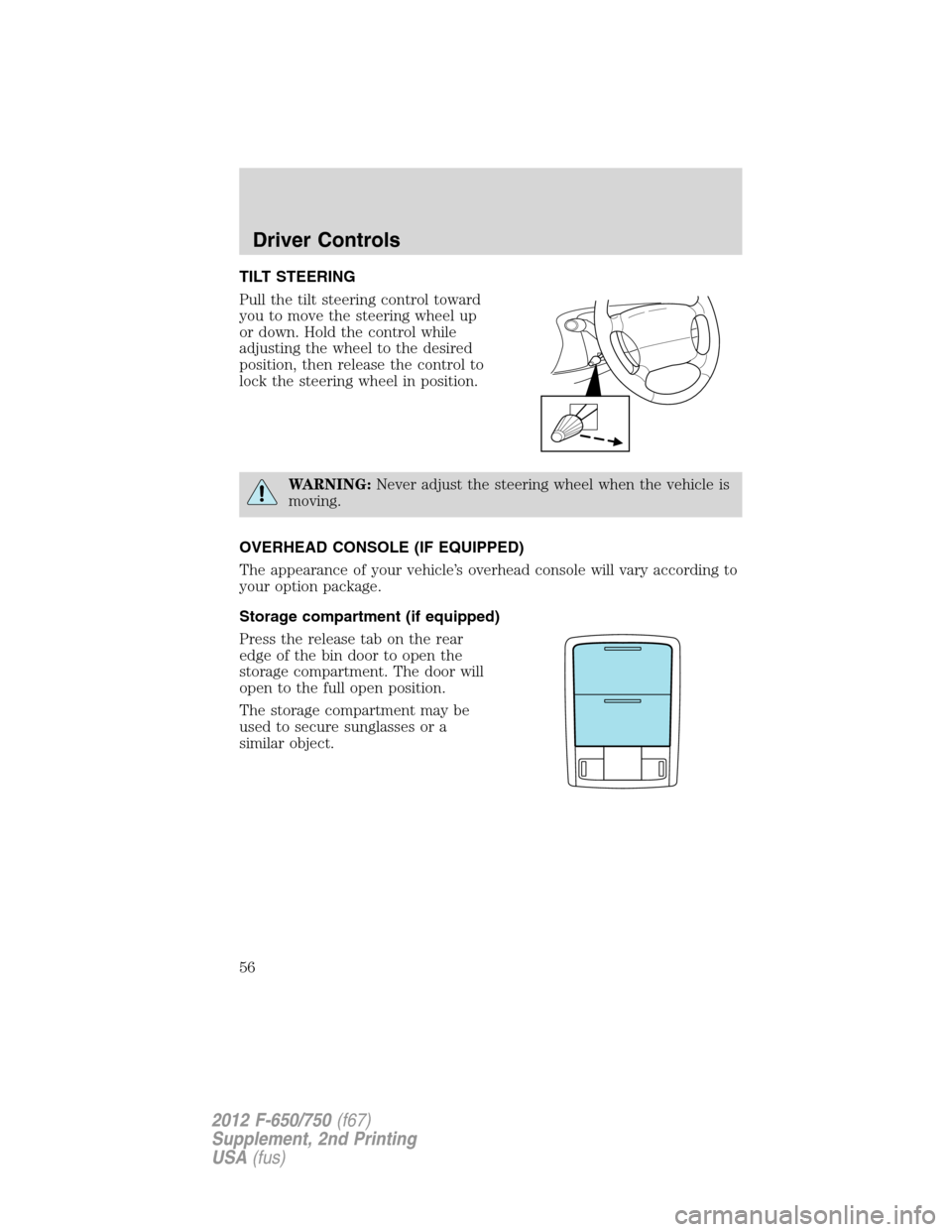
Pull the tilt steering control toward
you to move the steering wheel up
or down. Hold the control while
adjusting the wheel to the desired
position, then release the control to
lock the steering wheel in position.
WARNING:Never adjust the steering wheel when the vehicle is
moving.
OVERHEAD CONSOLE (IF EQUIPPED)
The appearance of your vehicle’s overhead console will vary according to
your option package.
Storage compartment (if equipped)
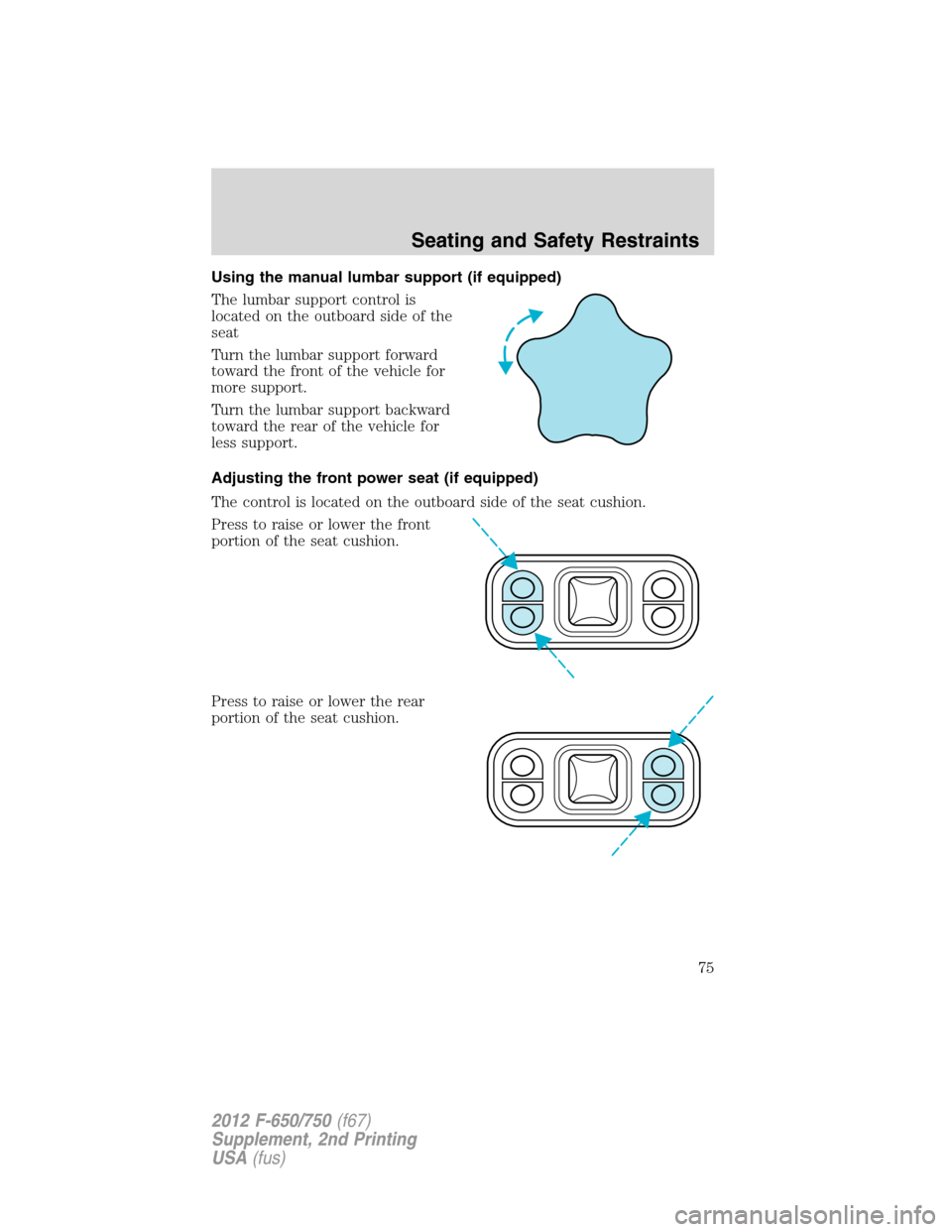
Press the release tab on the rear
edge of the bin door to open the
storage compartment. The door will
open to the full open position.
The storage compartment may be
used to secure sunglasses or a
similar object.
Driver Controls
56
2012 F-650/750(f67)
Supplement, 2nd Printing
USA(fus)
Page 62 of 306
Telescoping mirrors (if equipped)
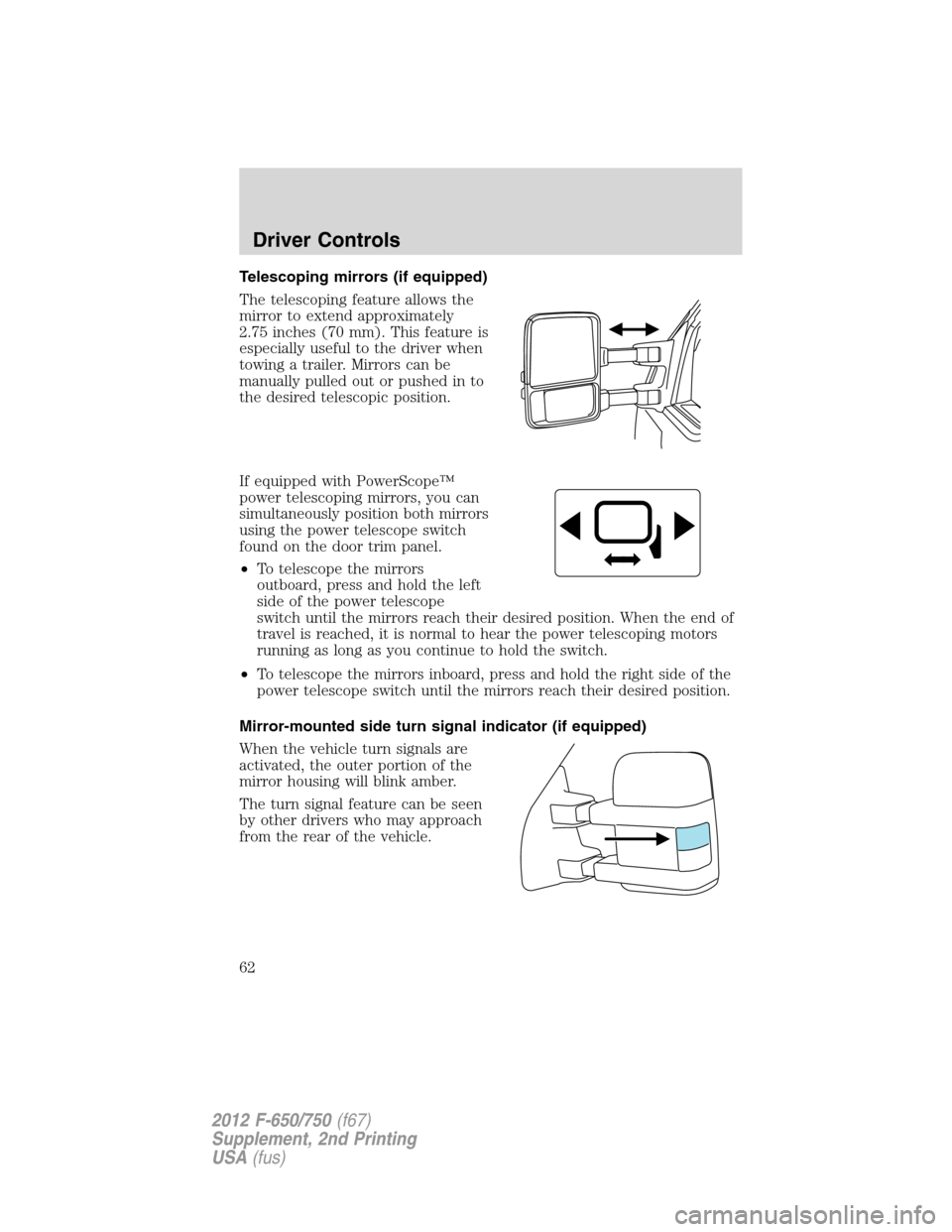
The telescoping feature allows the
mirror to extend approximately
2.75 inches (70 mm). This feature is
especially useful to the driver when
towing a trailer. Mirrors can be
manually pulled out or pushed in to
the desired telescopic position.
If equipped with PowerScope™
power telescoping mirrors, you can
simultaneously position both mirrors
using the power telescope switch
found on the door trim panel.
•To telescope the mirrors
outboard, press and hold the left
side of the power telescope
switch until the mirrors reach their desired position. When the end of
travel is reached, it is normal to hear the power telescoping motors
running as long as you continue to hold the switch.
•To telescope the mirrors inboard, press and hold the right side of the
power telescope switch until the mirrors reach their desired position.
Mirror-mounted side turn signal indicator (if equipped)
When the vehicle turn signals are
activated, the outer portion of the
mirror housing will blink amber.
The turn signal feature can be seen
by other drivers who may approach
from the rear of the vehicle.
Driver Controls
62
2012 F-650/750(f67)
Supplement, 2nd Printing
USA(fus)
Page 75 of 306
Using the manual lumbar support (if equipped)
The lumbar support control is
located on the outboard side of the
seat
Turn the lumbar support forward
toward the front of the vehicle for
more support.
Turn the lumbar support backward
toward the rear of the vehicle for
less support.
Adjusting the front power seat (if equipped)
The control is located on the outboard side of the seat cushion.
Press to raise or lower the front
portion of the seat cushion.
Press to raise or lower the rear
portion of the seat cushion.
Seating and Safety Restraints
75
2012 F-650/750(f67)
Supplement, 2nd Printing
USA(fus)
Page 77 of 306
Air-Ride seat (if equipped)
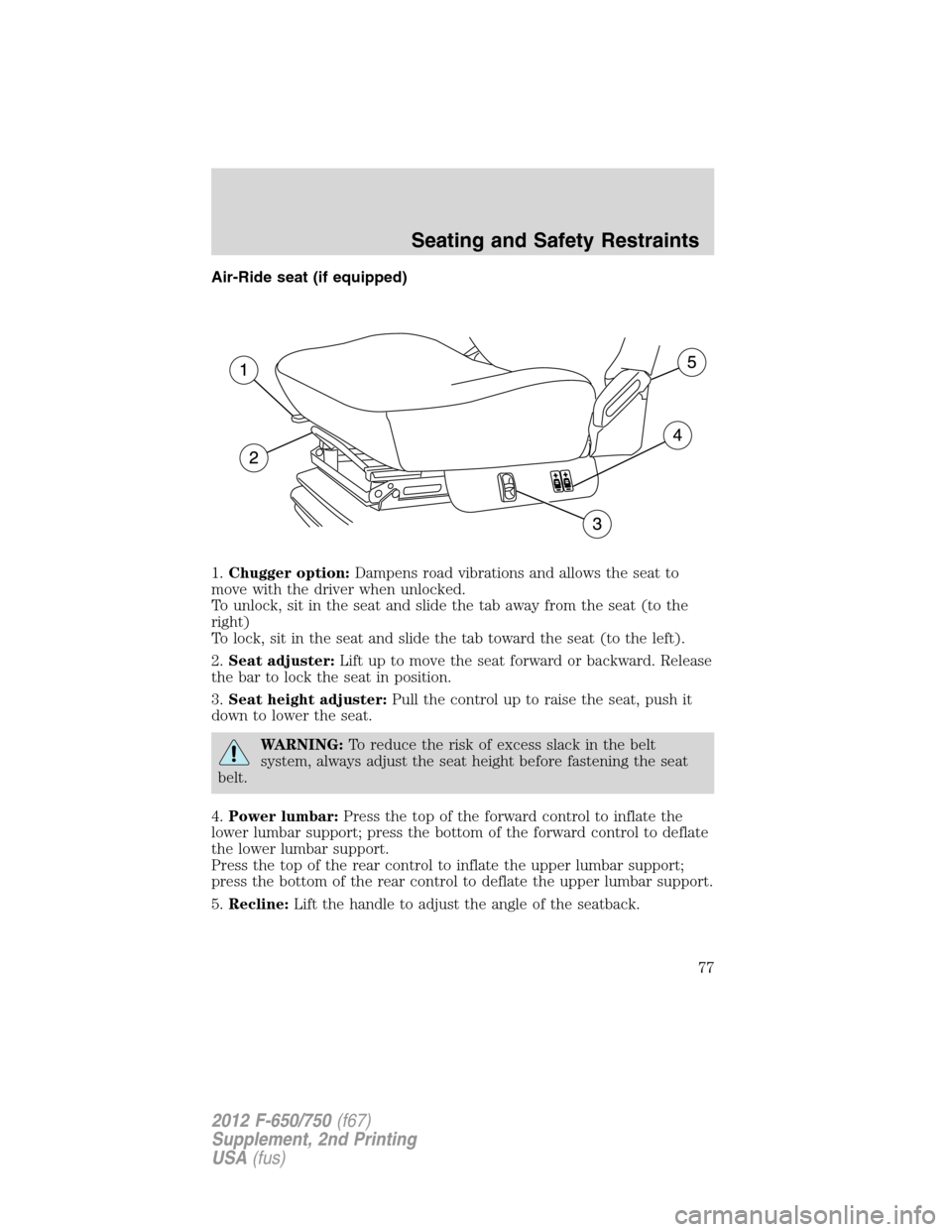
1.Chugger option:Dampens road vibrations and allows the seat to
move with the driver when unlocked.
To unlock, sit in the seat and slide the tab away from the seat (to the
right)
To lock, sit in the seat and slide the tab toward the seat (to the left).
2.Seat adjuster:Lift up to move the seat forward or backward. Release
the bar to lock the seat in position.
3.Seat height adjuster:Pull the control up to raise the seat, push it
down to lower the seat.
WARNING:To reduce the risk of excess slack in the belt
system, always adjust the seat height before fastening the seat
belt.
4.Power lumbar:Press the top of the forward control to inflate the
lower lumbar support; press the bottom of the forward control to deflate
the lower lumbar support.
Press the top of the rear control to inflate the upper lumbar support;
press the bottom of the rear control to deflate the upper lumbar support.
5.Recline:Lift the handle to adjust the angle of the seatback.
Seating and Safety Restraints
77
2012 F-650/750(f67)
Supplement, 2nd Printing
USA(fus)
Page 91 of 306
WARNING:If you must use a forward-facing child seat in the
front seat, move the vehicle seat all the way back. When
possible, all children age 12 and under should be properly restrained in
a rear seating position. If all children cannot be seated and restrained
properly in a rear seating position, properly restrain the largest child in
the front seat.
WARNING:Always carefully follow the instructions and
warnings provided by the manufacturer of any child restraint to
determine if the restraint device is appropriate for your child’s size,
height, weight, or age. Follow the child restraint manufacturer’s
instructions and warnings provided for installation and use in
conjunction with the instructions and warnings provided by the vehicle
manufacturer. A safety seat that is improperly installed or utilized, is
inappropriate for your child’s height, age, or weight or does not
properly fit the child may increase the risk of serious injury or death.
WARNING:Never let a passenger hold a child on his or her lap
while the vehicle is moving. The passenger cannot protect the
child from injury in a collision, which may result in serious injury or
death.
WARNING:Never use pillows, books, or towels to boost a child.
They can slide around and increase the likelihood of injury or
death in a collision.
WARNING:Always restrain an unoccupied child seat or booster
seat. These objects may become projectiles in a collision or
sudden stop, which may increase the risk of serious injury.
WARNING:Never place, or allow a child to place, the shoulder
belt under a child’s arm or behind the back because it reduces
the protection for the upper part of the body and may increase the risk
of injury or death in a collision.
WARNING:Do not leave children, or pets unattended in your
vehicle.
Seating and Safety Restraints
91
2012 F-650/750(f67)
Supplement, 2nd Printing
USA(fus)
Page 119 of 306
Parking brake control (knob)
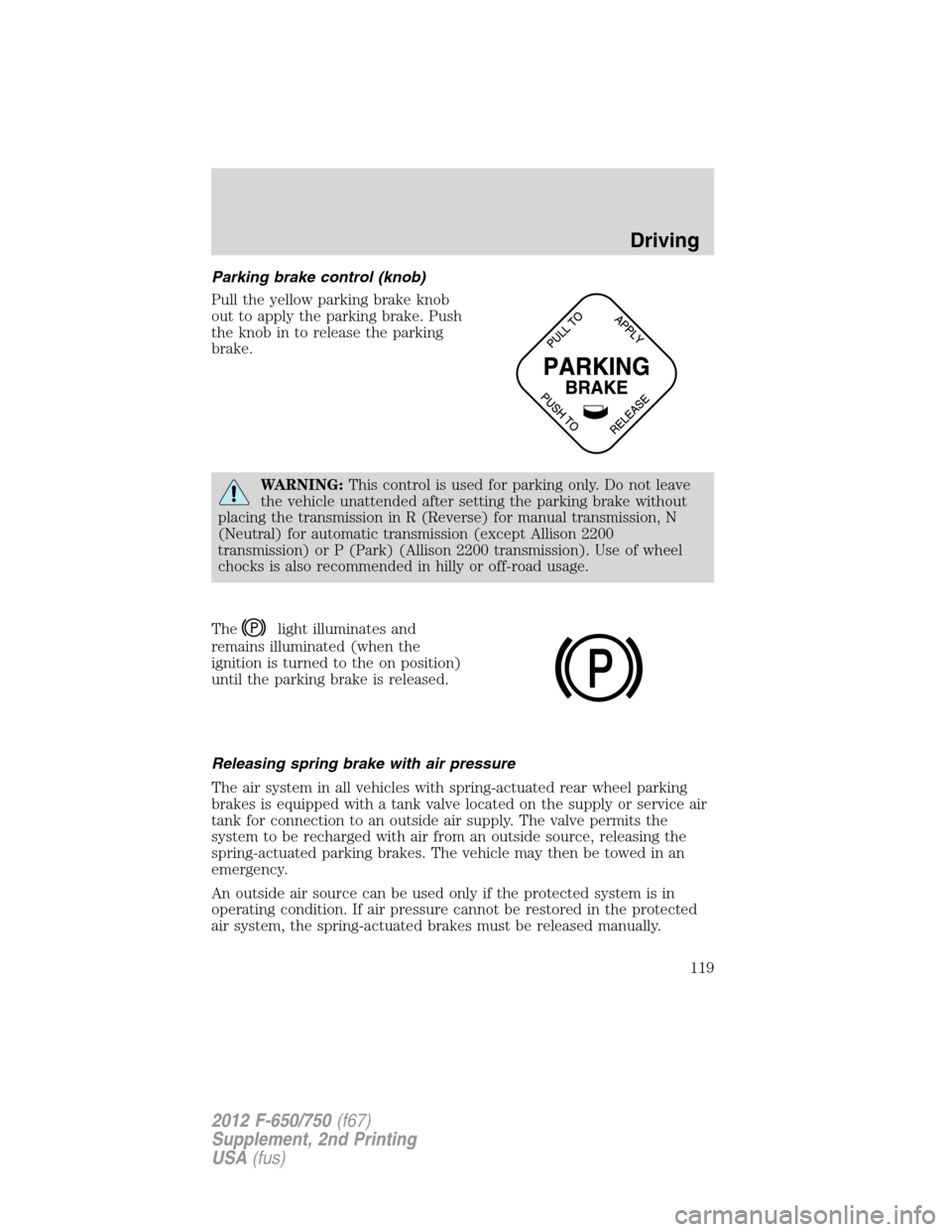
Pull the yellow parking brake knob
out to apply the parking brake. Push
the knob in to release the parking
brake.
WARNING:This control is used for parking only. Do not leave
the vehicle unattended after setting the parking brake without
placing the transmission in R (Reverse) for manual transmission, N
(Neutral) for automatic transmission (except Allison 2200
transmission) or P (Park) (Allison 2200 transmission). Use of wheel
chocks is also recommended in hilly or off-road usage.
The
light illuminates and
remains illuminated (when the
ignition is turned to the on position)
until the parking brake is released.
Releasing spring brake with air pressure
The air system in all vehicles with spring-actuated rear wheel parking
brakes is equipped with a tank valve located on the supply or service air
tank for connection to an outside air supply. The valve permits the
system to be recharged with air from an outside source, releasing the
spring-actuated parking brakes. The vehicle may then be towed in an
emergency.
An outside air source can be used only if the protected system is in
operating condition. If air pressure cannot be restored in the protected
air system, the spring-actuated brakes must be released manually.
P
Driving
119
2012 F-650/750(f67)
Supplement, 2nd Printing
USA(fus)
Page 147 of 306

Unloaded or lightly loaded vehicles
The braking system has been designed to safely stop your vehicle when
fully loaded to its GVWR.
WARNING:When operating empty or lightly loaded, sudden or
hard braking may induce wheel lockup with loss of vehicle
control and the possibility of accident and serious injury, especially on
wet or slippery road surfaces.
TRAILER TOWING
Towing a trailer places an additional load on your vehicle’s engine,
transmission, axle, brakes, tires and suspension. Inspect these
components carefully prior to and after any towing operation.
Consult your local motor vehicle speed regulations for towing a trailer.
Your vehicle’s load capacity is designated by weight, not by volume, so you
cannot necessarily use all available space when loading a vehicle. 2nd unit
bodies are not included in maximum trailer weight ratings. The weight of the
additional “body” must be subtracted from the maximum trailer weight.
Note:Do not exceed the GVWR or the GAWR specified on the
certification label.
Note:Do not exceed the GCWR rating or transmission damage may occur.
WARNING:Towing trailers beyond the maximum recommended
gross trailer weight exceeds the limit of the vehicle and could
result in engine damage, transmission damage, structural damage, loss
of vehicle control, vehicle rollover and personal injury.
Model Maximum
GVWR - lb (kg)Maximum
GCWR
F-650 Pro-Loader (Kick-Up
Frame)20500–26000
(9299–11792)*
F-650 Pro-Loader (Straight
Frame)/F-650 Straight Frame20500–29000
(9299–13154)*
F-750 25999–37000
(11793–16783)*
* Specific GCWR and maximum trailer weight applicable to a given
F–650/750 model is dependent on many variables including
transmission capability. Check with your sales consultant for the exact
rating on your vehicle.
Driving
147
2012 F-650/750(f67)
Supplement, 2nd Printing
USA(fus)
Page 148 of 306
Preparing to tow
Use the proper equipment for towing a trailer and make sure it is
properly attached to your vehicle. See your dealer or a reliable trailer
dealer if you require assistance.
Hitches
Do not use hitches that clamp onto the vehicle’s bumper or attach to the
axle. You must distribute the load in your trailer so that 10–15% of the
total weight of the trailer is on the tongue.
Safety chains
Always connect the trailer’s safety chains to the frame or hook retainers
of the vehicle hitch. To connect the trailer’s safety chains, cross the
chains under the trailer tongue and allow slack for turning corners.
If you use a rental trailer, follow the instructions that the rental agency
gives to you.
Do not attach safety chains to the bumper.
Trailer brakes
Electric brakes and manual, automatic or surge-type trailer brakes are safe
if installed properly and adjusted to the manufacturer’s specifications. The
trailer brakes must meet local and Federal regulations.
WARNING:Do not connect a trailer’s hydraulic brake system
directly to your vehicle’s brake system. Your vehicle may not
have enough braking power and your chances of having a collision
greatly increase.
Trailer lamps
Trailer lamps are required on most towed vehicles. Your vehicle may be
equipped with one of two possible trailer wiring designs. Make sure all
running lights, brake lights, turn signals and hazard lights are working.
See your dealer or trailer rental agency for proper instructions and
equipment for hooking up trailer lamps.
Driving while you tow
When towing a trailer:
•Do not drive faster than 70 mph (113 km/h) during the first 500 miles
(800 km) of trailer towing and don’t make full-throttle starts.
Driving
148
2012 F-650/750(f67)
Supplement, 2nd Printing
USA(fus)