2012 FORD F650 tires
[x] Cancel search: tiresPage 147 of 306

Unloaded or lightly loaded vehicles
The braking system has been designed to safely stop your vehicle when
fully loaded to its GVWR.
WARNING:When operating empty or lightly loaded, sudden or
hard braking may induce wheel lockup with loss of vehicle
control and the possibility of accident and serious injury, especially on
wet or slippery road surfaces.
TRAILER TOWING
Towing a trailer places an additional load on your vehicle’s engine,
transmission, axle, brakes, tires and suspension. Inspect these
components carefully prior to and after any towing operation.
Consult your local motor vehicle speed regulations for towing a trailer.
Your vehicle’s load capacity is designated by weight, not by volume, so you
cannot necessarily use all available space when loading a vehicle. 2nd unit
bodies are not included in maximum trailer weight ratings. The weight of the
additional “body” must be subtracted from the maximum trailer weight.
Note:Do not exceed the GVWR or the GAWR specified on the
certification label.
Note:Do not exceed the GCWR rating or transmission damage may occur.
WARNING:Towing trailers beyond the maximum recommended
gross trailer weight exceeds the limit of the vehicle and could
result in engine damage, transmission damage, structural damage, loss
of vehicle control, vehicle rollover and personal injury.
Model Maximum
GVWR - lb (kg)Maximum
GCWR
F-650 Pro-Loader (Kick-Up
Frame)20500–26000
(9299–11792)*
F-650 Pro-Loader (Straight
Frame)/F-650 Straight Frame20500–29000
(9299–13154)*
F-750 25999–37000
(11793–16783)*
* Specific GCWR and maximum trailer weight applicable to a given
F–650/750 model is dependent on many variables including
transmission capability. Check with your sales consultant for the exact
rating on your vehicle.
Driving
147
2012 F-650/750(f67)
Supplement, 2nd Printing
USA(fus)
Page 182 of 306
Follow the checks and services in theScheduled Maintenance Guide
chapter. Have your dealer or service center inspect your vehicle at least
once a year; remember that regular maintenance and inspections usually
prevent serious problems from developing later.
WARNING:Making modifications to various parts, components
and systems of the vehicle, such as brake and steering systems
can adversely affect the quality, reliability and operation of your vehicle
and could result in property damage, personal injury or death. Such
modifications must be avoided.
WARNING:Failure to properly perform maintenance and
servicing procedures could result in vehicle damage, personal
injury or death.
If the owner/operator of the vehicle is a skilled technician and intends on
performing the vehicle maintenance and service, he is strongly urged to
purchase a service manual.
WARNING:Take care when performing any maintenance,
system check or service on your vehicle. Some of the materials
may also be hazardous if used, serviced or handled improperly and
could result in property damage, personal injury or death.
Air conditioning system checks
Have the air conditioning system checked each spring. The refrigerant
charge, cleanliness of the condenser-evaporator cores and belt condition
are essential to system performance.
When the air conditioning system is being used daily, remove the fresh
air filter (if equipped) once each season and check for dirt, lint, etc.
Replace the filter if necessary. Vehicles operating in unusually dusty
conditions may require more frequent filter inspection and replacement.
Front axle - general service information
Maintaining the front axle alignment to specifications is very important
and should only be performed by a qualified technician. Toe-in
adjustment is particularly important with radial tires.
Make sure the axle mounting U-bolt nuts, attaching or mounting bolts
and nuts are securely tightened. Regularly check front axle for damage,
binding, worn parts and adequate lubrication.
Maintenance and Specifications
182
2012 F-650/750(f67)
Supplement, 2nd Printing
USA(fus)
Page 183 of 306
At regular intervals, or during other scheduled maintenance (tire
rotation/service, wheel bearing service, alignment, etc.), the kingpins
should be checked for excessive wear. Refer to the service manual for
proper procedures.
Toe-in setting - general inspection
Inspecting steer axle tires in the first 3,000–10,000 service miles
(5,000–16,000 service km) generally shows if tires are wearing normally.
Rapid outside shoulder wear on both tires indicates too much toe-in.
Rapid inside shoulder wear on both tires indicates too much toe-out. In
P&D-type service, left-to-right steer tire tread life differentials up to 40%
can be observed depending on routes and other variables.
Follow the tire manufacturer’s recommended cold inflation pressure for
the tire size, load range (ply rating) and steer axle loading typical for
their operation (each steer axle tire equals
12steer axle loading).
Special applications may warrant a setting based on experience with the
type of tire operating loads and conditions. Radial tires are more
sensitive to toe-in setting than bias ply tires. While not insensitive to
vehicle alignment, fine tuning school bus alignment to line-haul truck
standards does not drastically improve tire tread life.
It is essential that correct toe-in and tire pressure be maintained for
optimum tire wear.
Rear axle - general inspection
Make sure that the axle mounting U-bolts, attaching or mounting bolts
and nuts are securely tightened. Refer toU-bolt nut torquein this
chapter. Regularly check the rear axle for damaged, binding or worn
parts.
NoSpin Detroit Locker positive locking differential
Vehicles equipped with this type differential have the operator’s manual
supplied with the vehicle. Refer to this manual for maintenance checks.
Maintenance and Specifications
183
2012 F-650/750(f67)
Supplement, 2nd Printing
USA(fus)
Page 232 of 306

Checking the rear axle lubricant level
1. Park the vehicle on level ground.
2. Set the parking brake and shift into N (Neutral) (automatic
transmission) or 1 (First) (manual transmission) and turn the engine off.
3. Clean any dirt from around the rear axle filler plug.
4. Remove the filler plug and inspect the lubricant level; it should be up
to the bottom of the filler plug opening.
5. Add lubricant, if necessary, through the filler plug opening.
6. Clean and install the filler plug securely.
Draining and refilling the rear axle lubricant
1. Drain the rear axle while the lubricant is warm.
2. Park the vehicle on level ground.
3. Set the parking brake and shift into N (Neutral) (automatic
transmission) or 1 (First) (manual transmission) and turn the engine off.
4. Clean any dirt from around the rear axle filler and drain plugs.
5. Remove the filler and drain plugs and drain the lubricant into a
suitable container. Dispose of all used automotive fluids in a responsible
manner following your local authorized standards.
6. Clean and install the drain plug securely.
7. Add lubricant through the filler plug opening.
8. Clean and install the filler plug securely.
WHEELS
General
Wheel bearings should be inspected, lubricated and adjusted at regular
intervals. This is especially important if operating in deep sand, mud or
water. Refer toLubricant specificationsin this chapter.
Mount wheel balance weights on the dome-side of the wheel only; failure
to do so may result in loss of wheel weight and/or damage to brakes or
wheels.
Important:Remember to replace the wheel air valves when the road
tires are replaced at the end of their useful life.
Maintenance and Specifications
232
2012 F-650/750(f67)
Supplement, 2nd Printing
USA(fus)
Page 238 of 306
TIRE INFORMATION
Inflation
WARNING:Always maintain your tires in good condition.
Frequently check and maintain correct inflation pressures as
specified by tire manufacturers. Inspect periodically for abnormal wear
patterns and repair/replace cut or broken tire casing. Always use
experienced, trained personnel with proper equipment and correct
procedures to mount or remove tires and wheels. Failure to adhere to
these warnings could result in wheel or tire malfunction, damage to
your vehicle, personal injury, or death.
WARNING:To avoid personal injury or death, always follow
these instructions when mounting radial tires on wheels:
•Only personnel that have had proper training and experience should
mount or remove tires from rims or wheels.
•Use only heavy-duty rims or approved rims for radial tires. It may be
necessary to contact your wheel and rim distributor to determine if
your rims are approved for radial tires.
•If a tube is to be used, make sure special radial tire tubes are used
because of the increased flexing of the sidewalls on radial tires.
•Never use anti-freeze, silicones, or petroleum based lubricants when
mounting radial tires. Only an approved lubricant should be used as
an aid for mounting tires.
•Always inflate tires in a safety cage.
•Do not attempt to mix stud piloted wheels or fasteners with hub
piloted wheels or fasteners. To do so may cause premature wheel
failure resulting in property damage, personal injury, or death.
•Do not mix foreign (not made in North America) wheel mounting
parts with domestic (made in North America) parts. Many foreign
wheel components look similar to, but not exactly the same as
domestic made components. Mixing components could cause wheel or
fastener failures and result in property damage, personal injury, or
death.
•Do not change from aluminum wheels to steel wheels or vice-versa
without changing the mounting hardware where required or, in some
cases with flange nut mounting systems, changing the hub and stud
assembly. Mixing components could cause wheel or fastener failures
and result in property damage, personal injury, or death.
Maintenance and Specifications
238
2012 F-650/750(f67)
Supplement, 2nd Printing
USA(fus)
Page 239 of 306
All tires with Steel Carcass Plies (if equipped):
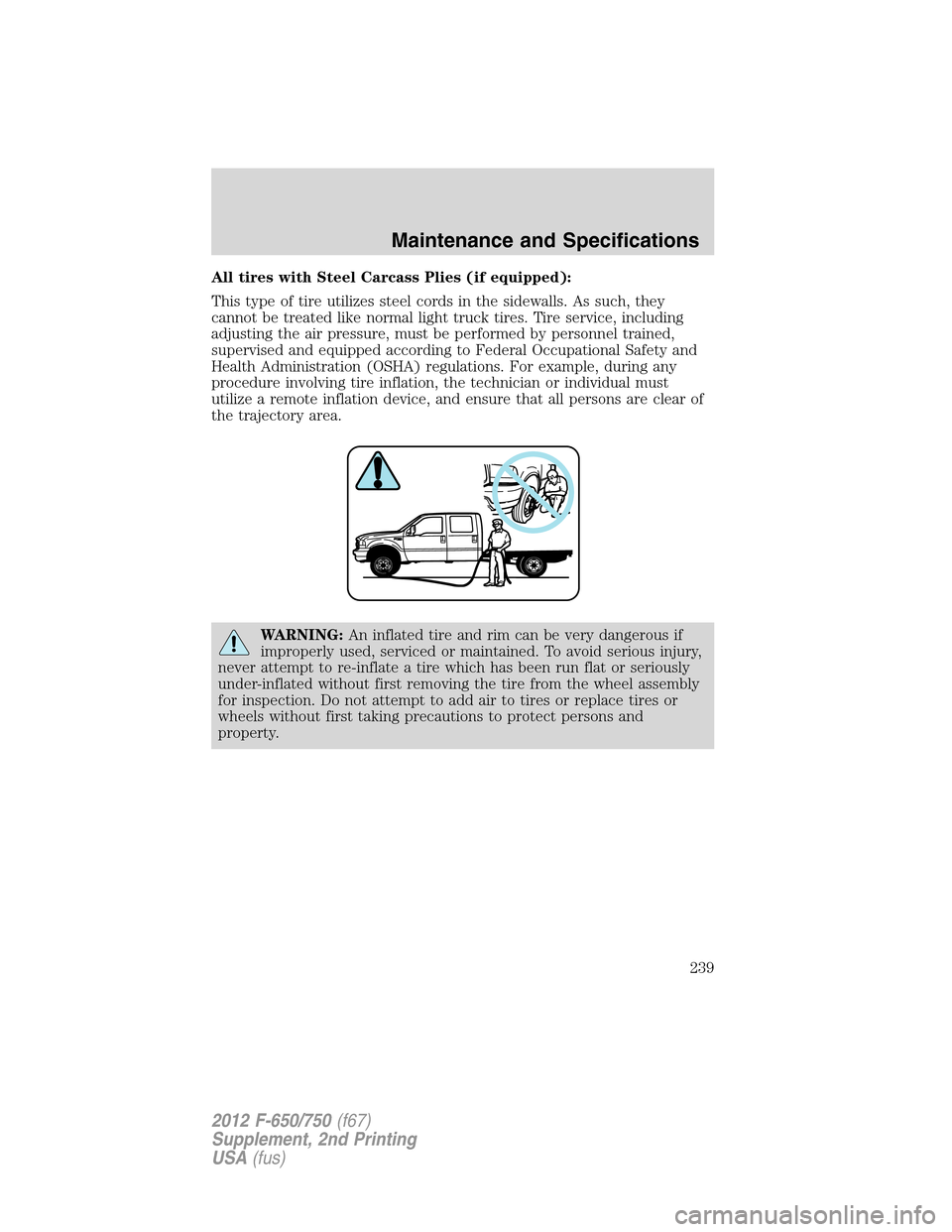
This type of tire utilizes steel cords in the sidewalls. As such, they
cannot be treated like normal light truck tires. Tire service, including
adjusting the air pressure, must be performed by personnel trained,
supervised and equipped according to Federal Occupational Safety and
Health Administration (OSHA) regulations. For example, during any
procedure involving tire inflation, the technician or individual must
utilize a remote inflation device, and ensure that all persons are clear of
the trajectory area.
WARNING:An inflated tire and rim can be very dangerous if
improperly used, serviced or maintained. To avoid serious injury,
never attempt to re-inflate a tire which has been run flat or seriously
under-inflated without first removing the tire from the wheel assembly
for inspection. Do not attempt to add air to tires or replace tires or
wheels without first taking precautions to protect persons and
property.
Maintenance and Specifications
239
2012 F-650/750(f67)
Supplement, 2nd Printing
USA(fus)
Page 240 of 306
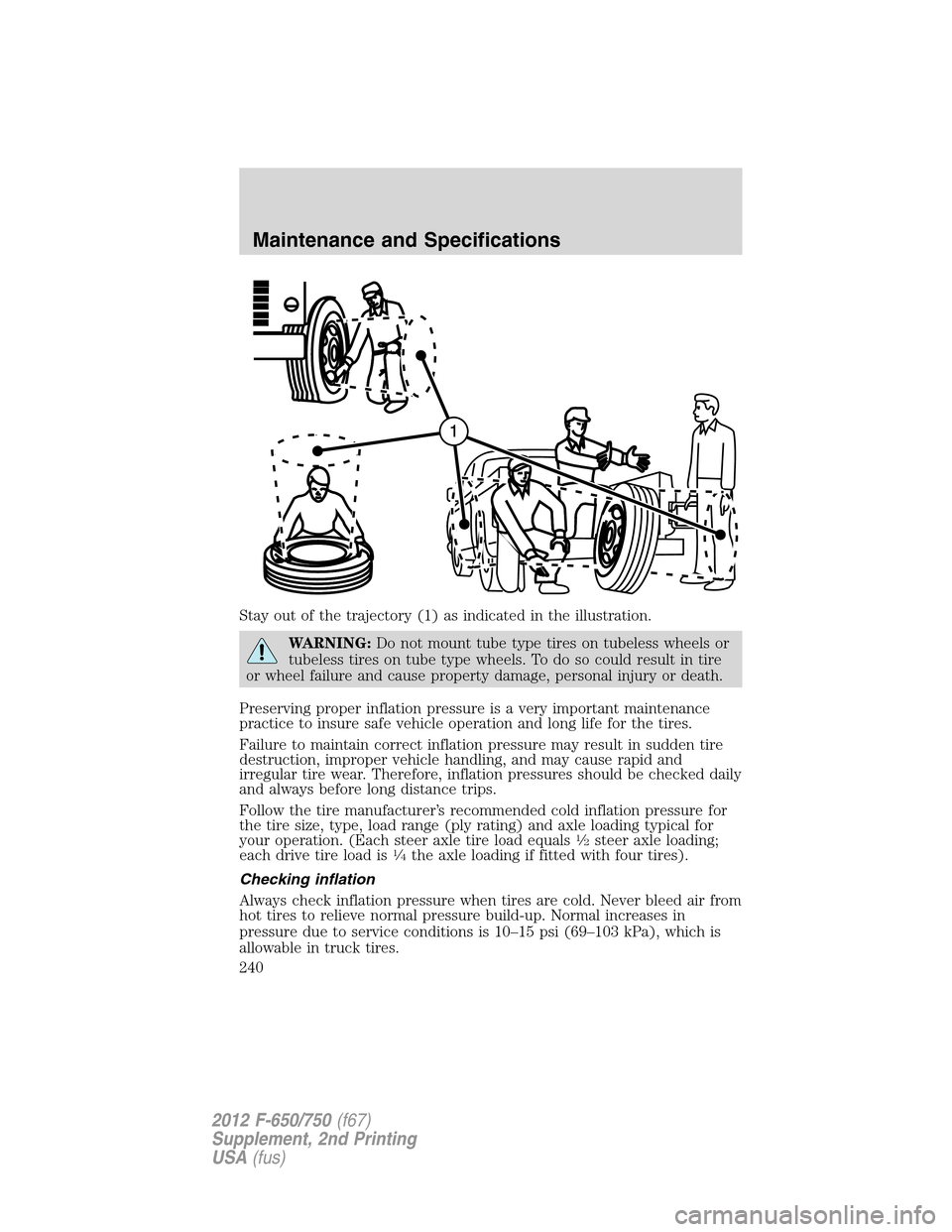
Stay out of the trajectory (1) as indicated in the illustration.
WARNING:Do not mount tube type tires on tubeless wheels or
tubeless tires on tube type wheels. To do so could result in tire
or wheel failure and cause property damage, personal injury or death.
Preserving proper inflation pressure is a very important maintenance
practice to insure safe vehicle operation and long life for the tires.
Failure to maintain correct inflation pressure may result in sudden tire
destruction, improper vehicle handling, and may cause rapid and
irregular tire wear. Therefore, inflation pressures should be checked daily
and always before long distance trips.
Follow the tire manufacturer’s recommended cold inflation pressure for
the tire size, type, load range (ply rating) and axle loading typical for
your operation. (Each steer axle tire load equals
12steer axle loading;
each drive tire load is14the axle loading if fitted with four tires).
Checking inflation
Always check inflation pressure when tires are cold. Never bleed air from
hot tires to relieve normal pressure build-up. Normal increases in
pressure due to service conditions is 10–15 psi (69–103 kPa), which is
allowable in truck tires.
Maintenance and Specifications
240
2012 F-650/750(f67)
Supplement, 2nd Printing
USA(fus)
Page 241 of 306
Tires should be properly inflated to manufacturers recommended
pressure for the size and service load in which the vehicle is being used.
Refer to the specific tire manufacturer with which your vehicle is
equipped with for the latest information concerning service load and
inflation pressure.
It is particularly important to keep moisture from the inside of tires, and
proper selection of air compressor equipment, proper air line routing,
and the use of shop air dryers is strongly recommended to avoid
moisture in the high pressure air used for tire inflation.
Under-inflation
Tires should not be permitted to become under-inflated. Increased
flexing due to under-inflation causes heat build-up within the tire
components. This leads to reduced strength, breakdown of the rubber
compounds, and possible separation of the tire components (i.e., ply and
tread separation and reduced retreadability).
Under-inflation is the primary cause of premature tire concerns including
sudden loss of air. In addition, low inflation causes an increase in rolling
resistance. This results in reduced fuel mileage, a loss in tread mileage,
and uneven wear due to increased tread movement. To determine proper
inflation refer to the tire manufacturer load/inflation guide which can be
found on the tire manufacturer website or at your local truck tire dealer.
Inspection
Check condition of tires for abnormal wear patterns, and proper inflation
pressures. Cut or broken tire casing must be repaired or replaced.
Tires should be inspected for the following conditions. If any are present,
the tire should be removed and repaired, retreaded or scrapped as the
condition indicates.
•Any blister, bump or raised portion anywhere on the surface of the
tire tread or sidewall (other than a bump made by a repair). These
indicate the start of internal separation.
•Any cut that reaches to the belt or ply cords, or any cut that is large
enough to grow in size and depth.
•Any nail or puncturing object.
•If any stone or object is held by a tread groove and is starting to drill
into the tread base, remove the object.
Proper tire inflation, toe-in adjustment, loads, and road speeds are
important factors governing tire mileage, steering ease and maneuverability.
Maintenance and Specifications
241
2012 F-650/750(f67)
Supplement, 2nd Printing
USA(fus)