2012 FORD F550 fuel pump
[x] Cancel search: fuel pumpPage 329 of 448

Fuse/Relay
Location Fuse Amp
Rating Protected Circuits
38 Relay Powertrain control module
(PCM) (diesel engine),
Electronic control module (ECM)
(gas engine)
39 10A** 4x4 hub lock
40 15A** 4x4 electronic lock
41 — Not used
42 — Not used
43 — Not used
44 — Not used
45 10A** Run/start relay coil
46 10A** Transmission control module
(TCM) keep-alive power (diesel
engine)
47 10A** A/C clutch feed
48 Relay Run/start
49 10A** Rearview camera system
50 10A** Blower motor relay coil
51 — Not used
52 10A** PCM/ECM/TCM run/start
53 10A** 4x4 module
54 10A** Anti-lock brake system (ABS)
run/start
55 10A** Rear window defroster coil,
Battery charge coil
56 20A** Passenger compartment fuse
panel run/start feed
57 Relay Fuel pump
58 — Not used
59 — Not used
60 — Not used
61 — Not used Roadside Emergencies
329
2012 F-250/350/450/550 (f23)
Owners Guide, 4th Printing
USA (fus)
Page 330 of 448

Fuse/Relay
Location Fuse Amp
Rating Protected Circuits
62 — Not used
63 — Not used
64 — Not used
65 — Not used
66 20A** Fuel pump
67 — Not used
68 10A** Fuel pump relay coil
69 — Not used
70 10A** Trailer tow backup lamp
71 10A** Cannister vent (gas engine)
72 10A** PCM/ECM relay coil feed
keep-alive power
73 — Not used
74 Relay Trailer tow left-hand stop/turn
75 Relay Trailer tow right-hand stop/turn
76 Relay Backup lamp
77 — Not used
78 — Not used
79 — Not used
80 — Not used
81 — Not used
82 20A* Auxiliary power point #2
83 20A* Auxiliary power point #1
84 30A* 4x4 shift motor
85 30A* Heated/cooled seats
86 25A* ABS coil feed
87 20A* Auxiliary power point #5
88 — Not used
89 40A* Starter motor
90 25A* Trailer tow battery charge
91 — Not usedRoadside Emergencies
330
2012 F-250/350/450/550 (f23)
Owners Guide, 4th Printing
USA (fus)
Page 389 of 448
WARNING: When refueling always shut the engine off and
never allow sparks or open flames near the filler neck. Never
smoke while refueling. Fuel vapor is extremely hazardous under certain
conditions. Care should be taken to avoid inhaling excess fumes.
WARNING: The flow of fuel through a fuel pump nozzle can
produce static electricity, which can cause a fire if fuel is
pumped into an ungrounded fuel container.
Refueling
WARNING: Fuel vapor burns violently and a fuel fire can cause
severe injuries. To help avoid injuries to you and others:
• Read and follow all the instructions on the pump island;
• Turn off your engine when you are refueling;
• Do not smoke if you are near fuel or refueling your vehicle;
• Keep sparks, flames and smoking materials away from fuel;
• Stay outside your vehicle and do not leave the fuel pump unattended
when refueling your vehicle — this is against the law in some places;
• Keep children away from the fuel pump; never let children pump
fuel.
• Do not use personal electronic devices while refueling.
Use the following guidelines to avoid electrostatic charge build-up when
filling an ungrounded fuel container:
• Place approved fuel container on the ground.
• DO NOT fill a fuel container while it is in the vehicle (including the
cargo area).
• Keep the fuel pump nozzle in contact with the fuel container while
filling.
• DO NOT use a device that would hold the fuel pump handle in the fill
position.
Fuel filler cap
When fueling your vehicle:
1. Turn the engine off.
2. Carefully turn the filler cap counterclockwise until it spins off.
3. Pull to remove the cap from the fuel filler pipe. Maintenance and Specifications
389
2012 F-250/350/450/550 (f23)
Owners Guide, 4th Printing
USA (fus)
Page 391 of 448
Octane recommendations
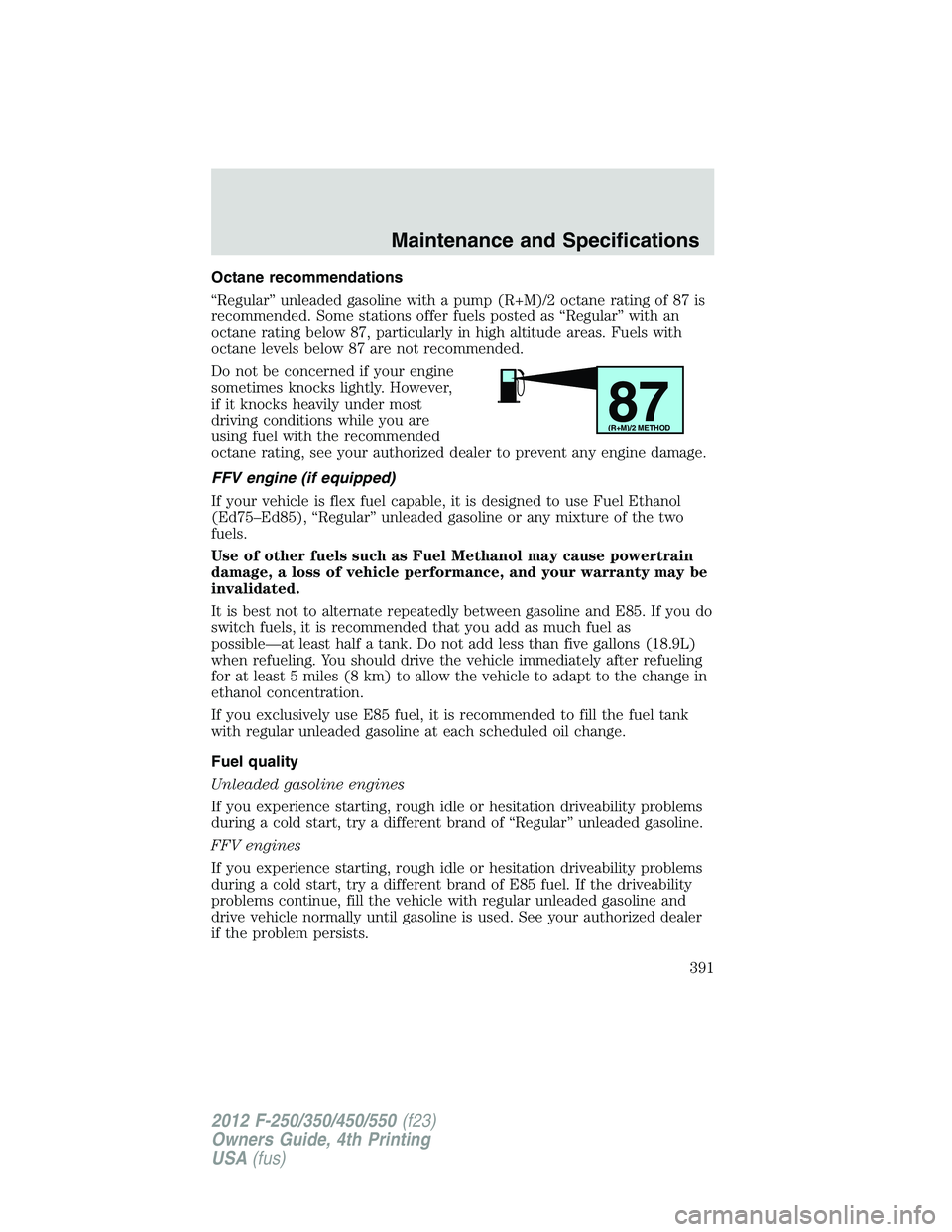
“Regular” unleaded gasoline with a pump (R+M)/2 octane rating of 87 is
recommended. Some stations offer fuels posted as “Regular” with an
octane rating below 87, particularly in high altitude areas. Fuels with
octane levels below 87 are not recommended.
Do not be concerned if your engine
sometimes knocks lightly. However,
if it knocks heavily under most
driving conditions while you are
using fuel with the recommended
octane rating, see your authorized dealer to prevent any engine damage.
FFV engine (if equipped)
If your vehicle is flex fuel capable, it is designed to use Fuel Ethanol
(Ed75–Ed85), “Regular” unleaded gasoline or any mixture of the two
fuels.
Use of other fuels such as Fuel Methanol may cause powertrain
damage, a loss of vehicle performance, and your warranty may be
invalidated.
It is best not to alternate repeatedly between gasoline and E85. If you do
switch fuels, it is recommended that you add as much fuel as
possible—at least half a tank. Do not add less than five gallons (18.9L)
when refueling. You should drive the vehicle immediately after refueling
for at least 5 miles (8 km) to allow the vehicle to adapt to the change in
ethanol concentration.
If you exclusively use E85 fuel, it is recommended to fill the fuel tank
with regular unleaded gasoline at each scheduled oil change.
Fuel quality
Unleaded gasoline engines
If you experience starting, rough idle or hesitation driveability problems
during a cold start, try a different brand of “Regular” unleaded gasoline.
FFV engines
If you experience starting, rough idle or hesitation driveability problems
during a cold start, try a different brand of E85 fuel. If the driveability
problems continue, fill the vehicle with regular unleaded gasoline and
drive vehicle normally until gasoline is used. See your authorized dealer
if the problem persists.
87 (R+M)/2 METHOD
Maintenance and Specifications
391
2012 F-250/350/450/550 (f23)
Owners Guide, 4th Printing
USA (fus)
Page 392 of 448
Do not add aftermarket fuel additive products to your fuel tank. It
should not be necessary to add any aftermarket products to your fuel
tank if you continue to use high quality fuel of the recommended octane
rating. These products have not been approved for your engine and
could cause damage to the fuel system. Repairs to correct the effects of
using an aftermarket product in your fuel may not be covered by your
warranty.
Many of the world’s automakers approved the World-Wide Fuel Charter
that recommends gasoline specifications to provide improved
performance and emission control system protection for your vehicle.
Gasolines that meet the World-Wide Fuel Charter should be used when
available. Ask your fuel supplier about gasolines that meet the
World-Wide Fuel Charter.
Diesel engine (if equipped)
Refer to the diesel supplement for information regarding diesel fuel
recommendations and requirements of your diesel-powered truck.
Cleaner air
Ford endorses the use of reformulated “cleaner-burning” gasolines to
improve air quality, per the recommendations in the Choosing the right
fuel section.
Running out of fuel
Avoid running out of fuel because this situation may have an adverse
effect on powertrain components.
If you have run out of fuel:
• You may need to cycle the ignition from off to on several times after
refueling to allow the fuel system to pump the fuel from the tank to
the engine. On restarting, cranking time will take a few seconds longer
than normal.
• Normally, adding 1 gallon (3.8L) of fuel is enough to restart the
engine. If the vehicle is out of fuel and on a steep grade, more than
1 gallon (3.8L) may be required.
• The service engine soon indicator may come on. For more
information on the service engine soon indicator, refer to
Warning lights and chimes in the Instrument Cluster chapter.Maintenance and Specifications
392
2012 F-250/350/450/550 (f23)
Owners Guide, 4th Printing
USA (fus)
Page 408 of 448

• Lubricate all hood, door and trunk lid hinges, and latches with a light
grade oil. See the Cleaning chapter for more information.
• Cover interior trim to prevent fading.
• Keep all rubber parts free from oil and solvents.
Engine
• The engine oil and filter should be changed prior to storage, as used
engine oil contain contaminates that may cause engine damage.
• Start the engine every 15 days. Run at fast idle until it reaches normal
operating temperature.
• With your foot on the brake, shift through all the gears while the
engine is running.
Fuel system
• Fill the fuel tank with high-quality fuel until the first automatic shutoff
of the fuel pump nozzle.
Note: During extended periods of vehicle storage (30 days or more),
fuel may deteriorate due to oxidation. Add a quality gas stabilizer
product to the vehicle fuel system whenever actual or expected storage
periods exceed 30 days. Follow the instructions on the additive label.
The vehicle should then be operated at idle speed to circulate the
additive throughout the fuel system.
Cooling system
• Protect against freezing temperatures.
• When removing vehicle from storage, check coolant fluid level.
Confirm there are no cooling system leaks, and fluid is at the
recommended level.
Battery
• Check and recharge as necessary. Keep connections clean.
• If storing your vehicle for more than 30 days without recharging the
battery, it may be advisable to disconnect the battery cables to ensure
battery charge is maintained for quick starting.
Note: If battery cables are disconnected, it will be necessary to reset
memory features.Maintenance and Specifications
408
2012 F-250/350/450/550 (f23)
Owners Guide, 4th Printing
USA (fus)
Page 444 of 448

Engine oil ..................................375
checking and adding ..............375
dipstick ....................................375
filter, specifications ........376, 410
recommendations ...................376
refill capacities ........................411
Event data recording ....................9
Exhaust fumes ..........................269
F
Fail safe cooling ........................384
Fleet MyKey programming ......129
Flexible Fuel Vehicle (FFV) ....386
Floor mats .........................122–123
Fluid capacities .........................411
Fog lamps ....................................88
Four-Wheel Drive vehicles .......301
driving off road .......................307
electronic shift ................301, 306
indicator light .........................302
lever operated shift ................303
manual locking hubs ..............301
preparing to drive your
vehicle .....................................285
Fuel ............................................386
calculating fuel
economy ............................25, 393
cap ...........................................389
capacity ...................................411
choosing the right fuel ...........390
detergent in fuel .....................392
filling your vehicle
with fuel ..................386, 389, 393
filter, specifications ................386
fuel pump shut-off ..................321
improving fuel economy ........393
octane rating ...................391, 415
quality ......................................391 running out of fuel .................392
safety information relating
to automotive fuels ................386
Fuel - flex fuel vehicle
(FFV) .........................386, 390–391
Fuses ..................................321–322
G
Garage door opener ..................116
Gas cap (see Fuel cap) ............389
Gas mileage
(see Fuel economy) .................393
Gauges .........................................21
H
Hazard flashers .........................320
Headlamps ...................................87
aiming ........................................90
autolamp system .......................87
daytime running lights .............89
flash to pass ..............................88
high beam .................................88
replacing bulbs .........................94
turning on and off ....................87
Heating
heating and air conditioning
system .................................78, 81
Hill descent mode .....................281
Hill start assist ..........................294
Hood ..........................................371
I
Ignition ...............................265, 415
Illuminated visor mirror .............99Index
444
2012 F-250/350/450/550 (f23)
Owners Guide, 4th Printing
USA (fus)