Page 405 of 462
Readiness for Inspection/Maintenance (I/M) testing
Some state/provincial and local governments may have
Inspection/Maintenance (I/M) programs to inspect the emission control
equipment on your vehicle. Failure to pass this inspection could prevent
you from getting a vehicle registration. Your vehicle may not pass the I/M
test if the service engine soon
indicator is on or not working
properly (bulb is burned out), or if the OBD-II system has determined
that some of the emission control systems have not been properly
checked. In this case, the vehicle is considered not ready for I/M testing.
If the service engine soon
indicator is on or the bulb does not
work, the vehicle may need to be serviced. Refer toOn-board
diagnostics (OBD-II)in this chapter.
If the vehicle’s engine or transmission has just been serviced, or the
battery has recently run down or been replaced, the OBD-II system may
indicate that the vehicle is not ready for I/M testing. To determine if the
vehicle is ready for I/M testing, turn the ignition key to the on position
for 15 seconds without cranking the engine. If the service engine
soon
indicator blinks eight times, it means that the vehicle is not
ready for I/M testing; if the service engine soon
indicator stays on
solid, it means that the vehicle is ready for I/M testing.
The OBD-II system is designed to check the emission control system
during normal driving. A complete check may take several days. If the
vehicle is not ready for I/M testing, the following driving cycle consisting
of mixed city and highway driving may be performed:
15 minutes of steady driving on an expressway/highway followed by
20 minutes of stop-and-go driving with at least four 30-second idle
periods.
Allow the vehicle to sit for at least eight hours without starting the
engine. Then, start the engine and complete the above driving cycle. The
engine must warm up to its normal operating temperature. Once started,
do not turn off the engine until the above driving cycle is complete. If
the vehicle is still not ready for I/M testing, the above driving cycle will
have to be repeated.
Maintenance and Specifications
405
2012 F-150(f12)
Owners Guide, 1st Printing
USA(fus)
Page 407 of 462
TRANSMISSION FLUID
Checking 6-speed automatic transmission fluid
The automatic transmission does not have a transmission fluid dipstick.
Refer to yourscheduled maintenance informationfor scheduled
intervals for fluid checks and changes. Your transmission does not
consume fluid. However, the fluid level should be checked if the
transmission is not working properly, (i.e., if the transmission slips or
shifts slowly) or if you notice some sign of fluid leakage.
Transmission fluid should be checked by an authorized dealer. If
required, fluid should be added by an authorized dealer.
Do not use supplemental transmission fluid additives, treatments or
cleaning agents. The use of these materials may affect transmission
operation and result in damage to internal transmission components.
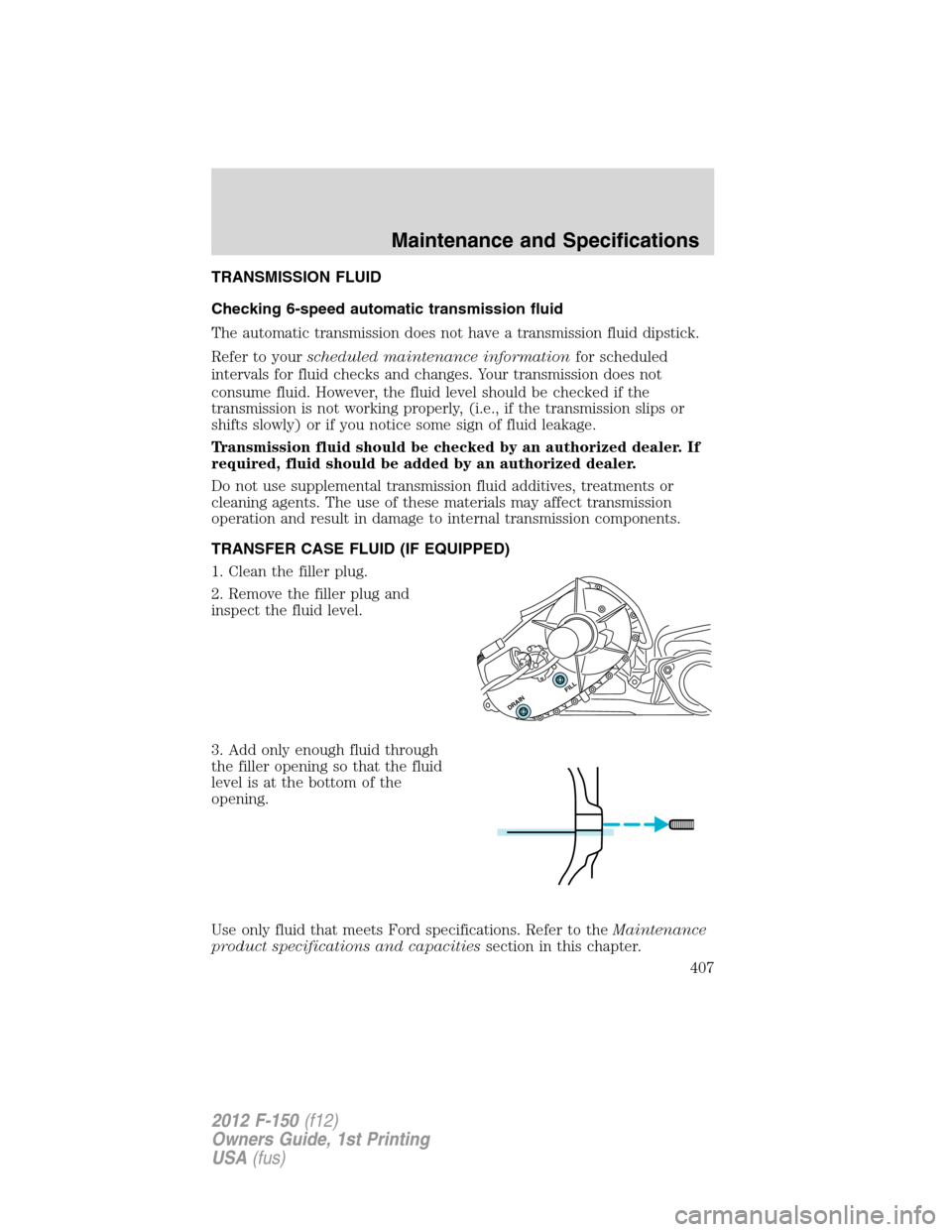
TRANSFER CASE FLUID (IF EQUIPPED)
1. Clean the filler plug.
2. Remove the filler plug and
inspect the fluid level.
3. Add only enough fluid through
the filler opening so that the fluid
level is at the bottom of the
opening.
Use only fluid that meets Ford specifications. Refer to theMaintenance
product specifications and capacitiessection in this chapter.
D
R
A
IN
F
IL
L
Maintenance and Specifications
407
2012 F-150(f12)
Owners Guide, 1st Printing
USA(fus)
Page 416 of 462

Item CapacityFord part name or
equivalentFord part number / Ford
specification
3.7L engine coolant 16.0 quarts (15.1L)
Motorcraft�Specialty Orange
Engine Coolant
3
•VC-3-B (US)
•CVC-3-B (Canada) /
WSS-M97B44-D 5.0L engine coolant 17.0 quarts (16.1L)
6.2L engine coolant 19.5 quarts (18.5L)
3.5L EcoBoost™
engine coolant16.5 quarts (15.6L)
Front axle (4X4) 3.5 pints (1.8L)Motorcraft�SAE 80W-90
Premium Rear Axle LubricantXY-80W-90-QL /
WSP-M2C197-A
Rear axle fluid 5.5 pints (2.6L)
4
Motorcraft�SAE 75W-140
Rear Synthetic Axle
Lubricant
5
XY-75W140-QL /
WSL-M2C192-A
Transmission
/steering/parking brake
linkages and pivots, brake
pedal shaft— Premium Long-Life GreaseXG-1-C /
ESA-M1C75-B
Hinges, latches, striker
plates, seat tracks, fuel filler
door hinge and door check
arm—Multi-Purpose Grease
(Lithium grease)XG-4 or XL-5 or equivalent /
ESB-M1C93-B
Power steering fluid
(6.2L engine only)Fill to between MIN
and MAX lines on
reservoirMotorcraft�
MERCON�V
AT FXT-5-QM /
MERCON�V
Transfer case fluid
(4X4 ESOF)1.5 quarts (1.4L)
6
Motorcraft�Transfer Case
FluidXL-12 /
—
Transfer case fluid
(torque on demand)1.5 quarts (1.4L)Motorcraft�
MERCON�LV
AT FXT-10-QLV /
MERCON�LV
Maintenance and Specifications
416
2012 F-150(f12)
Owners Guide, 1st Printing
USA(fus)
Page 417 of 462
Item CapacityFord part name or
equivalentFord part number / Ford
specification
Automatic transmission fluid
(6R80)12.1 quarts (11.7L)
7
(3.7L engine)
Motorcraft�
MERCON�LV
AT F
8
XT-10-QLV /
MERCON�LV 13.1 quarts (12.4L)
(5.0L engine)
13.1 quarts
(12.4L)
(6.2L engine)
13.1 quarts
(12.4L)
(3.5L EcoBoost™
engine)
Windshield washer fluid Fill as requiredMotorcraft�Premium
Windshield Washer
Concentrate (US)
Premium Quality Windshield
Washer Fluid (Canada)ZC-32-A (US)
CXC-37-(A, B, D, and F)
(Canada) /
WSB-M8B16-A2/- -
Fuel tank
Reg. Cab 6.5’ box /
SuperCab 5.5’ box26.0 gallons (98.4L) — —
Fuel tank SuperCrew 5.5’
box26.0 gallons (98.4L)
Standard
36.0 gallons (136.2L)
Optional——
Fuel tank SuperCrew 6.5’
box26.0 gallons (98.4L)
Standard
36.0 gallons (136.2L)
Optional——
Maintenance and Specifications
417
2012 F-150(f12)
Owners Guide, 1st Printing
USA(fus)
Page 418 of 462

Item CapacityFord part name or
equivalentFord part number / Ford
specification
Fuel tank
Reg. Cab 8’ box /
SuperCab 6.5’ box /
SuperCab 8’ box26.0 gallons (98.4L)
Standard
36.0 gallons (136.2L)
Optional——
1Use of synthetic or synthetic blend motor oil is not mandatory. Engine oil need only meet the
requirements of Ford specification WSS-M2C945-A and the API Certification mark.2Use of synthetic or synthetic blend motor oil is not mandatory. Engine oil need only meet the
requirements of Ford specification WSS-M2C946-A and the API Certification mark.3Add the coolant type originally equipped in your vehicle.4Service refill capacity is determined by filling the axle to 1/4-9/16 inch (6-14 mm) below the
bottom of the filler hole with the vehicle on a level surface.
Add 4 oz. (118 ml) of Additive Friction Modifier XL-3 or equivalent meeting Ford specification
EST-M2C118-A, for complete fill of 8.8 inch Traction-Lok axles.5Your vehicle’s rear axle is filled with a synthetic rear axle lubricant and is considered lubricated
for life. These lubricants do not need to be checked or changed unless a leak is suspected, service
is required or the axle assembly has been submerged in water. The axle lubricant should be
changed any time the rear axle has been submerged in water.6Service refill capacity is determined by filling the transfer case to the bottom of the filler hole
with the vehicle on a level surface.7Approximate dry fill capacity including transmission fluid cooling system, actual refill capacities
will vary based on vehicle application and transmission fluid cooling system (i.e. coolers size,
cooling lines, auxiliary cooler capacities). The amount of transmission fluid and fluid level should
be set by the indication on the dipstick’s normal operating range.8Automatic transmissions that require MERCON�LV should only use MERCON�LV fluid. Refer to
scheduled maintenance informationto determine the correct service interval. Use of any fluid
other than the recommended fluid may cause transmission damage.
Maintenance and Specifications
418
2012 F-150(f12)
Owners Guide, 1st Printing
USA(fus)
Page 423 of 462
TRANSMISSION CODE DESIGNATIONS
You can find a transmission code on
the Safety Compliance Certification
Label. The following table tells you
which transmission each code
represents.
Description Code
Six-speed automatic (6R80) 6
Maintenance and Specifications
423
2012 F-150(f12)
Owners Guide, 1st Printing
USA(fus)
Page 435 of 462

Multi-point inspection
In order to keep your vehicle running right, it is important to have the
systems on your vehicle checked regularly. This can help identify
potential issues and prevent major problems. Ford Motor Company
recommends the following multi-point inspection be performed at every
scheduled maintenance interval to help ensure your vehicle keeps
running great.
Multi-point inspection – Recommended each visit
Accessory drive belt(s) Half-shaft dust boots (if equipped)
Battery performance Horn operation
Clutch operation (if equipped) Radiator, cooler, heater and A/C hoses
Engine air filter Suspension component for leaks or
damage
Exhaust system Steering and linkage
Exterior lamps and hazard
warning system operationTires for wear and proper pressure,
including spare
Fluid levels*; fill if necessary Windshield for cracks, chips or pits
For oil and fluid leaks Washer spray and wiper operation
*Brake, coolant recovery reservoir, manual and automatic transmission
(with an underhood dipstick), power steering (if equipped) and
window washer
Be sure to ask your dealership service advisor or technician about the
multi-point vehicle inspection. It’s a comprehensive way to perform a
thorough inspection of your vehicle. It’s your checklist that gives you
immediate feedback on the overall condition of your vehicle. You’ll know
what’s been checked, what’s okay, as well as those things that may
require future or immediate attention. The multi-point vehicle inspection
is one more way to keep your vehicle running great!
Scheduled Maintenance
435
2012 F-150(f12)
Owners Guide, 1st Printing
USA(fus)
Page 438 of 462

Normal Scheduled Maintenance
At every oil change
interval as indicated
by the message
centerChange engine oil and filter
Rotate tires, inspect tire wear and measure tread
depth
Perform multi-point inspection (recommended)
Inspect automatic transmission fluid level (if
equipped with dipstick); consult dealer for
requirements
Inspect brake pads, shoes, rotors, drums, brake
linings, hoses and parking brake
Inspect cabin air filter (if equipped)
Inspect engine cooling system strength and hoses
Inspect exhaust system and heat shields
Inspect front axle and U-joints; lubricate if
equipped with grease fittings (4WD vehicles)
Inspect half-shaft boots (if equipped)
Inspect steering linkage, ball joints, suspension,
tie-rod ends, driveshaft and U-joints; lubricate if
equipped with grease fittings
Inspect wheels and related components for
abnormal noise, wear, looseness or drag
Reset your Intelligent Oil Life Monitor™ after each engine oil and filter
change; refer to theInstrument Clusterchapter
Do not exceed one year or 10,000 miles (16,000 km) between
service intervals
Scheduled Maintenance
438
2012 F-150(f12)
Owners Guide, 1st Printing
USA(fus)

