2012 FORD F150 trailer
[x] Cancel search: trailerPage 351 of 462
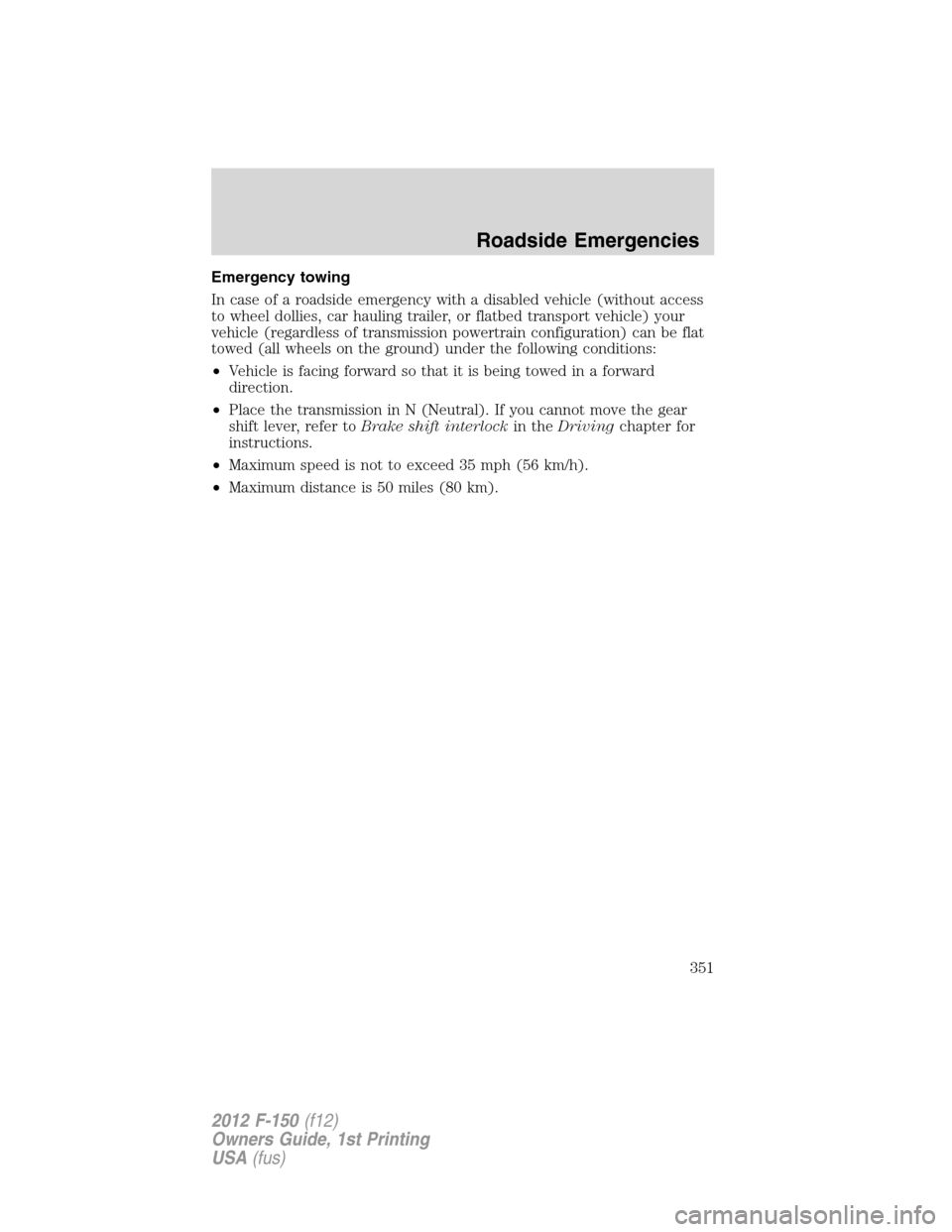
Emergency towing
In case of a roadside emergency with a disabled vehicle (without access
to wheel dollies, car hauling trailer, or flatbed transport vehicle) your
vehicle (regardless of transmission powertrain configuration) can be flat
towed (all wheels on the ground) under the following conditions:
•Vehicle is facing forward so that it is being towed in a forward
direction.
•Place the transmission in N (Neutral). If you cannot move the gear
shift lever, refer toBrake shift interlockin theDrivingchapter for
instructions.
•Maximum speed is not to exceed 35 mph (56 km/h).
•Maximum distance is 50 miles (80 km).
Roadside Emergencies
351
2012 F-150(f12)
Owners Guide, 1st Printing
USA(fus)
Page 391 of 462

Engine fluid temperature management (if equipped)
WARNING:To reduce the risk of collision and injury, be
prepared that the vehicle speed may reduce and the vehicle may
not be able to accelerate with full power until the fluid temperatures
reduce.
Your vehicle has been designed to pull a trailer, but because of the added
load, the vehicle’s engine may temporarily reach higher temperatures
during severe operating conditions such as ascending a long or steep
grade while pulling a trailer in hot ambient temperatures.
At this time, you may notice your engine coolant temperature gauge
needle move toward the H and the POWER REDUCED TO LOWER
TEMP message may appear on the message center.
You may notice a reduction in the vehicle’s speed caused by reduced
engine power. Your vehicle has been designed to enter this mode if
certain high temperature/high load conditions take place in order to
manage the engine’s fluid temperatures. The amount of speed reduction
will depend on the vehicle loading, towing, grade, ambient temperature,
and other factors. If this occurs, there is no need to pull off the road.
The vehicle can continue to be driven while this message is active.
The air conditioning may also cycle on and off during severe operating
conditions to protect overheating of the engine. When the engine coolant
temperature decreases to a more normal operating temperature, the air
conditioning will turn on once again.
If you notice any of the following:
•the engine coolant temperature gauge moves fully into the red (hot)
area
•the coolant temperature warning light illuminates
•the service engine soon indicator illuminates
1. Pull off the road as soon as safely possible and place the vehicle in P
(Park).
2. Leave the engine running until the coolant temperature gauge needle
moves away from the H range. After several minutes, if this does not
happen, follow the remaining steps.
Maintenance and Specifications
391
2012 F-150(f12)
Owners Guide, 1st Printing
USA(fus)
Page 397 of 462

Octane recommendations
3.7L V6/5.0L V8/6.2L V8 engines
“Regular” unleaded gasoline with a pump (R+M)/2 octane rating of 87 is
recommended. Some stations offer fuels posted as “Regular” with an
octane rating below 87, particularly in high altitude areas. Fuels with
octane levels below 87 are not recommended.
3.5L V6 EcoBoost™ engine
“Regular” unleaded gasoline with a pump (R+M)/2 octane rating of 87 is
recommended. Some stations offer fuels posted as “Regular” with an
octane rating below 87, particularly in high altitude areas. Fuels with
octane levels below 87 are not recommended. Premium fuel will provide
improved performance and is recommended for severe duty usage such
as trailer tow.
Do not be concerned if your engine
sometimes knocks lightly. However,
if it knocks heavily while you are
using fuel with the recommended
octane rating, see your authorized
dealer to prevent any engine damage.
FFV engine (if equipped)
If your vehicle is flex fuel capable, it is designed to use Fuel Ethanol
(Ed75–Ed85), “Regular” unleaded gasoline or any mixture of the two
fuels.
Use of other fuels such as Fuel Methanol may cause powertrain
damage, a loss of vehicle performance, and your warranty may be
invalidated.
It is best not to alternate repeatedly between gasoline and E85. If you do
switch fuels, it is recommended that you add as much fuel as
possible—at least half a tank. Do not add less than five gallons (18.9L)
when refueling. You should drive the vehicle immediately after refueling
for at least 5 miles (8 km) to allow the vehicle to adapt to the change in
ethanol concentration.
If you exclusively use E85 fuel, it is recommended to fill the fuel tank
with regular unleaded gasoline at each scheduled oil change.
87(R+M)/2 METHOD
Maintenance and Specifications
397
2012 F-150(f12)
Owners Guide, 1st Printing
USA(fus)
Page 402 of 462
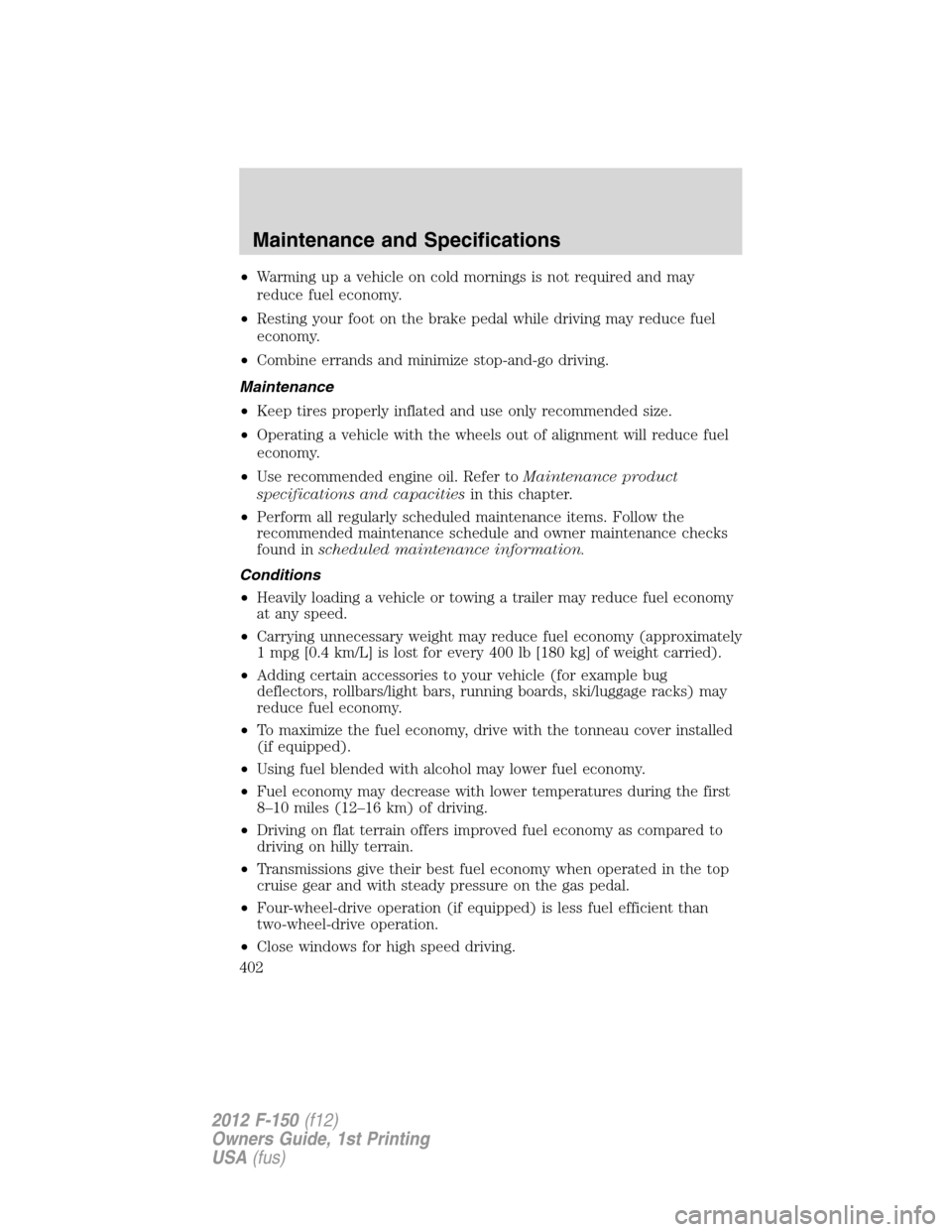
•Warming up a vehicle on cold mornings is not required and may
reduce fuel economy.
•Resting your foot on the brake pedal while driving may reduce fuel
economy.
•Combine errands and minimize stop-and-go driving.
Maintenance
•Keep tires properly inflated and use only recommended size.
•Operating a vehicle with the wheels out of alignment will reduce fuel
economy.
•Use recommended engine oil. Refer toMaintenance product
specifications and capacitiesin this chapter.
•Perform all regularly scheduled maintenance items. Follow the
recommended maintenance schedule and owner maintenance checks
found inscheduled maintenance information.
Conditions
•Heavily loading a vehicle or towing a trailer may reduce fuel economy
at any speed.
•Carrying unnecessary weight may reduce fuel economy (approximately
1 mpg [0.4 km/L] is lost for every 400 lb [180 kg] of weight carried).
•Adding certain accessories to your vehicle (for example bug
deflectors, rollbars/light bars, running boards, ski/luggage racks) may
reduce fuel economy.
•To maximize the fuel economy, drive with the tonneau cover installed
(if equipped).
•Using fuel blended with alcohol may lower fuel economy.
•Fuel economy may decrease with lower temperatures during the first
8–10 miles (12–16 km) of driving.
•Driving on flat terrain offers improved fuel economy as compared to
driving on hilly terrain.
•Transmissions give their best fuel economy when operated in the top
cruise gear and with steady pressure on the gas pedal.
•Four-wheel-drive operation (if equipped) is less fuel efficient than
two-wheel-drive operation.
•Close windows for high speed driving.
Maintenance and Specifications
402
2012 F-150(f12)
Owners Guide, 1st Printing
USA(fus)
Page 425 of 462
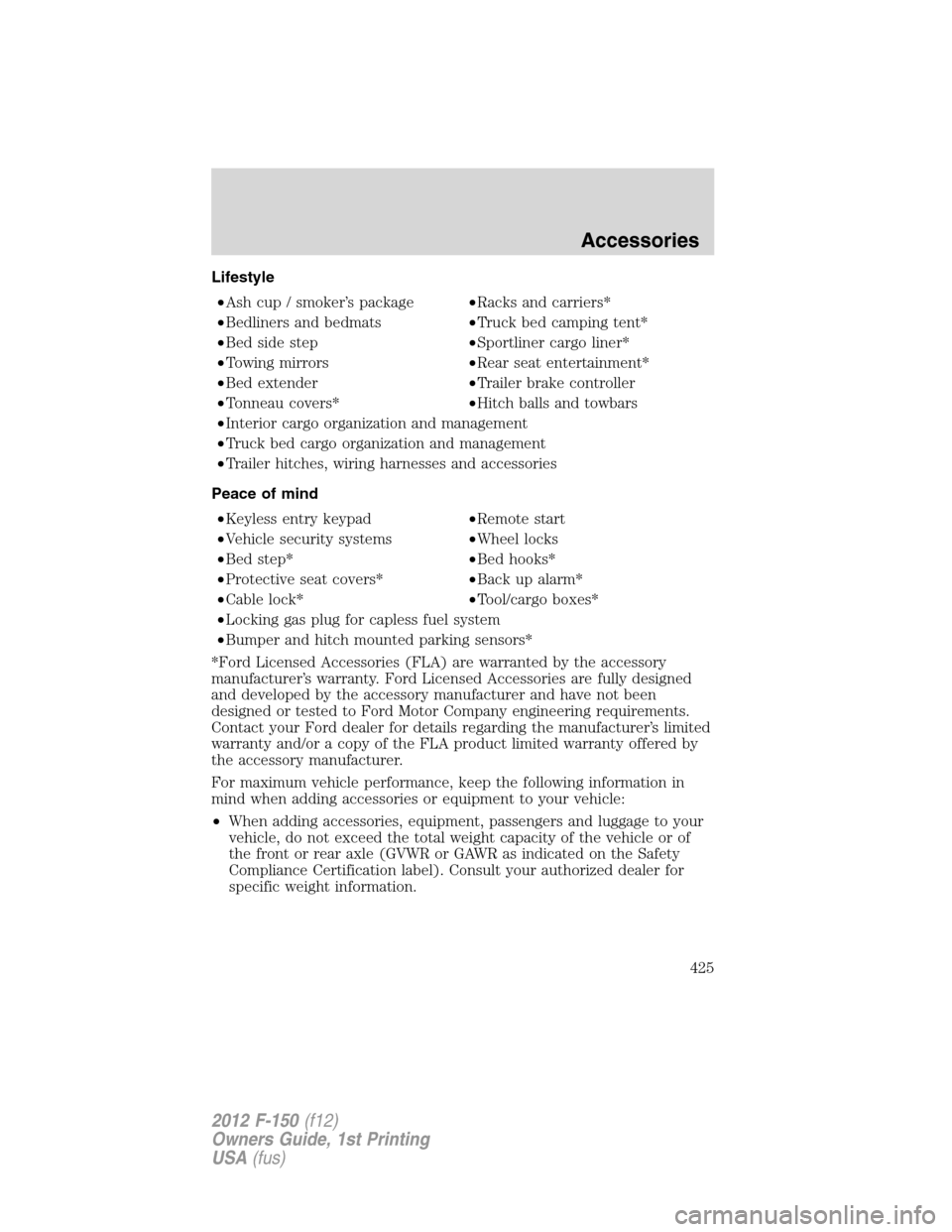
Lifestyle
•Ash cup / smoker’s package•Racks and carriers*
•Bedliners and bedmats•Truck bed camping tent*
•Bed side step•Sportliner cargo liner*
•Towing mirrors•Rear seat entertainment*
•Bed extender•Trailer brake controller
•Tonneau covers*•Hitch balls and towbars
•Interior cargo organization and management
•Truck bed cargo organization and management
•Trailer hitches, wiring harnesses and accessories
Peace of mind
•Keyless entry keypad•Remote start
•Vehicle security systems•Wheel locks
•Bed step*•Bed hooks*
•Protective seat covers*•Back up alarm*
•Cable lock*•Tool/cargo boxes*
•Locking gas plug for capless fuel system
•Bumper and hitch mounted parking sensors*
*Ford Licensed Accessories (FLA) are warranted by the accessory
manufacturer’s warranty. Ford Licensed Accessories are fully designed
and developed by the accessory manufacturer and have not been
designed or tested to Ford Motor Company engineering requirements.
Contact your Ford dealer for details regarding the manufacturer’s limited
warranty and/or a copy of the FLA product limited warranty offered by
the accessory manufacturer.
For maximum vehicle performance, keep the following information in
mind when adding accessories or equipment to your vehicle:
•When adding accessories, equipment, passengers and luggage to your
vehicle, do not exceed the total weight capacity of the vehicle or of
the front or rear axle (GVWR or GAWR as indicated on the Safety
Compliance Certification label). Consult your authorized dealer for
specific weight information.
Accessories
425
2012 F-150(f12)
Owners Guide, 1st Printing
USA(fus)
Page 447 of 462

SPECIAL OPERATING CONDITIONS - 3.5L, 3.7L AND 5.0L ENGINES
If you operate your vehicleprimarilyin any of the following conditions,
you need to perform additional maintenance as indicated. If you
occasionallyoperate your vehicle under any of these conditions, it is
not necessary to perform the additional maintenance. For specific
recommendations, see your dealership service advisor or technician.
Towing a trailer or using a camper or car-top carrier
As required Change engine oil and filter as indicated by
message center and perform services listed in
Normal Scheduled Maintenance chart
Inspect frequently,
service as requiredInspect and lubricate U-joints
See axle maintenance items underExceptions
Every 60,000 miles
(96,000 km)Change transfer case fluid (4WD vehicles)
Perform the services in the preceding table when specified or within
3,000 miles (4,800 km) of the OIL CHANGE REQUIRED message
appearing in the message center.
Example #1:The OIL CHANGE REQUIRED message comes on at
28,751 miles (46,270 km); perform the 30,000 mile (48,000 km)
automatic transmission fluid replacement.
Example #2:The OIL CHANGE REQUIRED message hasnotcome on
but the odometer reads 30,000 miles (48,000 km); perform the engine air
filter replacement. (i.e., Intelligent Oil Life Monitor™ was reset at
25,000 miles [40,000 km].)
Scheduled Maintenance
447
2012 F-150(f12)
Owners Guide, 1st Printing
USA(fus)
Page 449 of 462
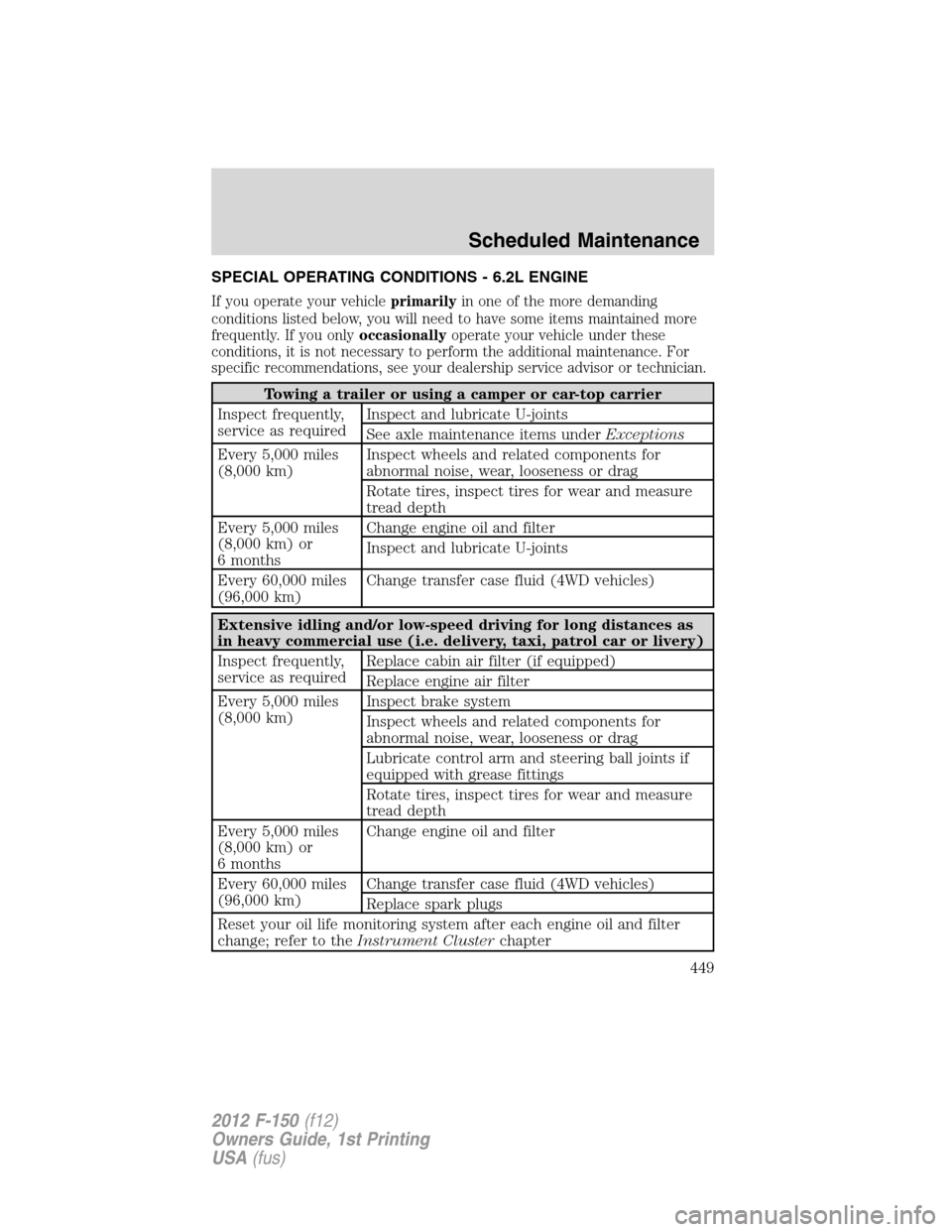
SPECIAL OPERATING CONDITIONS - 6.2L ENGINE
If you operate your vehicleprimarilyin one of the more demanding
conditions listed below, you will need to have some items maintained more
frequently. If you onlyoccasionallyoperate your vehicle under these
conditions, it is not necessary to perform the additional maintenance. For
specific recommendations, see your dealership service advisor or technician.
Towing a trailer or using a camper or car-top carrier
Inspect frequently,
service as requiredInspect and lubricate U-joints
See axle maintenance items underExceptions
Every 5,000 miles
(8,000 km)Inspect wheels and related components for
abnormal noise, wear, looseness or drag
Rotate tires, inspect tires for wear and measure
tread depth
Every 5,000 miles
(8,000 km) or
6 monthsChange engine oil and filter
Inspect and lubricate U-joints
Every 60,000 miles
(96,000 km)Change transfer case fluid (4WD vehicles)
Extensive idling and/or low-speed driving for long distances as
in heavy commercial use (i.e. delivery, taxi, patrol car or livery)
Inspect frequently,
service as requiredReplace cabin air filter (if equipped)
Replace engine air filter
Every 5,000 miles
(8,000 km)Inspect brake system
Inspect wheels and related components for
abnormal noise, wear, looseness or drag
Lubricate control arm and steering ball joints if
equipped with grease fittings
Rotate tires, inspect tires for wear and measure
tread depth
Every 5,000 miles
(8,000 km) or
6 monthsChange engine oil and filter
Every 60,000 miles
(96,000 km)Change transfer case fluid (4WD vehicles)
Replace spark plugs
Reset your oil life monitoring system after each engine oil and filter
change; refer to theInstrument Clusterchapter
Scheduled Maintenance
449
2012 F-150(f12)
Owners Guide, 1st Printing
USA(fus)
Page 453 of 462
EXCEPTIONS
There are several exceptions to the Normal Schedule. They are listed
below:
Normal vehicle axle maintenance:Rear axles and power take-off
(PTO) units with synthetic fluid and light-duty trucks equipped with
Ford-design axles are lubricated for life; do not check or change fluid
unless a leak is suspected, service is required or the assembly has been
submerged in water. During long periods of trailer towing with outside
temperatures above 70°F (21°C) and at wide-open throttle for long
periods above 45 mph (72 km/h), non-synthetic rear axle fluids should
be changed every 3,000 miles (4,800 km) or three months, whichever
comes first. This interval can be waived if the axle is filled with 75W140
synthetic gear fluid meeting Ford specification WSL-M2C192-A, part
number F1TZ-19580-B or equivalent. Add friction modifier XL-3
(EST-M2C118-A) or equivalent for complete refill of Traction-Lok rear
axles (refer toMaintenance product specifications and capacitiesin
theMaintenance and Specificationschapter for details).
Police/Taxi/Livery vehicle axle maintenance:Change rear axle fluid
every 100,000 miles (160,000 km). Rear axle fluid change may be waived
if the axle was filled with 75W140 synthetic gear fluid meeting Ford
specification WSL-M2C192-A, part number FITZ-19580-B or equivalent.
Add four ounces (118 mL) of additive friction modifier XL-3
(EST-M2C118-A) or equivalent for complete refill of Traction-Lok rear
axles. The axle fluid should be changed anytime the axle has been
submerged in water
California fuel filter replacement:If the vehicle is registered in
California, the California Air Resources Board has determined that the
failure to perform this maintenance item will not nullify the emission
warranty or limit recall liability prior to the completion of the vehicle’s
useful life. Ford Motor Company, however, urges you to have all
recommended maintenance services performed at the specified intervals
and to record all vehicle service.
Class A Motorhome:Change brake fluid every two years.
Scheduled Maintenance
453
2012 F-150(f12)
Owners Guide, 1st Printing
USA(fus)