2012 FORD F150 engine
[x] Cancel search: enginePage 266 of 462
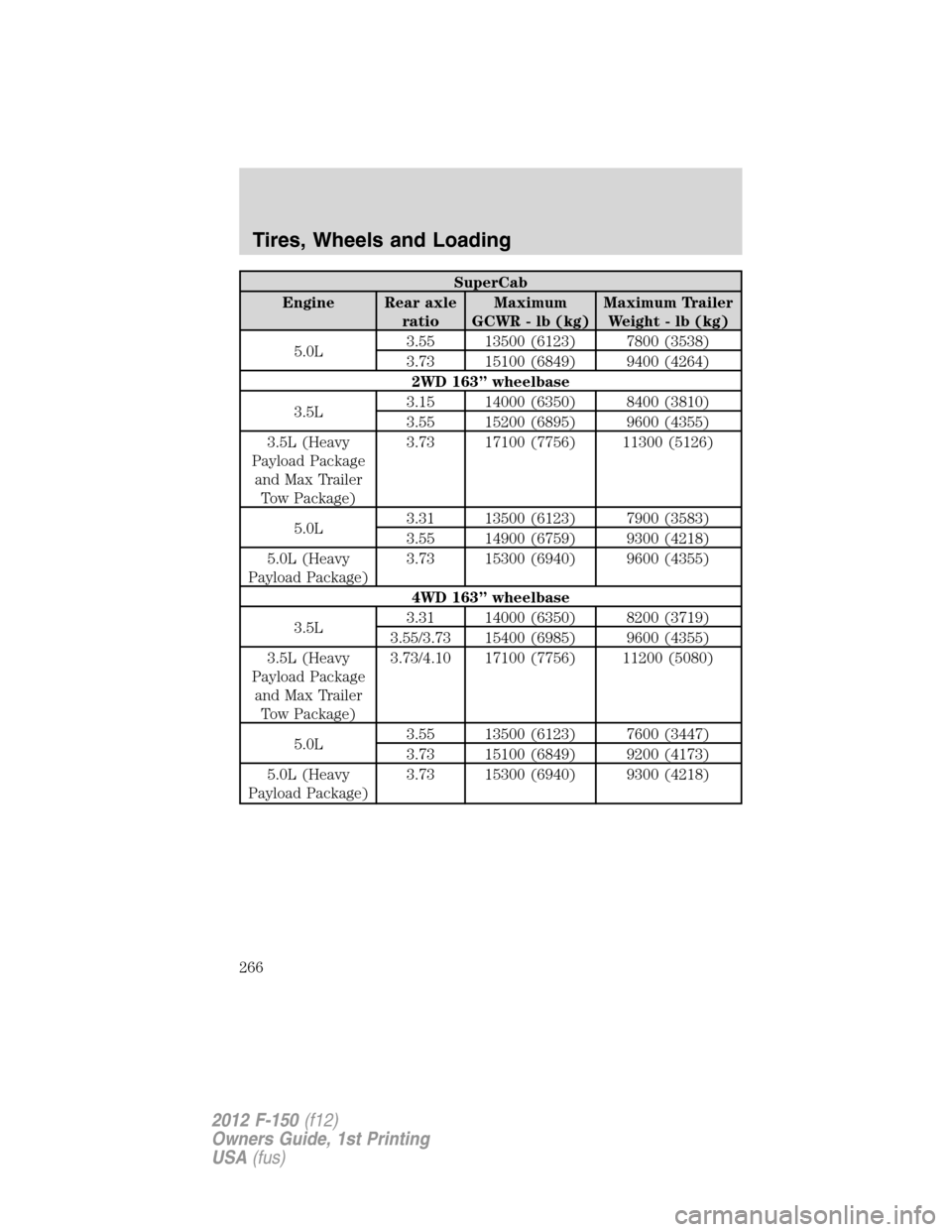
SuperCab
Engine Rear axle
ratioMaximum
GCWR - lb (kg)Maximum Trailer
Weight - lb (kg)
5.0L3.55 13500 (6123) 7800 (3538)
3.73 15100 (6849) 9400 (4264)
2WD 163” wheelbase
3.5L3.15 14000 (6350) 8400 (3810)
3.55 15200 (6895) 9600 (4355)
3.5L (Heavy
Payload Package
and Max Trailer
Tow Package)3.73 17100 (7756) 11300 (5126)
5.0L3.31 13500 (6123) 7900 (3583)
3.55 14900 (6759) 9300 (4218)
5.0L (Heavy
Payload Package)3.73 15300 (6940) 9600 (4355)
4WD 163” wheelbase
3.5L3.31 14000 (6350) 8200 (3719)
3.55/3.73 15400 (6985) 9600 (4355)
3.5L (Heavy
Payload Package
and Max Trailer
Tow Package)3.73/4.10 17100 (7756) 11200 (5080)
5.0L3.55 13500 (6123) 7600 (3447)
3.73 15100 (6849) 9200 (4173)
5.0L (Heavy
Payload Package)3.73 15300 (6940) 9300 (4218)
Tires, Wheels and Loading
266
2012 F-150(f12)
Owners Guide, 1st Printing
USA(fus)
Page 267 of 462
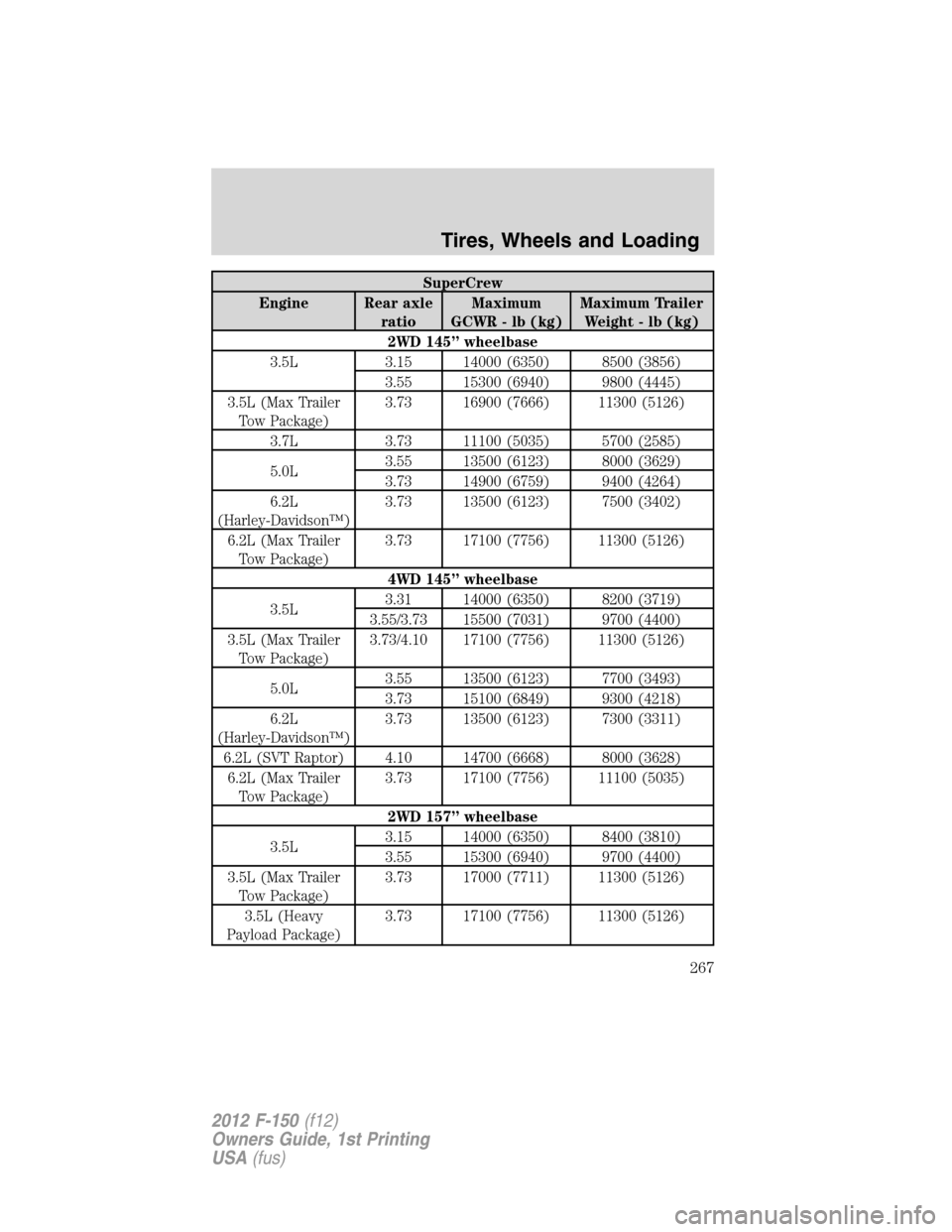
SuperCrew
Engine Rear axle
ratioMaximum
GCWR - lb (kg)Maximum Trailer
Weight - lb (kg)
2WD 145” wheelbase
3.5L 3.15 14000 (6350) 8500 (3856)
3.55 15300 (6940) 9800 (4445)
3.5L (Max Trailer
Tow Package)3.73 16900 (7666) 11300 (5126)
3.7L 3.73 11100 (5035) 5700 (2585)
5.0L3.55 13500 (6123) 8000 (3629)
3.73 14900 (6759) 9400 (4264)
6.2L
(Harley-Davidson™)3.73 13500 (6123) 7500 (3402)
6.2L (Max Trailer
Tow Package)3.73 17100 (7756) 11300 (5126)
4WD 145” wheelbase
3.5L3.31 14000 (6350) 8200 (3719)
3.55/3.73 15500 (7031) 9700 (4400)
3.5L (Max Trailer
Tow Package)3.73/4.10 17100 (7756) 11300 (5126)
5.0L3.55 13500 (6123) 7700 (3493)
3.73 15100 (6849) 9300 (4218)
6.2L
(Harley-Davidson™)3.73 13500 (6123) 7300 (3311)
6.2L (SVT Raptor) 4.10 14700 (6668) 8000 (3628)
6.2L (Max Trailer
Tow Package)3.73 17100 (7756) 11100 (5035)
2WD 157” wheelbase
3.5L3.15 14000 (6350) 8400 (3810)
3.55 15300 (6940) 9700 (4400)
3.5L (Max Trailer
Tow Package)3.73 17000 (7711) 11300 (5126)
3.5L (Heavy
Payload Package)3.73 17100 (7756) 11300 (5126)
Tires, Wheels and Loading
267
2012 F-150(f12)
Owners Guide, 1st Printing
USA(fus)
Page 268 of 462
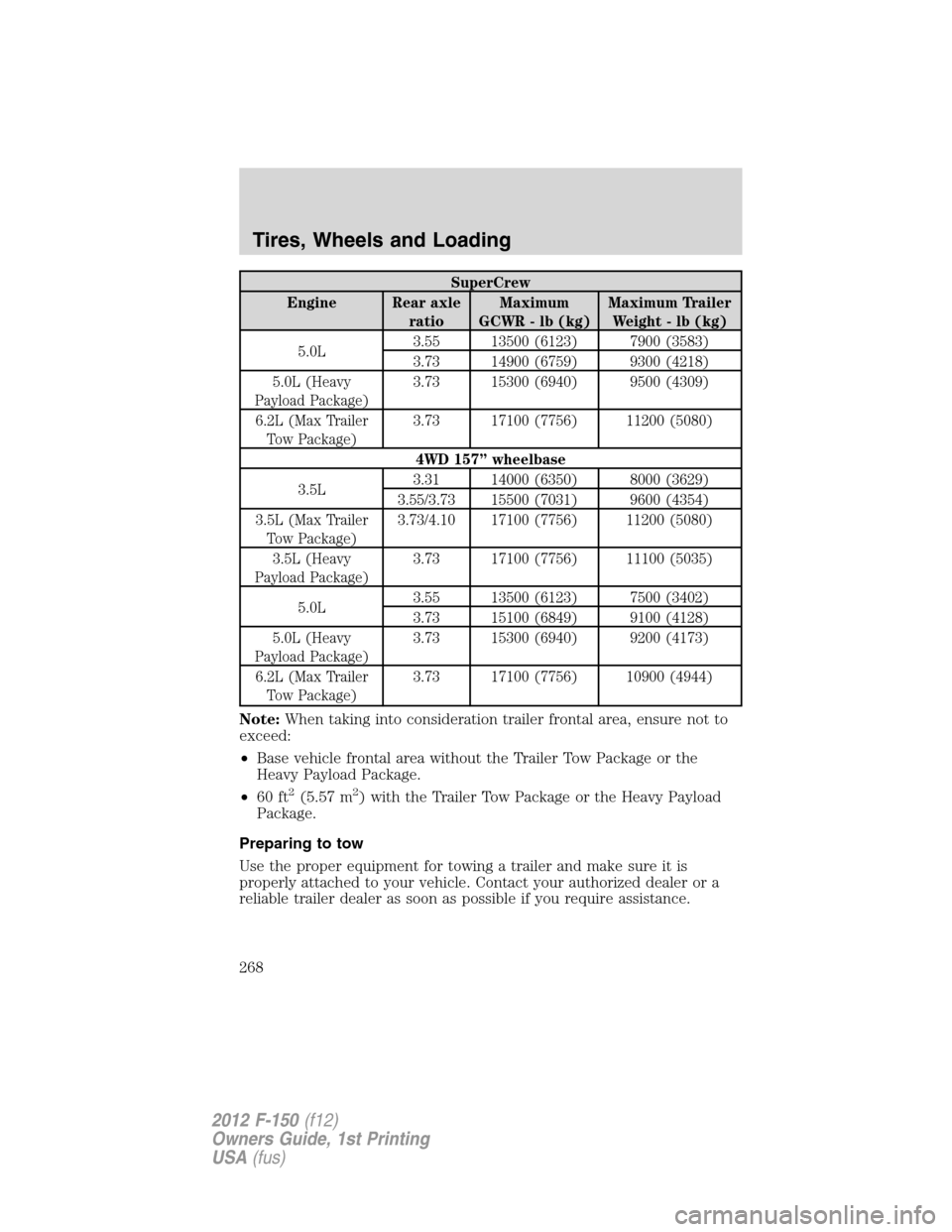
SuperCrew
Engine Rear axle
ratioMaximum
GCWR - lb (kg)Maximum Trailer
Weight - lb (kg)
5.0L3.55 13500 (6123) 7900 (3583)
3.73 14900 (6759) 9300 (4218)
5.0L (Heavy
Payload Package)3.73 15300 (6940) 9500 (4309)
6.2L (Max Trailer
Tow Package)3.73 17100 (7756) 11200 (5080)
4WD 157” wheelbase
3.5L3.31 14000 (6350) 8000 (3629)
3.55/3.73 15500 (7031) 9600 (4354)
3.5L (Max Trailer
Tow Package)3.73/4.10 17100 (7756) 11200 (5080)
3.5L (Heavy
Payload Package)3.73 17100 (7756) 11100 (5035)
5.0L3.55 13500 (6123) 7500 (3402)
3.73 15100 (6849) 9100 (4128)
5.0L (Heavy
Payload Package)3.73 15300 (6940) 9200 (4173)
6.2L (Max Trailer
Tow Package)3.73 17100 (7756) 10900 (4944)
Note:When taking into consideration trailer frontal area, ensure not to
exceed:
•Base vehicle frontal area without the Trailer Tow Package or the
Heavy Payload Package.
•60 ft
2(5.57 m2) with the Trailer Tow Package or the Heavy Payload
Package.
Preparing to tow
Use the proper equipment for towing a trailer and make sure it is
properly attached to your vehicle. Contact your authorized dealer or a
reliable trailer dealer as soon as possible if you require assistance.
Tires, Wheels and Loading
268
2012 F-150(f12)
Owners Guide, 1st Printing
USA(fus)
Page 275 of 462

Trailer towing tips
•Practice turning, stopping and backing-up before starting on a trip to
get the feel of the vehicle-trailer combination. When turning, make
wider turns so the trailer wheels will clear curbs and other obstacles.
•To aid in engine/transmission cooling and A/C efficiency during hot
weather while stopped in traffic, place the gearshift lever in P (Park).
•After you have traveled 50 miles (80 km), thoroughly check your
hitch, electrical connections and trailer wheel lug nuts.
•If you are driving down a long or steep hill, shift to a lower gear. Do
not apply the brakes continuously, as they may overheat and become
less effective. Also, see the information on tow/haul mode operation
underAutomatic transmission operationin theDrivingchapter.
•If you will be towing a trailer frequently in hot weather, hilly
conditions, at GCWR, or any combination of these factors, consider
refilling your rear axle with synthetic gear lube if not already so
equipped. Refer to theMaintenance and Specificationschapter for
the lubricant specification. Remember that regardless of the rear axle
lube used, do not tow a trailer for the first 1,000 miles (1,600 km) of a
new vehicle, and that the first 500 miles (800 km) of towing be done
at no faster than 70 mph (113 km/h) with no full throttle starts.
•Vehicles with trailers should not be parked on a grade. If you must
park on a grade, place wheel chocks under the trailer’s wheels.
Launching or retrieving a boat
Disconnect the wiring to the trailer before backing the trailer
into the water. Reconnect the wiring to the trailer after the
trailer is removed from the water.
When backing down a ramp during boat launching or retrieval:
•Do not allow the static water level to rise above the bottom edge of
the rear bumper.
•Do not allow waves to break higher than 6 in (15 cm) above the
bottom edge of the rear bumper.
Exceeding these limits may allow water to enter vehicle components:
•Causing internal damage to the components.
•Affecting driveability, emissions and reliability.
Replace the rear axle lubricant any time the axle has been submerged in
water. Rear axle lubricant quantities are not to be checked or changed
unless a leak is suspected or repair required.
Tires, Wheels and Loading
275
2012 F-150(f12)
Owners Guide, 1st Printing
USA(fus)
Page 276 of 462

RECREATIONAL TOWING
Note:Put your climate control system in recirculated air mode to
prevent exhaust fumes from entering the vehicle. Refer to theClimate
Controlschapter.
Follow these guidelines if you need to tow your vehicle behind another
vehicle, such as a motor home. The guidelines are designed to prevent
damage to your vehicle and its transmission after it is hooked-up to the
tow vehicle or tow dolly.
2WD vehiclescannot be towed with any wheels on the ground as
vehicle or transmission damage may occur. The vehicle must be towed
with all four wheels off the ground (i.e. with a car-hauling trailer).
4WD vehiclescan only be towed with all wheels on the ground by
placing the transfer case in its neutral position and engaging the
four-wheel-down towing feature. Perform the steps outlined in the
Four-wheel-down towingsection after positioning your vehicle behind
the tow vehicle and properly securing them together
Four-wheel-down towing
1. Turn the ignition to the on position; do not start the engine.
2. Press and hold the brake pedal.
3. Shift the 4WD switch to 2H.
4. Shift the transmission to N (Neutral).
5. Rotate the 4WD switch from 2H to 4L and back to 2H five times
within seven seconds.
•If completed successfully, the instrument cluster displaysNEUTRAL
TOW LEAVE IN NorNEUTRAL TOW ENABLED LEAVE
TRANSMISSION IN NEUTRAL, indicating that the vehicle is safe
to tow with all wheels on the ground.
•If the message is not shown in the display, the procedure must be
performed again from the beginning.
•An audible noise may be heard as the transfer case shifts into its
neutral position; this is normal.
6. Leave the transmission in N (Neutral) and turn the ignition as far as it
will go toward the off position (it will not turn fully off when the
transmission is in N [Neutral]). The key must be left in the ignition while
towing. To lock and unlock your vehicle, use the keyless entry keypad or
extra set of keys.
7. Release the brake pedal.
Tires, Wheels and Loading
276
2012 F-150(f12)
Owners Guide, 1st Printing
USA(fus)
Page 277 of 462

WARNING:Do not disconnect the battery during recreational
towing. Doing so will prevent the transfer case from shifting
properly and may cause the vehicle to roll even if the transmission is in
P (Park).
WARNING:Shifting the transfer case to its neutral position for
recreational towing may cause the vehicle to be able to roll even
if the transmission is in P (Park). The driver or others could be
injured. Make sure the foot brake is depressed and the vehicle is in a
secure and safe position while the transfer case is being shifted to its
neutral position.
WARNING:Failing to put the transfer case in its neutral
position will damage vehicle components.
Note:Four-wheel-down towing status can be checked at any time by
opening the driver’s door or turning the ignition to the accessory or on
position and verifying the NEUTRAL TOW ENABLED message is
displayed in the cluster.
To exit four-wheel-down towing and return the transfer case to its 2H
position:
1. With the vehicle still properly secured to the tow vehicle, press and
hold the brake pedal.
2. Turn the ignition to the on position; do not start the engine.
3. Shift the transmission out of N (Neutral) and into any gear.
4. Release the brake pedal.
•If completed successfully, the instrument cluster displays4X2,and
NEUTRAL TOW DISABLED.
•If the indicator light and message do not display, the procedure must
be performed again from the beginning.
•An audible noise may be heard as the transfer case shifts out of its
neutral position; this is normal.
5. Apply the parking brake, then disconnect the vehicle from the tow vehicle.
6. Release the parking brake, start the engine, and shift the transmission
to D (Drive) to make sure the transfer case is out of N (Neutral).
7. If the transfer case will not successfully shift out of N (Neutral), set
the parking brake until the vehicle can be serviced.
Tires, Wheels and Loading
277
2012 F-150(f12)
Owners Guide, 1st Printing
USA(fus)
Page 278 of 462

STARTING
Positions of the ignition
1. Off — locks the automatic
transmission gearshift lever and
allows key removal.Note:In order to
switch off the engine while the
vehicle is in motion, shift to neutral
and use the brakes to bring the
vehicle to a safe stop. After the
vehicle has stopped, turn the engine
off and shift into park. Then, turn the
key to the accessory or off position.
Note:The ignition key cannot be
removed from the ignition unless the gearshift lever is securely latched
in P (Park).
2. Accessory — allows the electrical accessories such as the radio to
operate while the engine is not running.
3. On — all electrical circuits operational. Warning lights illuminated. Key
position when driving.
4. Start — cranks the engine. Release the key as soon as the engine starts.
Note:Do not store the key in the ignition after the vehicle is turned off
and you have left the vehicle. This could cause a drain on the battery.
Preparing to start your vehicle
Engine starting is controlled by the powertrain control system.
This system meets all Canadian interference-causing equipment standard
requirements regulating the impulse electrical field strength of radio noise.
When starting a fuel-injected engine, don’t press the accelerator before
or during starting. Only use the accelerator when you have difficulty
starting the engine. For more information on starting the vehicle, refer to
Starting the enginein this chapter.
WARNING:Extended idling at high engine speeds can produce
very high temperatures in the engine and exhaust system,
creating the risk of fire or other damage.
Driving
278
2012 F-150(f12)
Owners Guide, 1st Printing
USA(fus)
Page 279 of 462

WARNING:Do not park, idle, or drive your vehicle in dry grass
or other dry ground cover. The emission system heats up the
engine compartment and exhaust system, which can start a fire.
WARNING:Do not start your vehicle in a closed garage or in
other enclosed areas. Exhaust fumes can be toxic. Always open
the garage door before you start the engine. SeeGuarding against
exhaust fumesin this chapter for more instructions.
WARNING:If you smell exhaust fumes inside your vehicle, have
your dealer inspect your vehicle immediately. Do not drive if you
smell exhaust fumes.
Important safety precautions
A computer system controls the engine’s idle revolutions per minute
(RPM). When the engine starts, the idle RPM runs higher than normal in
order to warm the engine. If the engine idle speed does not slow down
automatically, have the vehicle checked. If the vehicle is operated in a
heavy snow storm or blowing snow conditions, the engine air induction
may become partially clogged with snow and/or ice. If this occurs the
engine may experience a significant reduction in power output. At the
earliest opportunity, clear all snow and/or ice away from the air induction
inlet. Do not allow the vehicle to idle for more than 10 minutes at the
higher engine RPM.
Before starting the vehicle:
1. Make sure all vehicle occupants have buckled their safety belts. For
more information on safety belts and their proper usage, refer to the
Seating and Safety Restraintschapter.
2. Make sure the headlamps and vehicle accessories are off.
Driving
279
2012 F-150(f12)
Owners Guide, 1st Printing
USA(fus)