2012 FORD F150 change wheel
[x] Cancel search: change wheelPage 322 of 462

Information on transfer case operation and shifting procedures can be
found in this chapter. Information on transfer case maintenance can be
found in theMaintenance and Specificationschapter. You should
become thoroughly familiar with this information before you operate
your vehicle.
Normal characteristics
On some 4WD models, the initial shift from two-wheel drive to 4x4 while
the vehicle is moving can cause some momentary clunk and ratcheting
sounds. This is the front drivetrain coming up to speed and the
automatic locking hubs engaging and is not cause for concern.
Sand
When driving over sand, try to keep all four wheels on the most solid
area of the trail. Avoid reducing the tire pressures but shift to a lower
gear and drive steadily through the terrain. Apply the accelerator slowly
and avoid spinning the wheels.
Avoid excessive speed because vehicle momentum can work against you
and cause the vehicle to become stuck to the point that assistance may
be required from another vehicle. Remember, you may be able to back
out the way you came if you proceed with caution.
Mud and water
If you must drive through high
water, drive slowly. Traction or
brake capability may be limited.
When driving through water,
determine the depth; avoid water
higher than the bottom of the hubs
(if possible) and proceed slowly. If
the ignition system gets wet, the
vehicle may stall.
Once through water, always try the brakes. Wet brakes do not stop the
vehicle as effectively as dry brakes. Drying can be improved by moving
your vehicle slowly while applying light pressure on the brake pedal.
Be cautious of sudden changes in vehicle speed or direction when you
are driving in mud. Even 4WD vehicles can lose traction in slick mud. As
when you are driving over sand, apply the accelerator slowly and avoid
spinning your wheels. If the vehicle does slide, steer in the direction of
the slide until you regain control of the vehicle.
If the transmission, transfer case or front axle are submerged in water,
their fluids should be checked and changed, if necessary.
Driving
322
2012 F-150(f12)
Owners Guide, 1st Printing
USA(fus)
Page 324 of 462

Descend a hill in the same gear you
would use to climb up the hill to
avoid excessive brake application and
brake overheating. Do not descend in
neutral; instead, disengage overdrive
or manually shift to a lower gear.
When descending a steep hill, avoid
sudden hard braking as you could
lose control. When you brake hard,
the front wheels can’t turn and if
they aren’t turning, you won’t be able
to steer. The front wheels have to be
turning in order to steer the vehicle.
If your vehicle has anti-lock brakes, apply the brakes steadily. Do not
“pump” the brakes.
Driving on snow and ice
4WD vehicles have advantages over 2WD vehicles in snow and ice but
can skid like any other vehicle.
Should you start to slide while driving on snowy or icy roads, turn the
steering wheel in the direction of the slide until you regain control.
Avoid sudden applications of power and quick changes of direction on
snow and ice. Apply the accelerator slowly and steadily when starting
from a full stop.
Avoid sudden braking as well. Although a 4WD vehicle may accelerate
better than a two-wheel drive vehicle in snow and ice, it won’t stop any
faster, because as in other vehicles, braking occurs at all four wheels. Do
not become overconfident as to road conditions.
Make sure you allow sufficient distance between you and other vehicles for
stopping. Drive slower than usual and consider using one of the lower gears.
In emergency stopping situations, apply the brake steadily. Do not “pump”
the brakes. Refer to theBrakessection of this chapter for additional
information on the operation of the Anti-lock Brake System (ABS).
WARNING:If you are driving in slippery conditions that require
tire chains or cables, then it is critical that you drive cautiously.
Keep speeds down, allow for longer stopping distances and avoid
aggressive steering to reduce the chances of a loss of vehicle control
which can lead to serious injury or death. If the rear end of the vehicle
slides while cornering, steer in the direction of the slide until you
regain control of the vehicle.
Driving
324
2012 F-150(f12)
Owners Guide, 1st Printing
USA(fus)
Page 342 of 462
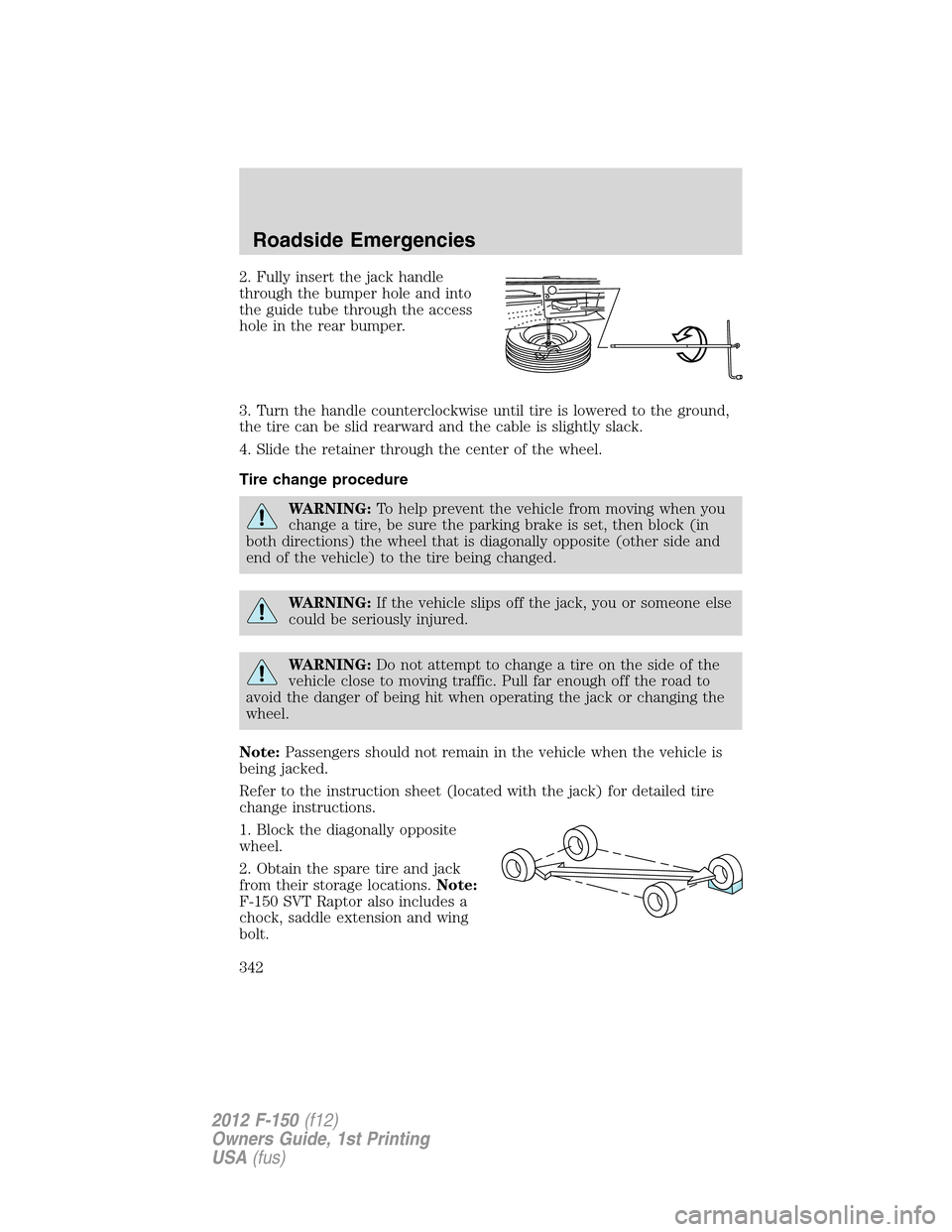
2. Fully insert the jack handle
through the bumper hole and into
the guide tube through the access
hole in the rear bumper.
3. Turn the handle counterclockwise until tire is lowered to the ground,
the tire can be slid rearward and the cable is slightly slack.
4. Slide the retainer through the center of the wheel.
Tire change procedure
WARNING:To help prevent the vehicle from moving when you
change a tire, be sure the parking brake is set, then block (in
both directions) the wheel that is diagonally opposite (other side and
end of the vehicle) to the tire being changed.
WARNING:If the vehicle slips off the jack, you or someone else
could be seriously injured.
WARNING:Do not attempt to change a tire on the side of the
vehicle close to moving traffic. Pull far enough off the road to
avoid the danger of being hit when operating the jack or changing the
wheel.
Note:Passengers should not remain in the vehicle when the vehicle is
being jacked.
Refer to the instruction sheet (located with the jack) for detailed tire
change instructions.
1. Block the diagonally opposite
wheel.
2. Obtain the spare tire and jack
from their storage locations.Note:
F-150 SVT Raptor also includes a
chock, saddle extension and wing
bolt.
Roadside Emergencies
342
2012 F-150(f12)
Owners Guide, 1st Printing
USA(fus)
Page 343 of 462
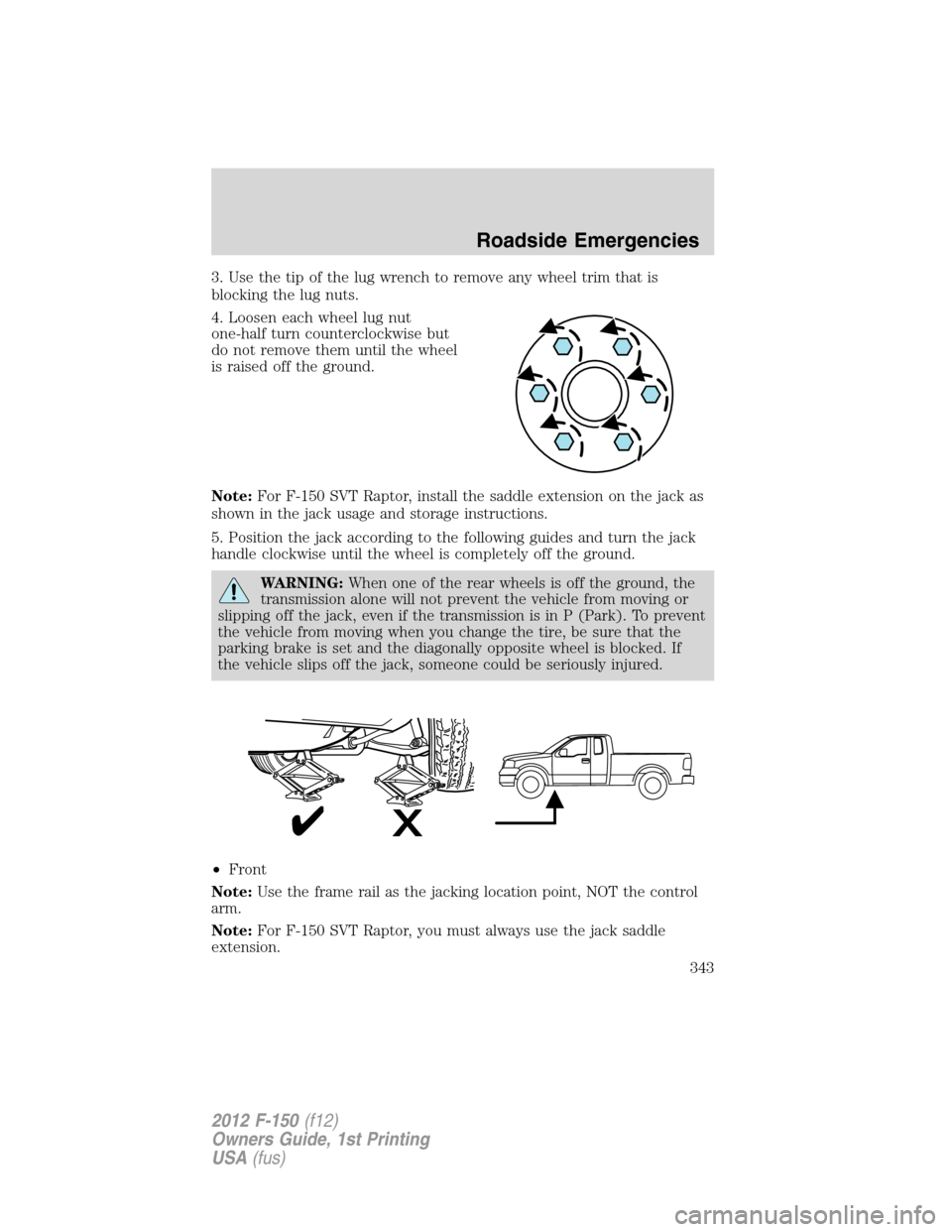
3. Use the tip of the lug wrench to remove any wheel trim that is
blocking the lug nuts.
4. Loosen each wheel lug nut
one-half turn counterclockwise but
do not remove them until the wheel
is raised off the ground.
Note:For F-150 SVT Raptor, install the saddle extension on the jack as
shown in the jack usage and storage instructions.
5. Position the jack according to the following guides and turn the jack
handle clockwise until the wheel is completely off the ground.
WARNING:When one of the rear wheels is off the ground, the
transmission alone will not prevent the vehicle from moving or
slipping off the jack, even if the transmission is in P (Park). To prevent
the vehicle from moving when you change the tire, be sure that the
parking brake is set and the diagonally opposite wheel is blocked. If
the vehicle slips off the jack, someone could be seriously injured.
•Front
Note:Use the frame rail as the jacking location point, NOT the control
arm.
Note:For F-150 SVT Raptor, you must always use the jack saddle
extension.
Roadside Emergencies
343
2012 F-150(f12)
Owners Guide, 1st Printing
USA(fus)
Page 412 of 462

Note:Failure to use the correct air filter element may result in severe
engine damage. The customer warranty may be void for any damage to
the engine if the correct air filter element is not used.
VEHICLE STORAGE
If you plan on storing your vehicle for an extended period of time
(30 days or more), refer to the following maintenance recommendations
to ensure your vehicle stays in good operating condition.
All motor vehicles and their components were engineered and tested for
reliable, regular driving. Long term storage under various conditions may
lead to component degradation or failure unless specific precautions are
taken to preserve the components.
General
•Store all vehicles in a dry, ventilated place.
•Protect from sunlight, if possible.
•If vehicles are stored outside, they require regular maintenance to
protect against rust and damage.
Body
•Wash vehicle thoroughly to remove dirt, grease, oil, tar or mud from
exterior surfaces, rear-wheel housing and underside of front fenders.
See theCleaningchapter for more information.
•Periodically wash vehicles stored in exposed locations.
•Touch-up raw or primed metal to prevent rust.
•Cover chrome and stainless steel parts with a thick coat of auto wax
to prevent discoloration. Re-wax as necessary when the vehicle is
washed. See theCleaningchapter for more information.
•Lubricate all hood, door and trunk lid hinges, and latches with a light
grade oil. See theCleaningchapter for more information.
•Cover interior trim to prevent fading.
•Keep all rubber parts free from oil and solvents.
Engine
•The engine oil and filter should be changed prior to storage, as used
engine oil contain contaminates that may cause engine damage.
•Start the engine every 15 days. Run at fast idle until it reaches normal
operating temperature.
•With your foot on the brake, shift through all the gears while the
engine is running.
Maintenance and Specifications
412
2012 F-150(f12)
Owners Guide, 1st Printing
USA(fus)
Page 438 of 462

Normal Scheduled Maintenance
At every oil change
interval as indicated
by the message
centerChange engine oil and filter
Rotate tires, inspect tire wear and measure tread
depth
Perform multi-point inspection (recommended)
Inspect automatic transmission fluid level (if
equipped with dipstick); consult dealer for
requirements
Inspect brake pads, shoes, rotors, drums, brake
linings, hoses and parking brake
Inspect cabin air filter (if equipped)
Inspect engine cooling system strength and hoses
Inspect exhaust system and heat shields
Inspect front axle and U-joints; lubricate if
equipped with grease fittings (4WD vehicles)
Inspect half-shaft boots (if equipped)
Inspect steering linkage, ball joints, suspension,
tie-rod ends, driveshaft and U-joints; lubricate if
equipped with grease fittings
Inspect wheels and related components for
abnormal noise, wear, looseness or drag
Reset your Intelligent Oil Life Monitor™ after each engine oil and filter
change; refer to theInstrument Clusterchapter
Do not exceed one year or 10,000 miles (16,000 km) between
service intervals
Scheduled Maintenance
438
2012 F-150(f12)
Owners Guide, 1st Printing
USA(fus)
Page 441 of 462

6.2L engine
Miles (x 1,000)* 7.5 15 22.5 30 37.5 45 52.5 60 67.5 75
Kilometers (x 1,000)* 12 24 36 48 60 72 84 96 108 120
Months* 6 12 18 24 30 36 42 48 54 60
Change engine oil and filter• •••••••••
Rotate tires, inspect tire wear and measure tread depth**• •••••••••
Inspect wheels and related components for abnormal noise, wear,
looseness or drag• •••••••••
Perform multi-point inspection (recommended)• •••••••••
Inspect automatic transmission fluid level (if equipped with
dipstick); consult dealer for requirements•••••
Inspect brake pads, shoes, rotors, drums, brake linings, hoses and
parking brake•••••
Inspect engine cooling system for strength and hoses•••••
Inspect exhaust system and heat shields•••••
Inspect front axle and U-joints; lubricate if equipped with grease
fittings (4WD vehicles)•••••
Inspect half-shaft boots (if equipped)•••••
Inspect steering linkage, ball joints, suspension, tie-rod ends,
driveshaft and U-joints; lubricate if equipped with grease fittings•••••
Inspect cabin air filter (if equipped)• ••••
* Whichever comes first
** SVT Raptor vehicles have specific tire rotation intervals; refer to theMaintenancechapter of the supplement
Reset your oil minder system after each engine oil and filter change; refer to theInstrument Clusterchapter
Scheduled Maintenance
441
2012 F-150(f12)
Owners Guide, 1st Printing
USA(fus)
Page 442 of 462

6.2L engine
Miles (x 1,000)* 82.5 90 97.5 105 112.5 120 127.5 135 142.5 150
Kilometers (x 1,000)* 132 144 156 168 180 192 204 216 228 240
Months* 66 72 78 84 90 96 102 108 114 120
Change engine oil and filter••••••••••
Rotate tires, inspect tire wear and measure tread depth**••••••••••
Inspect wheels and related components for abnormal noise,
wear, looseness or drag••••••••••
Perform multi-point inspection (recommended)••••••••••
Inspect automatic transmission fluid level (if equipped with
dipstick); consult dealer for requirements•••••
Inspect brake pads, shoes, rotors, drums, brake linings, hoses
and parking brake•••••
Inspect engine cooling system for strength and hoses•••••
Inspect exhaust system and heat shields•••••
Inspect front axle and U-joints; lubricate if equipped with
grease fittings (4WD vehicles)•••••
Inspect half-shaft boots (if equipped)•••••
Inspect steering linkage, ball joints, suspension, tie-rod ends,
driveshaft and U-joints; lubricate if equipped with grease
fittings•••••
Inspect cabin air filter (if equipped)••• • •
* Whichever comes first
** SVT Raptor vehicles have specific tire rotation intervals; refer to theMaintenancechapter of the supplement
Reset your oil minder system after each engine oil and filter change; refer to theInstrument Clusterchapter
Scheduled Maintenance
442
2012 F-150(f12)
Owners Guide, 1st Printing
USA(fus)