Page 348 of 462
3. Park the booster vehicle close to the hood of the disabled vehicle
making sure the two vehiclesdo nottouch. Set the parking brake on
both vehicles and stay clear of the engine cooling fan and other moving
parts.
4. Check all battery terminals and remove any excessive corrosion before
you attach the battery cables. Ensure that vent caps are tight and level.
5. Turn the heater fan on in both vehicles to protect from any electrical
surges. Turn all other accessories off.
Connecting the jumper cables
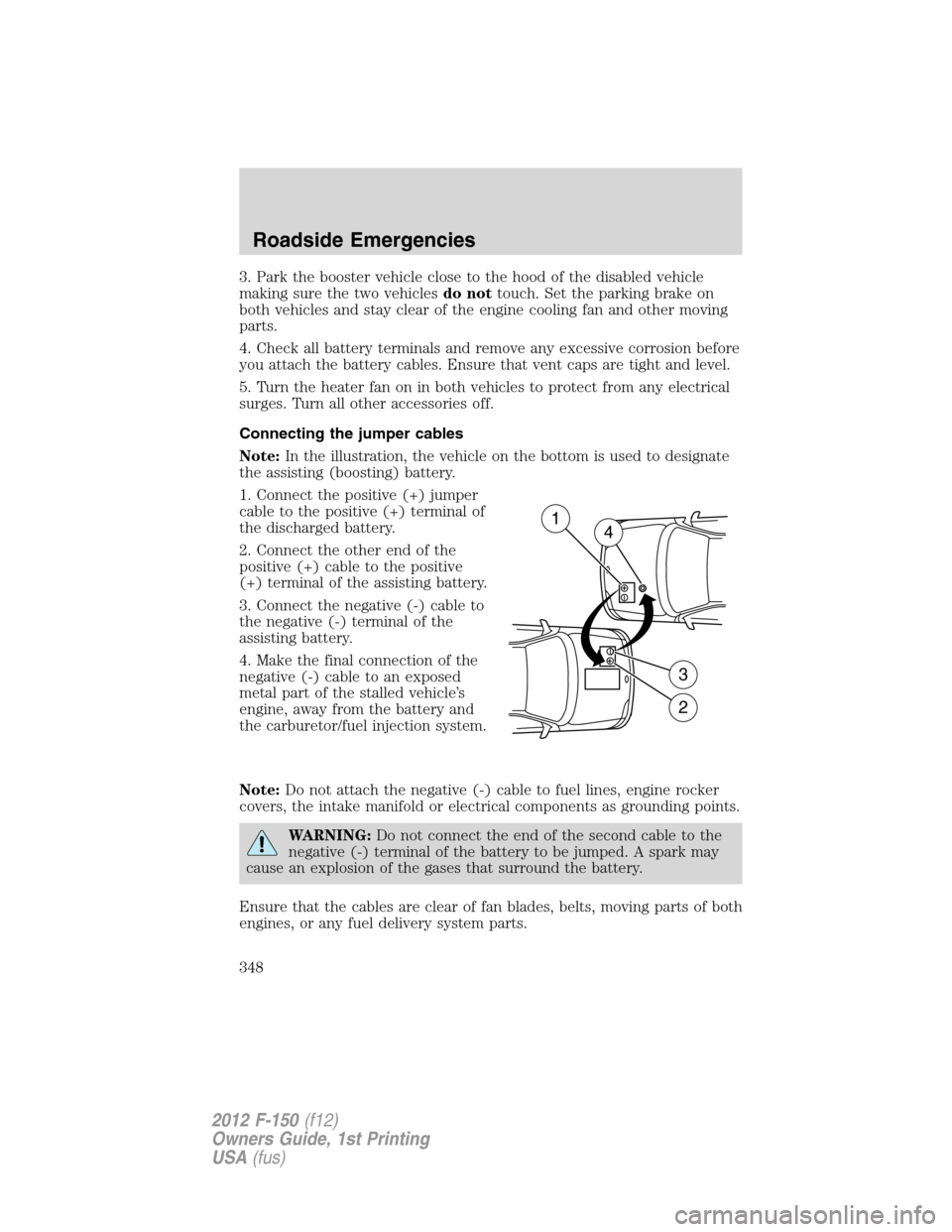
Note:In the illustration, the vehicle on the bottom is used to designate
the assisting (boosting) battery.
1. Connect the positive (+) jumper
cable to the positive (+) terminal of
the discharged battery.
2. Connect the other end of the
positive (+) cable to the positive
(+) terminal of the assisting battery.
3. Connect the negative (-) cable to
the negative (-) terminal of the
assisting battery.
4. Make the final connection of the
negative (-) cable to an exposed
metal part of the stalled vehicle’s
engine, away from the battery and
the carburetor/fuel injection system.
Note:Do not attach the negative (-) cable to fuel lines, engine rocker
covers, the intake manifold or electrical components as grounding points.
WARNING:Do not connect the end of the second cable to the
negative (-) terminal of the battery to be jumped. A spark may
cause an explosion of the gases that surround the battery.
Ensure that the cables are clear of fan blades, belts, moving parts of both
engines, or any fuel delivery system parts.
+–
+–
2
3
14
Roadside Emergencies
348
2012 F-150(f12)
Owners Guide, 1st Printing
USA(fus)
Page 435 of 462

Multi-point inspection
In order to keep your vehicle running right, it is important to have the
systems on your vehicle checked regularly. This can help identify
potential issues and prevent major problems. Ford Motor Company
recommends the following multi-point inspection be performed at every
scheduled maintenance interval to help ensure your vehicle keeps
running great.
Multi-point inspection – Recommended each visit
Accessory drive belt(s) Half-shaft dust boots (if equipped)
Battery performance Horn operation
Clutch operation (if equipped) Radiator, cooler, heater and A/C hoses
Engine air filter Suspension component for leaks or
damage
Exhaust system Steering and linkage
Exterior lamps and hazard
warning system operationTires for wear and proper pressure,
including spare
Fluid levels*; fill if necessary Windshield for cracks, chips or pits
For oil and fluid leaks Washer spray and wiper operation
*Brake, coolant recovery reservoir, manual and automatic transmission
(with an underhood dipstick), power steering (if equipped) and
window washer
Be sure to ask your dealership service advisor or technician about the
multi-point vehicle inspection. It’s a comprehensive way to perform a
thorough inspection of your vehicle. It’s your checklist that gives you
immediate feedback on the overall condition of your vehicle. You’ll know
what’s been checked, what’s okay, as well as those things that may
require future or immediate attention. The multi-point vehicle inspection
is one more way to keep your vehicle running great!
Scheduled Maintenance
435
2012 F-150(f12)
Owners Guide, 1st Printing
USA(fus)
Page 458 of 462

E
Electronic message center ...20, 31
Emergencies, roadside
jump-starting ..........................347
running out of fuel .........347, 398
Emission control system ..........403
Engine ................................419–420
cleaning ...................................362
coolant .....................................385
fail-safe cooling .......................389
idle speed control ...................382
lubrication specifications .......415
refill capacities ........................415
service points ..................373–376
Engine block heater .................282
Engine oil ..................................378
checking and adding ..............378
dipstick ....................................378
filter, specifications ................414
refill capacities ........................415
specifications ..........................415
Event data recording ....................7
Exhaust fumes ..........................282
F
Fail safe cooling ........................389
Fleet MyKey programming ......136
Flexible Fuel Vehicle (FFV) ....392
Floor mats .........................122–123
Fluid capacities .........................415
Fog lamps ....................................82
Four-Wheel Drive vehicles .......312
description ..............................314
driving off road .......................319
electronic shift ........................313
indicator light .........................312preparing to drive your
vehicle .....................................294
Fuel ............................................392
calculating fuel
economy ............................22, 400
cap ...........................................395
capacity ...................................415
choosing the right fuel ...........396
detergent in fuel .....................398
filler funnel .............................398
filling your vehicle
with fuel ..................392, 395, 400
filter, specifications ........392, 414
fuel pump shut-off ..................328
improving fuel economy ........400
octane rating ...........397, 419–420
quality ......................................398
running out of fuel .........347, 398
safety information relating
to automotive fuels ................392
Fuel - flex fuel vehicle
(FFV) .........................392, 396–397
Fuses ..................................328–329
G
Garage door opener ..................116
Gas cap (see Fuel cap) ............395
Gas mileage (see Fuel
economy) ...................................400
Gauges .........................................18
H
Hazard flashers .........................327
Headlamps ...................................82
aiming ........................................84
autolamp system .......................82
bulb specifications ....................88
daytime running lights .............83
Index
458
2012 F-150(f12)
Owners Guide, 1st Printing
USA(fus)