2012 FORD F SERIES MOTORHOME AND COMMERCIAL CHASSIS jump start
[x] Cancel search: jump startPage 1 of 160
Introduction 3
Instrument Cluster 10
Warning lights and chimes 10
Gauges 13
Message center 16
Lights 20
Headlamps 20
Turn signal control 21
Bulb replacement 21
Driver Controls 22
Windshield wiper/washer control 22
Steering wheel adjustment 22
Speed control 23
Tires, Wheels and Loading 25
Tire information 25
Tire inflation 27
Vehicle loading 42
Trailer towing 48
Driving 51
Starting 51
Brakes 54
Transmission operation 58
Roadside Emergencies 64
Getting roadside assistance 64
Hazard flasher control 65
Fuses and relays 66
Changing tires 74
Wheel lug nut torque 79
Jump starting 80
Wrecker towing 83
Table of Contents
1
2012 Motorhome(mot)
Supplement, 2nd Printing
USA(fus)
Page 64 of 160
ROADSIDE ASSISTANCE
Vehicles sold in the U.S. : Getting roadside assistance
To fully assist you should you have a vehicle concern, Ford Motor
Company offers a complimentary roadside assistance program. This
program is separate from the New Vehicle Limited Warranty. The service
is available:
•24–hours, seven days a week
•for the coverage period listed on the Roadside Assistance Card
included in your Owner Guide portfolio.
Roadside assistance will cover:
•a flat tire change with a good spare, if provided with the vehicle
(except vehicles that have been supplied with a tire inflation kit)
•battery jump start
•lock-out assistance (key replacement cost is the customer’s
responsibility)
•fuel delivery – Independent Service Contractors, if not prohibited by
state, local or municipal law shall deliver 5 gallons (18.9L) of fuel to a
disabled vehicle. Fuel delivery service is limited to two no-charge
occurrences within a 12-month period.
•towing – Ford and Lincoln eligible vehicle towed to an authorized
dealer within 35 miles (56.3 km) of the disablement location or to the
nearest authorized dealer. If a member requests to be towed to an
authorized dealer more than 35 miles (56.3 km) from the disablement
location, the member shall be responsible for any mileage costs in
excess of 35 miles (56.3 km).
Trailers shall be covered up to $200 if the disabled eligible vehicle
requires service at the nearest authorized dealer. If the trailer is disabled,
but the towing vehicle is operational, the trailer does not qualify for any
roadside services.
Vehicles sold in the U.S. : Using roadside assistance
Customers who require roadside assistance, may contact 1-800-444-3311.
Vehicles sold in Canada : Getting roadside assistance
Canadian customers who require roadside assistance, call
1–800–665–2006.
Roadside Emergencies
64
2012 Motorhome(mot)
Supplement, 2nd Printing
USA(fus)
Page 80 of 160
Bolt size Wheel lug nut torque*
ft-lb N•m
M14x1.5
(19.5 in. wheels)150 200
M22x1.5
(22.5 in. wheels)450 610
* Torque specifications are for nut and bolt threads free of dirt and
rust. Use only Ford recommended replacement fasteners.
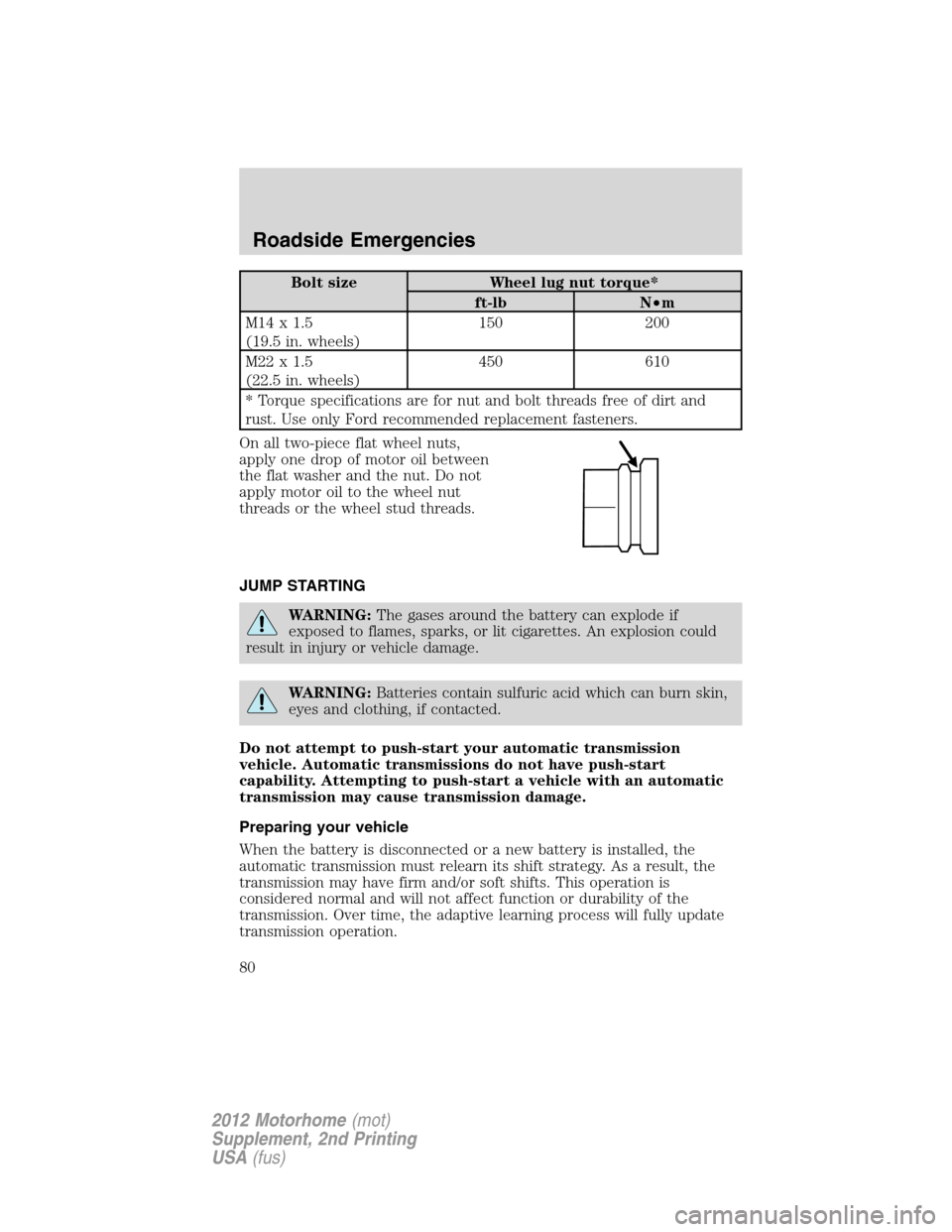
On all two-piece flat wheel nuts,
apply one drop of motor oil between
the flat washer and the nut. Do not
apply motor oil to the wheel nut
threads or the wheel stud threads.
JUMP STARTING
WARNING:The gases around the battery can explode if
exposed to flames, sparks, or lit cigarettes. An explosion could
result in injury or vehicle damage.
WARNING:Batteries contain sulfuric acid which can burn skin,
eyes and clothing, if contacted.
Do not attempt to push-start your automatic transmission
vehicle. Automatic transmissions do not have push-start
capability. Attempting to push-start a vehicle with an automatic
transmission may cause transmission damage.
Preparing your vehicle
When the battery is disconnected or a new battery is installed, the
automatic transmission must relearn its shift strategy. As a result, the
transmission may have firm and/or soft shifts. This operation is
considered normal and will not affect function or durability of the
transmission. Over time, the adaptive learning process will fully update
transmission operation.
Roadside Emergencies
80
2012 Motorhome(mot)
Supplement, 2nd Printing
USA(fus)
Page 81 of 160
1.Use only a 12–volt supply to start your vehicle.
2. Do not disconnect the battery of the disabled vehicle as this could
damage the vehicle’s electrical system.
3. Park the booster vehicle close to the hood of the disabled vehicle
making sure the two vehiclesdo nottouch. Set the parking brake on
both vehicles and stay clear of the engine cooling fan and other moving
parts.
4. Check all battery terminals and remove any excessive corrosion before
you attach the battery cables. Ensure that vent caps are tight and level.
5. Turn the heater fan on in both vehicles to protect from any electrical
surges. Turn all other accessories off.
Connecting the jumper cables
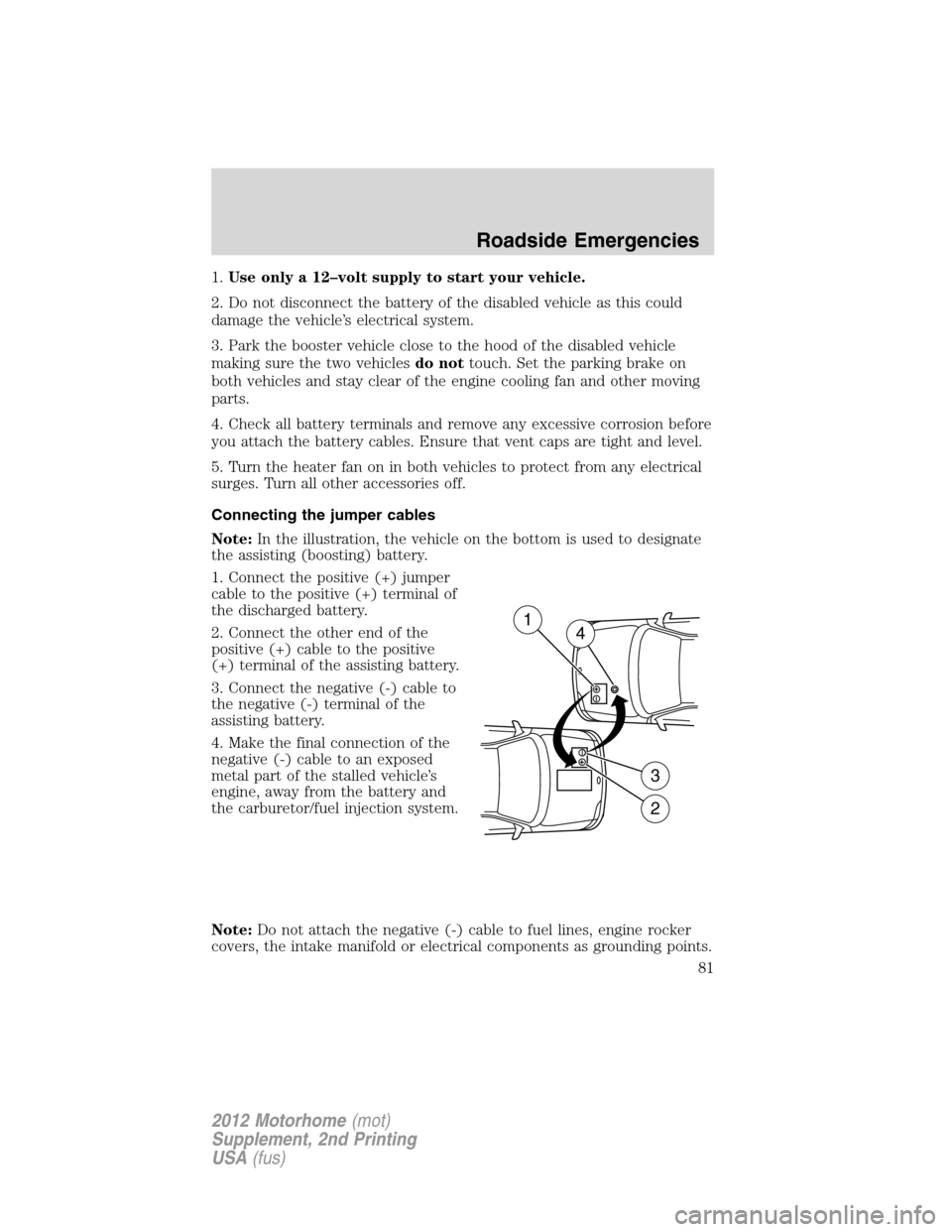
Note:In the illustration, the vehicle on the bottom is used to designate
the assisting (boosting) battery.
1. Connect the positive (+) jumper
cable to the positive (+) terminal of
the discharged battery.
2. Connect the other end of the
positive (+) cable to the positive
(+) terminal of the assisting battery.
3. Connect the negative (-) cable to
the negative (-) terminal of the
assisting battery.
4. Make the final connection of the
negative (-) cable to an exposed
metal part of the stalled vehicle’s
engine, away from the battery and
the carburetor/fuel injection system.
Note:Do not attach the negative (-) cable to fuel lines, engine rocker
covers, the intake manifold or electrical components as grounding points.
+–
+–
2
3
14
Roadside Emergencies
81
2012 Motorhome(mot)
Supplement, 2nd Printing
USA(fus)
Page 82 of 160
WARNING:Do not connect the end of the second cable to the
negative (-) terminal of the battery to be jumped. A spark may
cause an explosion of the gases that surround the battery.
Ensure that the cables are clear of fan blades, belts, moving parts of both
engines, or any fuel delivery system parts.
Jump starting
1. Start the engine of the booster vehicle and run the engine at
moderately increased speed.
2. Start the engine of the disabled vehicle.
3. Once the disabled vehicle has been started, run both engines for an
additional three minutes before disconnecting the jumper cables.
Removing the jumper cables
Remove the jumper cables in the reverse order that they were
connected.
Note:In the illustration, the vehicle on the bottom is used to designate
the assisting (boosting) battery.
Roadside Emergencies
82
2012 Motorhome(mot)
Supplement, 2nd Printing
USA(fus)
Page 83 of 160
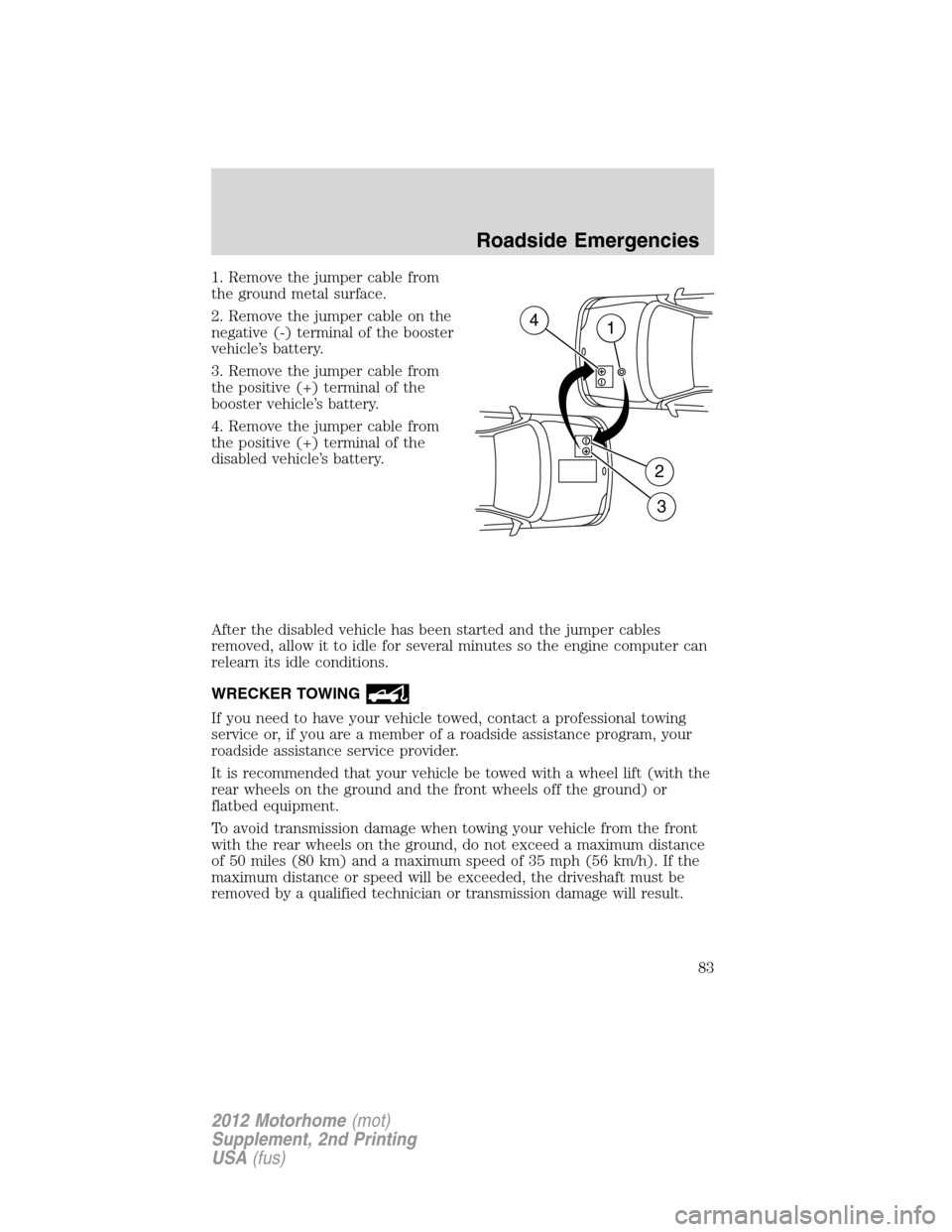
1. Remove the jumper cable from
the ground metal surface.
2. Remove the jumper cable on the
negative (-) terminal of the booster
vehicle’s battery.
3. Remove the jumper cable from
the positive (+) terminal of the
booster vehicle’s battery.
4. Remove the jumper cable from
the positive (+) terminal of the
disabled vehicle’s battery.
After the disabled vehicle has been started and the jumper cables
removed, allow it to idle for several minutes so the engine computer can
relearn its idle conditions.
WRECKER TOWING
If you need to have your vehicle towed, contact a professional towing
service or, if you are a member of a roadside assistance program, your
roadside assistance service provider.
It is recommended that your vehicle be towed with a wheel lift (with the
rear wheels on the ground and the front wheels off the ground) or
flatbed equipment.
To avoid transmission damage when towing your vehicle from the front
with the rear wheels on the ground, do not exceed a maximum distance
of 50 miles (80 km) and a maximum speed of 35 mph (56 km/h). If the
maximum distance or speed will be exceeded, the driveshaft must be
removed by a qualified technician or transmission damage will result.
+–
+–
DA
B
C
4D1
2
3
Roadside Emergencies
83
2012 Motorhome(mot)
Supplement, 2nd Printing
USA(fus)
Page 134 of 160
FORD ESP EXTENDED SERVICE PLANS (U.S. ONLY)
More than 32 million Ford and Lincoln owners have discovered the
powerful protection of Ford ESP. It is the only extended service plan
backed by Ford Motor Company, and provides “peace of mind”
protection beyond the New Vehicle Limited Warranty coverage.
Up to 500+ Covered Vehicle Components
There are four, new-vehicle Extended Service Plans with different levels
of coverage. Ask your dealer for details.
PremiumCare –Our most comprehensive coverage. With over 500
covered components, this plan is so complete that we generally only
discuss what’s not covered!
ExtraCare –Covers 113 components, and includes many high-tech
items.
BaseCare –Covers 84 components.
PowertrainCare –Covers 29 critical components.
Ford ESP is honored by all Ford and Lincoln Dealers in the U.S.
and CanadaIt’s the only extended service plan authorized and backed
by Ford Motor Company. That means you get:
•Reliable, quality service anywhere you go.
•Factory-trained technicians.
•Ford Authorized Parts used with every covered repair.
Rental car reimbursement
If your vehicle is kept overnight for covered repairs,you are
eligible for rental car coverage, including Bumper-to-Bumper warranty
repairs, or manufacturer’s recalls.
Transferable coverage
If you sell your vehicle before your Ford ESP coverage expires, you can
transfer any remaining coverage to the new owner. Whenever you’re
ready to sell your car, prospective buyers may feel better about taking a
risk on your used vehicle. Ford ESP may add resale value!
Plus,exclusive 24/7 roadside assistance,including:
•Towing, flat-tire change and battery jump starts.
•Out-of-fuel and lock-out assistance.
•Travel expense reimbursement for lodging, meals and rental car.
•Destination assistance for taxi, shuttle, rental car coverage and
emergency transportation.
Ford Extended Service Plan
134
2012 Motorhome(mot)
Supplement, 2nd Printing
USA(fus)
Page 158 of 160
Emergencies, roadside
jump-starting ............................80
Emergency Flashers ...................65
Emission control system ..........114
Engine ........................................131
cleaning .....................................92
coolant .....................................101
fail-safe cooling .......................105
idle speed control .....................98
lubrication specifications .......128
refill capacities ........................128
service points ......................94–95
Engine oil ....................................96
checking and adding ................96
dipstick ......................................96
filter, specifications ..........97, 127
recommendations .....................97
refill capacities ........................128
specifications ..........................128
Event data recording ....................5
Exhaust fumes ............................54
F
Fail safe cooling ........................105
Fluid capacities .........................128
Fuel ............................................107
calculating fuel economy .......111
capacity ...................................128
choosing the right fuel ...........109
detergent in fuel .....................110
filling your vehicle with
fuel ...................................107, 111
filter, specifications ........106, 127
improving fuel economy ........111
octane rating ...................109, 131
quality ......................................110
running out of fuel .................110
safety information relating to
automotive fuels .....................107Fuses ......................................66–67
G
Gas mileage
(see Fuel economy) .................111
Gauges .........................................13
H
Hazard flashers ...........................65
Headlamps ...................................20
daytime running lights .............20
flash to pass ..............................21
high beam .................................20
turning on and off ....................20
I
Ignition .................................51, 131
Inspection/maintenance (I/M)
testing ........................................115
Instrument panel
cluster ........................................10
lighting up panel and
interior .......................................21
J
Jump-starting your vehicle ........80
K
Keys
positions of the ignition ...........51
L
Lamps
daytime running light ...............20
headlamps .................................20
Index
158
2012 Motorhome(mot)
Supplement, 2nd Printing
USA(fus)