Page 57 of 160
Parking brake
Apply the parking brake whenever
the vehicle is parked. Press pedal
downward to set the parking brake.
The BRAKE warning lamp in the
instrument cluster illuminates and
remains illuminated (when the
ignition is turned on) until the
parking brake is released.
WARNING:Always set the parking brake fully and make sure
the gearshift is latched in P (Park). Turn the ignition to the
LOCK position and remove the key whenever you leave your vehicle.
The parking brake is not recommended to stop a moving vehicle.
However, if the normal brakes fail, the parking brake can be used to stop
your vehicle in an emergency. Since the parking brake applies only the
transmission mounted parking brake assembly, the vehicle’s stopping
distance will increase greatly and the handling of your vehicle will be
adversely affected.
P!
BRAKE
Driving
57
2012 Motorhome(mot)
Supplement, 2nd Printing
USA(fus)
Page 58 of 160
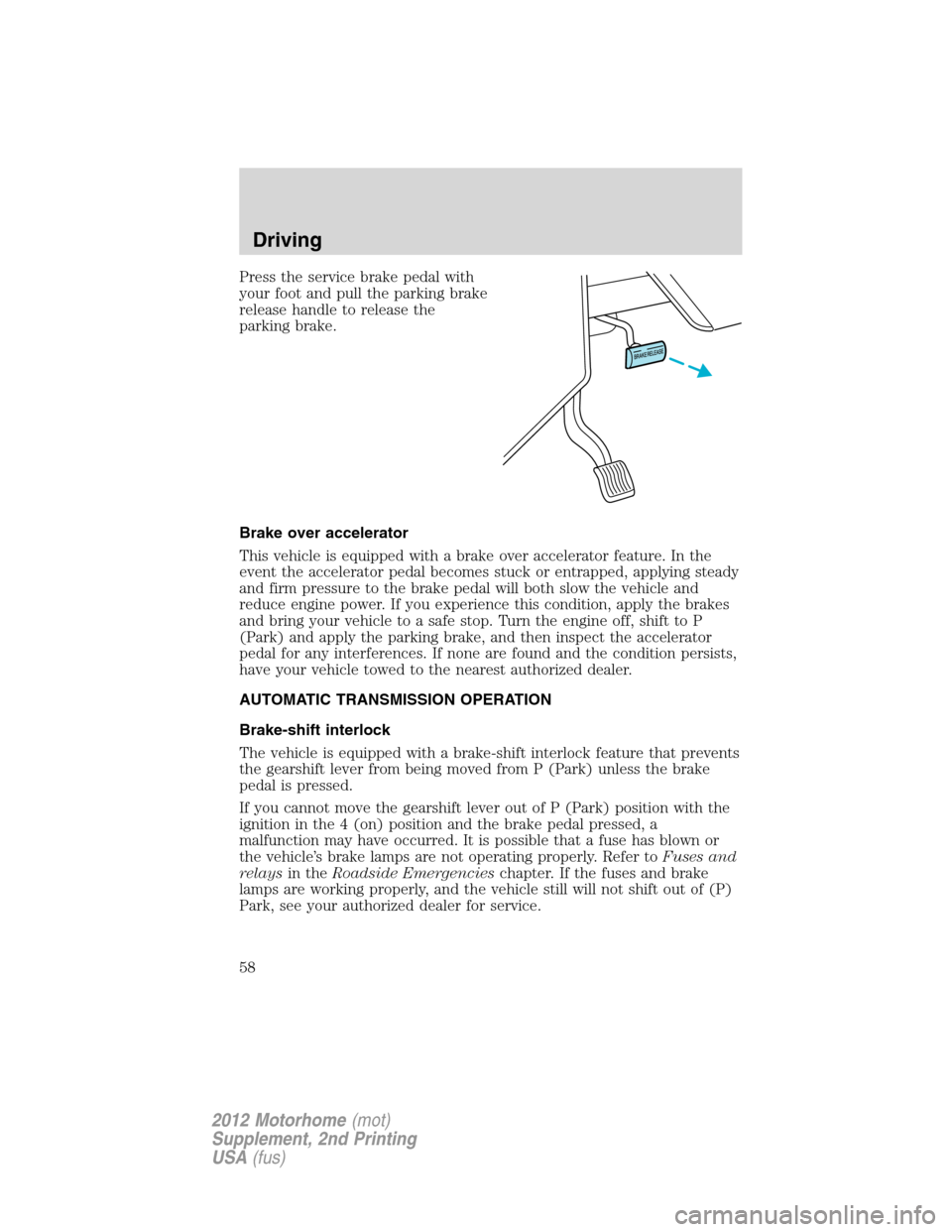
Press the service brake pedal with
your foot and pull the parking brake
release handle to release the
parking brake.
Brake over accelerator
This vehicle is equipped with a brake over accelerator feature. In the
event the accelerator pedal becomes stuck or entrapped, applying steady
and firm pressure to the brake pedal will both slow the vehicle and
reduce engine power. If you experience this condition, apply the brakes
and bring your vehicle to a safe stop. Turn the engine off, shift to P
(Park) and apply the parking brake, and then inspect the accelerator
pedal for any interferences. If none are found and the condition persists,
have your vehicle towed to the nearest authorized dealer.
AUTOMATIC TRANSMISSION OPERATION
Brake-shift interlock
The vehicle is equipped with a brake-shift interlock feature that prevents
the gearshift lever from being moved from P (Park) unless the brake
pedal is pressed.
If you cannot move the gearshift lever out of P (Park) position with the
ignition in the 4 (on) position and the brake pedal pressed, a
malfunction may have occurred. It is possible that a fuse has blown or
the vehicle’s brake lamps are not operating properly. Refer toFuses and
relaysin theRoadside Emergencieschapter. If the fuses and brake
lamps are working properly, and the vehicle still will not shift out of (P)
Park, see your authorized dealer for service.
Driving
58
2012 Motorhome(mot)
Supplement, 2nd Printing
USA(fus)
Page 59 of 160
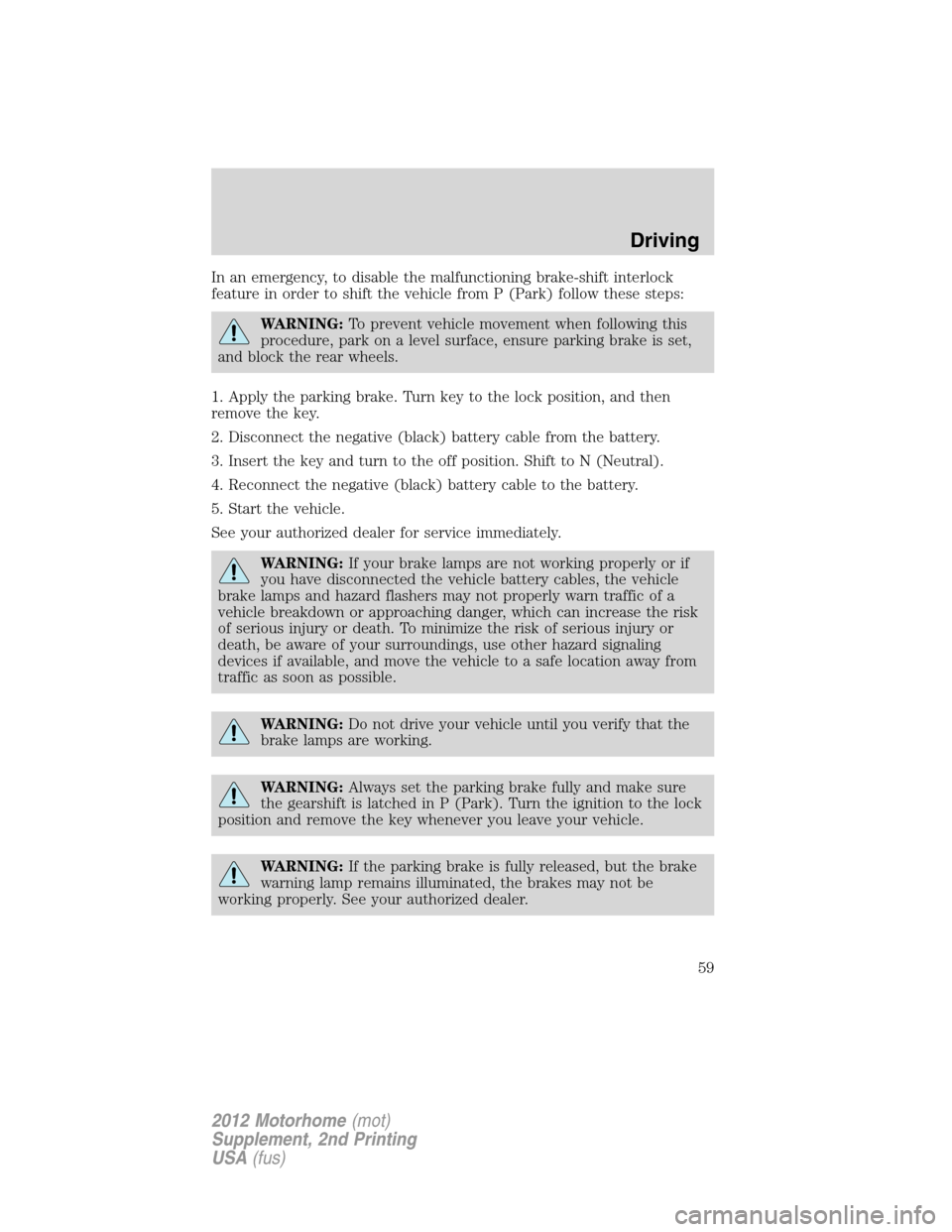
In an emergency, to disable the malfunctioning brake-shift interlock
feature in order to shift the vehicle from P (Park) follow these steps:
WARNING:To prevent vehicle movement when following this
procedure, park on a level surface, ensure parking brake is set,
and block the rear wheels.
1. Apply the parking brake. Turn key to the lock position, and then
remove the key.
2. Disconnect the negative (black) battery cable from the battery.
3. Insert the key and turn to the off position. Shift to N (Neutral).
4. Reconnect the negative (black) battery cable to the battery.
5. Start the vehicle.
See your authorized dealer for service immediately.
WARNING:If your brake lamps are not working properly or if
you have disconnected the vehicle battery cables, the vehicle
brake lamps and hazard flashers may not properly warn traffic of a
vehicle breakdown or approaching danger, which can increase the risk
of serious injury or death. To minimize the risk of serious injury or
death, be aware of your surroundings, use other hazard signaling
devices if available, and move the vehicle to a safe location away from
traffic as soon as possible.
WARNING:Do not drive your vehicle until you verify that the
brake lamps are working.
WARNING:Always set the parking brake fully and make sure
the gearshift is latched in P (Park). Turn the ignition to the lock
position and remove the key whenever you leave your vehicle.
WARNING:If the parking brake is fully released, but the brake
warning lamp remains illuminated, the brakes may not be
working properly. See your authorized dealer.
Driving
59
2012 Motorhome(mot)
Supplement, 2nd Printing
USA(fus)
Page 60 of 160

Understanding the shift positions of the 5–speed automatic
transmission
This vehicle is equipped with an adaptive transmission shift strategy.
Adaptive transmission shift strategy offers the optimal transmission
operation and shift quality. When the vehicle’s battery has been
disconnected for any type of service or repair, the transmission will need
to relearn the normal shift strategy parameters, much like having to reset
your radio stations when your vehicle battery has been disconnected.
The adaptive transmission shift strategy allows the transmission to
relearn these operating parameters. This learning process could take
several transmission upshifts and downshifts; during this learning
process, slightly firmer shifts may occur. After this learning process,
normal shift feel and shift scheduling will resume.
P (Park)
This position locks the transmission and prevents the rear wheels from
turning.
To put your vehicle in gear:
1. Start the engine
2. Press the brake pedal
3. Move the gearshift lever into the desired gear
To put your vehicle in P (Park):
1. Come to a complete stop
2. Move the gearshift lever and securely latch it in P (Park)
WARNING:Always set the parking brake fully and make sure
the gearshift is latched in P (Park). Turn the ignition to the lock
position and remove the key whenever you leave your vehicle.
R (Reverse)
With the gearshift lever in R (Reverse), the vehicle will move backward.
Always come to a complete stop before shifting into and out of R
(Reverse).
N (Neutral)
With the gearshift lever in N (Neutral), the vehicle can be started and is
free to roll. Hold the brake pedal down while in this position.
Driving
60
2012 Motorhome(mot)
Supplement, 2nd Printing
USA(fus)
Page 64 of 160
ROADSIDE ASSISTANCE
Vehicles sold in the U.S. : Getting roadside assistance
To fully assist you should you have a vehicle concern, Ford Motor
Company offers a complimentary roadside assistance program. This
program is separate from the New Vehicle Limited Warranty. The service
is available:
•24–hours, seven days a week
•for the coverage period listed on the Roadside Assistance Card
included in your Owner Guide portfolio.
Roadside assistance will cover:
•a flat tire change with a good spare, if provided with the vehicle
(except vehicles that have been supplied with a tire inflation kit)
•battery jump start
•lock-out assistance (key replacement cost is the customer’s
responsibility)
•fuel delivery – Independent Service Contractors, if not prohibited by
state, local or municipal law shall deliver 5 gallons (18.9L) of fuel to a
disabled vehicle. Fuel delivery service is limited to two no-charge
occurrences within a 12-month period.
•towing – Ford and Lincoln eligible vehicle towed to an authorized
dealer within 35 miles (56.3 km) of the disablement location or to the
nearest authorized dealer. If a member requests to be towed to an
authorized dealer more than 35 miles (56.3 km) from the disablement
location, the member shall be responsible for any mileage costs in
excess of 35 miles (56.3 km).
Trailers shall be covered up to $200 if the disabled eligible vehicle
requires service at the nearest authorized dealer. If the trailer is disabled,
but the towing vehicle is operational, the trailer does not qualify for any
roadside services.
Vehicles sold in the U.S. : Using roadside assistance
Customers who require roadside assistance, may contact 1-800-444-3311.
Vehicles sold in Canada : Getting roadside assistance
Canadian customers who require roadside assistance, call
1–800–665–2006.
Roadside Emergencies
64
2012 Motorhome(mot)
Supplement, 2nd Printing
USA(fus)
Page 68 of 160
Fuse/Relay
LocationFuse Amp
RatingProtected circuits
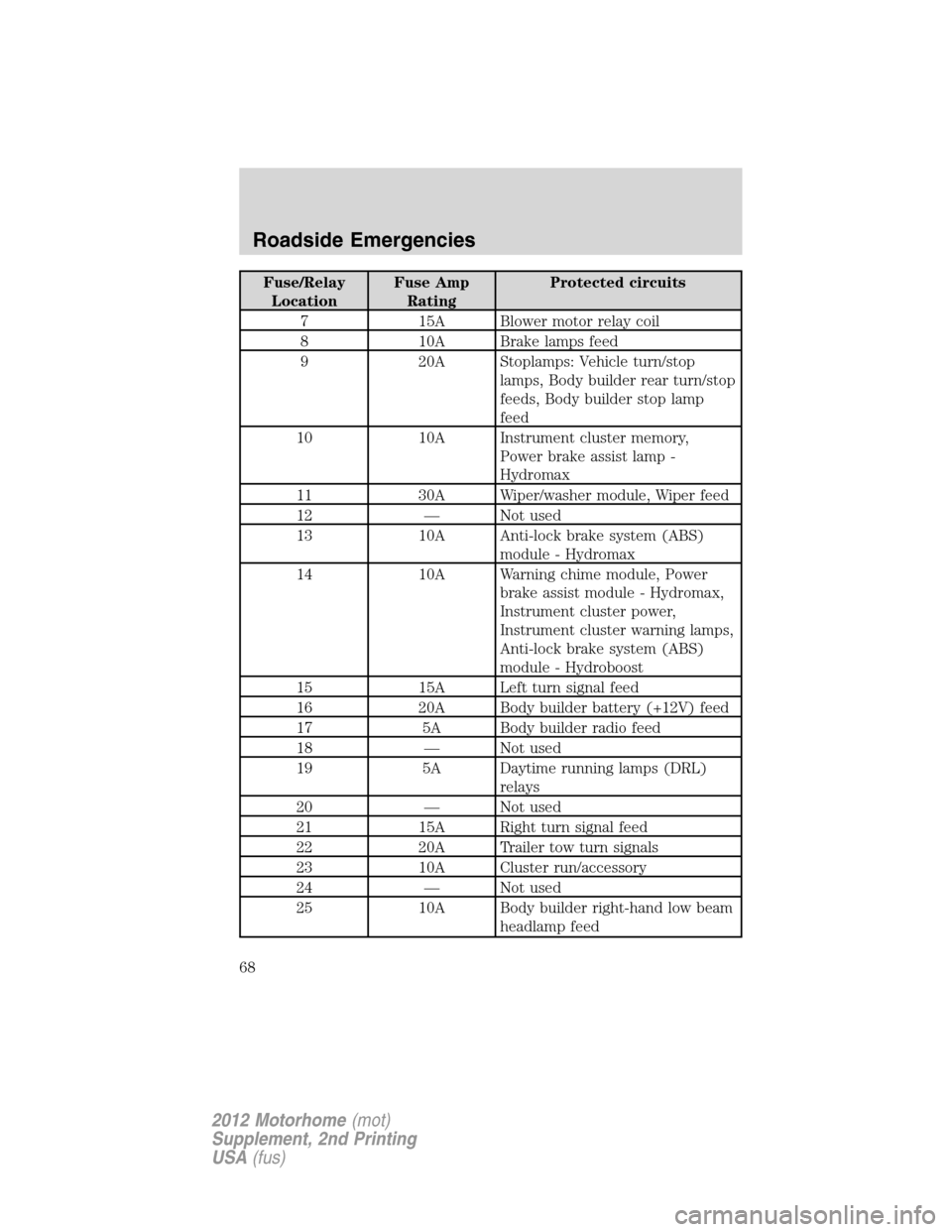
7 15A Blower motor relay coil
8 10A Brake lamps feed
9 20A Stoplamps: Vehicle turn/stop
lamps, Body builder rear turn/stop
feeds, Body builder stop lamp
feed
10 10A Instrument cluster memory,
Power brake assist lamp -
Hydromax
11 30A Wiper/washer module, Wiper feed
12 — Not used
13 10A Anti-lock brake system (ABS)
module - Hydromax
14 10A Warning chime module, Power
brake assist module - Hydromax,
Instrument cluster power,
Instrument cluster warning lamps,
Anti-lock brake system (ABS)
module - Hydroboost
15 15A Left turn signal feed
16 20A Body builder battery (+12V) feed
17 5A Body builder radio feed
18 — Not used
19 5A Daytime running lamps (DRL)
relays
20 — Not used
21 15A Right turn signal feed
22 20A Trailer tow turn signals
23 10A Cluster run/accessory
24 — Not used
25 10A Body builder right-hand low beam
headlamp feed
Roadside Emergencies
68
2012 Motorhome(mot)
Supplement, 2nd Printing
USA(fus)
Page 69 of 160
Fuse/Relay
LocationFuse Amp
RatingProtected circuits
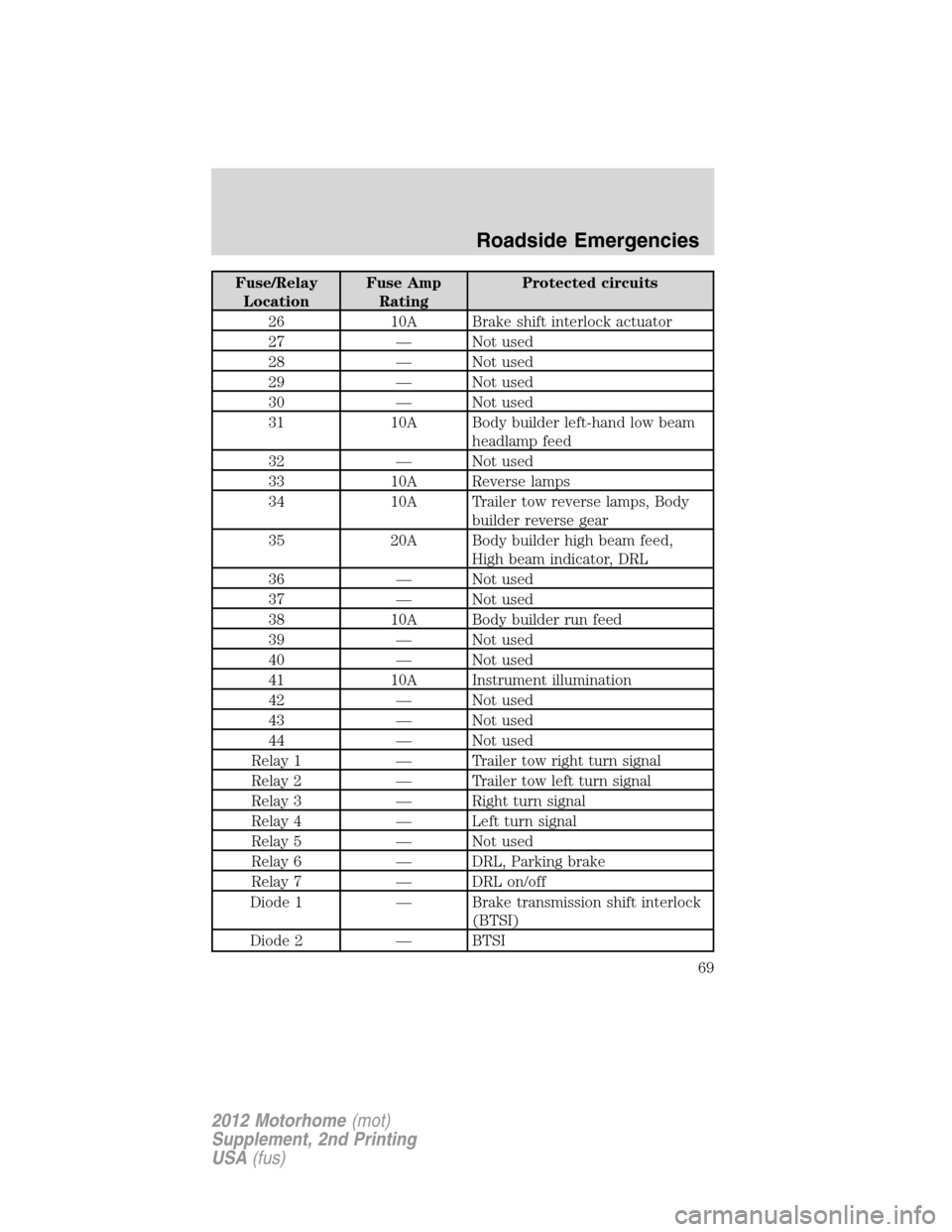
26 10A Brake shift interlock actuator
27 — Not used
28 — Not used
29 — Not used
30 — Not used
31 10A Body builder left-hand low beam
headlamp feed
32 — Not used
33 10A Reverse lamps
34 10A Trailer tow reverse lamps, Body
builder reverse gear
35 20A Body builder high beam feed,
High beam indicator, DRL
36 — Not used
37 — Not used
38 10A Body builder run feed
39 — Not used
40 — Not used
41 10A Instrument illumination
42 — Not used
43 — Not used
44 — Not used
Relay 1 — Trailer tow right turn signal
Relay 2 — Trailer tow left turn signal
Relay 3 — Right turn signal
Relay 4 — Left turn signal
Relay 5 — Not used
Relay 6 — DRL, Parking brake
Relay 7 — DRL on/off
Diode 1 — Brake transmission shift interlock
(BTSI)
Diode 2 — BTSI
Roadside Emergencies
69
2012 Motorhome(mot)
Supplement, 2nd Printing
USA(fus)
Page 72 of 160

Fuse/Relay
LocationFuse Amp
RatingProtected Circuits
6 20A* Park lamp feeds, Instrument panel
(IP) fuse #41, Warning chime
module, Trailer tow running lamp
relay coil, IP dimmer module
7 20A* Ignition coils, Radio capacitors
8 — Not used
9 10A* Starter main relay coil, Starter
ground relay coil
10 20A* Daytime running lamps (DRL)
11 20A* Fuel pump relay coil, PCM power
12 25A* Trailer tow back-up lamps feed, IP
- backup lamp feed
13 30A** Trailer tow electric brake
controller feed
14 60A** IP battery feed (fuse #9, 15, 21)
15 20A** Trailer tow park lamps
16 60A** Anti-lock brake system (ABS)
module - Hydromax
40A** Anti-lock brake system (ABS)
module - Hydroboost
17 20A** Horn feed
18 20A** Transmission control indicator
light, Tow/haul switch, Backup
lamp feed
19 — Not used
20 30A** PCM relay coil, PCM relay (PDB
fuses#3,5,7,18)
21 20A** Fuel pump motor, Fuel injectors
22 20A** Diagnostic tool connector, Cigar
lighter feed
23 40A** Blower motor feed
Roadside Emergencies
72
2012 Motorhome(mot)
Supplement, 2nd Printing
USA(fus)