Page 328 of 439
Fuse/Relay
LocationFuse Amp
RatingProtected Circuits
25 15A Liftgate release
26 5A Radio frequency module
27 20A IA module
28 15A Ignition switch, Push button start
29 20A Radio, 8” SYNC�Multi-function
display screen, SYNC�module,
Global positioning system module
30 15A Front park lamps
31 5A Trailer tow brake controller
32 15A 110V AC power point, Power
folding mirror, Power mirrors,
One touch up/down front
windows, Door lock illumination
33 10A Occupant classification sensor
34 10A Blind spot monitor, Rearview
camera, Reverse sensing system
35 5A Heads-up display, Climate control
humidity sensor, Terrain
management system, Hill descent
switch, Headlamp switch IGN
sense
36 10A Not used (spare)
37 10A Restraints control module
38 10A Auto-dimming rear view mirror,
Moon roof
39 15A High beam headlamps
40 10A Rear park lamps, License plate
lamps
41 7.5A Overdrive cancel, Tow/haul
42 5A Not used (spare)
43 10A Not used (spare)
44 10A Not used (spare)
Roadside Emergencies
328
2012 Explorer(exp)
Owners Guide, 1st Printing
USA(fus)
Page 330 of 439
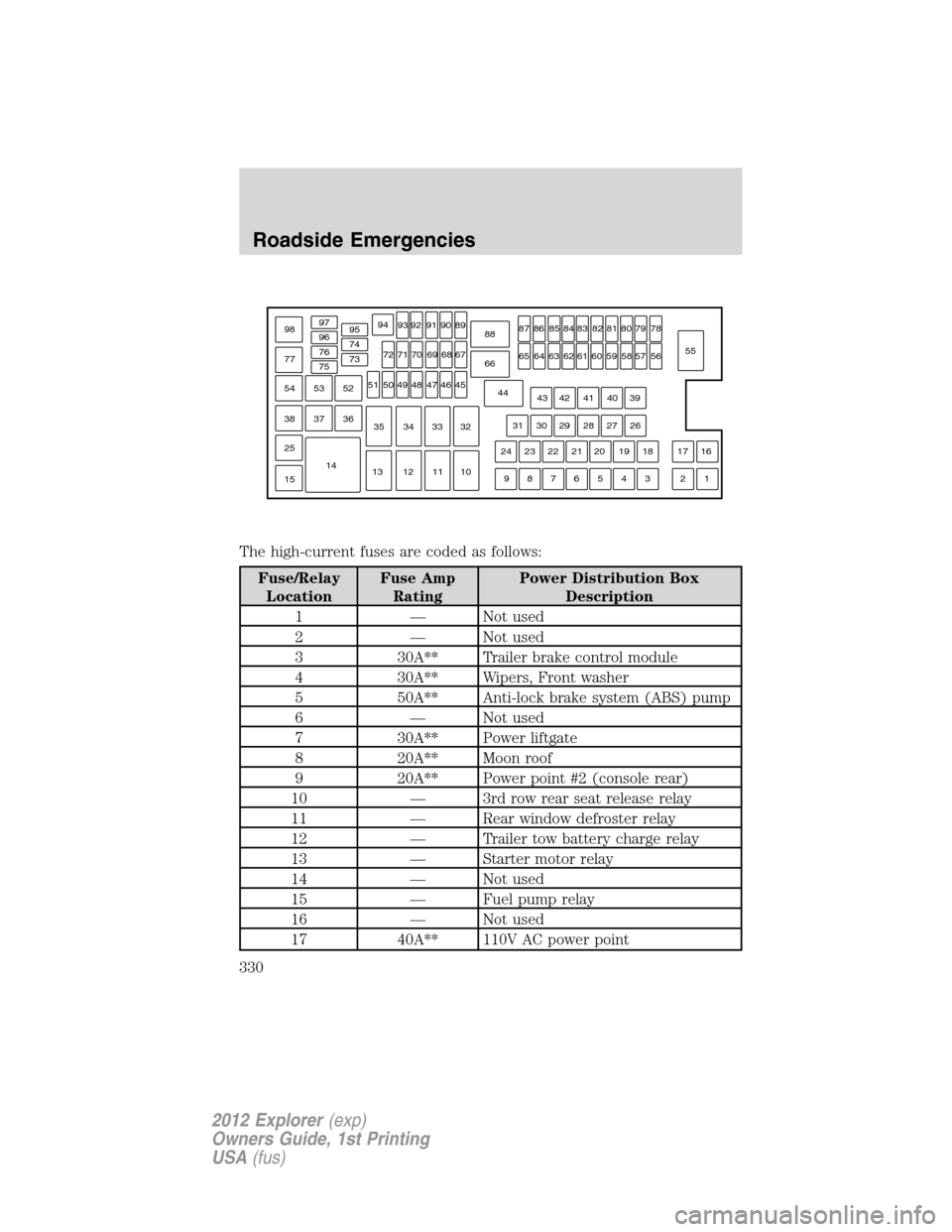
The high-current fuses are coded as follows:
Fuse/Relay
LocationFuse Amp
RatingPower Distribution Box
Description
1 — Not used
2 — Not used
3 30A** Trailer brake control module
4 30A** Wipers, Front washer
5 50A** Anti-lock brake system (ABS) pump
6 — Not used
7 30A** Power liftgate
8 20A** Moon roof
9 20A** Power point #2 (console rear)
10 — 3rd row rear seat release relay
11 — Rear window defroster relay
12 — Trailer tow battery charge relay
13 — Starter motor relay
14 — Not used
15 — Fuel pump relay
16 — Not used
17 40A** 110V AC power point
97
98
77969594
93 92 91 90 89
88
66
4478
56
39
26
18 1617
312 4 5 6 7 8 919 20 21 22 23 2427 28 29 30 3140 41 42 4355
57 58 59 60 61 62 63 64 6579 80 81 82 83 84 85 86 87
67
45
32
10 11 12 1333 34 3546 47 48 49 50 5168 69 70 71 72 74
73 76
75
53
37 36 54
38
25
151452
Roadside Emergencies
330
2012 Explorer(exp)
Owners Guide, 1st Printing
USA(fus)
Page 331 of 439
Fuse/Relay
LocationFuse Amp
RatingPower Distribution Box
Description
18 40A** Front blower motor
19 30A** Starter motor
20 20A** Power point #1/cigar lighter
21 20A** Power point #3 (cargo area)
22 30A** 3rd row seat module
23 30A** Driver power seat, Memory module
24 30A** Trailer tow (TT) battery charge
25 — Not used
26 40A** Rear window defroster, Heated
mirrors
27 20A** Power point (console)
28 30A** Climate controlled seats
29 — Not used
30 — Not used
31 — Not used
32 — Auxiliary blower motor relay
33 — Not used
34 — Blower motor relay
35 — Not used
36 — Not used
37 — TT right stop/turn lamps relay
38 — TT back up relay
39 40A** Auxiliary blower motor
40 — Not used
41 — Not used
42 30A** Passenger seat
43 40A** ABS valves
44 — Rear washer relay
45 5A* Rain sensor
46 — Not used
47 — Not used
Roadside Emergencies
331
2012 Explorer(exp)
Owners Guide, 1st Printing
USA(fus)
Page 335 of 439

A dissimilar spare tire/wheel is defined as a spare tire and/or wheel that
is different in brand, size or appearance from the road tires and wheels
and can be one of three types:
1.T-type mini-spare:This spare tire begins with the letter “T” for tire
size and may have “Temporary Use Only” molded in the sidewall
2.Full-size dissimilar spare with label on wheel:This spare tire has
a label on the wheel that states: “THIS TIRE AND WHEEL FOR
TEMPORARY USE ONLY”
When driving with one of the dissimilar spare tires listed above,do not:
•Exceed 50 mph (80 km/h)
•Load the vehicle beyond maximum vehicle load rating listed on the
Safety Compliance Label
•Tow a trailer
•Use snow chains on the end of the vehicle with the dissimilar spare
tire
•Use more than one dissimilar spare tire at a time
•Use commercial car washing equipment
•Try to repair the dissimilar spare tire
Use of one of the dissimilar spare tires listed above at any one wheel
location can lead to impairment of the following:
•Handling, stability and braking performance
•Comfort and noise
•Ground clearance and parking at curbs
•Winter weather driving capability
•Wet weather driving capability
3.Full-size dissimilar spare without label on wheel
When driving with the full-size dissimilar spare tire/wheel,do not:
•Exceed 70 mph (113 km/h)
•Use more than one dissimilar spare tire/wheel at a time
•Use commercial car washing equipment
•Use snow chains on the end of the vehicle with the dissimilar spare
tire/wheel
Roadside Emergencies
335
2012 Explorer(exp)
Owners Guide, 1st Printing
USA(fus)
Page 336 of 439
The usage of a full-size dissimilar spare tire/wheel can lead to
impairment of the following:
•Handling, stability and braking performance
•Comfort and noise
•Ground clearance and parking at curbs
•Winter weather driving capability
•Wet weather driving capability
•All-Wheel driving capability (if applicable)
•Load leveling adjustment (if applicable)
When driving with the full-size dissimilar spare tire/wheel additional
caution should be given to:
•Towing a trailer
•Driving vehicles equipped with a camper body
•Driving vehicles with a load on the cargo rack
Drive cautiously when using a full-size dissimilar spare tire/wheel and
seek service as soon as possible.
Stopping and securing the vehicle
1. Park on a level surface, set the
parking brake and activate hazard
flashers.
2. Place gearshift lever in P (Park)
and turn engine off.
Roadside Emergencies
336
2012 Explorer(exp)
Owners Guide, 1st Printing
USA(fus)
Page 337 of 439
Removing the spare tire and jack
If the 3rd row seat is stowed in the floor, you will need to unstow it
(raised position) to access the spare tire and jack. Refer toUnstowing
the third row seatin theSeating and Safety Restraintschapter for this
procedure.
1. Remove the floor filler and
carpeted floor panel located in the
rear of the vehicle.
2. Remove the wing nut that secures
the spare tire by turning it
counterclockwise.
3. Lift and remove the spare tire
from the spare tire well.
Roadside Emergencies
337
2012 Explorer(exp)
Owners Guide, 1st Printing
USA(fus)
Page 338 of 439
4. Remove the wing bolt that
secures the jack kit by turning it
counterclockwise.
5. Remove the jack kit which
includes jack (4), wheel wrench (lug
wrench) (3), wheel chock (5),
L-shaped bolt (1) and tow recovery
hook (2).
6. Remove the jack, wrench and
wheel chock from the foam tray.
7. Turn the lead screw (where the
lug wrench attaches) of the jack by
hand to release the wheel wrench
from the jack. Press the button on
the wrench to extend the handle.
Fold down the wrench socket.
Tire change procedure
WARNING:When one of the front wheels is off the ground, the
transaxle alone will not prevent the vehicle from moving or
slipping off the jack, even if the vehicle is in P (Park).
25
43
1
Roadside Emergencies
338
2012 Explorer(exp)
Owners Guide, 1st Printing
USA(fus)
Page 340 of 439

3. Put the jack in the jack notch
next to the tire you are changing.
Turn the jack handle clockwise until
the wheel is completely off the
ground.
4. Remove the lug nuts with the lug
wrench.
5. Replace the flat tire with the
spare tire, making sure the valve
stem is facing outward. Reinstall the
lug nuts until the wheel is snug against the hub. Do not fully tighten the
lug nuts until the wheel has been lowered.
6. Lower the wheel by turning the jack handle counterclockwise.
7. Remove the jack and fully tighten
the lug nuts in the order shown.
Refer toWheel lug nut torque
specificationslater in this chapter
for the proper lug nut torque
specification.
Stowing the mini-spare and jack
1. Replace the wheel chock in the foam tray.
2. Adjust the jack to the proper
height to install the wrench. Turn
the jack lead screw until the arrow
on the upper link is slightly below
the circle indicator shown on the
lower link.
1
4 3
2 5
Roadside Emergencies
340
2012 Explorer(exp)
Owners Guide, 1st Printing
USA(fus)