Page 318 of 439

Descend a hill in the same gear you
would use to climb up the hill to
avoid excessive brake application
and brake overheating. Do not
descend in neutral; instead,
disengage overdrive or manually
shift to a lower gear. When
descending a steep hill, avoid
sudden hard braking as you could
lose control. When you brake hard,
the front wheels cannot turn and if
they are not turning, you will not be
able to steer. The front wheels have to be turning in order to steer the
vehicle.
Since your vehicle has anti-lock brakes, apply the brakes steadily. Do not
“pump” the brakes.
Driving on snow and ice
WARNING:If you are driving in slippery conditions that require
tire chains or cables, then it is critical that you drive cautiously.
Keep speeds down, allow for longer stopping distances and avoid
aggressive steering to reduce the chances of a loss of vehicle control
which can lead to serious injury or death. If the rear end of the vehicle
slides while cornering, steer in the direction of the slide until you
regain control of the vehicle.
4WD vehicles have advantages over 2WD vehicles in snow and ice but
can skid like any other vehicle.
Should you start to slide while driving on snowy or icy roads, turn the
steering wheel in the direction of the slide until you regain control.
Avoid sudden applications of power and quick changes of direction on
snow and ice. Apply the accelerator slowly and steadily when starting
from a full stop.
Avoid sudden braking as well. Although a 4WD vehicle may accelerate
better than a two-wheel drive vehicle in snow and ice, it won’t stop any
faster, because as in other vehicles, braking occurs at all four wheels. Do
not become overconfident as to road conditions.
Driving
318
2012 Explorer(exp)
Owners Guide, 1st Printing
USA(fus)
Page 319 of 439

Make sure you allow sufficient distance between you and other vehicles
for stopping. Drive slower than usual and consider using one of the lower
gears. In emergency stopping situations, avoid locking of the wheels. Use
a “squeeze” technique, push on the brake pedal with a steadily increasing
force which allows the wheels to brake yet continue to roll so that you
may steer in the direction you want to travel. If you lock the wheels,
release the brake pedal and repeat the squeeze technique. Since your
vehicle is equipped with a Four Wheel Anti-Lock Brake System (ABS),
apply the brake steadily. Do not “pump” the brakes. Refer toBrakesin
this chapter for additional information on the operation of the anti-lock
brake system.
Maintenance and modifications
The suspension and steering systems on your vehicle have been designed
and tested to provide predictable performance whether loaded or empty
and durable load carrying capability. For this reason, Ford Motor
Company strongly recommends that you do not make modifications such
as adding or removing parts (such as lift kits or stabilizer bars) or by
using replacement parts not equivalent to the original factory equipment.
Any modifications to a vehicle that raise the center of gravity can make
it more likely the vehicle will roll over as a result of a loss of control.
Ford Motor Company recommends that caution be used with any vehicle
equipped with a high load or device (such as ladder racks or pickup box
cover).
Failure to maintain your vehicle properly may void the warranty, increase
your repair cost, reduce vehicle performance and operational capabilities
and adversely affect driver and passenger safety. Frequent inspection of
vehicle chassis components is recommended if the vehicle is subjected to
heavy off-road usage.
TERRAIN MANAGEMENT (IF EQUIPPED)
Terrain management adapts the responses of the vehicle’s engine,
transmission, 4WD system, suspension, and stability control systems to
match the demands of the terrain. The system optimizes drivability and
comfort as well as maximizing traction.
Driving
319
2012 Explorer(exp)
Owners Guide, 1st Printing
USA(fus)
Page 321 of 439

TERRAIN MANAGEMENT SYSTEM FAULT:If this message is
displayed, cycling the key may clear the fault. If the fault is not cleared
after a key cycle, have the system serviced by an authorized dealer.
MODE CHANGE NOT ACCEPTED, RETRY:If this message is
displayed, a vehicle system cannot support a mode change at the time of
driver request. Try the mode change again.
DRIVING THROUGH WATER
If driving through deep or standing
water is unavoidable, proceed very
slowly. Never drive through water
that is higher than the bottom of
the wheel rims (for cars) or the
bottom of the hubs (for trucks).
When driving through water, traction or brake capability may be limited.
Also, water may enter your engine’s air intake and severely damage your
engine or your vehicle may stall.Driving through deep water where
the transmission vent tube is submerged may allow water into the
transmission and cause internal transmission damage.
Once through the water, always dry the brakes by moving your
vehicle slowly while applying light pressure on the brake pedal.
Wet brakes do not stop the vehicle as quickly as dry brakes.
Driving
321
2012 Explorer(exp)
Owners Guide, 1st Printing
USA(fus)
Page 325 of 439
Standard fuse amperage rating and color
COLOR
Fuse
ratingMini fusesStandard
fusesMaxi fusesCartridge
maxi fuses
2A Grey Grey — —
3A Violet Violet — —
4A Pink Pink — —
5A Tan Tan — —
7.5A Brown Brown — —
10A Red Red — —
15A Blue Blue — —
20A Yellow Yellow Yellow Blue
25A Natural Natural — —
30A Green Green Green Pink
40A — — Orange Green
50A — — Red Red
60A — — Blue Yellow
70A — — Tan —
80A — — Natural —
Passenger compartment fuse panel
The fuse panel is located below and to the left of the steering wheel by
the brake pedal. Remove the panel cover to access the fuses.
To remove a fuse use the fuse puller tool provided on the fuse panel
cover.
Roadside Emergencies
325
2012 Explorer(exp)
Owners Guide, 1st Printing
USA(fus)
Page 327 of 439

Fuse/Relay
LocationFuse Amp
RatingProtected Circuits
9 10A 4” Radio display, Power liftgate
logic, Electronic finish panel,
SYNC�Base Module
10 10A Run/accessory relay (wipers, rear
washer), Rain sensor
11 10A Instrument cluster, Heads-up
display
12 15A Interior courtesy lamps (overhead
console, 2nd row, cargo), Puddle
lamps, Console bin LED,
Backlighting
13 15A Right turn lamps, Right trailer tow
(TT) turn/stop lamps
14 15A Left turn lamps, Left TT turn/stop
lamps
15 15A Reverse lamps, Stop lamps,
High-mounted stop lamp
16 10A Low beam headlamps (right)
17 10A Low beam headlamps (left)
18 10A Keypad illumination, Brake shift
interlock (BSI), Start button run
indicator, Passive anti-theft
system (PATS), Powertrain
control module (PCM) wake-up,
Rear seat power enable
19 20A Memory seat power
20 20A Locks
21 10A Intelligent access (IA), Keypad
22 20A Horn relay
23 15A Steering wheel control module,
IA, Headlamp switch
24 15A Datalink connector, Steering
wheel control module
Roadside Emergencies
327
2012 Explorer(exp)
Owners Guide, 1st Printing
USA(fus)
Page 328 of 439
Fuse/Relay
LocationFuse Amp
RatingProtected Circuits
25 15A Liftgate release
26 5A Radio frequency module
27 20A IA module
28 15A Ignition switch, Push button start
29 20A Radio, 8” SYNC�Multi-function
display screen, SYNC�module,
Global positioning system module
30 15A Front park lamps
31 5A Trailer tow brake controller
32 15A 110V AC power point, Power
folding mirror, Power mirrors,
One touch up/down front
windows, Door lock illumination
33 10A Occupant classification sensor
34 10A Blind spot monitor, Rearview
camera, Reverse sensing system
35 5A Heads-up display, Climate control
humidity sensor, Terrain
management system, Hill descent
switch, Headlamp switch IGN
sense
36 10A Not used (spare)
37 10A Restraints control module
38 10A Auto-dimming rear view mirror,
Moon roof
39 15A High beam headlamps
40 10A Rear park lamps, License plate
lamps
41 7.5A Overdrive cancel, Tow/haul
42 5A Not used (spare)
43 10A Not used (spare)
44 10A Not used (spare)
Roadside Emergencies
328
2012 Explorer(exp)
Owners Guide, 1st Printing
USA(fus)
Page 330 of 439
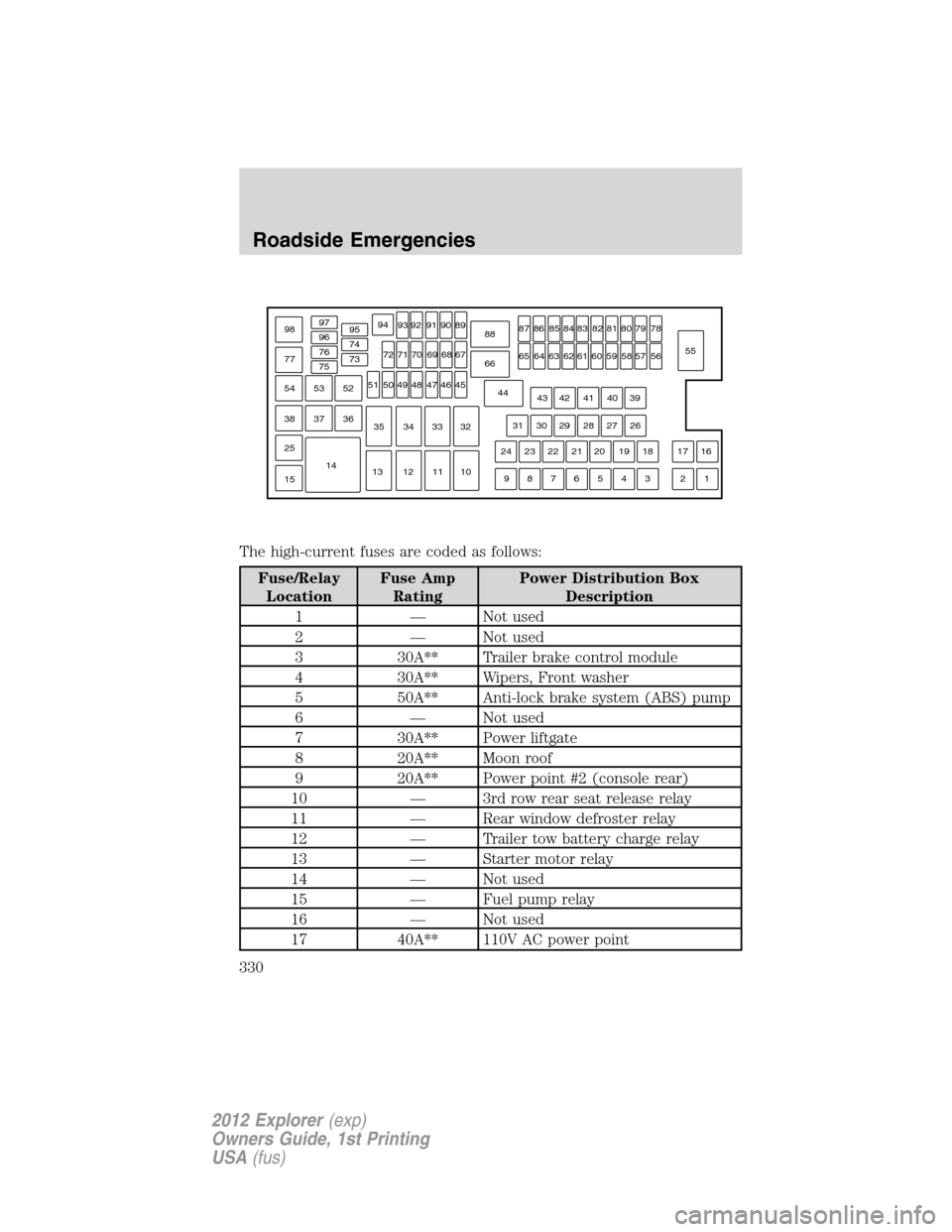
The high-current fuses are coded as follows:
Fuse/Relay
LocationFuse Amp
RatingPower Distribution Box
Description
1 — Not used
2 — Not used
3 30A** Trailer brake control module
4 30A** Wipers, Front washer
5 50A** Anti-lock brake system (ABS) pump
6 — Not used
7 30A** Power liftgate
8 20A** Moon roof
9 20A** Power point #2 (console rear)
10 — 3rd row rear seat release relay
11 — Rear window defroster relay
12 — Trailer tow battery charge relay
13 — Starter motor relay
14 — Not used
15 — Fuel pump relay
16 — Not used
17 40A** 110V AC power point
97
98
77969594
93 92 91 90 89
88
66
4478
56
39
26
18 1617
312 4 5 6 7 8 919 20 21 22 23 2427 28 29 30 3140 41 42 4355
57 58 59 60 61 62 63 64 6579 80 81 82 83 84 85 86 87
67
45
32
10 11 12 1333 34 3546 47 48 49 50 5168 69 70 71 72 74
73 76
75
53
37 36 54
38
25
151452
Roadside Emergencies
330
2012 Explorer(exp)
Owners Guide, 1st Printing
USA(fus)
Page 332 of 439
Fuse/Relay
LocationFuse Amp
RatingPower Distribution Box
Description
48 — Not used
49 — Not used
50 15A* Heated mirrors
51 — Not used
52 — Not used
53 — TT left stop/turn lamps relay
54 — Not used
55 — Wiper relay
56 15A* Transmission control module
57 20A* Left high-intensity discharge (HID)
headlamps
58 10A* Alternator sensor
59 10A* Brake on/off (BOO) switch
60 10A* TT back-up lamps
61 20A* 2nd row seat release
62 10A* A/C clutch
63 15A* TT stop/turn lamps
64 15A* Rear wipers
65 30A* Fuel pump
66 — Powertrain control module (PCM)
relay
67 20A* Vehicle power (VPWR) #2 (emission
related powertrain components)
68 15A* VPWR #4 (ignition coils)
69 15A* VPWR #1 (PCM)
70 10A* VPWR #3 (coil), All-wheel drive
module, A/C clutch
71 — Not used
72 — Not used
73 — Not used
74 — Not used
75 — Not used
Roadside Emergencies
332
2012 Explorer(exp)
Owners Guide, 1st Printing
USA(fus)