Page 206 of 439

The Safety Canopy is mounted to roof side-rail sheet metal, behind the
headliner, above each row of seats. In certain lateral collisions or rollover
events, the Safety Canopy system will be activated, regardless of which
seats are occupied. The Safety Canopy is designed to inflate between the
side window area and occupants to further enhance protection provided
in side impact collisions and rollover events.
The fact that the Safety Canopy did not activate in a collision does not
mean that something is wrong with the system. Rather, it means the
forces were not of the type sufficient to cause activation. The Safety
Canopy is designed to inflate in certain side impact collisions or rollover
events, not in rear impact, frontal or near-frontal collisions, unless the
collision causes sufficient lateral deceleration or rollover likelihood.
WARNING:If the Safety
Canopy system has
deployed, the Safety Canopy will
not function again unless replaced.
The Safety Canopy system
(including the A, B, C, and D
pillar trim and headliner) must be
inspected and serviced by an
authorized dealer. If the Safety
Canopy is not replaced, it will not
function again, which will increase
the risk of injury in a future
collision.
Determining if the system is operational
The SRS uses a readiness light in the instrument cluster or a tone to
indicate the condition of the system. Refer toWarning lights and
chimesin theInstrument Clusterchapter. Routine maintenance of the
airbag is not required.
Any difficulty with the system is indicated by one or more of the
following:
•The readiness light (same light as for front airbag system) will either
flash or stay lit.
•The readiness light will not illuminate immediately after ignition is
turned on.
Seating and Safety Restraints
206
2012 Explorer(exp)
Owners Guide, 1st Printing
USA(fus)
Page 270 of 439

the system will search for an IA key inside the vehicle and the message
center will display NO KEY DETECTED if the IA key is no longer
present. This message is a reminder that someone else in the vehicle
may have taken the IA key when exiting the vehicle. If the IA key is no
longer present in the vehicle, you will not be able to re-start your vehicle
outside of the Fast Restart time (seeFast Restart Featureabove).
Note:It is important to be aware of where your IA key is located in the
vehicle, to avoid becoming stranded without an IA key.
Guarding against exhaust fumes
WARNING:If you smell exhaust fumes inside your vehicle, have
your dealer inspect your vehicle immediately. Do not drive if you
smell exhaust fumes.
Carbon monoxide is present in exhaust fumes. Take precautions to avoid
its dangerous effects.
Important ventilating information
If the engine is idling while the vehicle is stopped for a long period of
time, open the windows at least 1 inch (2.5 cm) or adjust the heating or
air conditioning to bring in fresh air.
ENGINE BLOCK HEATER (IF EQUIPPED)
WARNING:Failure to follow engine block heater instructions
could result in property damage or physical injury.
WARNING:To reduce the risk of electrical shock, do not use
your heater with ungrounded electrical systems or two-pronged
(cheater) adapters.
An engine block heater warms the engine coolant which aids in starting
and allows the heater/defroster system to respond quickly. If your vehicle
is equipped with this system, your equipment includes a heater element
which is installed in your engine block and a wire harness which allows
the user to connect the system to a grounded 120 volt A/C electrical
source. The block heater system is most effective when outdoor
temperatures reach below 0°F (-18°C).
Driving
270
2012 Explorer(exp)
Owners Guide, 1st Printing
USA(fus)
Page 326 of 439
The fuses are coded as follows:
Fuse/Relay
LocationFuse Amp
RatingProtected Circuits
1 30A One touch up/down driver side
front window
2 15A Not used (spare)
3 30A One touch up/down passenger
side front window
4 10A Interior demand lamps (overhead
console, 2nd row, cargo), glove
box lamp, 2nd and 3rd row seat
release, visor lamps
5 20A Amplifier
6 5A Not used (spare)
7 7.5A Memory seat module logic feed
8 10A Not used (spare)
1
2
3
4
5
6
7
8
9
10
11
12
13
14
15
16
17
18
19
20
21
223341
42
43
44
45
34
35
36
37
23
24
25
26
27
283846
394729
32
40
31
30
48
49
Roadside Emergencies
326
2012 Explorer(exp)
Owners Guide, 1st Printing
USA(fus)
Page 328 of 439
Fuse/Relay
LocationFuse Amp
RatingProtected Circuits
25 15A Liftgate release
26 5A Radio frequency module
27 20A IA module
28 15A Ignition switch, Push button start
29 20A Radio, 8” SYNC�Multi-function
display screen, SYNC�module,
Global positioning system module
30 15A Front park lamps
31 5A Trailer tow brake controller
32 15A 110V AC power point, Power
folding mirror, Power mirrors,
One touch up/down front
windows, Door lock illumination
33 10A Occupant classification sensor
34 10A Blind spot monitor, Rearview
camera, Reverse sensing system
35 5A Heads-up display, Climate control
humidity sensor, Terrain
management system, Hill descent
switch, Headlamp switch IGN
sense
36 10A Not used (spare)
37 10A Restraints control module
38 10A Auto-dimming rear view mirror,
Moon roof
39 15A High beam headlamps
40 10A Rear park lamps, License plate
lamps
41 7.5A Overdrive cancel, Tow/haul
42 5A Not used (spare)
43 10A Not used (spare)
44 10A Not used (spare)
Roadside Emergencies
328
2012 Explorer(exp)
Owners Guide, 1st Printing
USA(fus)
Page 329 of 439
Fuse/Relay
LocationFuse Amp
RatingProtected Circuits
45 5A Not used (spare)
46 10A Climate control module
47 15A Fog lamps, left and right turn
signal mirror feed
48 30A Circuit
BreakerRear power windows, Passenger
power window, One touch down
(driver side only)
49 Delayed
accessory relayBody control module
Power distribution box
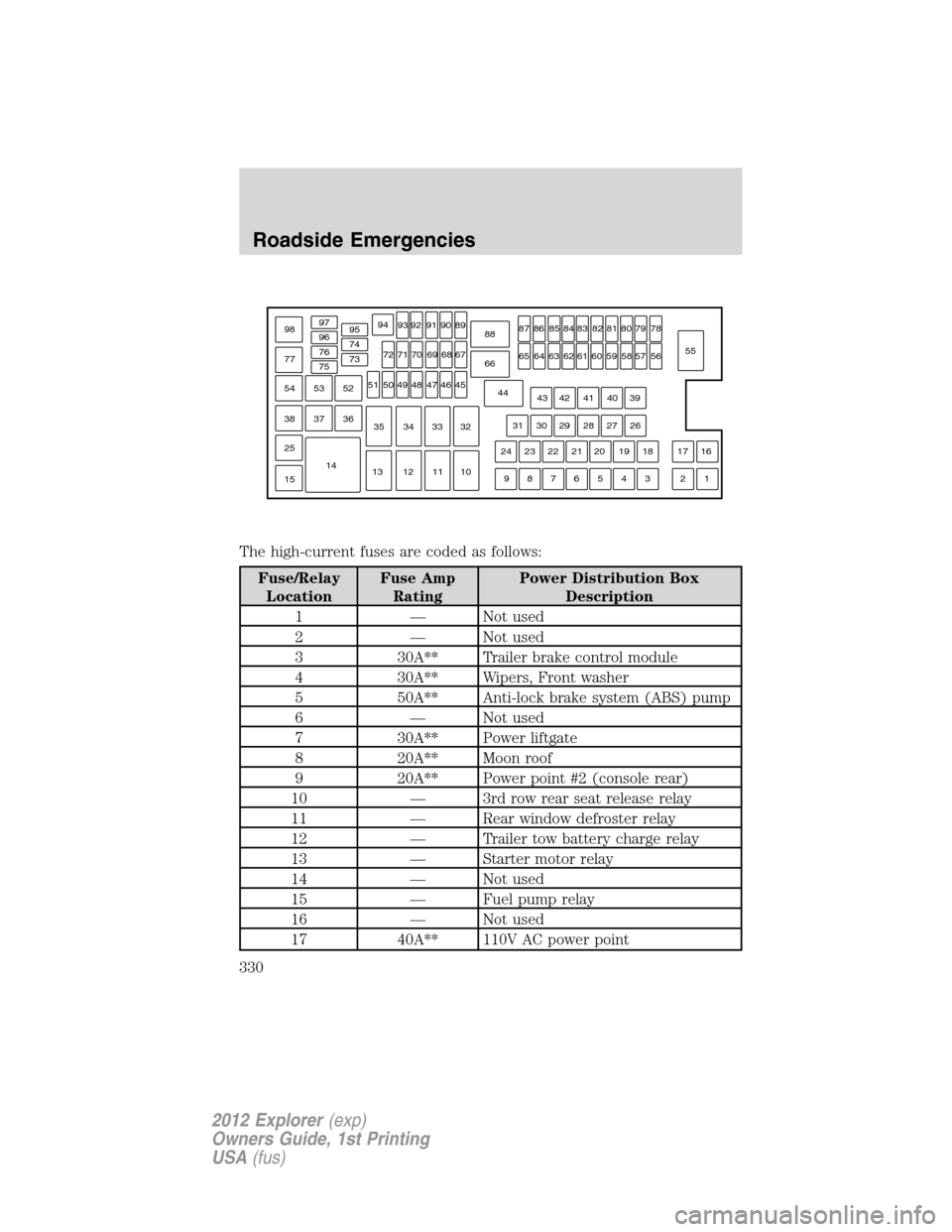
The power distribution box is located in the engine compartment. The
power distribution box contains high-current fuses that protect your
vehicle’s main electrical systems from overloads.
WARNING:Always disconnect the battery before servicing high
current fuses.
WARNING:To reduce risk of electrical shock, always replace
the cover to the power distribution box before reconnecting the
battery or refilling fluid reservoirs.
If the battery has been disconnected and reconnected, refer to the
Batterysection of theMaintenance and Specificationschapter.
Roadside Emergencies
329
2012 Explorer(exp)
Owners Guide, 1st Printing
USA(fus)
Page 330 of 439
The high-current fuses are coded as follows:
Fuse/Relay
LocationFuse Amp
RatingPower Distribution Box
Description
1 — Not used
2 — Not used
3 30A** Trailer brake control module
4 30A** Wipers, Front washer
5 50A** Anti-lock brake system (ABS) pump
6 — Not used
7 30A** Power liftgate
8 20A** Moon roof
9 20A** Power point #2 (console rear)
10 — 3rd row rear seat release relay
11 — Rear window defroster relay
12 — Trailer tow battery charge relay
13 — Starter motor relay
14 — Not used
15 — Fuel pump relay
16 — Not used
17 40A** 110V AC power point
97
98
77969594
93 92 91 90 89
88
66
4478
56
39
26
18 1617
312 4 5 6 7 8 919 20 21 22 23 2427 28 29 30 3140 41 42 4355
57 58 59 60 61 62 63 64 6579 80 81 82 83 84 85 86 87
67
45
32
10 11 12 1333 34 3546 47 48 49 50 5168 69 70 71 72 74
73 76
75
53
37 36 54
38
25
151452
Roadside Emergencies
330
2012 Explorer(exp)
Owners Guide, 1st Printing
USA(fus)
Page 331 of 439
Fuse/Relay
LocationFuse Amp
RatingPower Distribution Box
Description
18 40A** Front blower motor
19 30A** Starter motor
20 20A** Power point #1/cigar lighter
21 20A** Power point #3 (cargo area)
22 30A** 3rd row seat module
23 30A** Driver power seat, Memory module
24 30A** Trailer tow (TT) battery charge
25 — Not used
26 40A** Rear window defroster, Heated
mirrors
27 20A** Power point (console)
28 30A** Climate controlled seats
29 — Not used
30 — Not used
31 — Not used
32 — Auxiliary blower motor relay
33 — Not used
34 — Blower motor relay
35 — Not used
36 — Not used
37 — TT right stop/turn lamps relay
38 — TT back up relay
39 40A** Auxiliary blower motor
40 — Not used
41 — Not used
42 30A** Passenger seat
43 40A** ABS valves
44 — Rear washer relay
45 5A* Rain sensor
46 — Not used
47 — Not used
Roadside Emergencies
331
2012 Explorer(exp)
Owners Guide, 1st Printing
USA(fus)
Page 359 of 439

2.0L EcoBoost™ engine
PLASTIC (NON-PAINTED) EXTERIOR PARTS
Use only approved products to clean plastic parts. These products are
available from your authorized dealer.
•For routine cleaning, use Motorcraft�Detail Wash (ZC-3-A).
•If tar or grease spots are present, use Motorcraft�Bug and Tar
Remover (ZC-42).
WINDOWS AND WIPER BLADES
The windshield, rear and side windows and the wiper blades should be
cleaned regularly. If the wipers do not wipe properly, substances on the
vehicle’s glass or the wiper blades may be the cause. These may include
hot wax treatments used by commercial car washes, water repellent
coatings, tree sap, or other organic contamination; these contaminants
may cause squeaking or chatter noise from the blades, and streaking and
smearing of the windshield. To clean these items, follow these tips:
•The windshield, rear windows and side windows may be cleaned with
a non-abrasive cleaner such as Motorcraft�Ultra-Clear Spray Glass
Cleaner (ZC-23), available from your authorized dealer.
Cleaning
359
2012 Explorer(exp)
Owners Guide, 1st Printing
USA(fus)