Page 330 of 439
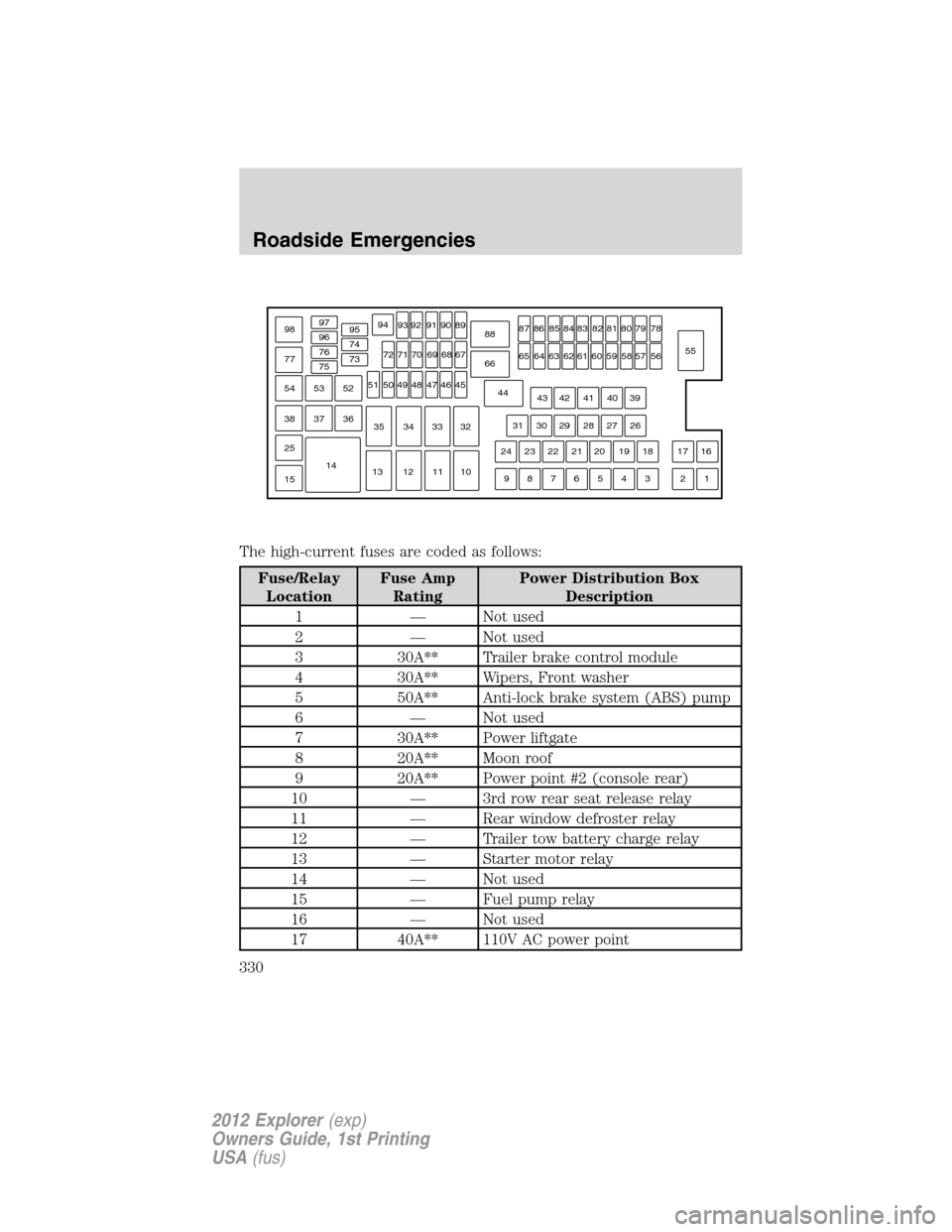
The high-current fuses are coded as follows:
Fuse/Relay
LocationFuse Amp
RatingPower Distribution Box
Description
1 — Not used
2 — Not used
3 30A** Trailer brake control module
4 30A** Wipers, Front washer
5 50A** Anti-lock brake system (ABS) pump
6 — Not used
7 30A** Power liftgate
8 20A** Moon roof
9 20A** Power point #2 (console rear)
10 — 3rd row rear seat release relay
11 — Rear window defroster relay
12 — Trailer tow battery charge relay
13 — Starter motor relay
14 — Not used
15 — Fuel pump relay
16 — Not used
17 40A** 110V AC power point
97
98
77969594
93 92 91 90 89
88
66
4478
56
39
26
18 1617
312 4 5 6 7 8 919 20 21 22 23 2427 28 29 30 3140 41 42 4355
57 58 59 60 61 62 63 64 6579 80 81 82 83 84 85 86 87
67
45
32
10 11 12 1333 34 3546 47 48 49 50 5168 69 70 71 72 74
73 76
75
53
37 36 54
38
25
151452
Roadside Emergencies
330
2012 Explorer(exp)
Owners Guide, 1st Printing
USA(fus)
Page 332 of 439
Fuse/Relay
LocationFuse Amp
RatingPower Distribution Box
Description
48 — Not used
49 — Not used
50 15A* Heated mirrors
51 — Not used
52 — Not used
53 — TT left stop/turn lamps relay
54 — Not used
55 — Wiper relay
56 15A* Transmission control module
57 20A* Left high-intensity discharge (HID)
headlamps
58 10A* Alternator sensor
59 10A* Brake on/off (BOO) switch
60 10A* TT back-up lamps
61 20A* 2nd row seat release
62 10A* A/C clutch
63 15A* TT stop/turn lamps
64 15A* Rear wipers
65 30A* Fuel pump
66 — Powertrain control module (PCM)
relay
67 20A* Vehicle power (VPWR) #2 (emission
related powertrain components)
68 15A* VPWR #4 (ignition coils)
69 15A* VPWR #1 (PCM)
70 10A* VPWR #3 (coil), All-wheel drive
module, A/C clutch
71 — Not used
72 — Not used
73 — Not used
74 — Not used
75 — Not used
Roadside Emergencies
332
2012 Explorer(exp)
Owners Guide, 1st Printing
USA(fus)
Page 359 of 439

2.0L EcoBoost™ engine
PLASTIC (NON-PAINTED) EXTERIOR PARTS
Use only approved products to clean plastic parts. These products are
available from your authorized dealer.
•For routine cleaning, use Motorcraft�Detail Wash (ZC-3-A).
•If tar or grease spots are present, use Motorcraft�Bug and Tar
Remover (ZC-42).
WINDOWS AND WIPER BLADES
The windshield, rear and side windows and the wiper blades should be
cleaned regularly. If the wipers do not wipe properly, substances on the
vehicle’s glass or the wiper blades may be the cause. These may include
hot wax treatments used by commercial car washes, water repellent
coatings, tree sap, or other organic contamination; these contaminants
may cause squeaking or chatter noise from the blades, and streaking and
smearing of the windshield. To clean these items, follow these tips:
•The windshield, rear windows and side windows may be cleaned with
a non-abrasive cleaner such as Motorcraft�Ultra-Clear Spray Glass
Cleaner (ZC-23), available from your authorized dealer.
Cleaning
359
2012 Explorer(exp)
Owners Guide, 1st Printing
USA(fus)
Page 360 of 439

•The wiper blades can be cleaned with isopropyl (rubbing) alcohol or
Motorcraft�Premium Windshield Washer Concentrate (ZC-32-A) in
the U.S., or Premium Quality Windshield Washer Fluid [CXC-37-(A, B,
D, or F)] in Canada, available from your authorized dealer. This
washer fluid contains special solution in addition to alcohol which
helps to remove the hot wax deposited on the wiper blade and
windshield from automated car wash facilities. Be sure to replace
wiper blades when they appear worn or do not function properly.
•Do not use abrasives, as they may cause scratches.
•Do not use fuel, kerosene, or paint thinner to clean any parts.
If you cannot remove those streaks after cleaning with the glass cleaner
or if the wipers chatter and move in a jerky motion, clean the outer
surface of the windshield and the wiper blades using a sponge or soft
cloth with a neutral detergent or mild-abrasive cleaning solution. After
cleaning, rinse the windshield and wiper blades with clean water. The
windshield is clean if beads do not form when you rinse the windshield
with water.
Do not use sharp objects, such as a razor blade, to clean the
inside of the rear window or to remove decals, as it may cause
damage to the rear window defroster’s heated grid lines.
INSTRUMENT PANEL/INTERIOR TRIM AND CLUSTER LENS
Clean the instrument panel, interior trim areas and cluster lens with a
clean, damp, white cotton cloth, then use a clean and dry white cotton
cloth to dry these areas.
•Avoid cleaners or polishes that increase the gloss of the upper portion
of the instrument panel. The dull finish in this area helps protect the
driver from undesirable windshield reflection.
•Be certain to wash or wipe your hands clean if you have been in
contact with certain products such as insect repellent and suntan
lotion in order to avoid possible damage to the interior painted
surfaces.
•Do not use household or glass cleaners as these may damage the
finish of the instrument panel, interior trim and cluster lens.
•Do not allow air fresheners and hand sanitizers to spill on interior
surfaces. If a spill occurs,wipe off immediately.Damage may not be
covered by your warranty.
Cleaning
360
2012 Explorer(exp)
Owners Guide, 1st Printing
USA(fus)
Page 368 of 439

WINDSHIELD WASHER FLUID
Add fluid to fill the reservoir if the
level is low. In very cold weather, do
not fill the reservoir completely.
Only use a washer fluid that meets Ford specifications. Do not use any
special washer fluid such as windshield water repellent type fluid or bug
wash. They may cause squeaking, chatter noise, streaking and smearing.
Refer to theMaintenance product specifications and capacities
section in this chapter.
State or local regulations on volatile organic compounds may restrict the
use of methanol, a common windshield washer antifreeze additive.
Washer fluids containing non-methanol antifreeze agents should be used
only if they provide cold weather protection without damaging the
vehicle’s paint finish, wiper blades or washer system.
WARNING:If you operate your vehicle in temperatures below
40°F (5°C), use washer fluid with antifreeze protection. Failure
to use washer fluid with antifreeze protection in cold weather could
result in impaired windshield vision and increase the risk of injury or
accident.
Do not put washer fluid in the engine coolant reservoir. Washer
fluid placed in the cooling system may harm engine and cooling
system components.
Checking and adding washer fluid for the liftgate
Washer fluid for the liftgate is supplied by the same reservoir as the
windshield.
Maintenance and Specifications
368
2012 Explorer(exp)
Owners Guide, 1st Printing
USA(fus)
Page 369 of 439
CHANGING THE WIPER BLADES
1. Pull the wiper blade and arm
away from the glass.
2. Squeeze the locking tabs to
release the blade from the arm and
pull the blade away from the arm to
remove it.
3. Attach the new blade to the arm and snap it into place.
Replace wiper blades at least once per year for optimum performance.
Poor wiper quality can be improved by cleaning the wiper blades and the
windshield. Refer toWindows and wiper bladesin theCleaning
chapter.
To prolong the life of the wiper blades, it is highly recommended to
scrape off the ice on the windshield before turning on the wipers. The
layer of ice has many sharp edges and can damage the micro edge of the
wiper rubber element.
Changing the rear window wiper blade
To replace the rear wiper blade:
1. Press the wiper blade against the
glass with one hand and hold it.
2. Pull the wiper arm away from the
wiper blade to separate.
Maintenance and Specifications
369
2012 Explorer(exp)
Owners Guide, 1st Printing
USA(fus)
Page 370 of 439

3. To attach the new wiper to the
wiper arm, align the slot (1) and
cross pin (2) and firmly press the
wiper arm into the wiper blade until
a click is heard.
If you find this procedure too difficult, please see your dealer.
ENGINE OIL
Checking the engine oil
Refer to thescheduled maintenance informationfor the appropriate
intervals for checking the engine oil.
1. Make sure the vehicle is on level ground.
2. Turn the engine off and wait 15 minutes for the oil to drain into the
oil pan.
3. Set the parking brake and ensure the gearshift is securely latched in P
(Park).
4. Open the hood. Protect yourself from engine heat.
5. Locate and carefully remove the
engine oil level dipstick. See
Identifying components in the
engine compartmentin this
chapter for location of dipstick.
6. Wipe the dipstick clean. Insert the dipstick fully, then remove it again.
•If the oil level isbetween the lower and upper holes,the oil level
is acceptable,DO NOT ADD OIL.
•If the oil level is below the lower hole, add enough oil to raise the
level within the lower and upper holes.
•Oil levels above the upper hole may cause engine damage. Some oil
must be removed from the engine by an authorized dealer.
7. Put the dipstick back in and ensure it is fully seated.
2
1
Maintenance and Specifications
370
2012 Explorer(exp)
Owners Guide, 1st Printing
USA(fus)
Page 401 of 439

Brakes
•Make sure brakes and parking brake are fully released.
Tires
•Maintain recommended air pressure.
Miscellaneous
•Make sure all linkages, cables, levers and pins under vehicle are
covered with grease to prevent rust.
•Move vehicles at least 25 feet (8 m) every 15 days to lubricate
working parts and prevent corrosion.
MOTORCRAFT PART NUMBERS
Component 3.5L V6 engine 2.0L EcoBoost™
engine
Air filter element FA-1884 FA-1884
Battery BXT-65-650 BXT-65-650
Oil filter FL-500-S FL-910-S
Spark plugs
1
Cabin air filter FP-68 FP-68
Windshield wiper
bladeWW-2001-PF
1For spark plug replacement, see your authorized dealer. Refer to
scheduled maintenance informationfor the appropriate intervals for
changing the spark plugs.
Note:Replace the spark plugs with ones that meet Ford material and
design specifications for your vehicle, such as Motorcraft�or equivalent
replacement parts. The customer warranty may be void for any damage
to the engine if such spark plugs are not used.
Maintenance and Specifications
401
2012 Explorer(exp)
Owners Guide, 1st Printing
USA(fus)