Page 287 of 400
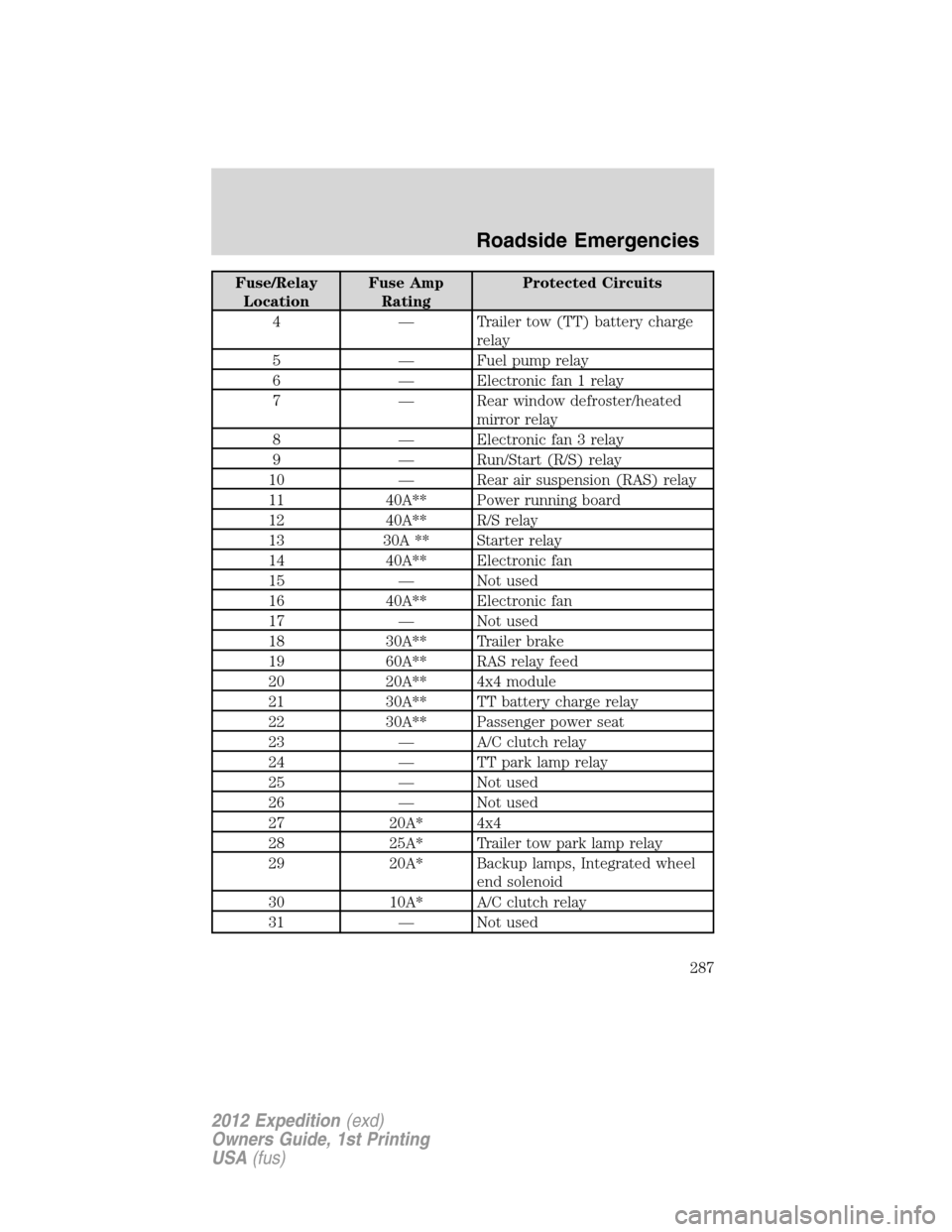
Fuse/Relay
LocationFuse Amp
RatingProtected Circuits
4 — Trailer tow (TT) battery charge
relay
5 — Fuel pump relay
6 — Electronic fan 1 relay
7 — Rear window defroster/heated
mirror relay
8 — Electronic fan 3 relay
9 — Run/Start (R/S) relay
10 — Rear air suspension (RAS) relay
11 40A** Power running board
12 40A** R/S relay
13 30A ** Starter relay
14 40A** Electronic fan
15 — Not used
16 40A** Electronic fan
17 — Not used
18 30A** Trailer brake
19 60A** RAS relay feed
20 20A** 4x4 module
21 30A** TT battery charge relay
22 30A** Passenger power seat
23 — A/C clutch relay
24 — TT park lamp relay
25 — Not used
26 — Not used
27 20A* 4x4
28 25A* Trailer tow park lamp relay
29 20A* Backup lamps, Integrated wheel
end solenoid
30 10A* A/C clutch relay
31 — Not used
Roadside Emergencies
287
2012 Expedition(exd)
Owners Guide, 1st Printing
USA(fus)
Page 294 of 400
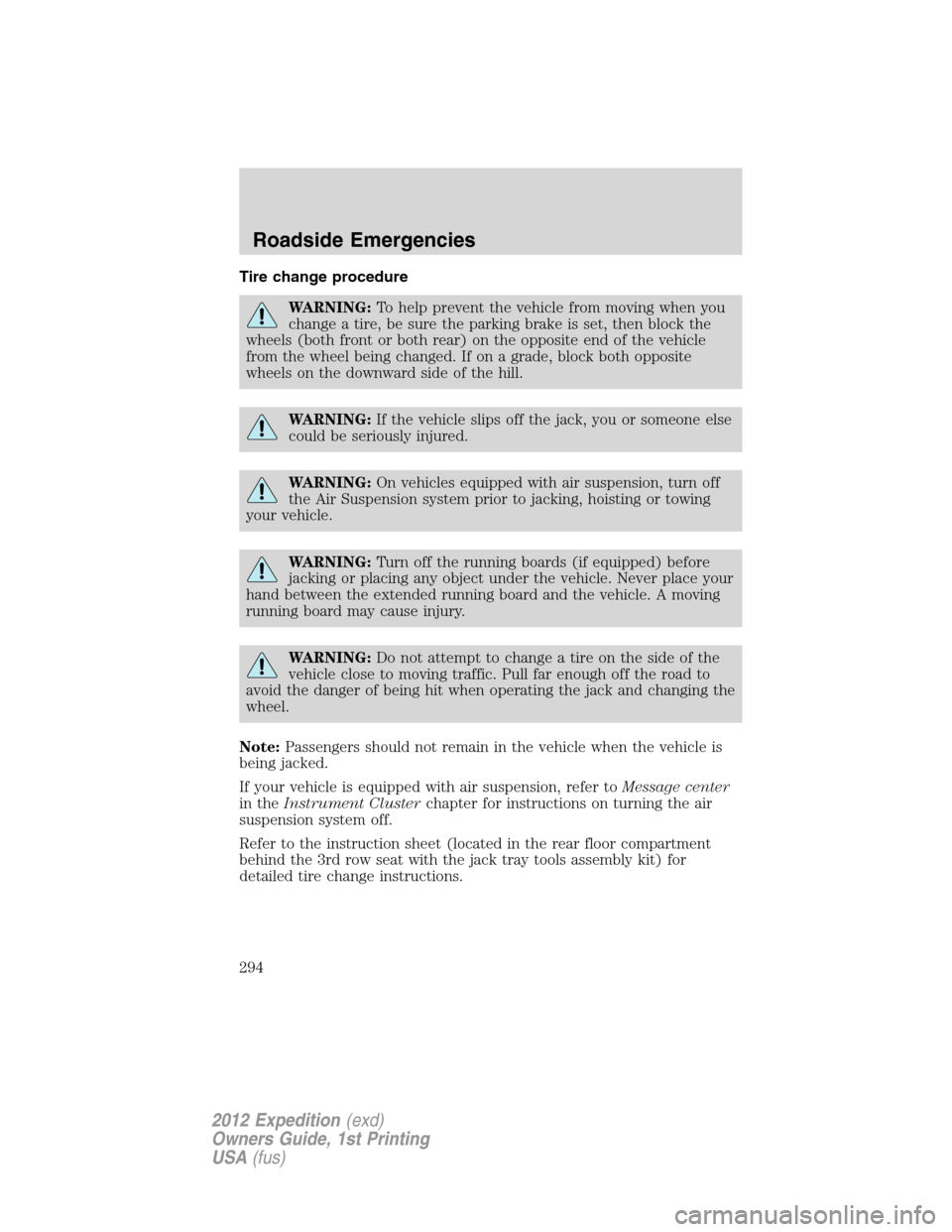
Tire change procedure
WARNING:To help prevent the vehicle from moving when you
change a tire, be sure the parking brake is set, then block the
wheels (both front or both rear) on the opposite end of the vehicle
from the wheel being changed. If on a grade, block both opposite
wheels on the downward side of the hill.
WARNING:If the vehicle slips off the jack, you or someone else
could be seriously injured.
WARNING:On vehicles equipped with air suspension, turn off
the Air Suspension system prior to jacking, hoisting or towing
your vehicle.
WARNING:Turn off the running boards (if equipped) before
jacking or placing any object under the vehicle. Never place your
hand between the extended running board and the vehicle. A moving
running board may cause injury.
WARNING:Do not attempt to change a tire on the side of the
vehicle close to moving traffic. Pull far enough off the road to
avoid the danger of being hit when operating the jack and changing the
wheel.
Note:Passengers should not remain in the vehicle when the vehicle is
being jacked.
If your vehicle is equipped with air suspension, refer toMessage center
in theInstrument Clusterchapter for instructions on turning the air
suspension system off.
Refer to the instruction sheet (located in the rear floor compartment
behind the 3rd row seat with the jack tray tools assembly kit) for
detailed tire change instructions.
Roadside Emergencies
294
2012 Expedition(exd)
Owners Guide, 1st Printing
USA(fus)
Page 295 of 400
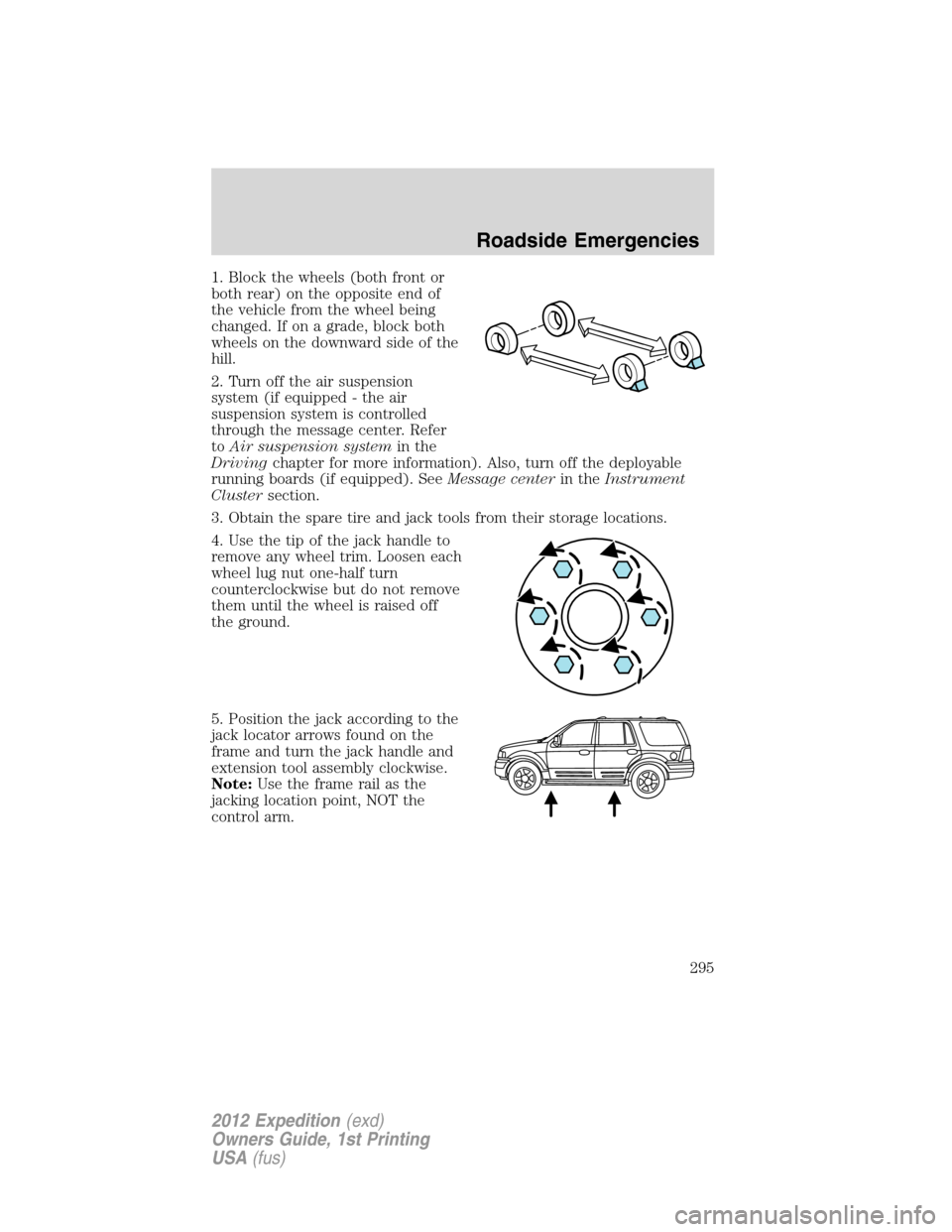
1. Block the wheels (both front or
both rear) on the opposite end of
the vehicle from the wheel being
changed. If on a grade, block both
wheels on the downward side of the
hill.
2. Turn off the air suspension
system (if equipped - the air
suspension system is controlled
through the message center. Refer
toAir suspension systemin the
Drivingchapter for more information). Also, turn off the deployable
running boards (if equipped). SeeMessage centerin theInstrument
Clustersection.
3. Obtain the spare tire and jack tools from their storage locations.
4. Use the tip of the jack handle to
remove any wheel trim. Loosen each
wheel lug nut one-half turn
counterclockwise but do not remove
them until the wheel is raised off
the ground.
5. Position the jack according to the
jack locator arrows found on the
frame and turn the jack handle and
extension tool assembly clockwise.
Note:Use the frame rail as the
jacking location point, NOT the
control arm.
Roadside Emergencies
295
2012 Expedition(exd)
Owners Guide, 1st Printing
USA(fus)
Page 297 of 400
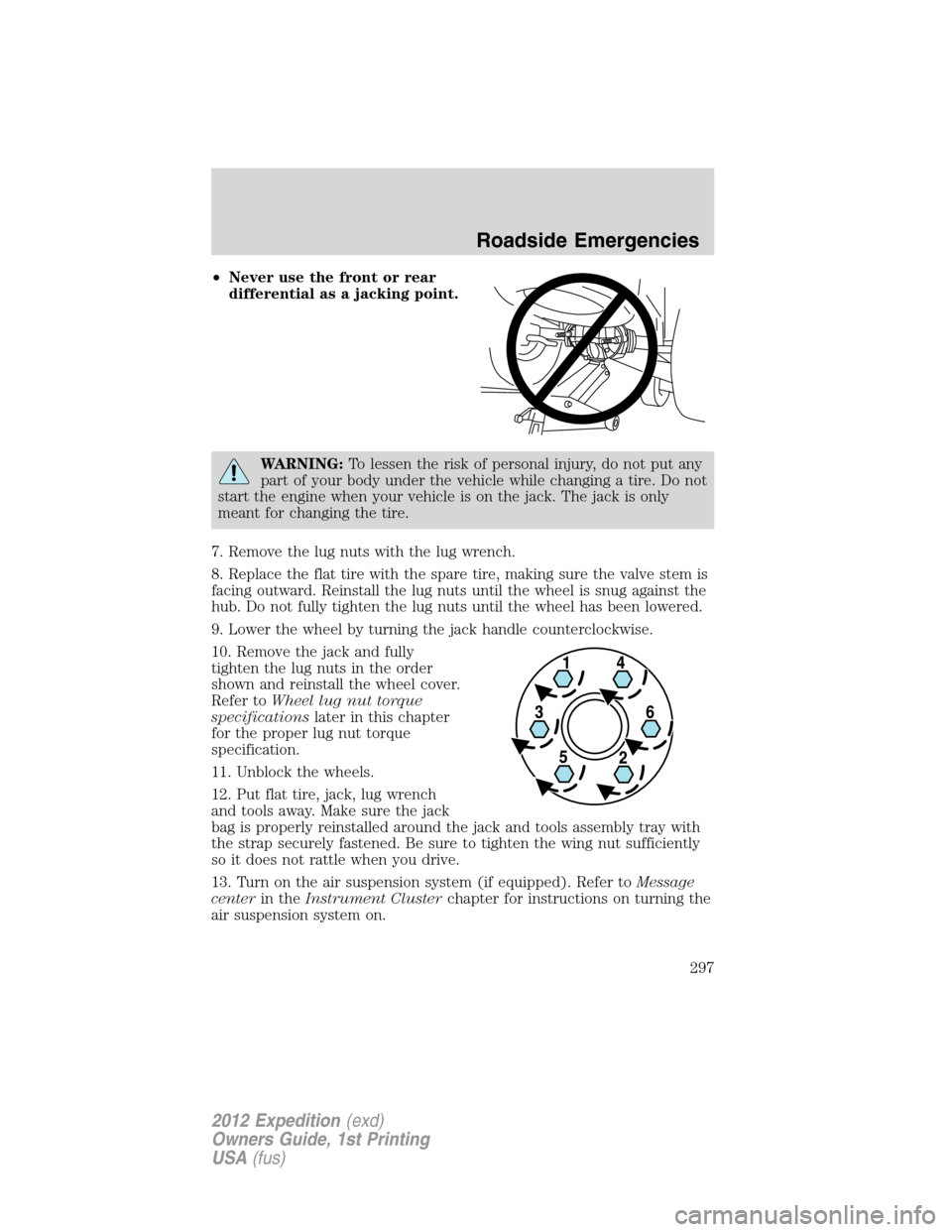
•Never use the front or rear
differential as a jacking point.
WARNING:To lessen the risk of personal injury, do not put any
part of your body under the vehicle while changing a tire. Do not
start the engine when your vehicle is on the jack. The jack is only
meant for changing the tire.
7. Remove the lug nuts with the lug wrench.
8. Replace the flat tire with the spare tire, making sure the valve stem is
facing outward. Reinstall the lug nuts until the wheel is snug against the
hub. Do not fully tighten the lug nuts until the wheel has been lowered.
9. Lower the wheel by turning the jack handle counterclockwise.
10. Remove the jack and fully
tighten the lug nuts in the order
shown and reinstall the wheel cover.
Refer toWheel lug nut torque
specificationslater in this chapter
for the proper lug nut torque
specification.
11. Unblock the wheels.
12. Put flat tire, jack, lug wrench
and tools away. Make sure the jack
bag is properly reinstalled around the jack and tools assembly tray with
the strap securely fastened. Be sure to tighten the wing nut sufficiently
so it does not rattle when you drive.
13. Turn on the air suspension system (if equipped). Refer toMessage
centerin theInstrument Clusterchapter for instructions on turning the
air suspension system on.
Roadside Emergencies
297
2012 Expedition(exd)
Owners Guide, 1st Printing
USA(fus)
Page 304 of 400
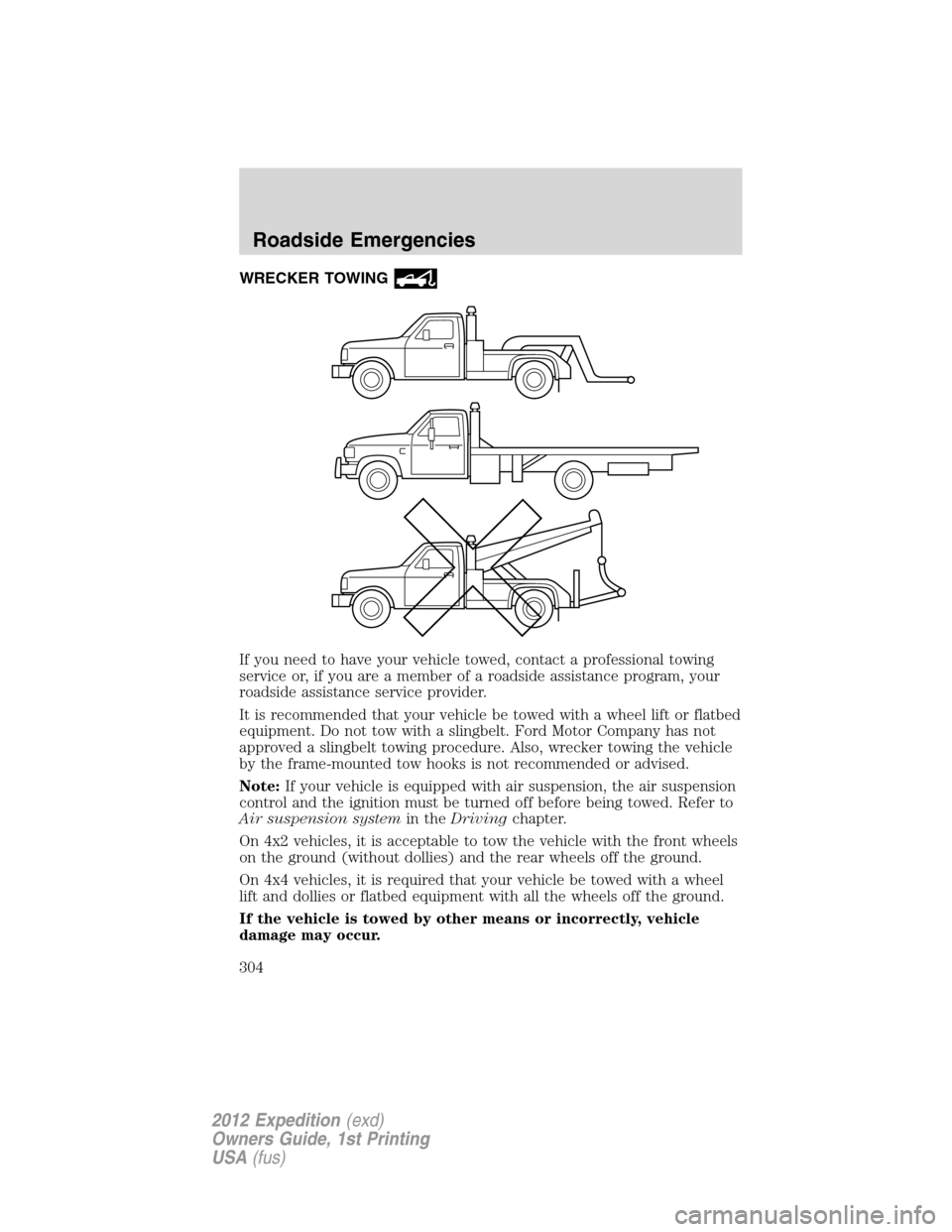
WRECKER TOWING
If you need to have your vehicle towed, contact a professional towing
service or, if you are a member of a roadside assistance program, your
roadside assistance service provider.
It is recommended that your vehicle be towed with a wheel lift or flatbed
equipment. Do not tow with a slingbelt. Ford Motor Company has not
approved a slingbelt towing procedure. Also, wrecker towing the vehicle
by the frame-mounted tow hooks is not recommended or advised.
Note:If your vehicle is equipped with air suspension, the air suspension
control and the ignition must be turned off before being towed. Refer to
Air suspension systemin theDrivingchapter.
On 4x2 vehicles, it is acceptable to tow the vehicle with the front wheels
on the ground (without dollies) and the rear wheels off the ground.
On 4x4 vehicles, it is required that your vehicle be towed with a wheel
lift and dollies or flatbed equipment with all the wheels off the ground.
If the vehicle is towed by other means or incorrectly, vehicle
damage may occur.
Roadside Emergencies
304
2012 Expedition(exd)
Owners Guide, 1st Printing
USA(fus)
Page 376 of 400
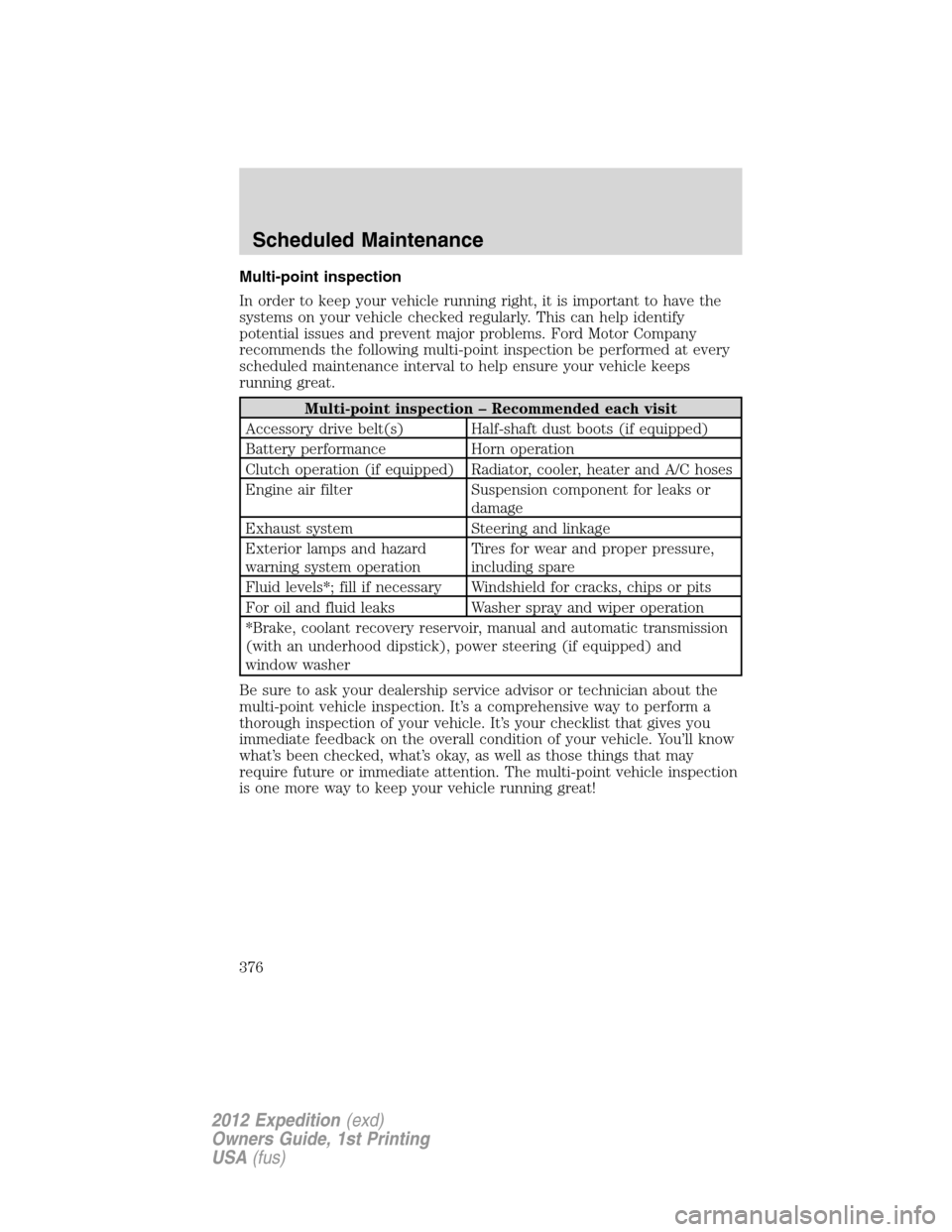
Multi-point inspection
In order to keep your vehicle running right, it is important to have the
systems on your vehicle checked regularly. This can help identify
potential issues and prevent major problems. Ford Motor Company
recommends the following multi-point inspection be performed at every
scheduled maintenance interval to help ensure your vehicle keeps
running great.
Multi-point inspection – Recommended each visit
Accessory drive belt(s) Half-shaft dust boots (if equipped)
Battery performance Horn operation
Clutch operation (if equipped) Radiator, cooler, heater and A/C hoses
Engine air filter Suspension component for leaks or
damage
Exhaust system Steering and linkage
Exterior lamps and hazard
warning system operationTires for wear and proper pressure,
including spare
Fluid levels*; fill if necessary Windshield for cracks, chips or pits
For oil and fluid leaks Washer spray and wiper operation
*Brake, coolant recovery reservoir, manual and automatic transmission
(with an underhood dipstick), power steering (if equipped) and
window washer
Be sure to ask your dealership service advisor or technician about the
multi-point vehicle inspection. It’s a comprehensive way to perform a
thorough inspection of your vehicle. It’s your checklist that gives you
immediate feedback on the overall condition of your vehicle. You’ll know
what’s been checked, what’s okay, as well as those things that may
require future or immediate attention. The multi-point vehicle inspection
is one more way to keep your vehicle running great!
Scheduled Maintenance
376
2012 Expedition(exd)
Owners Guide, 1st Printing
USA(fus)
Page 379 of 400
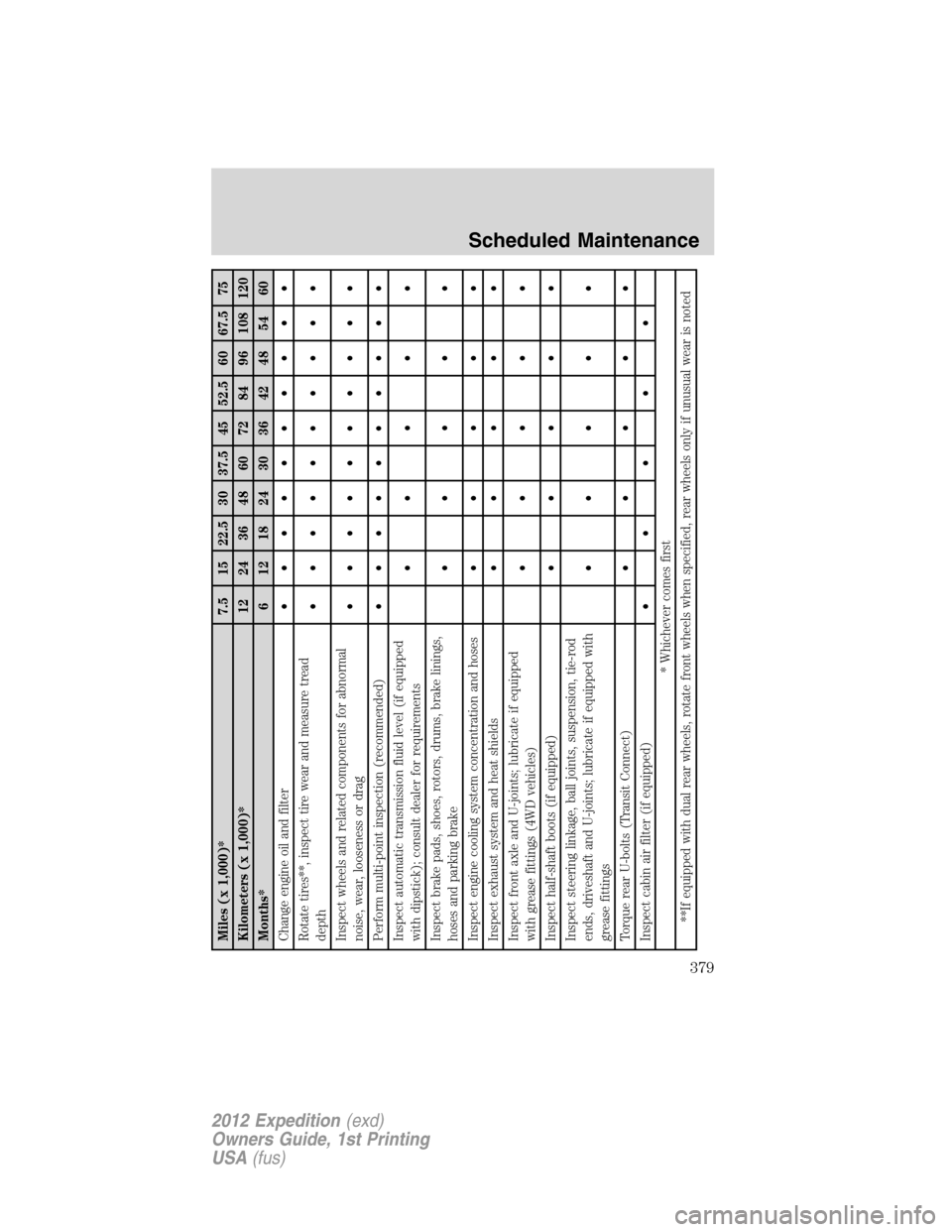
Miles (x 1,000)* 7.5 15 22.5 30 37.5 45 52.5 60 67.5 75
Kilometers (x 1,000)* 12 24 36 48 60 72 84 96 108 120
Months* 6 12 18 24 30 36 42 48 54 60
Change engine oil and filter• •••••••••
Rotate tires**, inspect tire wear and measure tread
depth• •••••••••
Inspect wheels and related components for abnormal
noise, wear, looseness or drag• •••••••••
Perform multi-point inspection (recommended)• •••••••••
Inspect automatic transmission fluid level (if equipped
with dipstick); consult dealer for requirements•••••
Inspect brake pads, shoes, rotors, drums, brake linings,
hoses and parking brake•••••
Inspect engine cooling system concentration and hoses•••••
Inspect exhaust system and heat shields•••••
Inspect front axle and U-joints; lubricate if equipped
with grease fittings (4WD vehicles)•••••
Inspect half-shaft boots (if equipped)•••••
Inspect steering linkage, ball joints, suspension, tie-rod
ends, driveshaft and U-joints; lubricate if equipped with
grease fittings•••••
Torque rear U-bolts (Transit Connect)•••••
Inspect cabin air filter (if equipped)•••••
* Whichever comes first
**If equipped with dual rear wheels, rotate front wheels when specified, rear wheels only if unusual wear is noted
Scheduled Maintenance
379
2012 Expedition(exd)
Owners Guide, 1st Printing
USA(fus)
Page 380 of 400
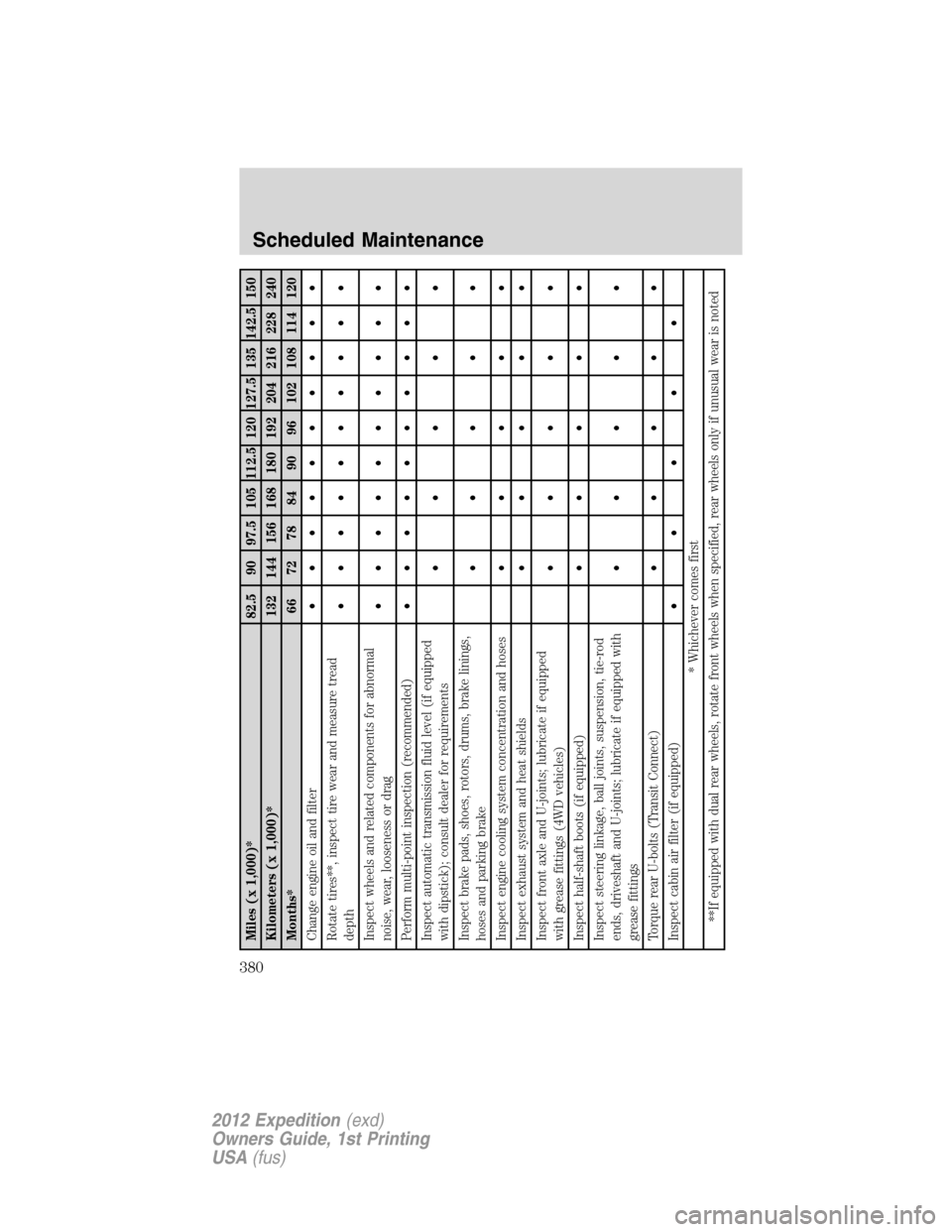
Miles (x 1,000)* 82.5 90 97.5 105 112.5 120 127.5 135 142.5 150
Kilometers (x 1,000)* 132 144 156 168 180 192 204 216 228 240
Months* 66 72 78 84 90 96 102 108 114 120
Change engine oil and filter• •••••••••
Rotate tires**, inspect tire wear and measure tread
depth• •••••••••
Inspect wheels and related components for abnormal
noise, wear, looseness or drag• •••••••••
Perform multi-point inspection (recommended)• •••••••••
Inspect automatic transmission fluid level (if equipped
with dipstick); consult dealer for requirements•••••
Inspect brake pads, shoes, rotors, drums, brake linings,
hoses and parking brake•••••
Inspect engine cooling system concentration and hoses•••••
Inspect exhaust system and heat shields•••••
Inspect front axle and U-joints; lubricate if equipped
with grease fittings (4WD vehicles)•••••
Inspect half-shaft boots (if equipped)•••••
Inspect steering linkage, ball joints, suspension, tie-rod
ends, driveshaft and U-joints; lubricate if equipped with
grease fittings•••••
Torque rear U-bolts (Transit Connect)•••••
Inspect cabin air filter (if equipped)•••••
* Whichever comes first
**If equipped with dual rear wheels, rotate front wheels when specified, rear wheels only if unusual wear is noted
Scheduled Maintenance
380
2012 Expedition(exd)
Owners Guide, 1st Printing
USA(fus)