2012 FORD ESCAPE clutch
[x] Cancel search: clutchPage 75 of 361
3. Press and release SET +.
4. Take your foot off the accelerator pedal.
5. The indicator
light on the instrument cluster will turn on.
Note:
•Vehicle speed may vary momentarily when driving up and down a
steep hill.
•If the vehicle speed increases above the set speed on a downhill, you
may want to apply the brakes to reduce the speed.
•If the vehicle speed decreases more than 10 mph (16 km/h) below
your set speed on an uphill, your speed control will disengage.
Disengaging speed control
Tap the brake pedal or clutch pedal (if equipped) to disengage the speed
control. Disengaging the speed control will not erase previous set speed.
Note:When you use the clutch pedal to disengage the speed control,
the engine speed may briefly increase, this is normal.
Resuming a set speed
Press and release RES. This will automatically return the vehicle to the
previously set speed.
Increasing speed while using speed control
To set a higher speed:
•Press and hold SET + until you get to the desired speed, then release.
You can also use SET + to operate the tap-up function. Press and
release SET + to increase the set speed in 1 mph (1.6 km/h)
increments.
•Use the accelerator pedal to get to the desired speed, then speed
press and release SET +.
Reducing speed while using speed control
To reduce a set speed:
•Press and hold SET– until you get to the desired speed, then release.
You can also use SET– to operate the tap-down function. Press and
release SET– to decrease the set speed in 1 mph (1.6 km/h)
increments.
•Press the brake pedal or the clutch pedal (if equipped) until the
desired vehicle speed is reached and press and release SET +.
Driver Controls
75
2012 Escape(204)
Owners Guide, 1st Printing
USA(fus)
Page 208 of 361

•Make sure the gearshift is in P
(Park).
If starting a vehicle with a manual
transmission:
•Make sure the parking brake is
set.
•Press and hold the clutch pedal
to the floor and put the gearshift
lever in N (Neutral).
3. Turn the key to 3 (on) without
turning the key to 4 (start).
Some warning lights will briefly illuminate. SeeWarning lights and
chimesin theInstrument Clusterchapter for more information
regarding the warning lights.
Driving
208
2012 Escape(204)
Owners Guide, 1st Printing
USA(fus)
Page 224 of 361
AUTOMATIC TRANSMISSION OPERATION (IF EQUIPPED)
Automatic transmission adaptive learning
Your transmission is equipped with an adaptive learning strategy found in
the vehicle computer. This feature is designed to increase durability and
provide consistent shift feel over the life of the vehicle. A new vehicle or
transmission may have firm and/or soft shifts. This operation is
considered normal and will not affect function or durability of the
transmission. Over time, the adaptive learning process will fully update
transmission operation. Additionally, whenever the battery is
disconnected or a new battery installed, the strategy must be relearned.
Understanding the gearshift positions of the 6–speed automatic
transmission
Your vehicle has been designed to improve fuel economy by reducing
fuel usage while coasting or decelerating. When you take your foot off
the accelerator pedal and the vehicle begins to slow down, the torque
converter clutch locks up and aggressively shuts off fuel flow to the
engine while decelerating. This fuel economy benefit may be perceived
as a light to medium braking sensation when removing your foot from
the accelerator pedal.
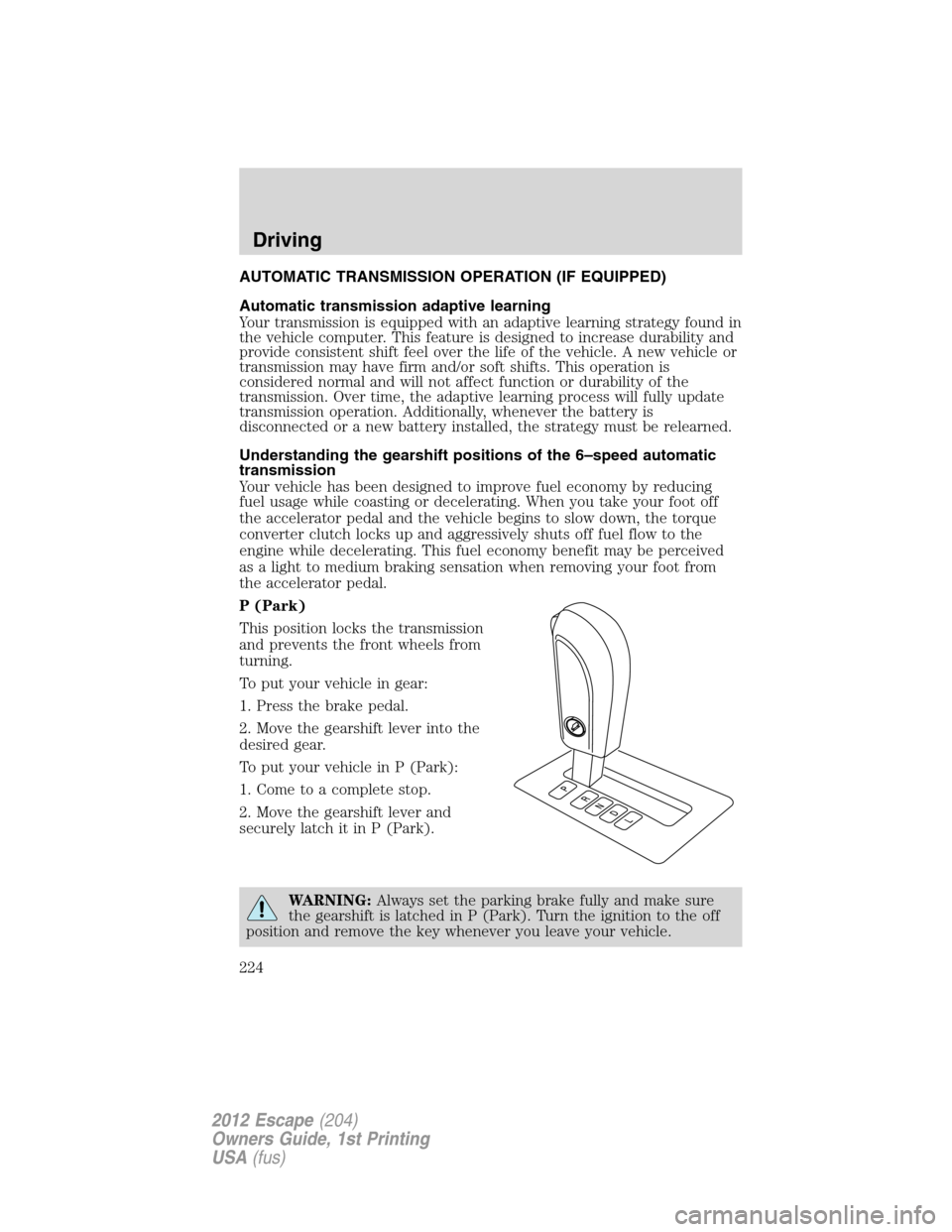
P (Park)
This position locks the transmission
and prevents the front wheels from
turning.
To put your vehicle in gear:
1. Press the brake pedal.
2. Move the gearshift lever into the
desired gear.
To put your vehicle in P (Park):
1. Come to a complete stop.
2. Move the gearshift lever and
securely latch it in P (Park).
WARNING:Always set the parking brake fully and make sure
the gearshift is latched in P (Park). Turn the ignition to the off
position and remove the key whenever you leave your vehicle.
Driving
224
2012 Escape(204)
Owners Guide, 1st Printing
USA(fus)
Page 226 of 361

To return to normal D (Drive) position (with O/D), press the
transmission control switch again.
•The grade assist lamp in the instrument cluster will not be illuminated.
•The transmission will operate in gears one through six.
O/D (overdrive mode) is automatically returned each time the engine is
turned off.
L (Low)
•Provides maximum engine braking.
•Will downshift to the lowest available gear for the current vehicle
speed; allows for first gear when vehicle reaches slower speeds.
•Is not intended for use under extended or normal driving conditions
and results in lower fuel economy.
If your vehicle gets stuck in mud or snow
Note:Do not rock the vehicle if the engine is not at normal operating
temperature or damage to the transmission may occur.
Note:Do not rock the vehicle for more than a minute or damage to the
transmission and tires may occur, or the engine may overheat.
If your vehicle gets stuck in mud or snow, it may be rocked out by
shifting between forward and reverse gears, stopping between shifts in a
steady pattern. Press lightly on the accelerator in each gear.
MANUAL TRANSMISSION OPERATION (IF EQUIPPED)
Using the clutch
Manual transmission vehicles have a starter interlock that prevents
cranking the engine unless the clutch pedal is fully pressed.
To start the vehicle:
1. Make sure the parking brake is fully set.
2. Press the clutch pedal to the
floor, then put the gearshift lever in
the neutral position.
3. Start the engine.
4. Press the brake pedal and move
the gearshift lever to the desired
gear; 1 (First) or R (Reverse).
5. Release the parking brake, then slowly release the clutch pedal while
slowly pressing on the accelerator.
Driving
226
2012 Escape(204)
Owners Guide, 1st Printing
USA(fus)
Page 227 of 361
During each shift, the clutch pedal must be fully pressed to the floor.
Make sure the floor mat is properly positioned so it doesn’t interfere with
the full extension of the clutch pedal.
Failure to fully press the clutch pedal to the floor may cause
increased shift efforts, prematurely wear transmission
components or damage the transmission.
Do not drive with your foot resting on the clutch pedal or use the
clutch pedal to hold your vehicle at a standstill while waiting on a
hill. These actions will severely reduce the life of the clutch and
could nullify a clutch warranty claim.
Recommended shift speeds
Upshift according to the following charts for best fuel economy:
Upshifts during light to moderate accelerations and cruises
(for best fuel economy)
Shift from:
1-2 10 mph (16 km/h)
2-3 20 mph (32 km/h)
3-4 30 mph (48 km/h)
4-5 37 mph (60 km/h)
Reverse
Make sure that your vehicle is at a complete stop before you shift
into R (Reverse). Failure to do so may damage the transmission.
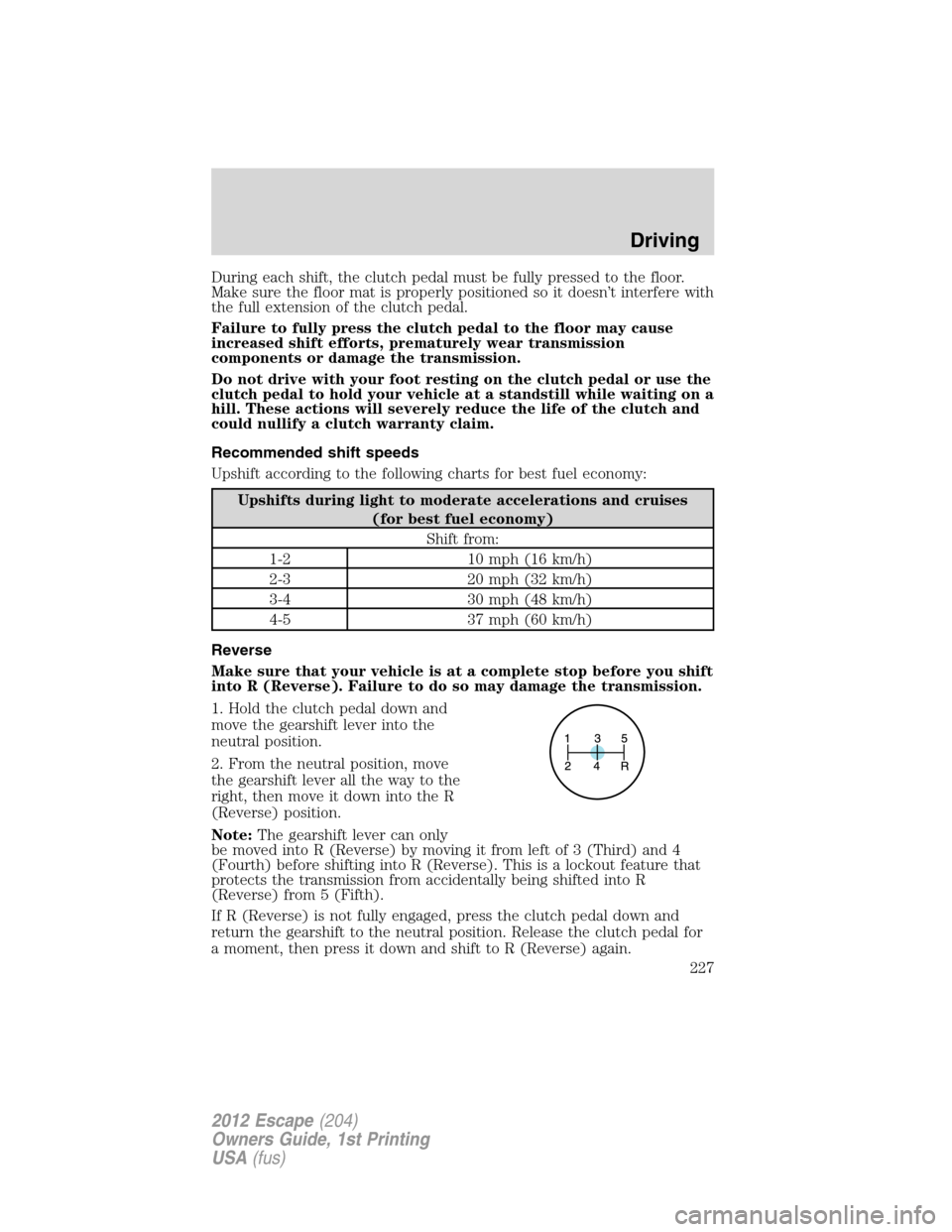
1. Hold the clutch pedal down and
move the gearshift lever into the
neutral position.
2. From the neutral position, move
the gearshift lever all the way to the
right, then move it down into the R
(Reverse) position.
Note:The gearshift lever can only
be moved into R (Reverse) by moving it from left of 3 (Third) and 4
(Fourth) before shifting into R (Reverse). This is a lockout feature that
protects the transmission from accidentally being shifted into R
(Reverse) from 5 (Fifth).
If R (Reverse) is not fully engaged, press the clutch pedal down and
return the gearshift to the neutral position. Release the clutch pedal for
a moment, then press it down and shift to R (Reverse) again.
Driving
227
2012 Escape(204)
Owners Guide, 1st Printing
USA(fus)
Page 228 of 361
Parking your vehicle
1. Apply the brake and shift into the neutral position.
2. Fully apply the parking brake, hold the clutch pedal down, then shift
into 1 (First).
3. Turn the ignition off.
WARNING:Do not park your vehicle in Neutral, it may move
unexpectedly and injure someone. Use 1 (First) gear and set the
parking brake fully.
REVERSE SENSING SYSTEM (IF EQUIPPED)
The reverse sensing system (RSS) sounds a tone to warn the driver of
obstacles near the rear bumper when R (Reverse) is selected and the
vehicle is moving at speeds less than 3 mph (5 km/h). The system is not
effective at speeds above 3 mph (5 km/h) and may not detect certain
angular or moving objects.
WARNING:To help avoid personal injury, please read and
understand the limitations of the reverse sensing system as
contained in this section. Reverse sensing is only an aid for some
(generally large and fixed) objects when moving in reverse on a flat
surface at “parking speeds”. Inclement weather may also affect the
function of the RSS; this may include reduced performance or a false
activation.
WARNING:To help avoid personal injury, always use caution
when in reverse and when using the RSS.
WARNING:This system is not designed to prevent contact with
small or moving objects. The system is designed to provide a
warning to assist the driver in detecting large stationary objects to
avoid damaging the vehicle. The system may not detect smaller
objects, particularly those close to the ground.
WARNING:Certain add-on devices such as large trailer hitches,
bike or surfboard racks and any device that may block the
normal detection zone of the RSS system may create false beeps.
Driving
228
2012 Escape(204)
Owners Guide, 1st Printing
USA(fus)
Page 252 of 361
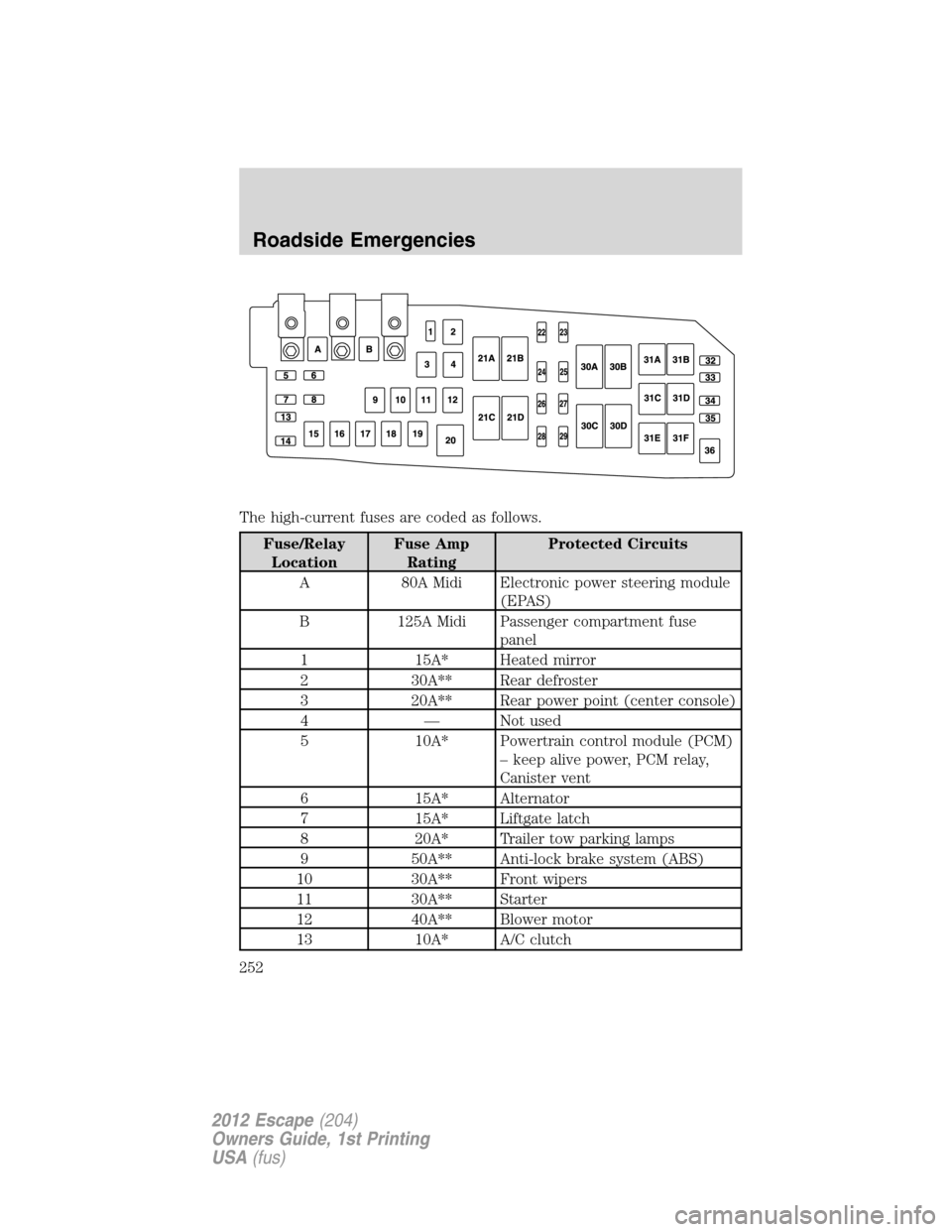
The high-current fuses are coded as follows.
Fuse/Relay
LocationFuse Amp
RatingProtected Circuits
A 80A Midi Electronic power steering module
(EPAS)
B 125A Midi Passenger compartment fuse
panel
1 15A* Heated mirror
2 30A** Rear defroster
3 20A** Rear power point (center console)
4 — Not used
5 10A* Powertrain control module (PCM)
– keep alive power, PCM relay,
Canister vent
6 15A* Alternator
7 15A* Liftgate latch
8 20A* Trailer tow parking lamps
9 50A** Anti-lock brake system (ABS)
10 30A** Front wipers
11 30A** Starter
12 40A** Blower motor
13 10A* A/C clutch
Roadside Emergencies
252
2012 Escape(204)
Owners Guide, 1st Printing
USA(fus)
Page 253 of 361

Fuse/Relay
LocationFuse Amp
RatingProtected Circuits
14 15A* Trailer tow turn lamps
15 — Not used
16 40A** Cooling fan 1
17 40A** Cooling fan 2
18 20A** ABS solenoid
19 30A** Power seats
20 — A/C clutch relay
21A — Rear defroster relay
21B — Fuel relay
21C — Blower relay
21D — PCM relay
22 20A* Fuel pump
23 15A* Fuel injectors
24 — Not used
25 5A* ABS
26 15A* Ignition coils
27 10A* PCM – general powertrain
components malfunction indicator
lamp
28 20A* PCM – emission related
powertrain components
malfunction indicator lamp
29 15A* PCM
30A — Cooling fan 1 relay
30B — Starter relay
30C — Cooling fan main relay
30D — Cooling fan 2 relay
31A — Reverse lamp relay
31B — Not used
31C — Trailer tow left turn relay
31D — Trailer tow right turn relay
31E — Trailer tow park relay
Roadside Emergencies
253
2012 Escape(204)
Owners Guide, 1st Printing
USA(fus)