Page 122 of 361
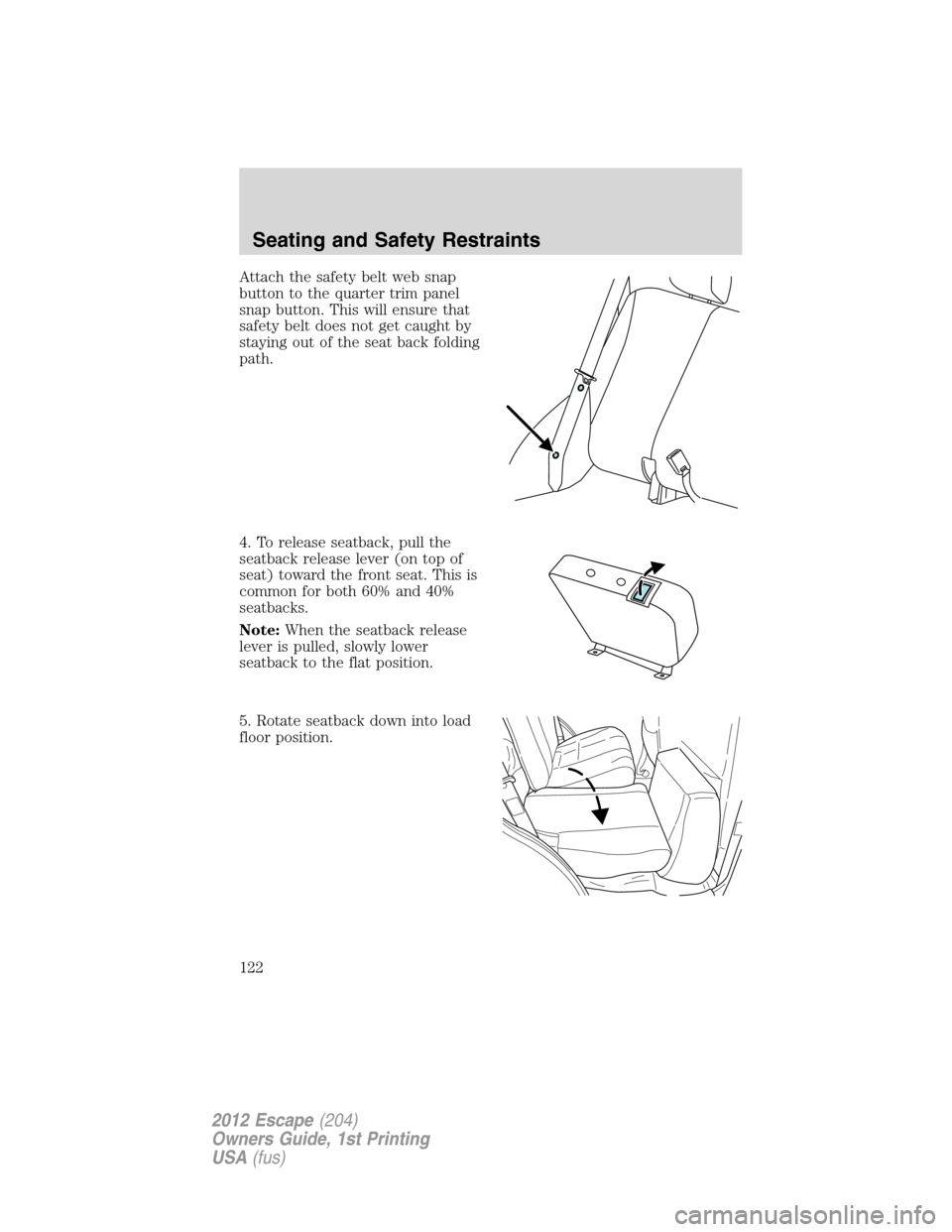
Attach the safety belt web snap
button to the quarter trim panel
snap button. This will ensure that
safety belt does not get caught by
staying out of the seat back folding
path.
4. To release seatback, pull the
seatback release lever (on top of
seat) toward the front seat. This is
common for both 60% and 40%
seatbacks.
Note:When the seatback release
lever is pulled, slowly lower
seatback to the flat position.
5. Rotate seatback down into load
floor position.
Seating and Safety Restraints
122
2012 Escape(204)
Owners Guide, 1st Printing
USA(fus)
Page 139 of 361
WARNING:Never place your arm over the airbag module as a
deploying airbag can result in serious arm fractures or other
injuries.
To properly position yourself away from the airbag:
•Move your seat to the rear as far as you can while still reaching the
pedals comfortably.
•Recline the seat slightly one or two degrees from the upright position.
WARNING:Do not put anything on or over the airbag module.
Placing objects on or over the airbag inflation area may cause
those objects to be propelled by the airbag into your face and torso
causing serious injury.
WARNING:Do not attempt to service, repair, or modify the
airbag supplemental restraint systems or its fuses. Contact your
authorized dealer as soon as possible.
WARNING:Modifications to the front end of the vehicle,
including frame, bumper, front end body structure, tow hooks
and B-pillar surrounding parts may affect the performance of the
airbag sensors increasing the risk of injury. Do not modify the front
end of the vehicle.
WARNING:Additional equipment may affect the performance of
the airbag sensors increasing the risk of injury.
Seating and Safety Restraints
139
2012 Escape(204)
Owners Guide, 1st Printing
USA(fus)
Page 145 of 361
ObjectsPass Airbag Off
Indicator LampPassenger Airbag
Empty seat, or small to medium
object with safety belt buckledLit Disabled
If you think that the status of the “passenger airbag off” indicator lamp is
incorrect, check for the following:
•Objects lodged underneath the seat
•
Objects between the seat cushion and the center console (if equipped)
•Objects placed on the front-passenger seat’s occupant’s lap
•Objects that may have trapped the safety belt against the seat or
passenger side b-pillar, preventing free movement of the safety belt
•Other passengers or cargo pushing or pulling on the seat’s bottom
cushion
•Rear seat passenger’s feet resting on or pushing on the seat’s bottom
cushion
The conditions listed above may cause the weight of a properly seated
occupant to be incorrectly interpreted by the front passenger sensing
system. The person in the front passenger seat may appear heavier or
lighter due to the conditions described in the list above.
WARNING:To reduce the risk of possible serious injury:
Do not stow objects in seat back map pocket (if equipped) or
hang objects off seat back if a child is in the front passenger seat.
Do not place objects underneath the front passenger seat or between
the seat and the center console (if equipped).
Check the “passenger airbag off” or “pass airbag off” indicator lamp for
proper airbag Status.
Failure to follow these instructions may interfere with the front
passenger seat sensing system.
In case there is a problem with the
front passenger sensing system, the
airbag readiness lamp in the
instrument cluster will stay lit.
Seating and Safety Restraints
145
2012 Escape(204)
Owners Guide, 1st Printing
USA(fus)
Page 149 of 361
WARNING:Several airbag system components get hot after
inflation. Do not touch them after inflation.
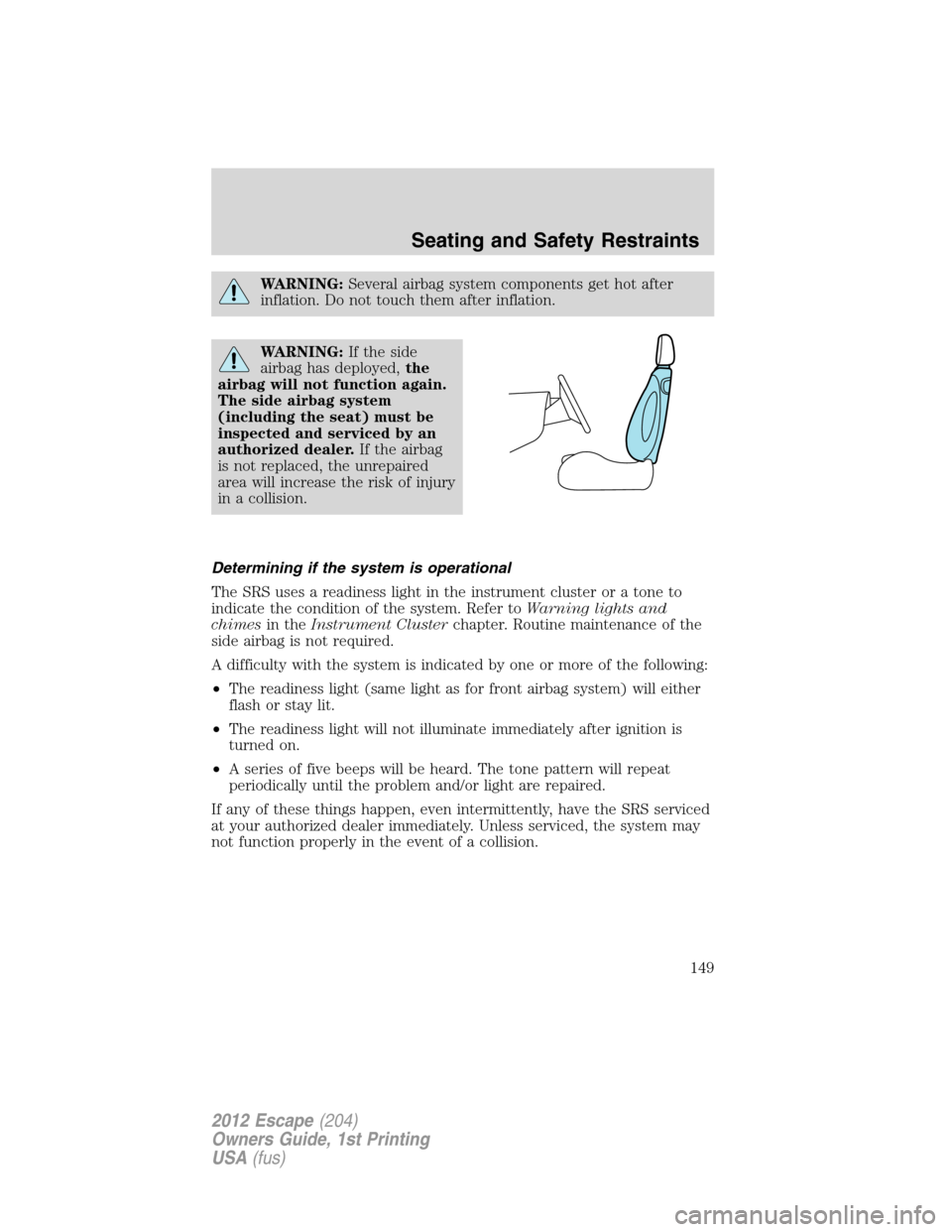
WARNING:If the side
airbag has deployed,the
airbag will not function again.
The side airbag system
(including the seat) must be
inspected and serviced by an
authorized dealer.If the airbag
is not replaced, the unrepaired
area will increase the risk of injury
in a collision.
Determining if the system is operational
The SRS uses a readiness light in the instrument cluster or a tone to
indicate the condition of the system. Refer toWarning lights and
chimesin theInstrument Clusterchapter. Routine maintenance of the
side airbag is not required.
A difficulty with the system is indicated by one or more of the following:
•The readiness light (same light as for front airbag system) will either
flash or stay lit.
•The readiness light will not illuminate immediately after ignition is
turned on.
•A series of five beeps will be heard. The tone pattern will repeat
periodically until the problem and/or light are repaired.
If any of these things happen, even intermittently, have the SRS serviced
at your authorized dealer immediately. Unless serviced, the system may
not function properly in the event of a collision.
Seating and Safety Restraints
149
2012 Escape(204)
Owners Guide, 1st Printing
USA(fus)
Page 153 of 361
Determining if the system is operational
The SRS uses a readiness light in the instrument cluster or a tone to
indicate the condition of the system. Refer toWarning lights and
chimesin theInstrument Clusterchapter. Routine maintenance of the
side airbag is not required.
A difficulty with the system is indicated by one or more of the following:
•The readiness light (same light as for front airbag system) will either
flash or stay lit.
•The readiness light will not illuminate immediately after ignition is
turned on.
•A series of five beeps will be heard. The tone pattern will repeat
periodically until the problem and/or light are repaired.
If any of these things happen, even intermittently, have the SRS serviced
at your authorized dealer immediately. Unless serviced, the system may
not function properly in the event of a collision.
SOS Post-Crash Alert System™
The system automatically flashes the turn signal lamps and sounds the
horn three times at four second intervals in the event of a serious impact
that deploys an airbag (front, side, side curtain [if equipped] or Safety
Canopy�[if equipped]) or the safety belt pretensioners.
The system can be turned off when any one of the following actions are
taken by the driver or any other person:
•pressing the hazard control button,
•or pressing the panic button on the remote entry transmitter.
The feature will continue to operate until the vehicle runs out of power.
Disposal of airbags and airbag equipped vehicles (including
pretensioners)
Contact your authorized dealer as soon as possible. Airbags MUST BE
disposed of by qualified personnel.
Seating and Safety Restraints
153
2012 Escape(204)
Owners Guide, 1st Printing
USA(fus)
Page 157 of 361
WARNING:Never let a passenger hold a child on his or her lap
while the vehicle is moving. The passenger cannot protect the
child from injury in a collision, which may result in serious injury or
death.
WARNING:Never use pillows, books, or towels to boost a child.
They can slide around and increase the likelihood of injury or
death in a collision.
WARNING:Always restrain an unoccupied child seat or booster
seat. These objects may become projectiles in a collision or
sudden stop, which may increase the risk of serious injury.
WARNING:Never place, or allow a child to place, the shoulder
belt under a child’s arm or behind the back because it reduces
the protection for the upper part of the body and may increase the risk
of injury or death in a collision.
WARNING:Do not leave children, unreliable adults, or pets
unattended in your vehicle.
Transporting children
Always make sure your child is secured properly in a device that is
appropriate for their age, height and weight. All children are shaped
differently. The child height, age and weight thresholds provided are
recommendations or the minimum requirements of law. The National
Highway Traffic Safety Administration (NHTSA) provides education and
training to ensure that all children ages 0 to 16 are properly restrained in
the correct restraint system. Ford recommends checking with a NHTSA
Certified Child Passenger Safety Technician (CPST) and your
pediatrician to make sure your seat is appropriate for your child and
properly installed in the vehicle. To locate a child seat fitting station and
CPST contact the NHTSA toll free at1-888-327-4236or on the internet
at http://www.nhtsa.dot.gov. In Canada, check with your local St. John
Ambulance office for referral to a CPST or for further information,
contact your provincial ministry of transportation, your local St. John
Ambulance office at http://www.sfa.ca, or Transport Canada at
1–800–333–0371 (http://www.tc.gc.ca).
Seating and Safety Restraints
157
2012 Escape(204)
Owners Guide, 1st Printing
USA(fus)
Page 161 of 361
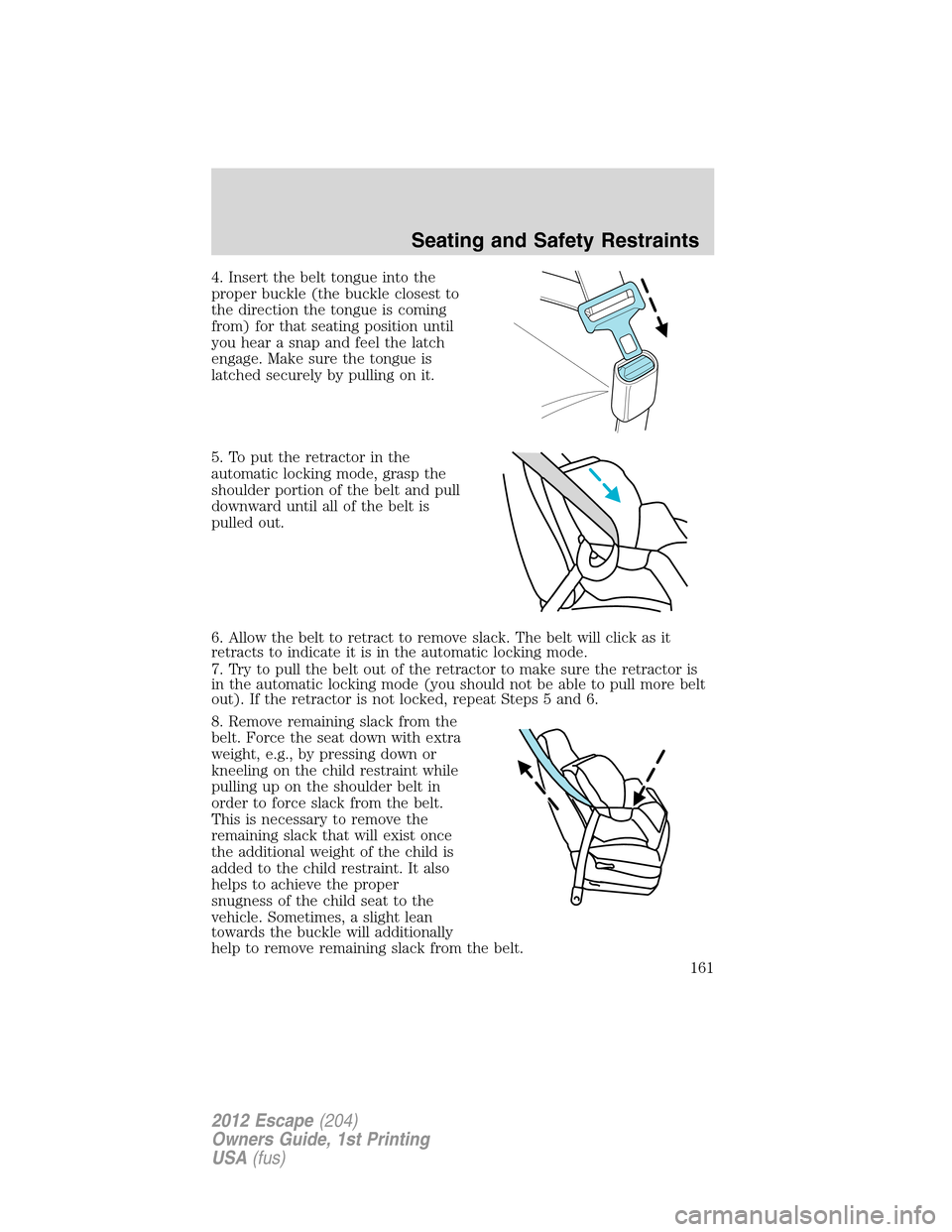
4. Insert the belt tongue into the
proper buckle (the buckle closest to
the direction the tongue is coming
from) for that seating position until
you hear a snap and feel the latch
engage. Make sure the tongue is
latched securely by pulling on it.
5. To put the retractor in the
automatic locking mode, grasp the
shoulder portion of the belt and pull
downward until all of the belt is
pulled out.
6. Allow the belt to retract to remove slack. The belt will click as it
retracts to indicate it is in the automatic locking mode.
7. Try to pull the belt out of the retractor to make sure the retractor is
in the automatic locking mode (you should not be able to pull more belt
out). If the retractor is not locked, repeat Steps 5 and 6.
8. Remove remaining slack from the
belt. Force the seat down with extra
weight, e.g., by pressing down or
kneeling on the child restraint while
pulling up on the shoulder belt in
order to force slack from the belt.
This is necessary to remove the
remaining slack that will exist once
the additional weight of the child is
added to the child restraint. It also
helps to achieve the proper
snugness of the child seat to the
vehicle. Sometimes, a slight lean
towards the buckle will additionally
help to remove remaining slack from the belt.
Seating and Safety Restraints
161
2012 Escape(204)
Owners Guide, 1st Printing
USA(fus)
Page 166 of 361
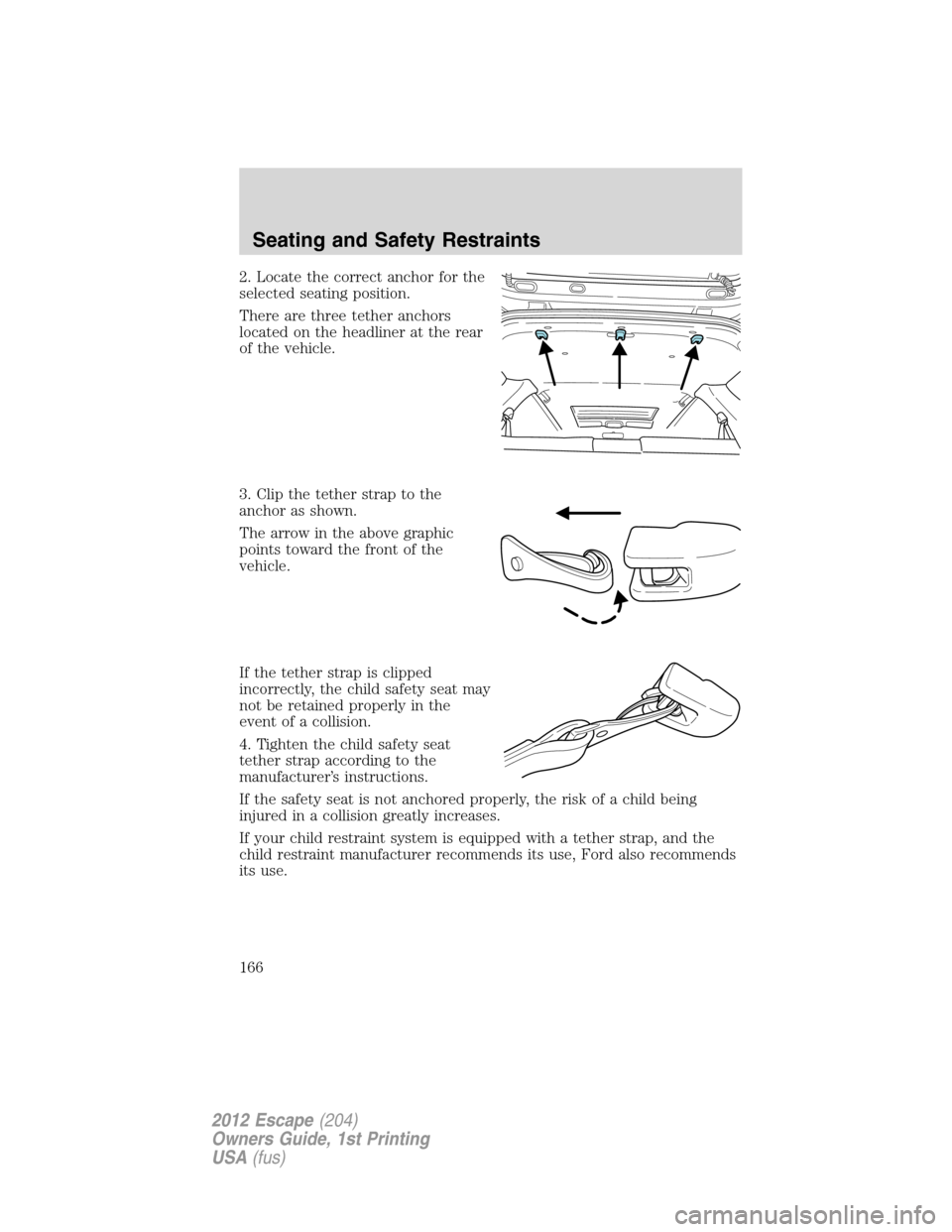
2. Locate the correct anchor for the
selected seating position.
There are three tether anchors
located on the headliner at the rear
of the vehicle.
3. Clip the tether strap to the
anchor as shown.
The arrow in the above graphic
points toward the front of the
vehicle.
If the tether strap is clipped
incorrectly, the child safety seat may
not be retained properly in the
event of a collision.
4. Tighten the child safety seat
tether strap according to the
manufacturer’s instructions.
If the safety seat is not anchored properly, the risk of a child being
injured in a collision greatly increases.
If your child restraint system is equipped with a tether strap, and the
child restraint manufacturer recommends its use, Ford also recommends
its use.
Seating and Safety Restraints
166
2012 Escape(204)
Owners Guide, 1st Printing
USA(fus)