Driving style — good driving and fuel economy habits
Give consideration to the lists that follow and you may be able to change
a number of variables and improve your fuel economy.
Habits
•Smooth, moderate operation can yield up to 10% savings in fuel.
•Steady speeds without stopping will usually give the best fuel
economy.
•Idling for long periods of time (greater than one minute) may waste
fuel.
•Anticipate stopping; slowing down may eliminate the need to stop.
•Sudden or hard accelerations may reduce fuel economy.
•Slow down gradually.
•Driving at reasonable speeds (traveling at 55 mph [88 km/h] uses 15%
less fuel than traveling at 65 mph [105 km/h]).
•Revving the engine before turning it off may reduce fuel economy.
•Using the air conditioner or defroster may reduce fuel economy.
•You may want to turn off the speed control in hilly terrain if
unnecessary shifting between the top gears occurs. Unnecessary
shifting of this type could result in reduced fuel economy.
•Warming up a vehicle on cold mornings is not required and may
reduce fuel economy.
•Resting your foot on the brake pedal while driving may reduce fuel
economy.
•Combine errands and minimize stop-and-go driving.
Maintenance
•Keep tires properly inflated and use only recommended size.
•Operating a vehicle with the wheels out of alignment will reduce fuel
economy.
•Use recommended engine oil. Refer toMaintenance product
specifications and capacitiesin this chapter.
•Perform all regularly scheduled maintenance items. Follow the
recommended maintenance schedule and owner maintenance checks
found inscheduled maintenance information.
Maintenance and Specifications
312
2012 Escape(204)
Owners Guide, 1st Printing
USA(fus)
Adjusting automatic transmission fluid levels
Before adding any fluid, make sure the correct type is used. The type of
fluid used is normally indicated on the dipstick blade. Refer to
Maintenance product specifications and capacitiesin this chapter.
Use of a non-approved automatic transmission fluid may cause
internal transmission component damage.
If necessary, add fluid in 1/2 pint (250 ml) increments through the filler
tube until the level is correct.
If an overfill occurs, excess fluid
should be removed by an authorized
dealer.
An overfill condition of transmission fluid may cause shift and/or
engagement concerns and/or possible damage.
Do not use supplemental transmission fluid additives, treatments or
cleaning agents. The use of these materials may affect transmission
operation and result in damage to internal transmission components.
Checking transmission fluid level for recreational flat tow
operation
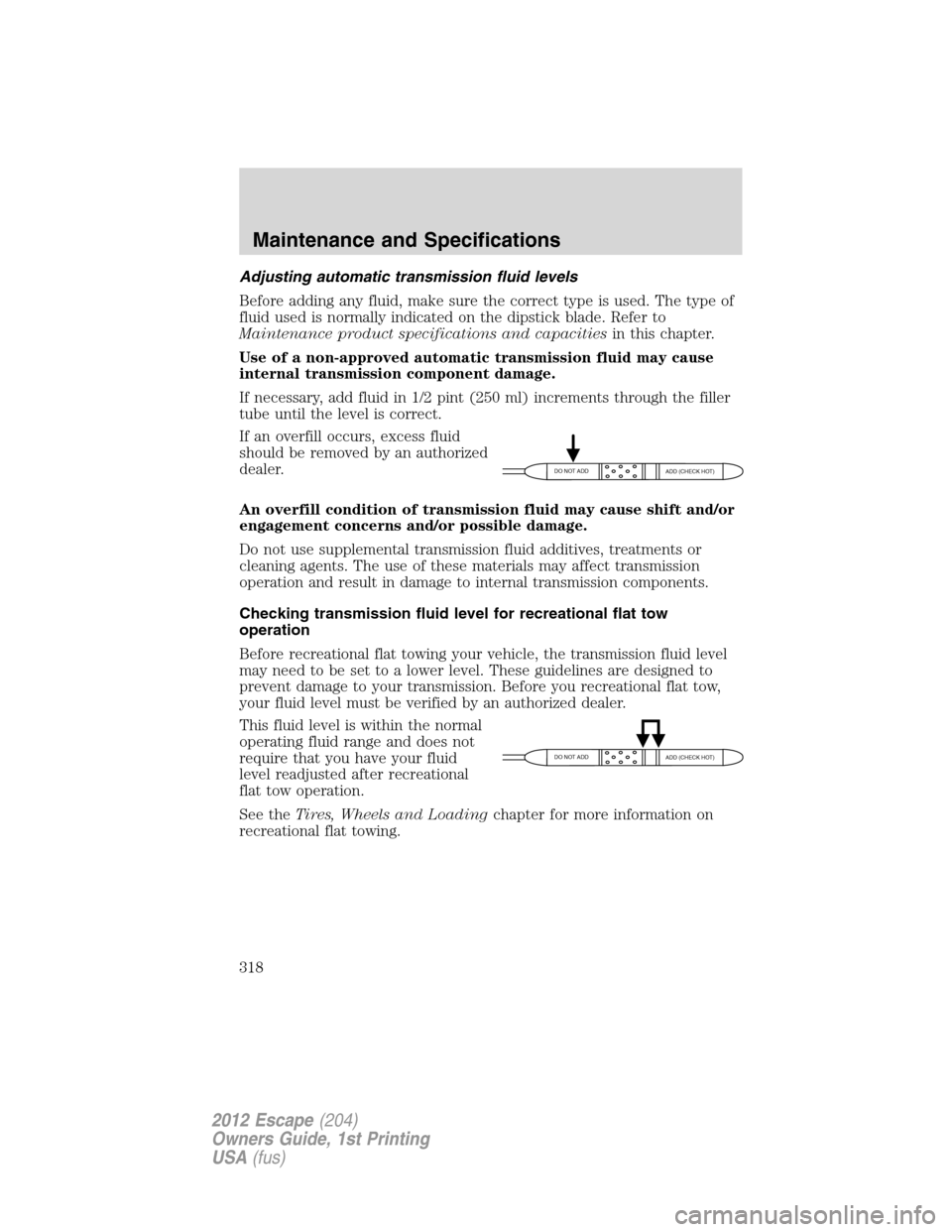
Before recreational flat towing your vehicle, the transmission fluid level
may need to be set to a lower level. These guidelines are designed to
prevent damage to your transmission. Before you recreational flat tow,
your fluid level must be verified by an authorized dealer.
This fluid level is within the normal
operating fluid range and does not
require that you have your fluid
level readjusted after recreational
flat tow operation.
See theTires, Wheels and Loadingchapter for more information on
recreational flat towing.
DO NOT ADD
ADD (CHECK HOT)
DO NOT ADD
ADD (CHECK HOT)
Maintenance and Specifications
318
2012 Escape(204)
Owners Guide, 1st Printing
USA(fus)
Seats ..........................................112
child safety seats ....................158
heated ......................................117
SecuriCode keyless entry
system ........................................106
SecuriLock passive anti-theft
system ........................................108
Servicing your vehicle ..............285
Setting the clock .........................28
Snowplowing .................................6
SOS Post Crash Alert ...............153
Spark plugs,
specifications .....................323, 327
Special notice
ambulance conversions ..............6
utility-type vehicles ....................6
Specification chart,
lubricants ...................................324
Speed control ..............................74
Starting a flex fuel vehicle .......209
Starting your
vehicle ........................206–207, 209
jump starting ..........................265
Steering wheel
controls ......................................76
tilting .........................................66
Stereo
CD-MP3 .....................................28
SYNC�..........................................45
T
Tilt steering wheel ......................66
Tire Pressure Monitoring
System (TPMS)
Tires, Wheels and Loading ....189
Tires ...........................174–176, 254alignment ................................183
care ..........................................179
changing ..................254, 257, 259
checking the pressure ............179
inflating ...................................177
label .........................................188
replacing ..................................180
rotating ....................................183
safety practices .......................182
sidewall information ...............184
snow tires and chains ............193
spare tire .........................255, 257
terminology .............................176
tire grades ...............................175
treadwear ........................175, 179
Towing .......................................201
recreational towing .................204
trailer towing ..........................201
wrecker ....................................268
Transmission
automatic operation ...............224
brake-shift interlock (BSI) ....222
fluid, checking and adding
(automatic) .............................316
fluid, checking and adding
(manual) .........................316, 319
fluid, refill capacities ..............324
lubricant specifications ..........324
manual operation ....................226
Trunk ...........................................89
Turn signal ..................................57
U
Universal garage door opener ....79
USB port ......................................39
V
Vehicle Identification Number
(VIN) ..........................................328
Index
360
2012 Escape(204)
Owners Guide, 1st Printing
USA(fus)