1. Drive the vehicle 20 miles (30 km) or until it reaches normal operating
temperature.
2. Park the vehicle on a level surface and engage the parking brake.
3. With the parking brake engaged and your foot on the brake pedal,
start the engine and move the gearshift lever through all of the gear
ranges. Allow sufficient time for each gear to engage.
4. Latch the gearshift lever in P (Park) and leave the engine running.
5. Remove the dipstick, wiping it clean with a clean, dry lint free rag. If
necessary, refer toIdentifying components in the engine compartment
in this chapter for the location of the dipstick.
6. Install the dipstick making sure it is fully seated in the filler tube.
7. Remove the dipstick and inspect the fluid level. The fluid should be in
the operating range for normal operating temperature.
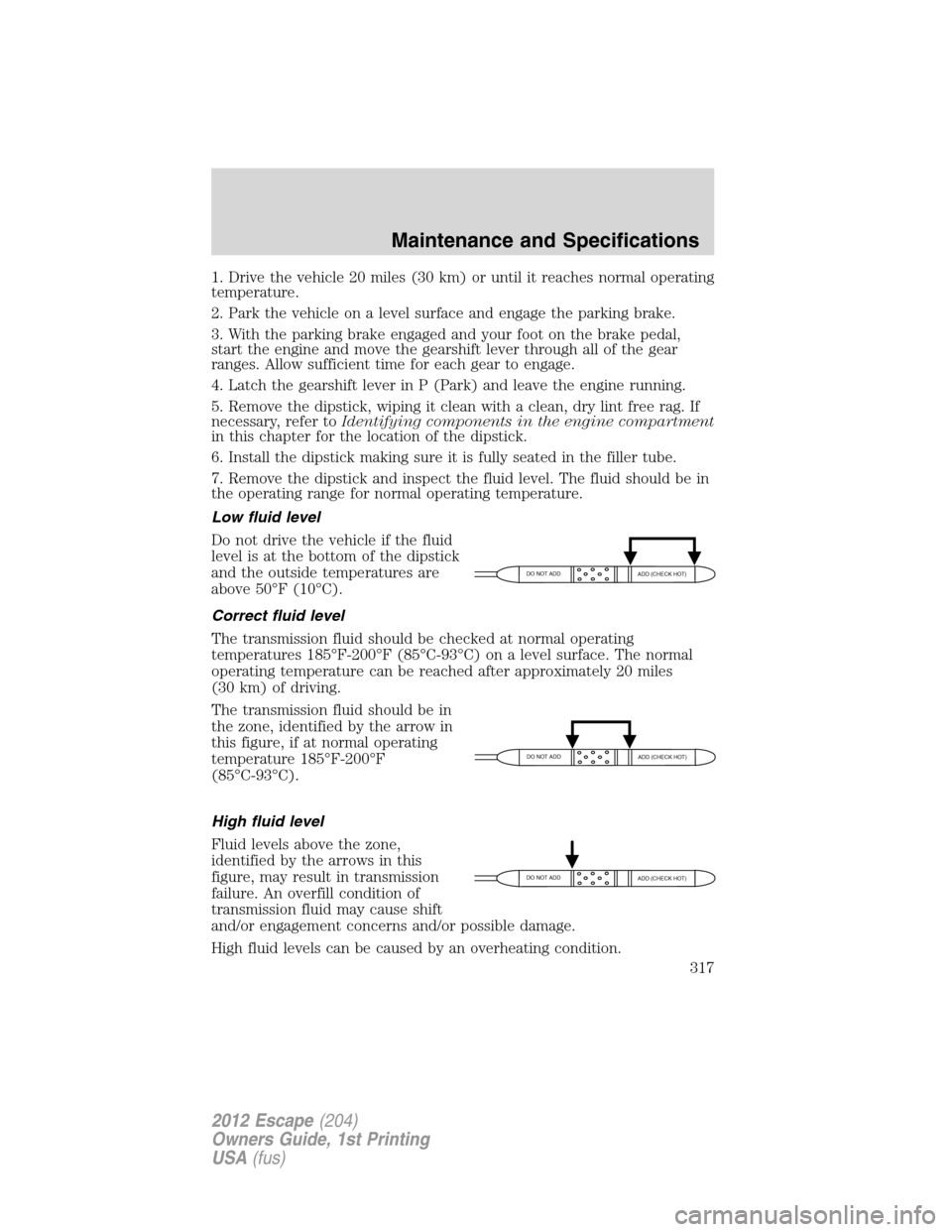
Low fluid level
Do not drive the vehicle if the fluid
level is at the bottom of the dipstick
and the outside temperatures are
above 50°F (10°C).
Correct fluid level
The transmission fluid should be checked at normal operating
temperatures 185°F-200°F (85°C-93°C) on a level surface. The normal
operating temperature can be reached after approximately 20 miles
(30 km) of driving.
The transmission fluid should be in
the zone, identified by the arrow in
this figure, if at normal operating
temperature 185°F-200°F
(85°C-93°C).
High fluid level
Fluid levels above the zone,
identified by the arrows in this
figure, may result in transmission
failure. An overfill condition of
transmission fluid may cause shift
and/or engagement concerns and/or possible damage.
High fluid levels can be caused by an overheating condition.
DO NOT ADD
ADD (CHECK HOT)
DO NOT ADD
ADD (CHECK HOT)
DO NOT ADD
ADD (CHECK HOT)
Maintenance and Specifications
317
2012 Escape(204)
Owners Guide, 1st Printing
USA(fus)
Your vehicle is very sophisticated and built with multiple complex
performance systems. Every manufacturer develops these systems using
different specifications and performance features. That’s why it’s
important to rely upon your dealership to properly diagnose and repair
your vehicle.
Ford Motor Company has recommended maintenance intervals for
various parts and component systems based upon engineering testing.
Ford Motor Company relies upon this testing to determine the most
appropriate mileage for replacement of oils and fluids to protect your
vehicle at the lowest overall cost to you and recommends against
maintenance schedules that deviate from the scheduled maintenance
information.
Ford strongly recommends the use of genuine Ford replacement parts.
Parts other than Ford, Motorcraft�or Ford-authorized remanufactured
parts that are used for maintenance replacement or for the service of
components affecting emission control must be equivalent to genuine
Ford Motor Company parts in performance and durability. It is the
owner’s responsibility to determine the equivalency of such parts. Please
consult yourWarranty Guidefor complete warranty information.
Chemicals or additives not approved by Ford are not required for factory
recommended maintenance. In fact, Ford Motor Company recommends
against the use of such additive products unless specifically
recommended by Ford for a particular application.
Oils, fluids and flushing
In many cases, fluid discoloration is a normal operating characteristic
and, by itself, does not necessarily indicate a concern or that the fluid
needs to be changed. However, discolored fluids that also show signs of
overheating and/or foreign material contamination should be inspected
immediately by a qualified expert such as the factory-trained technicians
at your dealership. Your vehicle’s oils and fluids should be changed at the
specified intervals or in conjunction with a repair. Flushing is a viable
way to change fluid for many vehicle sub-systems during scheduled
maintenance. It is critical that systems are flushed only with new fluid
that is the same as that required to fill and operate the system, or using
a Ford-approved flushing chemical.
Scheduled Maintenance
337
2012 Escape(204)
Owners Guide, 1st Printing
USA(fus)