Page 288 of 361
3.0L V6 engine
1. Engine coolant reservoir
2. Air filter assembly
3. Brake fluid reservoir
4. Automatic transmission fluid dipstick
5. Power distribution box
6. Battery
7. Coolant bleed valve
8. Engine oil dipstick
9. Engine oil filler cap
10. Windshield washer fluid reservoir
1
1086
2435
97
Maintenance and Specifications
288
2012 Escape(204)
Owners Guide, 1st Printing
USA(fus)
Page 316 of 361

The OBD-II system is designed to check the emission control system
during normal driving. A complete check may take several days. If the
vehicle is not ready for I/M testing, the following driving cycle consisting
of mixed city and highway driving may be performed:
15 minutes of steady driving on an expressway/highway followed by
20 minutes of stop-and-go driving with at least four 30-second idle periods.
Allow the vehicle to sit for at least eight hours without starting the
engine. Then, start the engine and complete the above driving cycle. The
engine must warm up to its normal operating temperature. Once started,
do not turn off the engine until the above driving cycle is complete. If
the vehicle is still not ready for I/M testing, the above driving cycle will
have to be repeated.
BRAKE/CLUTCH FLUID
Brake and clutch (if equipped) systems are supplied from the same
reservoir.
The fluid level will drop slowly as the
brakes wear, and will rise when the
brake components are replaced. Fluid
levels between the MIN and MAX
lines are within the normal operating
range; there is no need to add fluid.
If the fluid levels are outside of the
normal operating range, the
performance of the system could be
compromised; seek service from your
authorized dealer immediately.
TRANSMISSION FLUID
Checking automatic transmission fluid (if equipped)
Refer to yourscheduled maintenance informationfor scheduled
intervals for fluid checks and changes. Your transmission does not
consume fluid. However, the fluid level should be checked if the
transmission is not working properly, i.e., if the transmission slips or
shifts slowly or if you notice some sign of fluid leakage.
Automatic transmission fluid expands when warmed. To obtain an
accurate fluid check, drive the vehicle until it is warmed up
(approximately 20 miles [30 km]). If your vehicle has been operated
for an extended period at high speeds, in city traffic during hot
weather or pulling a trailer, the vehicle should be turned off for
about 30 minutes to allow fluid to cool before checking.
Maintenance and Specifications
316
2012 Escape(204)
Owners Guide, 1st Printing
USA(fus)
Page 317 of 361
1. Drive the vehicle 20 miles (30 km) or until it reaches normal operating
temperature.
2. Park the vehicle on a level surface and engage the parking brake.
3. With the parking brake engaged and your foot on the brake pedal,
start the engine and move the gearshift lever through all of the gear
ranges. Allow sufficient time for each gear to engage.
4. Latch the gearshift lever in P (Park) and leave the engine running.
5. Remove the dipstick, wiping it clean with a clean, dry lint free rag. If
necessary, refer toIdentifying components in the engine compartment
in this chapter for the location of the dipstick.
6. Install the dipstick making sure it is fully seated in the filler tube.
7. Remove the dipstick and inspect the fluid level. The fluid should be in
the operating range for normal operating temperature.
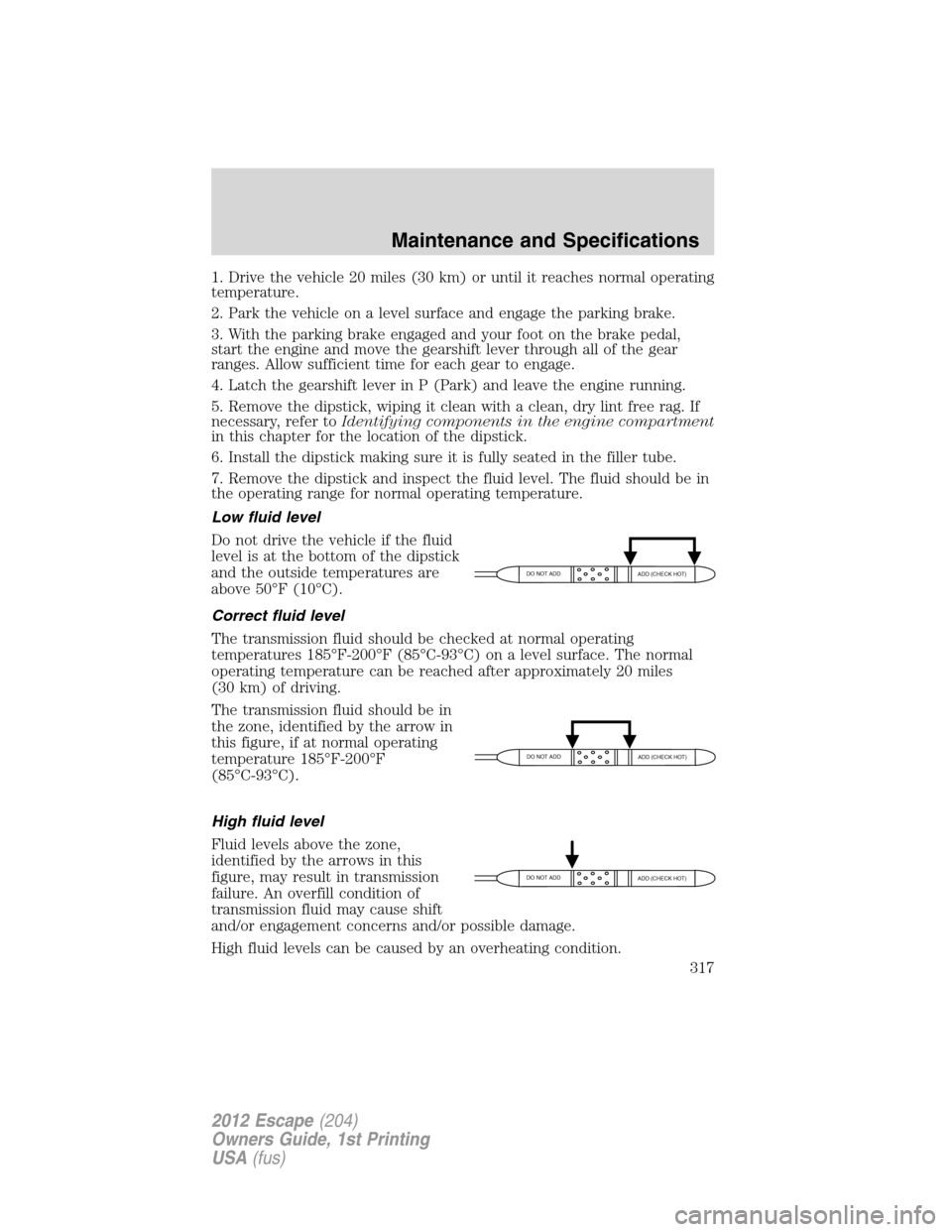
Low fluid level
Do not drive the vehicle if the fluid
level is at the bottom of the dipstick
and the outside temperatures are
above 50°F (10°C).
Correct fluid level
The transmission fluid should be checked at normal operating
temperatures 185°F-200°F (85°C-93°C) on a level surface. The normal
operating temperature can be reached after approximately 20 miles
(30 km) of driving.
The transmission fluid should be in
the zone, identified by the arrow in
this figure, if at normal operating
temperature 185°F-200°F
(85°C-93°C).
High fluid level
Fluid levels above the zone,
identified by the arrows in this
figure, may result in transmission
failure. An overfill condition of
transmission fluid may cause shift
and/or engagement concerns and/or possible damage.
High fluid levels can be caused by an overheating condition.
DO NOT ADD
ADD (CHECK HOT)
DO NOT ADD
ADD (CHECK HOT)
DO NOT ADD
ADD (CHECK HOT)
Maintenance and Specifications
317
2012 Escape(204)
Owners Guide, 1st Printing
USA(fus)
Page 319 of 361
Checking and adding manual transmission fluid (if equipped)
1. Park the vehicle on a level
surface.
2. Engage the parking brake fully –
put in first gear.
3. Ensure the vehicle cannot move.
4. Clean the filler plug.
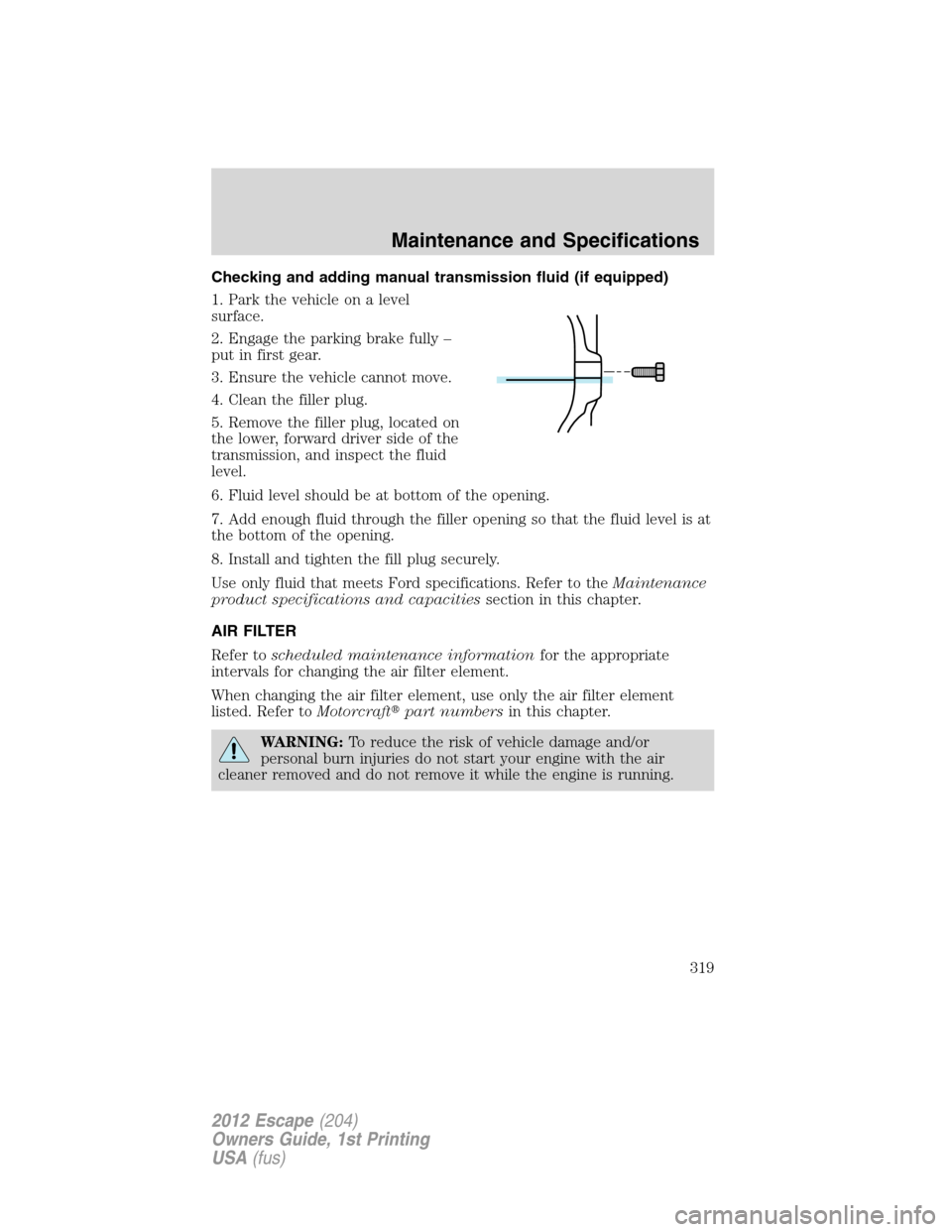
5. Remove the filler plug, located on
the lower, forward driver side of the
transmission, and inspect the fluid
level.
6. Fluid level should be at bottom of the opening.
7. Add enough fluid through the filler opening so that the fluid level is at
the bottom of the opening.
8. Install and tighten the fill plug securely.
Use only fluid that meets Ford specifications. Refer to theMaintenance
product specifications and capacitiessection in this chapter.
AIR FILTER
Refer toscheduled maintenance informationfor the appropriate
intervals for changing the air filter element.
When changing the air filter element, use only the air filter element
listed. Refer toMotorcraft�part numbersin this chapter.
WARNING:To reduce the risk of vehicle damage and/or
personal burn injuries do not start your engine with the air
cleaner removed and do not remove it while the engine is running.
Maintenance and Specifications
319
2012 Escape(204)
Owners Guide, 1st Printing
USA(fus)
Page 322 of 361
Fuel system
•Fill the fuel tank with high-quality fuel until the first automatic shutoff
of the fuel pump nozzle.
Note:During extended periods of vehicle storage (30 days or more),
fuel may deteriorate due to oxidation. Add a quality gas stabilizer
product to the vehicle fuel system whenever actual or expected storage
periods exceed 30 days. Follow the instructions on the additive label.
The vehicle should then be operated at idle speed to circulate the
additive throughout the fuel system.
Cooling system
•Protect against freezing temperatures.
•When removing vehicle from storage, check coolant fluid level.
Confirm there are no cooling system leaks, and fluid is at the
recommended level.
Battery
•Check and recharge as necessary. Keep connections clean.
•If storing your vehicle for more than 30 days without recharging the
battery, it may be advisable to disconnect the battery cables to ensure
battery charge is maintained for quick starting.
Note:If battery cables are disconnected, it will be necessary to reset
memory features.
Brakes
•Make sure brakes and parking brake are fully released.
Tires
•Maintain recommended air pressure.
Miscellaneous
•Make sure all linkages, cables, levers and pins under vehicle are
covered with grease to prevent rust.
•Move vehicles at least 25 feet (8 m) every 15 days to lubricate
working parts and prevent corrosion.
Maintenance and Specifications
322
2012 Escape(204)
Owners Guide, 1st Printing
USA(fus)
Page 324 of 361
MAINTENANCE PRODUCT SPECIFICATIONS AND CAPACITIES
Item CapacityFord part name or
equivalentFord part number /
Ford Specification
Brake fluid and (clutch
fluid –if equipped)Between MIN and
MAX on reservoirMotorcraft�High
Performance DOT 3 Motor
Vehicle Brake FluidPM-1-C /
WSS-M6C62-A or
WSS-M6C65-A1
Door weatherstrips — Silicone LubricantXL-6 /
ESR-M13P4-A
Body hinges, latches,
door striker plates and
rollers, seat tracks, fuel
filler door hinge and
spring, primary and
auxiliary hood latches—Multi-Purpose Grease
(Lithium grease)XG-4 or XL-5 or
equivalent /
ESB-M1C93-B
Engine coolant
(2.5L engine)7.4 quarts (7.0L)
Motorcraft�Specialty
Orange Engine Coolant
1
VC-3-B (US)
CVC-3-B (Canada) /
WSS-M97B44-D Engine coolant
(3.0L engine)9.5 quarts (9.0L)
Maintenance and Specifications
324
2012 Escape(204)
Owners Guide, 1st Printing
USA(fus)
Page 339 of 361

Owner checks and services
Certain basic maintenance checks and inspections should be performed
by the owner or a service technician at the intervals indicated. Service
information and supporting specifications are provided in this owner’s
guide.
Any adverse condition should be brought to the attention of your dealer
or qualified service technician as soon as possible for the proper service
advice. The owner maintenance service checks are generally not covered
by warranties so you may be charged for labor, parts or fluids used.
Engine oil/coolant change intervals
Engine oilAs indicated by the message center: do not
exceed one year or 10,000 miles (16,000 km)
Engine coolant,
initial change6 years or 100,000 miles (160,000 km)
(whichever comes first)
Engine coolant, after
initial changeEvery 3 years or 50,000 miles (80,000 km)
Check every month
Engine oil level
Function of all interior and exterior lights
Tires for wear and proper pressure, including spare
Windshield washer fluid level
Check every six months
Battery connections; clean if necessary
Body and door drain holes for obstructions; clean if necessary
Cooling system fluid level and coolant strength
Door weatherstrips for wear; lubricate if necessary
Hinges/latches/outside locks for proper operation; lubricate if necessary
Parking brake for proper operation
Safety belts and seat latches for wear and function
Safety warning lamps (brake, ABS, airbag, safety belt) for operation
Washer spray/wiper operation; clean or replace blades as necessary
Scheduled Maintenance
339
2012 Escape(204)
Owners Guide, 1st Printing
USA(fus)
Page 340 of 361

Multi-point inspection
In order to keep your vehicle running right, it is important to have the
systems on your vehicle checked regularly. This can help identify
potential issues and prevent major problems. Ford Motor Company
recommends the following multi-point inspection be performed at every
scheduled maintenance interval to help ensure your vehicle keeps
running great.
Multi-point inspection – Recommended each visit
Accessory drive belt(s) Half-shaft dust boots (if equipped)
Battery performance Horn operation
Clutch operation (if equipped) Radiator, cooler, heater and A/C hoses
Engine air filter Suspension component for leaks or
damage
Exhaust system Steering and linkage
Exterior lamps and hazard
warning system operationTires for wear and proper pressure,
including spare
Fluid levels*; fill if necessary Windshield for cracks, chips or pits
For oil and fluid leaks Washer spray and wiper operation
*Brake, coolant recovery reservoir, manual and automatic transmission
(with an underhood dipstick), power steering (if equipped) and
window washer
Be sure to ask your dealership service advisor or technician about the
multi-point vehicle inspection. It’s a comprehensive way to perform a
thorough inspection of your vehicle. It’s your checklist that gives you
immediate feedback on the overall condition of your vehicle. You’ll know
what’s been checked, what’s okay, as well as those things that may
require future or immediate attention. The multi-point vehicle inspection
is one more way to keep your vehicle running great!
Scheduled Maintenance
340
2012 Escape(204)
Owners Guide, 1st Printing
USA(fus)

