Page 298 of 391
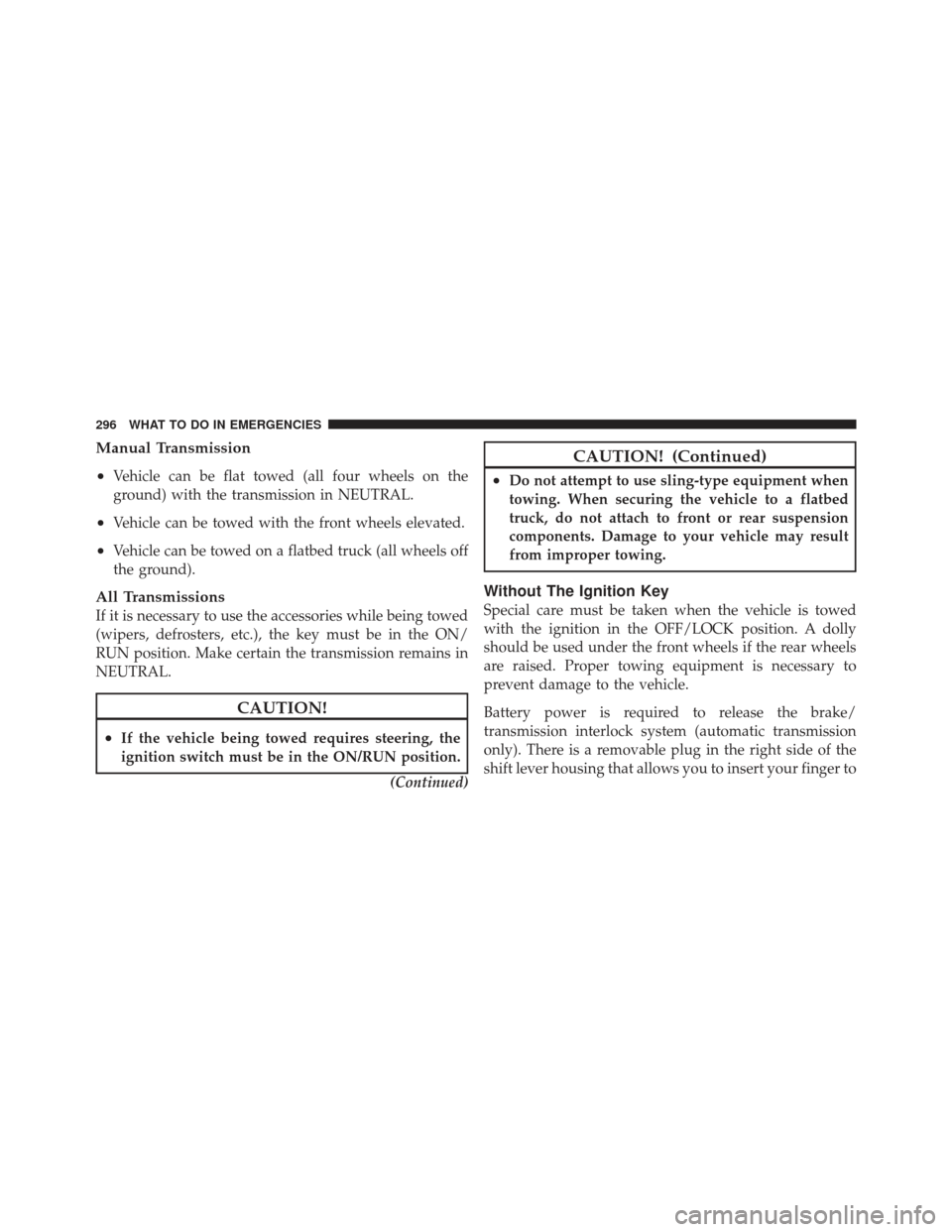
Manual Transmission
•
Vehicle can be flat towed (all four wheels on the
ground) with the transmission in NEUTRAL.
•Vehicle can be towed with the front wheels elevated.
•Vehicle can be towed on a flatbed truck (all wheels off
the ground).
All Transmissions
If it is necessary to use the accessories while being towed
(wipers, defrosters, etc.), the key must be in the ON/
RUN position. Make certain the transmission remains in
NEUTRAL.
CAUTION!
•If the vehicle being towed requires steering, the
ignition switch must be in the ON/RUN position.(Continued)
CAUTION! (Continued)
•Do not attempt to use sling-type equipment when
towing. When securing the vehicle to a flatbed
truck, do not attach to front or rear suspension
components. Damage to your vehicle may result
from improper towing.
Without The Ignition Key
Special care must be taken when the vehicle is towed
with the ignition in the OFF/LOCK position. A dolly
should be used under the front wheels if the rear wheels
are raised. Proper towing equipment is necessary to
prevent damage to the vehicle.
Battery power is required to release the brake/
transmission interlock system (automatic transmission
only). There is a removable plug in the right side of the
shift lever housing that allows you to insert your finger to
296 WHAT TO DO IN EMERGENCIES
Page 299 of 391
override the system. The ignition key must be in the
ON/RUN position to use the override lever.
CAUTION!
Failure to follow these towing methods can cause
severe transmission damage. Such damage is not
covered by the New Vehicle Limited Warranty.
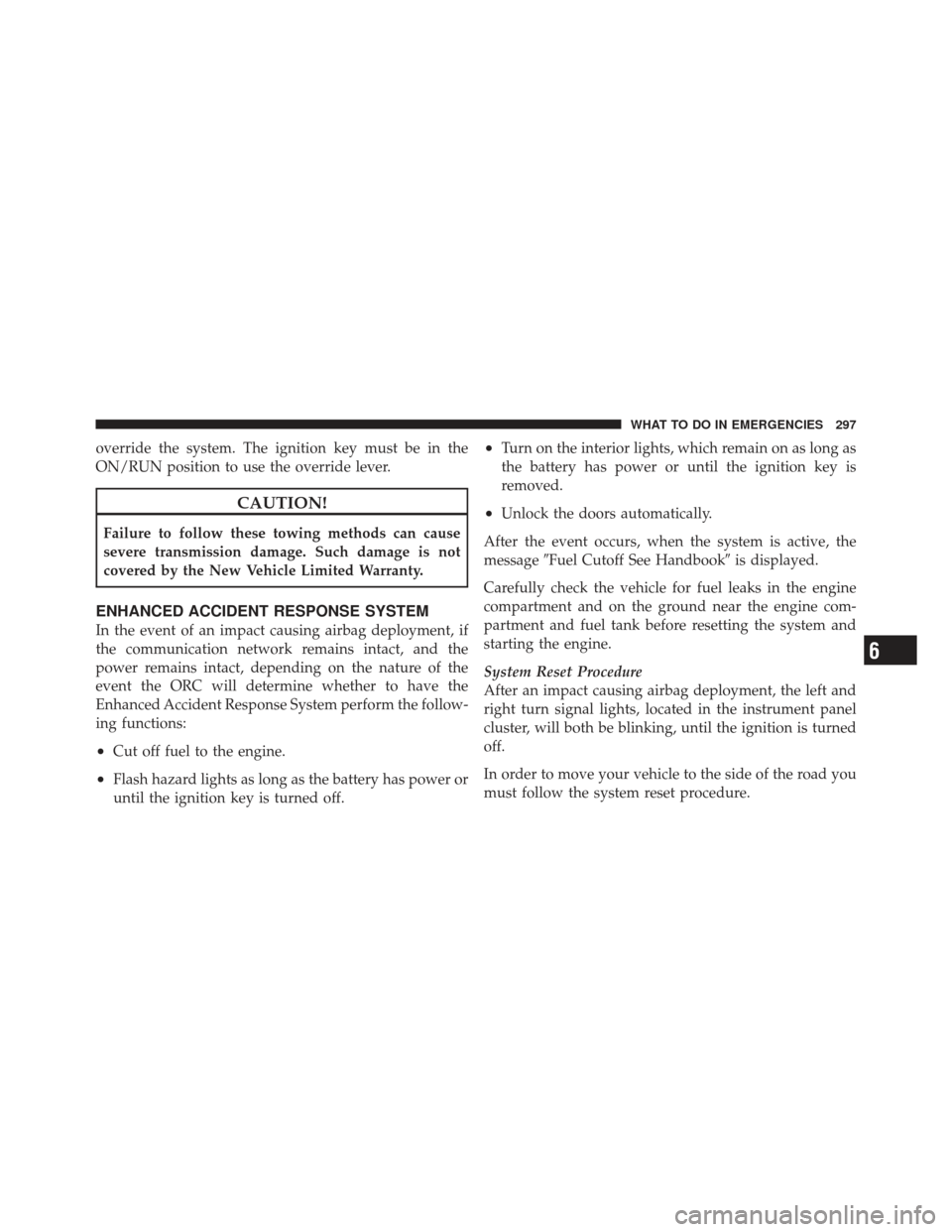
ENHANCED ACCIDENT RESPONSE SYSTEM
In the event of an impact causing airbag deployment, if
the communication network remains intact, and the
power remains intact, depending on the nature of the
event the ORC will determine whether to have the
Enhanced Accident Response System perform the follow-
ing functions:
•Cut off fuel to the engine.
•Flash hazard lights as long as the battery has power or
until the ignition key is turned off.
•Turn on the interior lights, which remain on as long as
the battery has power or until the ignition key is
removed.
•Unlock the doors automatically.
After the event occurs, when the system is active, the
message �Fuel Cutoff See Handbook� is displayed.
Carefully check the vehicle for fuel leaks in the engine
compartment and on the ground near the engine com-
partment and fuel tank before resetting the system and
starting the engine.
System Reset Procedure
After an impact causing airbag deployment, the left and
right turn signal lights, located in the instrument panel
cluster, will both be blinking, until the ignition is turned
off.
In order to move your vehicle to the side of the road you
must follow the system reset procedure.
6
WHAT TO DO IN EMERGENCIES 297
Page 302 of 391
▫Manual Transmission – If Equipped ....... 325
▫ Automatic Transmission – If Equipped ..... 325
▫ Appearance Care And Protection From
Corrosion .......................... 326
▫ Convertible Top Care – If Equipped ....... 332
� Fuses .............................. 334
▫ Interior Fuses ....................... 334
▫ Underhood Fuses .................... 336
� Vehicle Storage ....................... 338
� Replacement Bulbs .................... 339
� Bulb Replacement ..................... 339
▫ Headlamps ........................ 339 ▫
Front Turn Signal, Parking And Daytime
Running Lamps ..................... 340
▫ Front Fog Lamps .................... 340
▫ Front/Rear Side Marker Lamps .......... 341
▫ Rear Tail, Stop, Backup And Turn Signal
Lamps ............................ 341
▫
Center High Mounted Stop Lamp (CHMSL). . 342
� Fluid Capacities ...................... 343
� Fluids, Lubricants, And Genuine Parts ....... 344
▫ Engine ............................ 344
▫ Chassis ........................... 345
300 MAINTAINING YOUR VEHICLE
Page 304 of 391
ONBOARD DIAGNOSTIC SYSTEM – OBD II
Your vehicle is equipped with a sophisticated onboard
diagnostic system called OBD II. This system monitors
the performance of the emissions, engine, and automatic
transmission control systems. When these systems are
operating properly, your vehicle will provide excellent
performance and fuel economy, as well as engine emis-
sions well within current government regulations.
If any of these systems require service, the OBD II system
will turn on the “Malfunction Indicator Light” (MIL). It
will also store diagnostic codes and other information to
assist your service technician in making repairs. Al-
though your vehicle will usually be drivable and not
need towing, see your authorized dealer for service as
soon as possible.CAUTION!
•Prolonged driving with the MIL on could cause
further damage to the emission control system. It
could also affect fuel economy and drivability. The
vehicle must be serviced before any emissions
tests can be performed.
•If the MIL is flashing while the engine is running,
severe catalytic converter damage and power loss
will soon occur. Immediate service is required.
EMISSIONS INSPECTION AND MAINTENANCE
PROGRAMS
In some localities, it may be a legal requirement to pass
an inspection of your vehicle’s emissions control system.
Failure to pass could prevent vehicle registration.
302 MAINTAINING YOUR VEHICLE
Page 327 of 391
Manual Transmission – If Equipped
Lubricant Selection
Use only the manufacturers recommended transmission
fluid. Refer to “Fluids, Lubricants, and Genuine Parts” in
“Maintaining Your Vehicle” for further information.
Fluid Level Check
Check the fluid level by removing the fill plug. The fluid
level should be between the bottom of the fill hole and a
point not more than 3/16 in (4.7 mm) below the bottom
of the hole.
Add fluid, if necessary, to maintain the proper level.
Frequency Of Fluid Change
Under normal operating conditions, the fluid installed at
the factory will give satisfactory lubrication for the life of
the vehicle. Fluid changes are not necessary unless lubri-
cant has become contaminated with water.NOTE:
If contaminated with water, the fluid should be
changed immediately.
Automatic Transmission – If Equipped
The automatic transmission and differential assembly are
contained within a single housing.
The fluid level in the automatic transmission should be
checked whenever the vehicle is serviced. Operation with
an improper fluid level will greatly reduce the life of the
transmission and the fluid.
Selection Of Lubricant
It is important that the proper lubricant is used in the
transmission to assure optimum transmission perfor-
mance. Use only manufacturer ’s recommended transmis-
sion fluid. Refer to “Fluids, Lubricants, and Genuine
Parts” in “Maintaining Your Vehicle” for further informa-
tion. It is important that the transmission fluid be main-
tained at the prescribed level using the recommended
7
MAINTAINING YOUR VEHICLE 325
Page 328 of 391
fluid. No chemical flushes should be used in any trans-
mission; only the approved lubricant may be used.
Special Additives
Automatic Transmission Fluid (ATF) is an engineered
product and its performance may be impaired by supple-
mental additives. Therefore, do not add any fluid addi-
tives to the transmission. The only exception to this
policy is the use of special dyes to aid in detecting fluid
leaks. In addition, avoid using transmission sealers as
they may adversely affect seals.
CAUTION!
Do not use chemical flushes in your transmission as
the chemicals can damage your transmission compo-
nents. Such damage is not covered by the New
Vehicle Limited Warranty.
Fluid Level Check
The automatic transmission has no dipstick and is dealer
serviced only.
Fluid And Filter Changes
Refer to the “Maintenance Schedule” for the proper
maintenance intervals
Appearance Care And Protection From Corrosion
Protection Of Body And Paint From Corrosion
Vehicle body care requirements vary according to geo-
graphic locations and usage. Chemicals that make roads
passable in snow and ice and those that are sprayed on
trees and road surfaces during other seasons, are highly
corrosive to the metal in your vehicle. Outside parking,
which exposes your vehicle to airborne contaminants,
road surfaces on which the vehicle is operated, extreme
hot or cold weather and other extreme conditions will
have an adverse effect on paint, metal trim, and under-
body protection.
326 MAINTAINING YOUR VEHICLE
Page 347 of 391
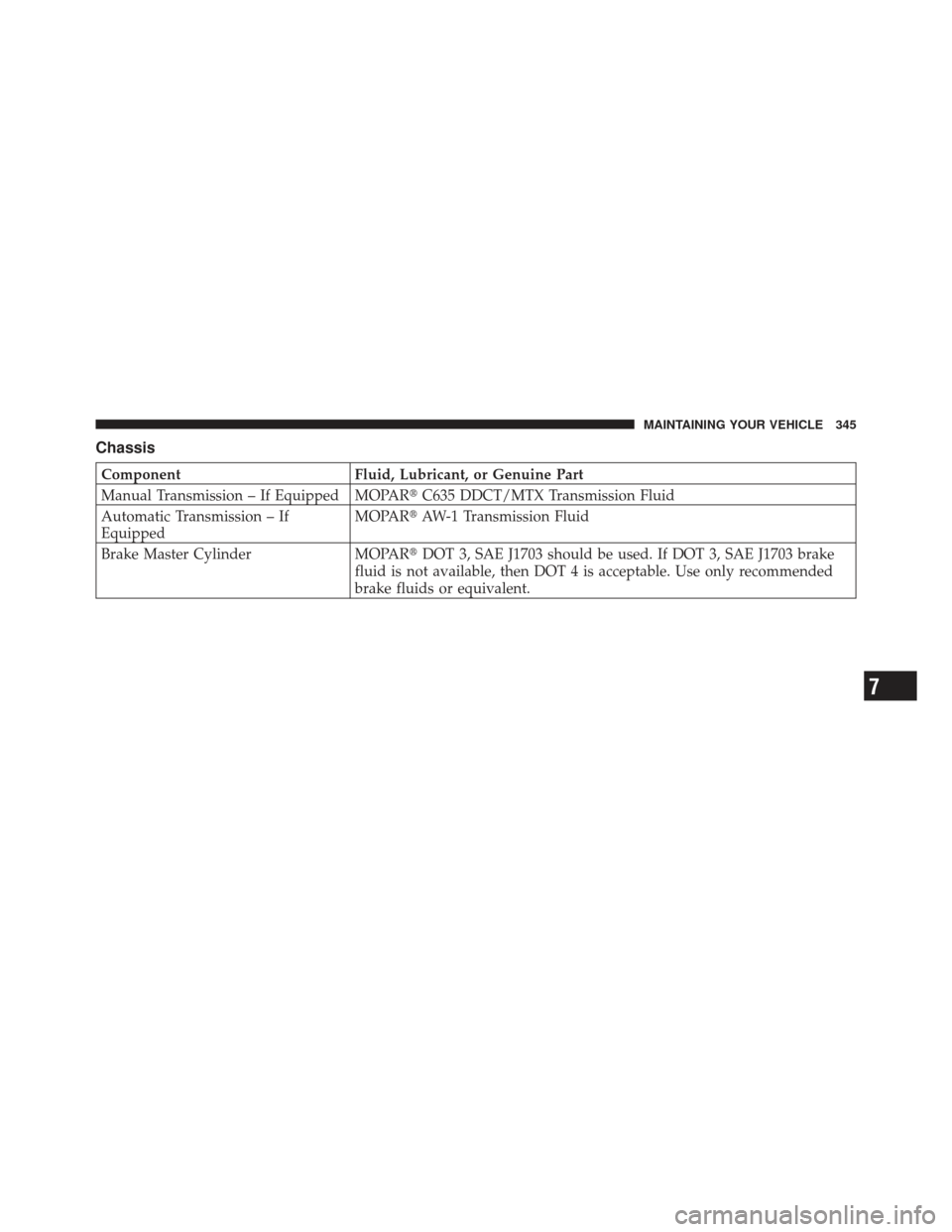
Chassis
ComponentFluid, Lubricant, or Genuine Part
Manual Transmission – If Equipped MOPAR �C635 DDCT/MTX Transmission Fluid
Automatic Transmission – If
Equipped MOPAR�
AW-1 Transmission Fluid
Brake Master Cylinder MOPAR�DOT 3, SAE J1703 should be used. If DOT 3, SAE J1703 brake
fluid is not available, then DOT 4 is acceptable. Use only recommended
brake fluids or equivalent.
7
MAINTAINING YOUR VEHICLE 345
Page 376 of 391
Adding Engine Coolant (Antifreeze).......... 319
Adding Fuel ........................... 262
Adding Washer Fluid ..................... 314
Additives, Fuel ......................... 259
Air Cleaner, Engine (Engine Air Cleaner Filter) . . . 308
Air Conditioner Maintenance ............... 311
Air Conditioning ........................ 186
Air Conditioning Controls ................. 186
Air Conditioning Refrigerant ................ 311
Air Conditioning System .............186,190,311
Air Conditioning, Operating Tips ............ 196
Air Pressure, Tires ....................... 243
Airbag .............................. 38,48
Airbag Deployment ....................... 50
Airbag Light ..................... 46,53,68,131
Airbag Maintenance ....................... 52
Airbag, Side ...................... 42,44,47,48
Airbag, Window (Side Curtain) ...........42,44,48
Alterations/Modifications, Vehicle ............. 7Anti-Lock Brake System (ABS)
.............. 224
Anti-Lock Warning Light .................. 137
Antifreeze (Engine Coolant) ...........318,343,344
Capacities .......................... 343
Disposal ........................... 320
Appearance Care ........................ 326
Automatic Dimming Mirror ................. 77
Automatic Door Locks ..................... 22
Automatic Temperature Control (ATC) ......... 190
Automatic Transaxle ...................... 12
Automatic Transmission ................207,325
Adding Fluid ....................... 326
Fluid and Filter Changes ............... 326
Fluid Level Check .................... 326
Fluid Type ......................... 325
Gear Ranges ........................ 209
Special Additives ..................... 326
Autostick ............................. 214
374 INDEX