Page 132 of 358
Certain conditions, such as a loose or missing gas cap,
poor fuel quality, etc., may illuminate the MIL after
engine start. The vehicle should be serviced if the light
stays on through several of your typical driving cycles. In
most situations, the vehicle will drive normally and will
not require towing.
CAUTION!
Prolonged driving with the MIL on could cause
damage to the engine control system. It also could
affect fuel economy and drivability. If the MIL is
flashing, severe catalytic converter damage and
power loss will soon occur. Immediate service is
required.
WARNING!
A malfunctioning catalytic converter, as referenced
above, can reach higher temperatures than in normal
operating conditions. This can cause a fire if you
drive slowly or park over flammable substances such
as dry plants, wood, cardboard, etc. This could result
in death or serious injury to the driver, occupants or
others.
19. Engine Temperature Warning Light This light warns of an overheated engine condi-
tion. The engine coolant temperature indicator
will illuminate and a single chime will sound after
reaching a set threshold.
If the light turns on while driving, safely pull over and
stop the vehicle. If the A/C system is on, turn it off. Also,
shift the transmission into NEUTRAL and idle the ve-
hicle. If the temperature reading does not return to
130 UNDERSTANDING YOUR INSTRUMENT PANEL
Page 197 of 358

▫Tread Wear Indicators ................. 229
▫ Life Of Tire ........................ 229
▫ Replacement Tires .................... 230
� Tire Chains .......................... 232
� Tire Rotation Recommendations ........... 232
� Tire Pressure Monitoring System (TPMS) ..... 233
▫ Base System ........................ 236
▫ General Information .................. 238
� Fuel Requirements ..................... 238
▫ Reformulated Gasoline ................ 239
▫ Gasoline/Oxygenate Blends ............. 239
▫ E-85 Usage In Non-Flex Fuel Vehicles ...... 240▫
MMT In Gasoline .................... 240
▫ Materials Added To Fuel ............... 241
▫ Fuel System Cautions ................. 241
▫ Carbon Monoxide Warnings ............ 242
� Adding Fuel ......................... 243
▫ Fuel Filler Cap (Gas Cap) .............. 243
▫ Loose Fuel Filler Cap Message ........... 245
� Trailer Towing ........................ 245
� Recreational Towing (Behind
Motorhome, Etc.) ...................... 245
▫ Towing This Vehicle Behind
Another Vehicle ..................... 245
5
STARTING AND OPERATING 195
Page 226 of 358
WARNING! (Continued)
•Unequal tire pressures from one side of the ve-
hicle to the other can cause the vehicle to drift to
the right or left.
•Always drive with each tire inflated to the recom-
mended cold tire inflation pressure.
Economy
Improper inflation pressures can cause uneven wear
patterns to develop across the tire tread. These abnormal
wear patterns will reduce tread life, resulting in a need
for earlier tire replacement. Under-inflation also increases
tire rolling resistance and results in higher fuel
consumption.
Ride Comfort And Vehicle Stability
Proper tire inflation contributes to a comfortable ride.
Over-inflation produces a jarring and uncomfortable
ride.
Tire Inflation Pressures
The proper cold tire inflation pressure is listed on the
driver’s side B-Pillar.
The pressure should be checked and adjusted as well as
inspected for signs of tire wear or visible damage, at least
once a month. Use a good quality pocket-type gauge to
check tire pressure. Do not make a visual judgement
when determining proper inflation. Radial tires may look
properly inflated even when they are under-inflated.
CAUTION!
After inspecting or adjusting the tire pressure, al-
ways reinstall the valve stem cap. This will prevent
moisture and dirt from entering the valve stem,
which could damage the valve stem.
Inflation pressures specified on the placard are always
cold tire inflation pressure. Cold tire inflation pressure is
224 STARTING AND OPERATING
Page 237 of 358

CAUTION!
•The TPMS has been optimized for the original
equipment tires and wheels. TPMS pressures and
warnings have been established for the tire size
equipped on your vehicle. Undesirable system
operation or sensor damage may result when us-
ing replacement equipment that is not of the same
size, type, and/or style. Aftermarket wheels can
cause sensor damage. Do not use aftermarket tire
sealants or balance beads if your vehicle is
equipped with a TPMS, as damage to the sensors
may result.
•After inspecting or adjusting the tire pressure,
always reinstall the valve stem cap. This will
prevent moisture and dirt from entering the valve
stem, which could damage the Tire Pressure Moni-
toring Sensor.NOTE:
•The TPMS is not intended to replace normal tire care
and maintenance, or to provide warning of a tire
failure or condition.
•The TPMS should not be used as a tire pressure gauge
while adjusting your tire pressure.
•Driving on a significantly under-inflated tire causes
the tire to overheat and can lead to tire failure.
Under-inflation also reduces fuel efficiency and tire
tread life, and may affect the vehicle’s handling and
stopping ability.
•The TPMS is not a substitute for proper tire mainte-
nance, and it is the driver ’s responsibility to maintain
correct tire pressure using an accurate tire gauge, even
if under-inflation has not reached the level to trigger
illumination of the Tire Pressure Monitoring Telltale
Light.
5
STARTING AND OPERATING 235
Page 245 of 358
WARNING! (Continued)
•Guard against carbon monoxide with proper
maintenance. Have the exhaust system inspected
every time the vehicle is raised. Have any abnor-
mal conditions repaired promptly. Until repaired,
drive with all side windows fully open.
•Keep the liftgate closed when driving your vehicle
to prevent carbon monoxide and other poisonous
exhaust gases from entering the vehicle.
ADDING FUEL
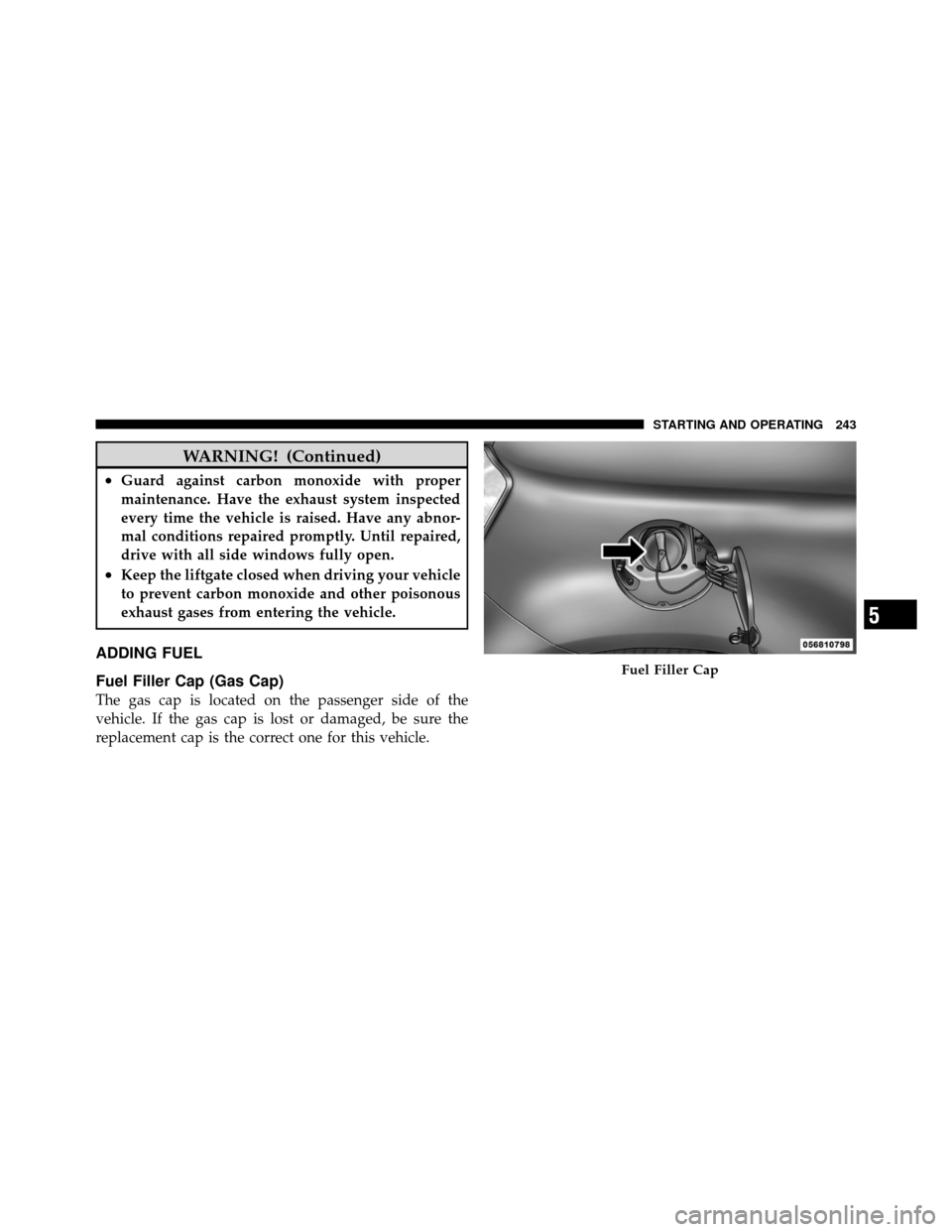
Fuel Filler Cap (Gas Cap)
The gas cap is located on the passenger side of the
vehicle. If the gas cap is lost or damaged, be sure the
replacement cap is the correct one for this vehicle.
Fuel Filler Cap
5
STARTING AND OPERATING 243
Page 246 of 358
CAUTION!
•Damage to the fuel system or emission control
system could result from using an improper fuel
cap (gas cap). A poorly fitting cap could let impu-
rities into the fuel system. Also, a poorly fitting
aftermarket cap can cause the “Malfunction Indi-
cator Light (MIL)” to illuminate, due to fuel vapors
escaping from the system.
•To avoid fuel spillage and overfilling, do not “top
off” the fuel tank after filling.
WARNING!
•Never have any smoking materials lit in or near
the vehicle when the gas cap is removed or the
tank is being filled.(Continued)
WARNING! (Continued)
•Never add fuel when the engine is running. It may
cause the MIL to turn on and could cause a fire.
•A fire may result if gasoline is pumped into a
portable container that is inside of a vehicle. You
could be burned. Always place gas containers on
the ground while filling.
NOTE:
•When the fuel nozzle “clicks” or shuts off, the fuel
tank is full.
•Tighten the gas cap about 1/4 turn until you hear one
click. This is an indication that the cap is properly
tightened.
•If the gas cap is not tightened properly, the MIL will
come on. Be sure the gas cap is tightened every time
the vehicle is refueled.
244 STARTING AND OPERATING
Page 247 of 358

Loose Fuel Filler Cap Message
After fuel has been added, the vehicle diagnostic system
can determine if the fuel filler cap is possibly loose,
improperly installed, or damaged. If the system detects a
malfunction, the “gASCAP” message will display in the
odometer display. Tighten the gas cap until a�clicking�
sound is heard. This is an indication that the gas cap is
properly tightened. Press the odometer reset button to turn the message off. If the problem persists, the message
will appear the next time the vehicle is started. This
might indicate a damaged cap. If the problem is detected
twice in a row, the system will turn on the MIL. Resolving
the problem will turn the MIL off.
TRAILER TOWING
Trailer towing with this vehicle is not allowed.
RECREATIONAL TOWING (BEHIND MOTORHOME, ETC.)
Towing This Vehicle Behind Another Vehicle
Towing Condition
Wheels OFF the Ground Manual Transmission
Flat Tow NONETransmission in NEUTRAL
Dolly Tow Front
OK
Rear NOT ALLOWED
On Trailer ALLOK
5
STARTING AND OPERATING 245
Page 283 of 358
Engine Oil Selection
For best performance and maximum protection for tur-
bocharged engines under all types of operating condi-
tions, the manufacturer recommends synthetic engine
oils that are API Certified and meet the requirements of
Chrysler Material Standard MS-10896.
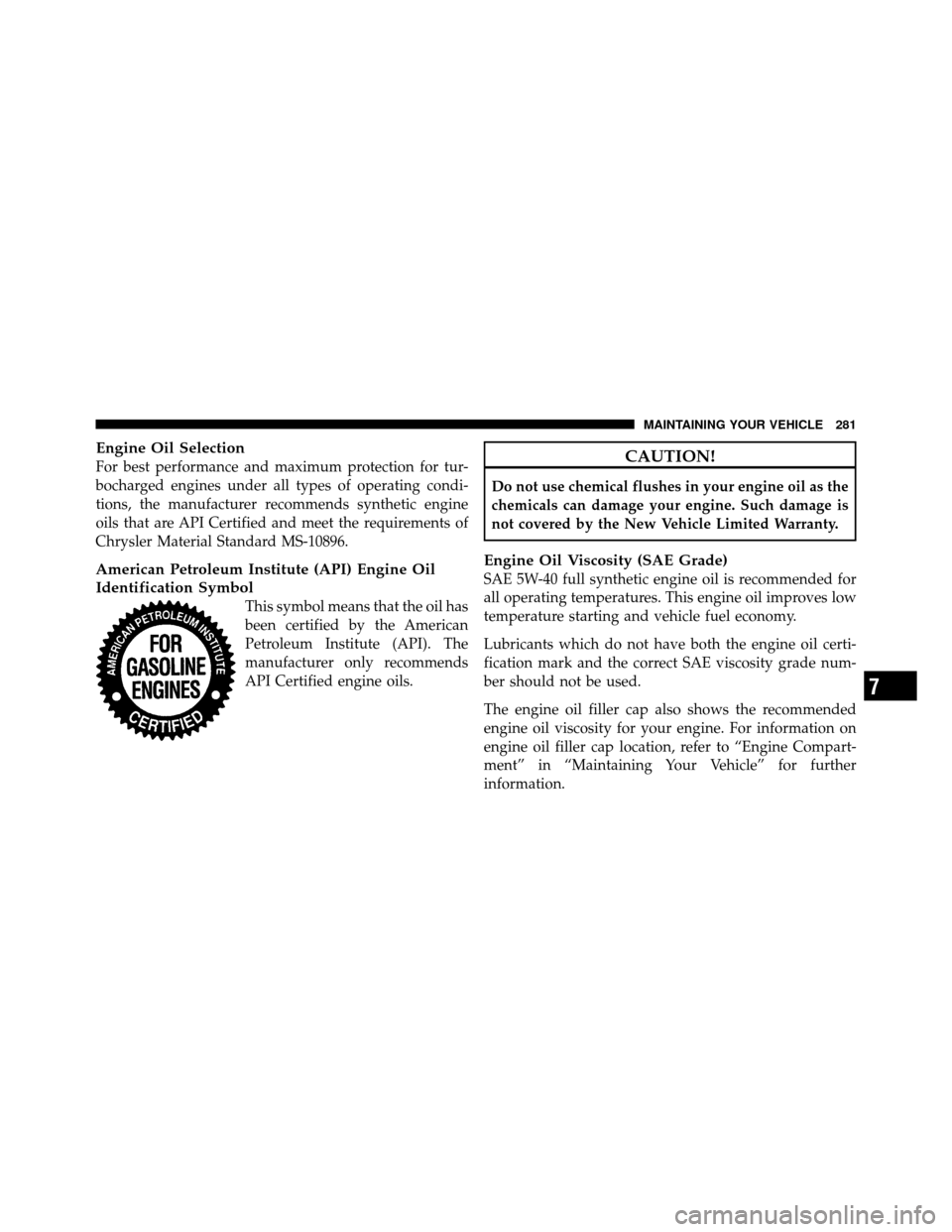
American Petroleum Institute (API) Engine Oil
Identification Symbol
This symbol means that the oil has
been certified by the American
Petroleum Institute (API). The
manufacturer only recommends
API Certified engine oils.
CAUTION!
Do not use chemical flushes in your engine oil as the
chemicals can damage your engine. Such damage is
not covered by the New Vehicle Limited Warranty.
Engine Oil Viscosity (SAE Grade)
SAE 5W-40 full synthetic engine oil is recommended for
all operating temperatures. This engine oil improves low
temperature starting and vehicle fuel economy.
Lubricants which do not have both the engine oil certi-
fication mark and the correct SAE viscosity grade num-
ber should not be used.
The engine oil filler cap also shows the recommended
engine oil viscosity for your engine. For information on
engine oil filler cap location, refer to “Engine Compart-
ment” in “Maintaining Your Vehicle” for further
information.
7
MAINTAINING YOUR VEHICLE 281