Page 86 of 358
SEATS
Seats are a part of the Occupant Restraint System of the
vehicle.
WARNING!
•It is dangerous to ride in a cargo area, inside or
outside of a vehicle. In a collision, people riding in
these areas are more likely to be seriously injured
or killed.
•Do not allow people to ride in any area of your
vehicle that is not equipped with seats and seat
belts. In a collision, people riding in these areas
are more likely to be seriously injured or killed.
•Be sure everyone in your vehicle is in a seat and
using a seat belt properly.
Front Seats Forward/Rearward Adjustment
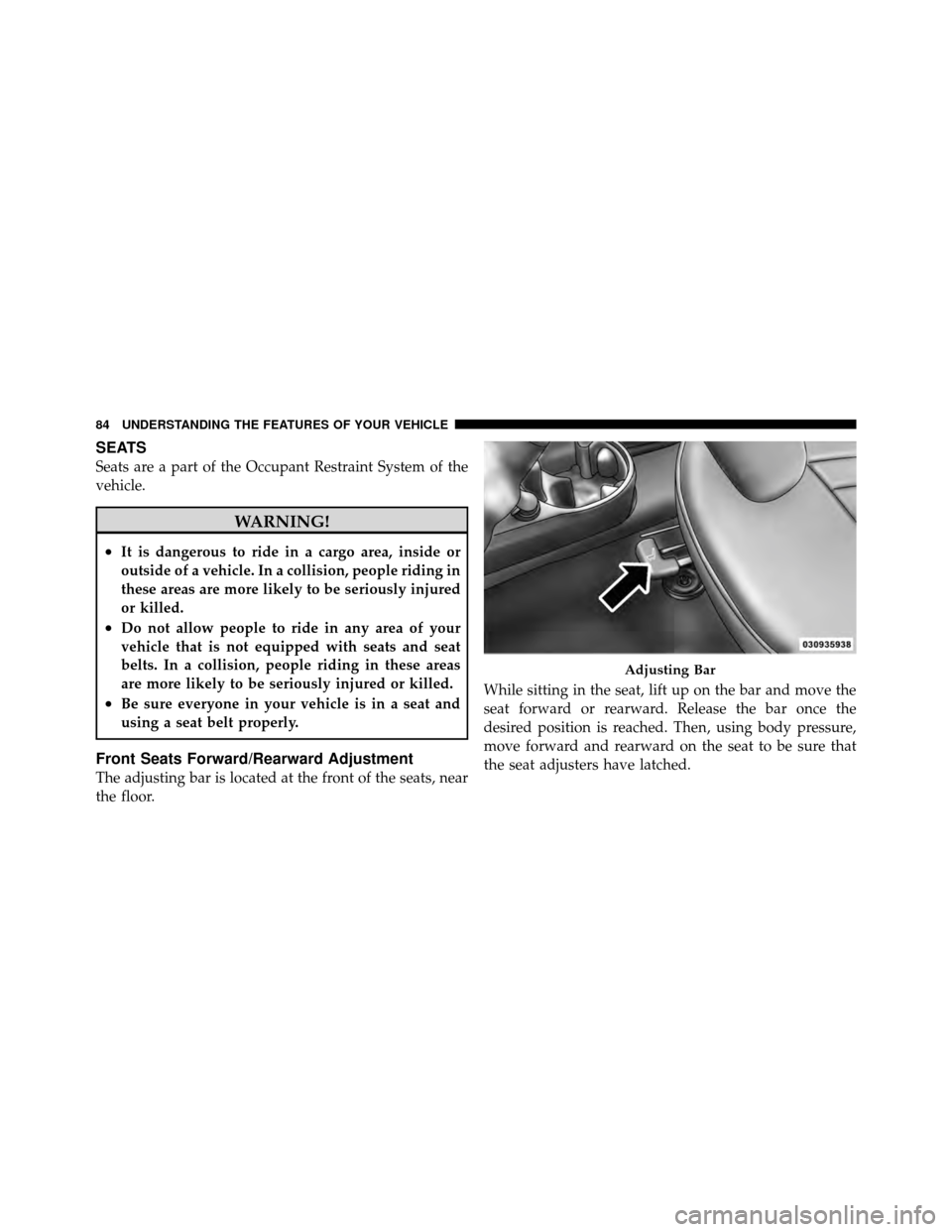
The adjusting bar is located at the front of the seats, near
the floor.While sitting in the seat, lift up on the bar and move the
seat forward or rearward. Release the bar once the
desired position is reached. Then, using body pressure,
move forward and rearward on the seat to be sure that
the seat adjusters have latched.
Adjusting Bar
84 UNDERSTANDING THE FEATURES OF YOUR VEHICLE
Page 87 of 358
WARNING!
•Adjusting a seat while driving may be dangerous.
Moving a seat while driving could result in loss of
control which could cause a collision and serious
injury or death.
•Seats should be adjusted before fastening the seat
belts and while the vehicle is parked. Serious
injury or death could result from a poorly adjusted
seat belt.
Recline Adjustment
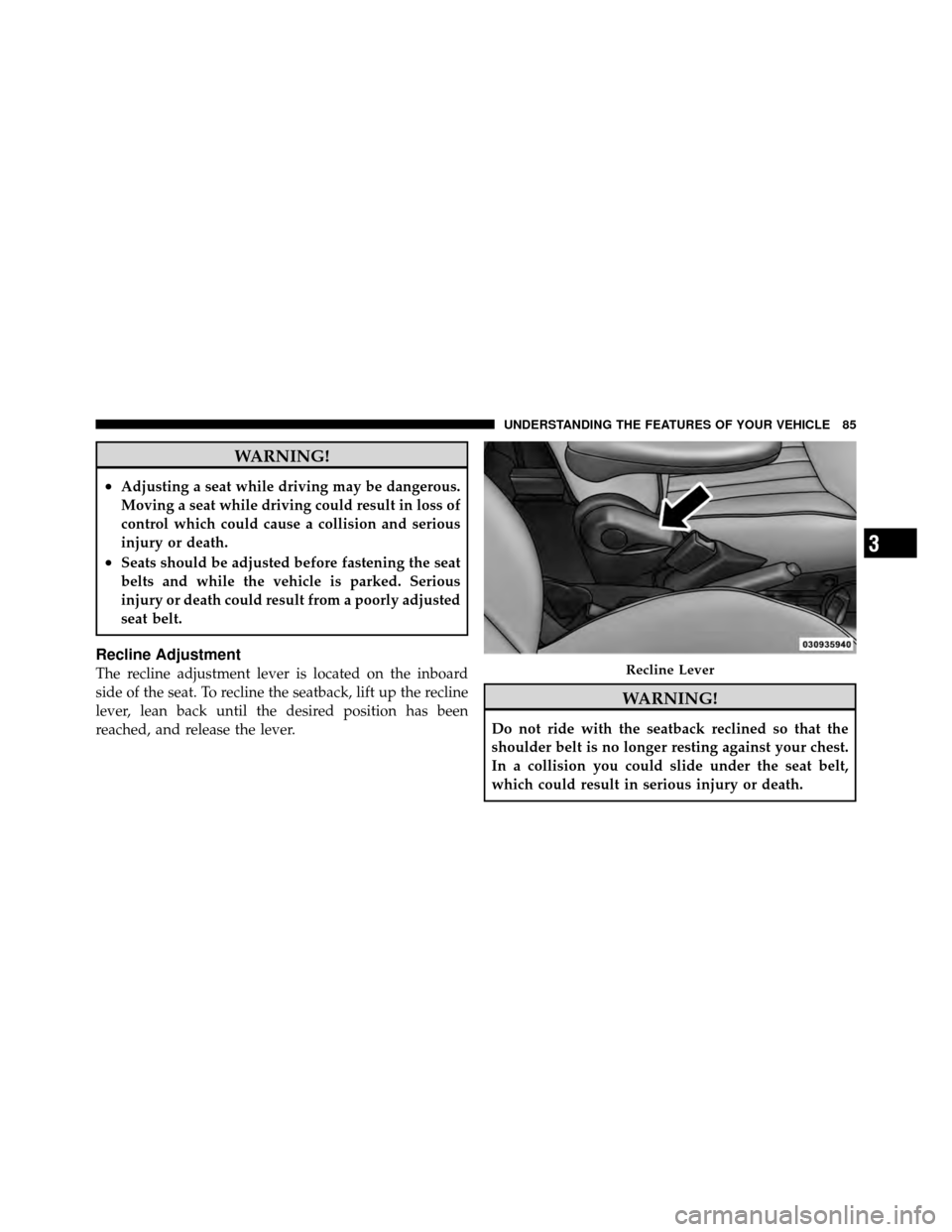
The recline adjustment lever is located on the inboard
side of the seat. To recline the seatback, lift up the recline
lever, lean back until the desired position has been
reached, and release the lever.
WARNING!
Do not ride with the seatback reclined so that the
shoulder belt is no longer resting against your chest.
In a collision you could slide under the seat belt,
which could result in serious injury or death.
Recline Lever
3
UNDERSTANDING THE FEATURES OF YOUR VEHICLE 85
Page 90 of 358
WARNING!
•Persons who are unable to feel pain to the skin
because of advanced age, chronic illness, diabetes,
spinal cord injury, medication, alcohol use, ex-
haustion or other physical condition must exercise
care when using the seat heater. It may cause burns
even at low temperatures, especially if used for
long periods of time.
•Do not place anything on the seat that insulates
against heat, such as a blanket or cushion. This
may cause the seat heater to overheat. Sitting in a
seat that has been overheated could cause serious
burns due to the increased surface temperature of
the seat.
Head Restraints
Head restraints are designed to reduce the risk of injury
by restricting head movement in the event of a rear
impact. Head restraints should be adjusted so that the top
of the head restraint is located above the top of your ear.
WARNING!
The head restraints for all occupants must be prop-
erly adjusted before operating the vehicle or occupy-
ing a seat. Head restraints should never be adjusted
while the vehicle is in motion. Driving a vehicle with
the head restraints improperly adjusted or removed
could cause serious injury or death in the event of an
accident.
Rear Head Restraints
To raise the head restraint, pull upward on the head
restraint. To lower the head restraint, press the push
button, located at the base of the head restraint, and push
88 UNDERSTANDING THE FEATURES OF YOUR VEHICLE
Page 93 of 358
WARNING!
Be sure the hood is fully latched before driving your
vehicle. If the hood is not fully latched, it could open
when the vehicle is in motion and block your vision.
Failure to follow this warning could result in serious
injury or death.
CAUTION!
To prevent possible damage, do not slam the hood to
close it. Lower the hood until it is open approxi-
mately 8 in (20 cm) and then drop it. This should
secure both latches. Never drive your vehicle unless
the hood is fully closed, with both latches engaged.
LIGHTS
Multifunction Lever
The multifunction lever, located on the left side of the
steering wheel, controls the operation of the headlights,
headlight beam selection, passing light and turn signals.
NOTE:The external lights can only be turned on with
the ignition in the ON/RUN position.
3
UNDERSTANDING THE FEATURES OF YOUR VEHICLE 91
Page 102 of 358
TILT STEERING COLUMN — IF EQUIPPED
This feature allows you to tilt the steering column
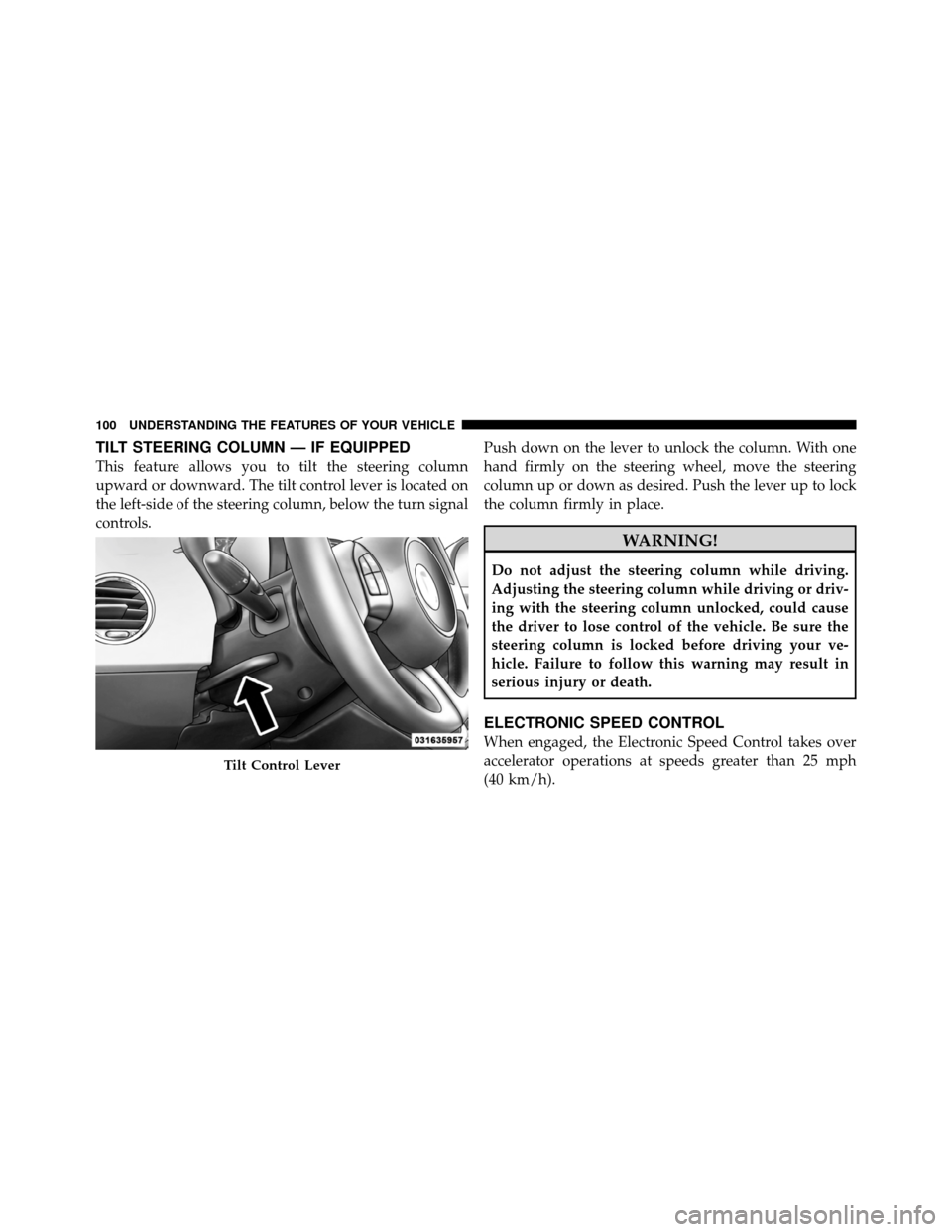
upward or downward. The tilt control lever is located on
the left-side of the steering column, below the turn signal
controls.Push down on the lever to unlock the column. With one
hand firmly on the steering wheel, move the steering
column up or down as desired. Push the lever up to lock
the column firmly in place.
WARNING!
Do not adjust the steering column while driving.
Adjusting the steering column while driving or driv-
ing with the steering column unlocked, could cause
the driver to lose control of the vehicle. Be sure the
steering column is locked before driving your ve-
hicle. Failure to follow this warning may result in
serious injury or death.
ELECTRONIC SPEED CONTROL
When engaged, the Electronic Speed Control takes over
accelerator operations at speeds greater than 25 mph
(40 km/h).
Tilt Control Lever
100 UNDERSTANDING THE FEATURES OF YOUR VEHICLE
Page 103 of 358
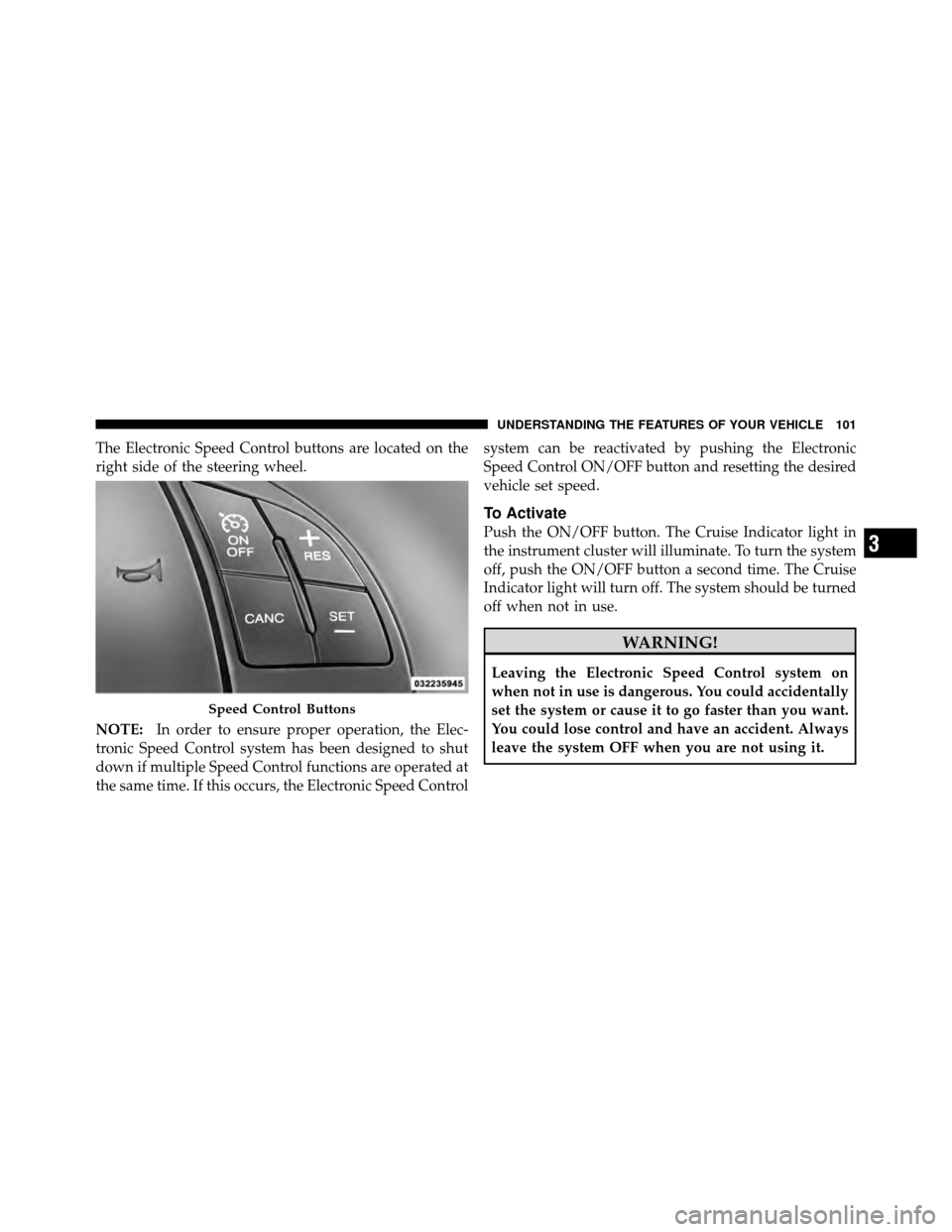
The Electronic Speed Control buttons are located on the
right side of the steering wheel.
NOTE:In order to ensure proper operation, the Elec-
tronic Speed Control system has been designed to shut
down if multiple Speed Control functions are operated at
the same time. If this occurs, the Electronic Speed Control system can be reactivated by pushing the Electronic
Speed Control ON/OFF button and resetting the desired
vehicle set speed.
To Activate
Push the ON/OFF button. The Cruise Indicator light in
the instrument cluster will illuminate. To turn the system
off, push the ON/OFF button a second time. The Cruise
Indicator light will turn off. The system should be turned
off when not in use.
WARNING!
Leaving the Electronic Speed Control system on
when not in use is dangerous. You could accidentally
set the system or cause it to go faster than you want.
You could lose control and have an accident. Always
leave the system OFF when you are not using it.
Speed Control Buttons
3
UNDERSTANDING THE FEATURES OF YOUR VEHICLE 101
Page 105 of 358
decrease until the button is released. Release the button
when the desired speed is reached, and the new set speed
will be established.
Pressing the SET (-) button once will result in a 1 mph
(2 km/h) decrease in set speed. Each subsequent tap of
the button results in a decrease of 1 mph (2 km/h).
To Accelerate For Passing
Press the accelerator as you would normally. When the
pedal is released, the vehicle will return to the set speed.
Using Electronic Speed Control On Hills
NOTE:The Electronic Speed Control system maintains
speed up and down hills. A slight speed change on
moderate hills is normal.
On steep hills, a greater speed loss or gain may occur so
it may be preferable to drive without Electronic Speed
Control.
WARNING!
Electronic Speed Control can be dangerous where the
system cannot maintain a constant speed. Your ve-
hicle could go too fast for the conditions, and you
could lose control and have an accident. Do not use
Electronic Speed Control in heavy traffic or on roads
that are winding, icy, snow-covered or slippery.
REAR PARK ASSIST — IF EQUIPPED
The Rear Park Assist system provides an audible indica-
tion of the distance between the rear fascia/bumper and
a detected obstacle when backing up, e.g. during a
parking maneuver. Refer to the “Park Assist System
Usage Precautions” for the limitations of this system and
recommendations.
3
UNDERSTANDING THE FEATURES OF YOUR VEHICLE 103
Page 107 of 358
Audible And Visual Signals Supplied By The Rear Park Assist System.
SIGNALMEANING INDICATION
Obstacle Distance An obstacle is present within
the sensors’ field of view Audible signal
(dashboard loudspeaker)
• Sound pulses emitted at a rate that increases
as the distance decreases.
• Emits continuous tone at 12 in (30 cm)
• Adjustable volume level. (Refer to “Menu
Functions” for further information).
Failure Sensor or System failures Visual Signal
(instrument panel)
• Icon appears on display.
• Message is displayed on multifunction display
(where provided).
While audible signals are emitted, the audio system is not
muted.
The audible signal is cut out immediately if the distance
increases. The tone cycle remains constant if the distance measured by the inner sensors is constant. If this condi-
tion occurs for the external sensors, the signal is cut off
after 3 seconds (stopping warnings during maneuvers
parallel to walls).
3
UNDERSTANDING THE FEATURES OF YOUR VEHICLE 105