Page 275 of 358
MAINTAINING YOUR VEHICLE
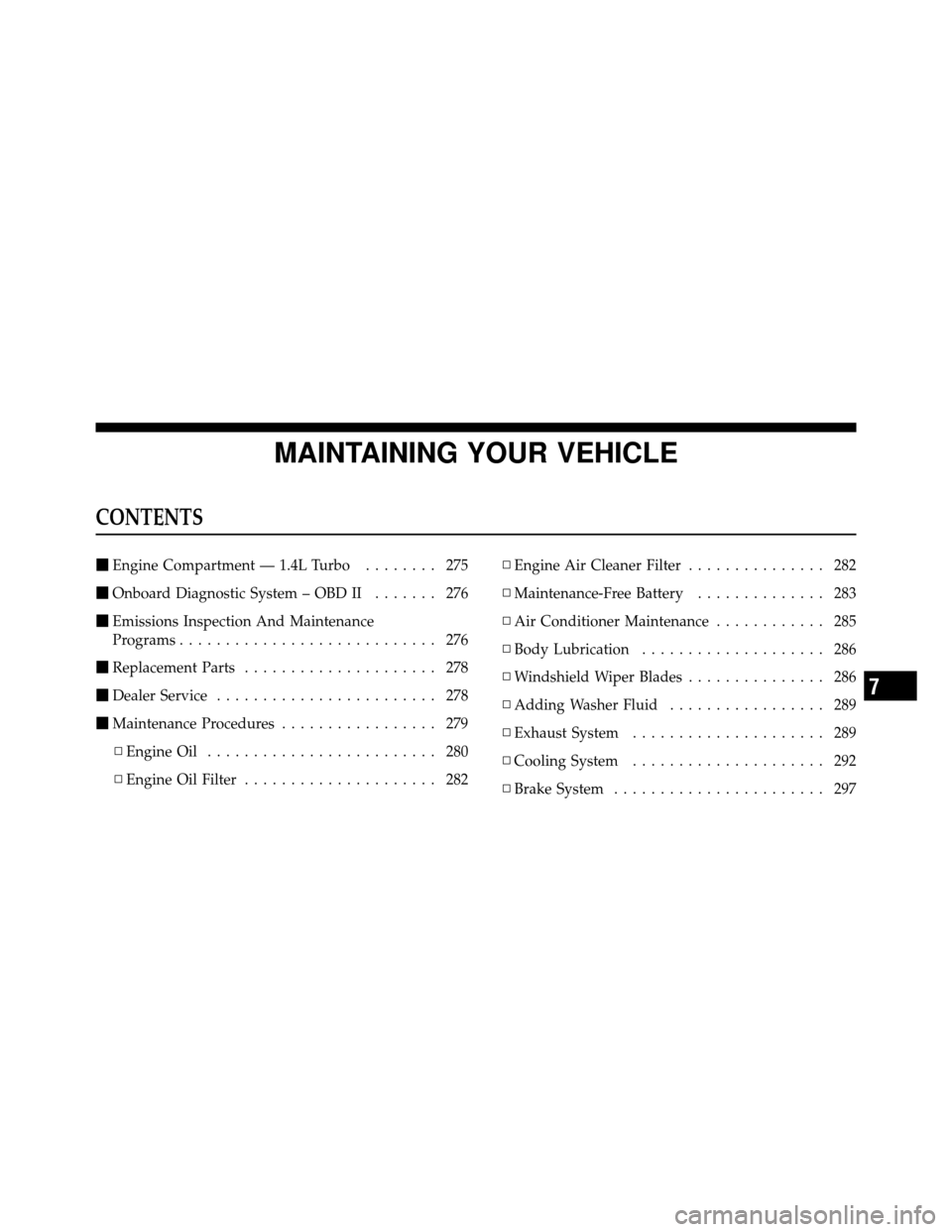
CONTENTS
�Engine Compartment — 1.4L Turbo ........ 275
� Onboard Diagnostic System – OBD II ....... 276
� Emissions Inspection And Maintenance
Programs ............................ 276
� Replacement Parts ..................... 278
� Dealer Service ........................ 278
� Maintenance Procedures ................. 279
▫ Engine Oil ......................... 280
▫ Engine Oil Filter ..................... 282 ▫
Engine Air Cleaner Filter ............... 282
▫ Maintenance-Free Battery .............. 283
▫ Air Conditioner Maintenance ............ 285
▫ Body Lubrication .................... 286
▫ Windshield Wiper Blades ............... 286
▫ Adding Washer Fluid ................. 289
▫ Exhaust System ..................... 289
▫ Cooling System ..................... 292
▫ Brake System ....................... 297
7
Page 294 of 358

Cooling System
WARNING!
•When working near the radiator cooling fan, dis-
connect the fan motor lead or turn the ignition
switch to the OFF position. The fan is temperature
controlled and can start at any time the ignition
switch is in the ON position.
•You or others can be badly burned by hot engine
coolant (antifreeze) or steam from your radiator. If
you see or hear steam coming from under the
hood, do not open the hood until the radiator has
had time to cool. Never try to open a cooling
system pressure cap when the radiator is hot.
Coolant Checks
Check engine coolant (antifreeze) protection every
12 months (before the onset of freezing weather, where
applicable). If the engine coolant (antifreeze) is dirty orrusty in appearance, the system should be drained,
flushed and refilled with fresh engine coolant (anti-
freeze). Check the front of the A/C condenser for any
accumulation of bugs, leaves, etc. If dirty, clean by gently
spraying water from a garden hose vertically down the
face of the condenser.
Cooling System – Drain, Flush, And Refill
Refer to the “Maintenance Schedule” for the proper
maintenance intervals.
If the engine coolant (antifreeze) is dirty or contains a
considerable amount of sediment, clean and flush with a
reliable cooling system cleaner. Follow with a thorough
rinsing to remove all deposits and chemicals. Properly
dispose of old engine coolant (antifreeze).
Selection Of Coolant
Refer to “Fluids, Lubricants, and Genuine Parts” in
“Maintaining Your Vehicle” for further information.
292 MAINTAINING YOUR VEHICLE
Page 295 of 358
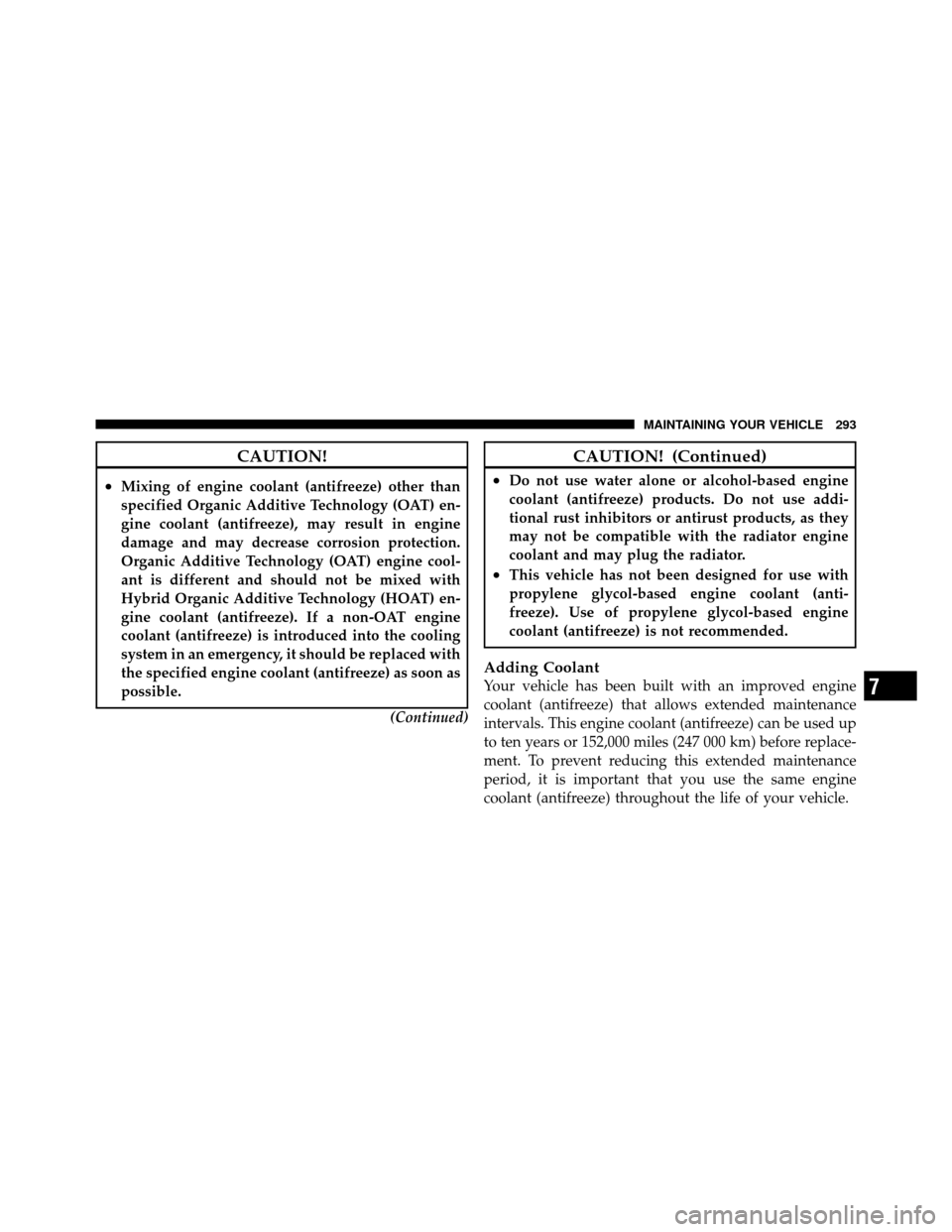
CAUTION!
•Mixing of engine coolant (antifreeze) other than
specified Organic Additive Technology (OAT) en-
gine coolant (antifreeze), may result in engine
damage and may decrease corrosion protection.
Organic Additive Technology (OAT) engine cool-
ant is different and should not be mixed with
Hybrid Organic Additive Technology (HOAT) en-
gine coolant (antifreeze). If a non-OAT engine
coolant (antifreeze) is introduced into the cooling
system in an emergency, it should be replaced with
the specified engine coolant (antifreeze) as soon as
possible.(Continued)
CAUTION! (Continued)
•Do not use water alone or alcohol-based engine
coolant (antifreeze) products. Do not use addi-
tional rust inhibitors or antirust products, as they
may not be compatible with the radiator engine
coolant and may plug the radiator.
•This vehicle has not been designed for use with
propylene glycol-based engine coolant (anti-
freeze). Use of propylene glycol-based engine
coolant (antifreeze) is not recommended.
Adding Coolant
Your vehicle has been built with an improved engine
coolant (antifreeze) that allows extended maintenance
intervals. This engine coolant (antifreeze) can be used up
to ten years or 152,000 miles (247 000 km) before replace-
ment. To prevent reducing this extended maintenance
period, it is important that you use the same engine
coolant (antifreeze) throughout the life of your vehicle.7
MAINTAINING YOUR VEHICLE 293
Page 296 of 358
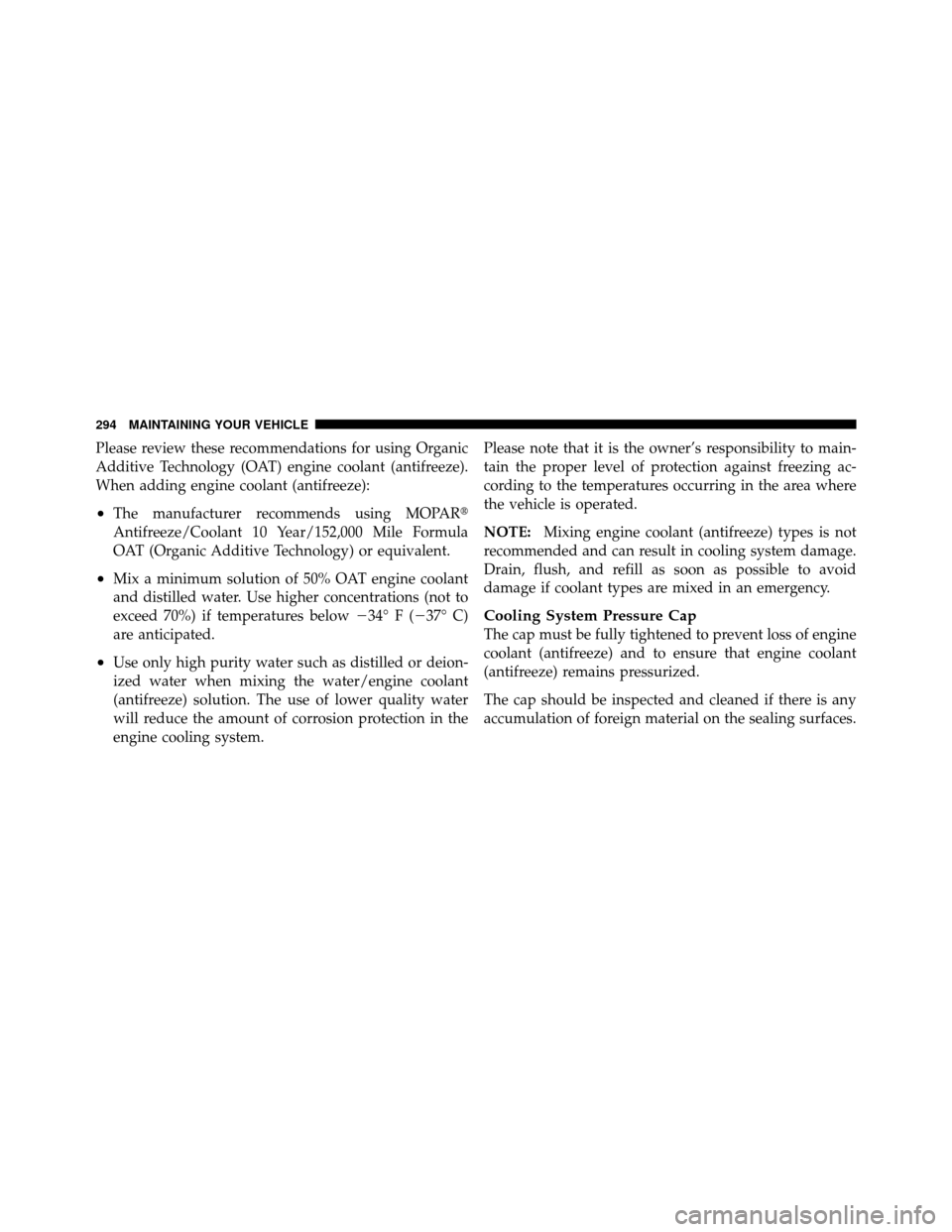
Please review these recommendations for using Organic
Additive Technology (OAT) engine coolant (antifreeze).
When adding engine coolant (antifreeze):
•The manufacturer recommends using MOPAR�
Antifreeze/Coolant 10 Year/152,000 Mile Formula
OAT (Organic Additive Technology) or equivalent.
•Mix a minimum solution of 50% OAT engine coolant
and distilled water. Use higher concentrations (not to
exceed 70%) if temperatures below �34°F(�37° C)
are anticipated.
•Use only high purity water such as distilled or deion-
ized water when mixing the water/engine coolant
(antifreeze) solution. The use of lower quality water
will reduce the amount of corrosion protection in the
engine cooling system. Please note that it is the owner’s responsibility to main-
tain the proper level of protection against freezing ac-
cording to the temperatures occurring in the area where
the vehicle is operated.
NOTE:
Mixing engine coolant (antifreeze) types is not
recommended and can result in cooling system damage.
Drain, flush, and refill as soon as possible to avoid
damage if coolant types are mixed in an emergency.
Cooling System Pressure Cap
The cap must be fully tightened to prevent loss of engine
coolant (antifreeze) and to ensure that engine coolant
(antifreeze) remains pressurized.
The cap should be inspected and cleaned if there is any
accumulation of foreign material on the sealing surfaces.
294 MAINTAINING YOUR VEHICLE
Page 297 of 358

WARNING!
•The warning words “DO NOT OPEN HOT” on
the cooling system pressure cap are a safety pre-
caution. Never add engine coolant (antifreeze)
when the engine is overheated. Do not loosen or
remove the cap to cool an overheated engine. Heat
causes pressure to build up in the cooling system.
To prevent scalding or injury, do not remove the
pressure cap while the system is hot or under
pressure.
•Do not use a pressure cap other than the one
specified for your vehicle. Personal injury or en-
gine damage may result.
Disposal Of Used Engine Coolant
Used ethylene glycol-based engine coolant (antifreeze) is
a regulated substance requiring proper disposal. Check
with your local authorities to determine the disposalrules for your community. To prevent ingestion by ani-
mals or children do not store ethylene glycol-based
engine coolant (antifreeze) in open containers or allow it
to remain in puddles on the ground. If ingested by a child
or pet, seek emergency assistance immediately. Clean up
any ground spills immediately.
Coolant Level
The coolant expansion bottle provides a quick visual
method for determining that the coolant level is ad-
equate. With the engine off and cold, the level of the
engine coolant (antifreeze) in the bottle should be be-
tween the bottom and top lines marked “COLD FILL
RANGE”.
As long as the engine operating temperature is satisfac-
tory, the coolant bottle need only be checked once a
month.
7
MAINTAINING YOUR VEHICLE 295
Page 298 of 358

When additional engine coolant (antifreeze) is needed to
maintain the proper level, it should be added to the
coolant bottle. Do not overfill.
Points To Remember
NOTE:When the vehicle is stopped after a few miles/
kilometers of operation, you may observe vapor coming
from the front of the engine compartment. This is nor-
mally a result of moisture from rain, snow, or high
humidity accumulating on the radiator and being vapor-
ized when the thermostat opens, allowing hot engine
coolant (antifreeze) to enter the radiator.
If an examination of your engine compartment shows no
evidence of radiator or hose leaks, the vehicle may be
safely driven. The vapor will soon dissipate.
•Do not overfill the coolant expansion bottle.
•Check the coolant freeze point in the radiator and in
the coolant expansion bottle. If engine coolant (anti-
freeze) needs to be added, the contents of the coolant
expansion bottle must also be protected against freez-
ing.
•If frequent engine coolant (antifreeze) additions are
required, the cooling system should be pressure tested
for leaks.
•Maintain engine coolant (antifreeze) concentration at
50% OAT engine coolant (antifreeze) (minimum) and
distilled water for proper corrosion protection of your
engine which contains aluminum components.
•Make sure that the coolant expansion bottle overflow
hoses are not kinked or obstructed.
•Keep the front of the radiator clean. If your vehicle is
equipped with air conditioning, keep the front of the
condenser clean.
296 MAINTAINING YOUR VEHICLE
Page 316 of 358
Center High Mounted Stop Lamp (CHMSL)
1. Remove the two guard caps and the two fastening
screws.
2. Remove the center high mounted stop lamp assembly.
3. Disconnect the electric connector.
4. Press the retaining device and open the bulb holder.5. Remove the snap-fitted bulb to be replaced and re-
place it.
6. Close the back cap locking it properly.
7. Reinstall the two fastening screws and reinstall the
guard caps.
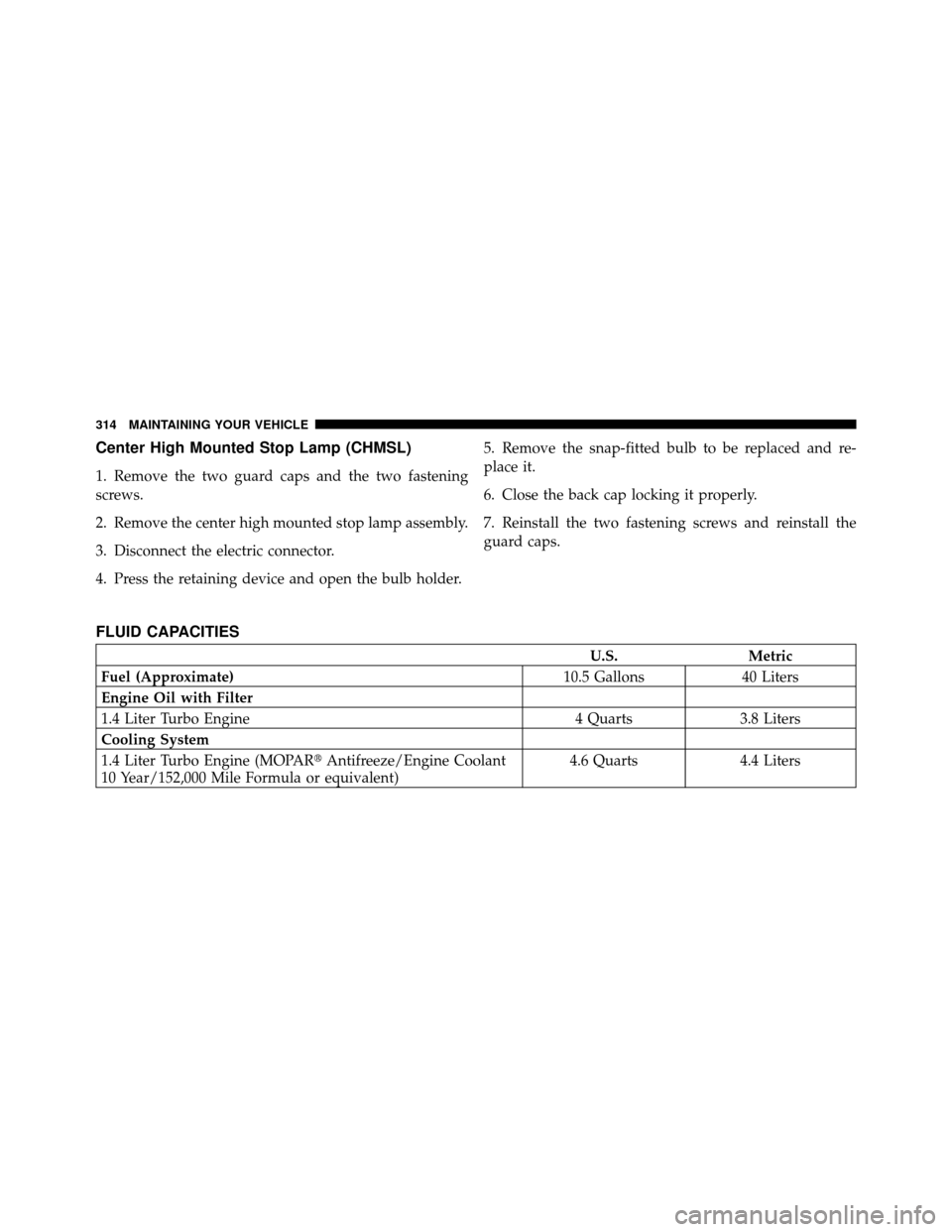
FLUID CAPACITIES
U.S.
Metric
Fuel (Approximate) 10.5 Gallons 40 Liters
Engine Oil with Filter
1.4 Liter Turbo Engine 4 Quarts 3.8 Liters
Cooling System
1.4 Liter Turbo Engine (MOPAR� Antifreeze/Engine Coolant
10 Year/152,000 Mile Formula or equivalent) 4.6 Quarts
4.4 Liters
314 MAINTAINING YOUR VEHICLE
Page 346 of 358
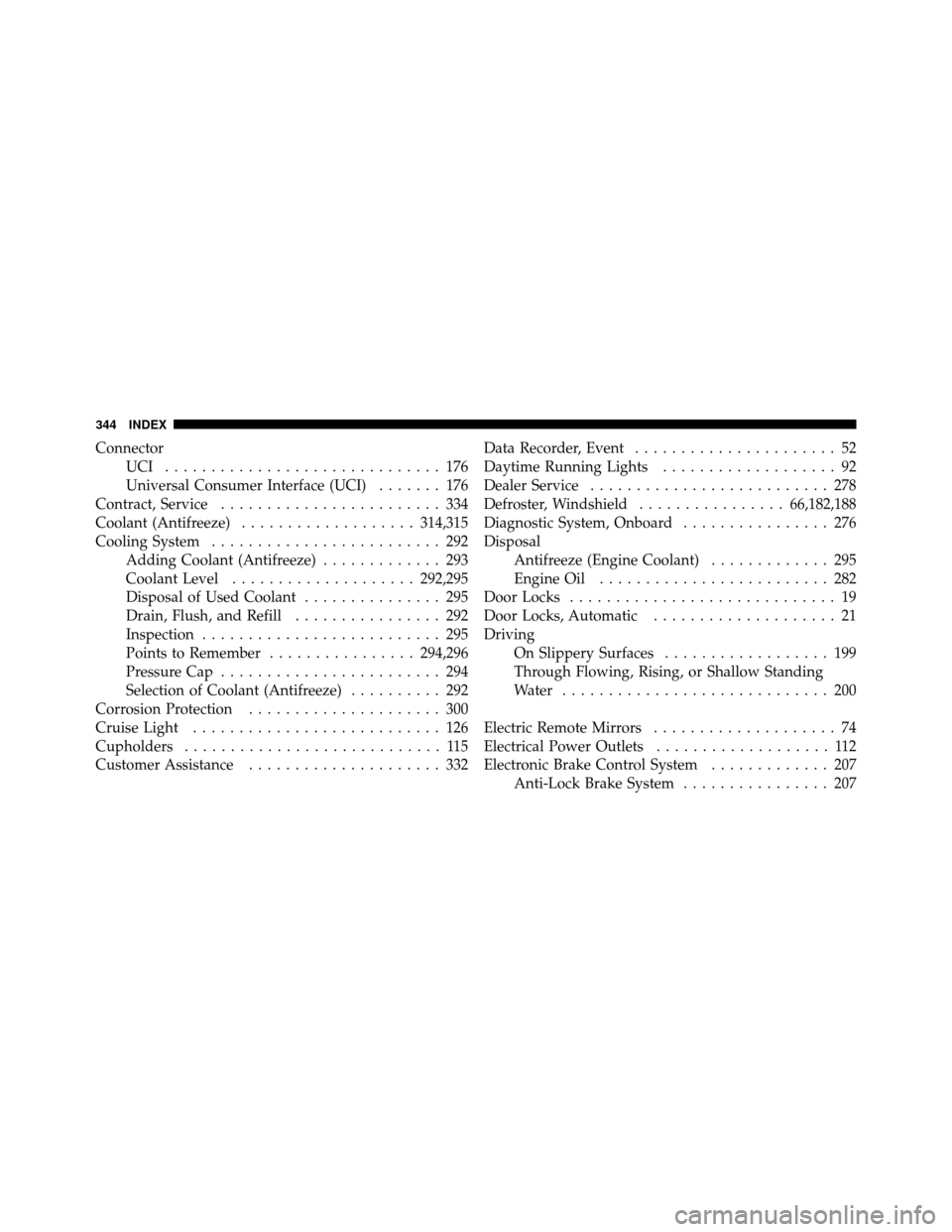
ConnectorUCI .............................. 176
Universal Consumer Interface (UCI) ....... 176
Contract, Service ........................ 334
Coolant (Antifreeze) ................... 314,315
Cooling System ......................... 292
Adding Coolant (Antifreeze) ............. 293
Coolant Level .................... 292,295
Disposal of Used Coolant ............... 295
Drain, Flush, and Refill ................ 292
Inspection .......................... 295
Points to Remember ................ 294,296
Pressure Cap ........................ 294
Selection of Coolant (Antifreeze) .......... 292
Corrosion Protection ..................... 300
Cruise Light ........................... 126
Cupholders ............................ 115
Customer Assistance ..................... 332 Data Recorder, Event
...................... 52
Daytime Running Lights ................... 92
Dealer Service .......................... 278
Defroster, Windshield ................66,182,188
Diagnostic System, Onboard ................ 276
Disposal Antifreeze (Engine Coolant) ............. 295
Engine Oil ......................... 282
Door Locks ............................. 19
Door Locks, Automatic .................... 21
Driving On Slippery Surfaces .................. 199
Through Flowing, Rising, or Shallow Standing
Water ............................. 200
Electric Remote Mirrors .................... 74
Electrical Power Outlets ................... 112
Electronic Brake Control System ............. 207
Anti-Lock Brake System ................ 207
344 INDEX