Page 453 of 603

Figure out the weight on the front and rear of the vehicle
separately. It is important that you distribute the load
evenly over the front and rear axles.
Overloading can cause potential safety hazards and
shorten useful service life. Heavier axles or suspension
components do not necessarily increase the vehicle’s
GVWR.
Loading
To load your vehicle properly, first figure out its empty
weight, axle-by-axle and side-by-side. Store heavier items
down low and be sure you distribute their weight as
evenly as possible. Stow all loose items securely before
driving. If weighing the loaded vehicle shows that you
have exceeded either GAWR, but the total load is within
the specified GVWR, you must redistribute the weight.
Improper weight distribution can have an adverse effect
on the way your vehicle steers and handles and the way
the brakes operate.
TRAILER TOWING
In this section, you will find safety tips and information
on limits to the type of towing you can reasonably do
with your vehicle. Before towing a trailer, carefully
review this information to tow your load as efficiently
and safely as possible.
To maintain warranty coverage, follow the requirements
and recommendations in this manual concerning ve-
hicles used for trailer towing.
Common Towing Definitions
The following trailer towing related definitions will assist
you in understanding the following information:
Gross Vehicle Weight Rating (GVWR)
The GVWR is the total allowable weight of your vehicle.
This includes driver, passengers, cargo, and tongue
weight. The total load must be limited so that you do not
5
STARTING AND OPERATING 451
Page 462 of 603

WARNING! (Continued)
•Make certain that the load is secured in the trailer
and that it will not shift during travel. When
trailering cargo that is not fully secured, dynamic
load shifts can occur that may be difficult for the
driver to control. You could lose control of your
vehicle and have a collision.
•When hauling cargo or towing a trailer, do not
overload your vehicle or trailer. Overloading can
cause a loss of control, poor performance, or dam-
age to brakes, axle, engine, transmission, steering,
suspension, chassis structure, or tires.
•Safety chains must always be used between your
vehicle and trailer. Always connect the chains to
the frame or hook retainers of the vehicle hitch.
Cross the chains under the trailer tongue and
allow enough slack for turning corners.(Continued)
WARNING! (Continued)
•Vehicles with trailers should not be parked on a
grade. When parking, apply the parking brake on
the tow vehicle. Put the tow vehicle automatic
transmission in PARK. Always, block or �chock�
the trailer wheels.
•GCWR must not be exceeded.
•Total weight must be distributed between the tow
vehicle and the trailer such that the following four
ratings are not exceeded:
1. GVWR
2. GTW
3. GAWR
4. Tongue weight rating for the trailer hitch uti-
lized. (This requirement may limit the ability to
always achieve the 10% to 15% range of tongue
weight as a percentage of total trailer weight.)
460 STARTING AND OPERATING
Page 477 of 603

Spare Tire Stowage
NOTE:Refer to “Spare Tire Removal” for information
on assembling the winch tools.
1. Place the spare tire near to the winch cable. Hold the
spare upright so that the tire’s tread is on the ground and
the valve stem is at the top of the wheel facing away from
the rear of the vehicle.
2. Tilt the retainer at the end of the winch cable and drop
it through the center of the wheel. Then place the spare
tire with the cable and retainer underneath the vehicle.
3. Fit the assembled jack-handle over the winch drive
nut. Rotate the jack-handle assembly clockwise to raise
the spare tire into the storage area. Continue to rotate the
jack-handle assembly until you hear the winch mecha-
nism click three times. It cannot be over tightened. Push
against the tire several times to be sure it is held securely
in place.
Jacking Instructions
WARNING!
Carefully follow these tire changing warnings to
help prevent personal injury or damage to your
vehicle:
•Always park on a firm, level surface as far from
the edge of the roadway as possible before raising
the vehicle.
•Turn on the Hazard Warning flasher.
•Block the wheel diagonally opposite the wheel to
be raised.
•Set the parking brake firmly and set an automatic
transmission in PARK.
•Never start or run the engine with the vehicle on a
jack.
(Continued)
6
WHAT TO DO IN EMERGENCIES 475
Page 478 of 603
WARNING! (Continued)
•Do not let anyone sit in the vehicle when it is on a
jack.
•Do not get under the vehicle when it is on a jack.
•Only use the jack in the positions indicated and
for lifting this vehicle during a tire change.
•If working on or near a roadway, be extremely
careful of motor traffic.
•To assure that spare tires, flat or inflated, are
securely stowed, spares must be stowed with the
valve stem facing the ground.
CAUTION!
Do not attempt to raise the vehicle by jacking on
locations other than those indicated in the Jacking
Instructions for this vehicle.
Jack Warning LabelJacking Locations
476 WHAT TO DO IN EMERGENCIES
Page 493 of 603

If the vehicle’s battery is discharged, see “Shift Lever
Override” in “What To Do In Emergencies” for instruc-
tions on shifting the automatic transmission out of the
PARK position for towing.
CAUTION!
•Do not attempt to use sling type equipment when
towing. When securing the vehicle to a flat bed
truck, do not attach to front or rear suspension
components. Damage to your vehicle may result
from improper towing.
•Do not push or tow this vehicle with another
vehicle as damage to the bumper fascia and trans-
mission may result.
•If the vehicle being towed requires steering, the
ignition switch must be in the ON/RUN position,
not the LOCK/OFF or ACC positions.
All-Wheel Drive (AWD)
The manufacturer requires towing with all four wheels
OFF the ground. Acceptable methods are to tow the
vehicle on a flatbed, or with one end of vehicle raised and
the opposite end on a towing dolly.
CAUTION!
Failure to follow these towing methods could result
in damage to the transmission and/or transfer case.
Such damage is not covered by the New Vehicle
Limited Warranty.
6
WHAT TO DO IN EMERGENCIES 491
Page 513 of 603
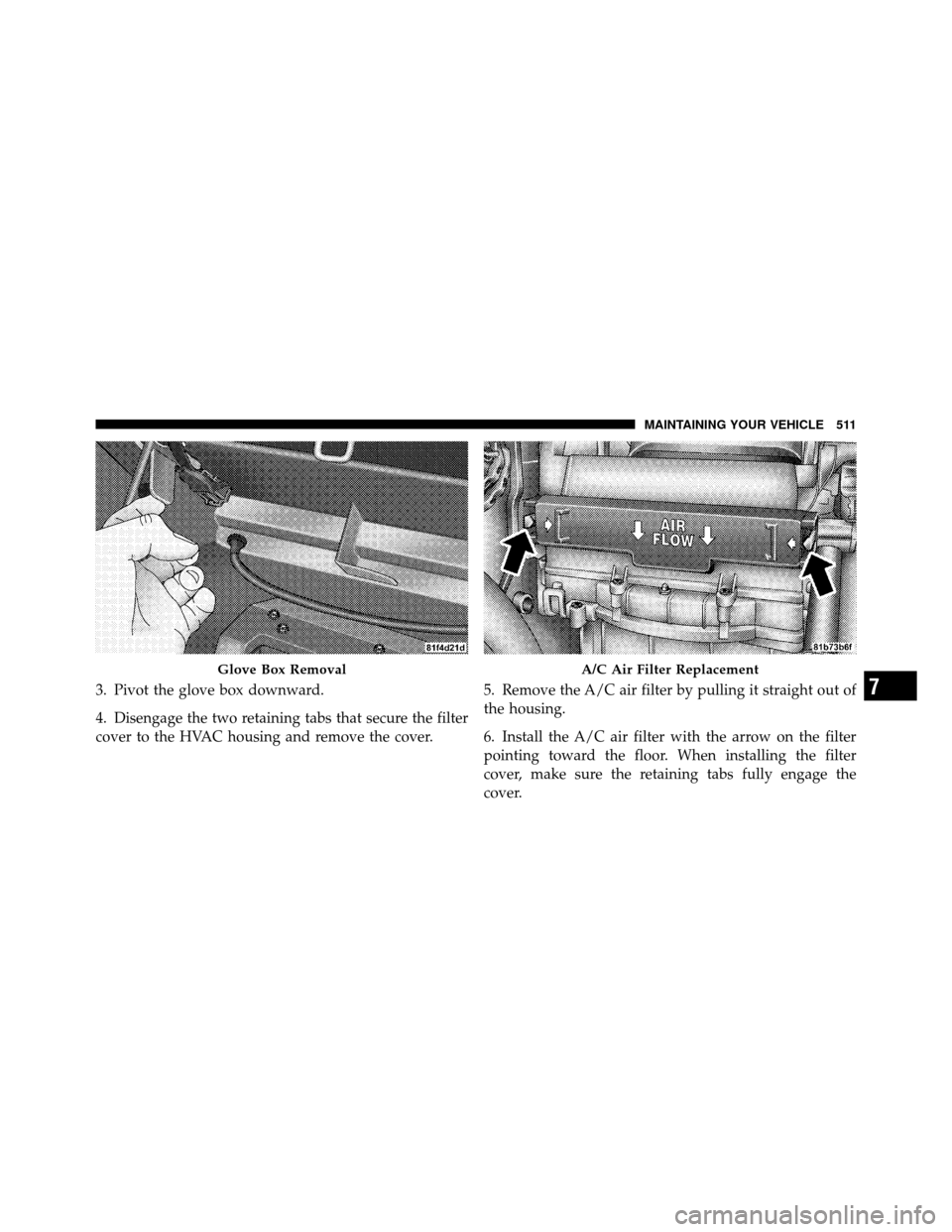
3. Pivot the glove box downward.
4. Disengage the two retaining tabs that secure the filter
cover to the HVAC housing and remove the cover.5. Remove the A/C air filter by pulling it straight out of
the housing.
6. Install the A/C air filter with the arrow on the filter
pointing toward the floor. When installing the filter
cover, make sure the retaining tabs fully engage the
cover.
Glove Box RemovalA/C Air Filter Replacement
7
MAINTAINING YOUR VEHICLE 511
Page 527 of 603

WARNING! (Continued)
•To avoid contamination from foreign matter or
moisture, use only new brake fluid or fluid that
has been in a tightly closed container. Keep the
master cylinder reservoir cap secured at all times.
Brake fluid in a open container absorbs moisture
from the air resulting in a lower boiling point.
This may cause it to boil unexpectedly during hard
or prolonged braking, resulting in sudden brake
failure. This could result in a collision.
•Overfilling the brake fluid reservoir can result in
spilling brake fluid on hot engine parts, causing
the brake fluid to catch fire. Brake fluid can also
damage painted and vinyl surfaces, care should be
taken to avoid its contact with these surfaces.(Continued)
WARNING! (Continued)
•Do not allow petroleum based fluid to contami-
nate the brake fluid. Brake seal components could
be damaged, causing partial or complete brake
failure. This could result in a collision.
Automatic Transmission
The automatic transmission and differential assembly are
contained within a single housing.
The fluid level in the automatic transmission should be
checked whenever the vehicle is serviced. Operation with
an improper fluid level will greatly reduce the life of the
transmission and the fluid.
7
MAINTAINING YOUR VEHICLE 525
Page 580 of 603

About Your Brakes.................... 396,399
ABS (Anti-Lock Brake System) .............. 400
Adding Engine Coolant (Antifreeze) .......... 520
Adding Fuel ........................... 447
Adding Washer Fluid ..................... 515
Additives, Fuel ......................... 441
Air Cleaner, Engine (Engine Air Cleaner Filter) . . . 506
Air Conditioner Maintenance ............... 509
Air Conditioning Filter .................360,510
Air Conditioning Refrigerant .............509,510
Air Conditioning System ................353,509
Air Conditioning, Operating Tips ............ 361
Air Conditioning, Rear Zone ................ 355
Air Pressure, Tires ....................... 419
Airbag .............................. 61,70
Airbag Deployment ....................... 72
Airbag Light ................... 68,69,74,92,274
Airbag Maintenance ....................... 73
Airbag, Side ........................ 64,67,70Airbag, Window (Side Curtain)
...........65,67,70
Alarm (Security Alarm) .................... 17
Alarm Light ........................... 281
Alarm System (Security Alarm) ............... 17
Alarm, Panic ............................ 23
All Wheel Drive (AWD) ................... 391
Alterations/Modifications, Vehicle ............. 7
Anti-Lock Brake System (ABS) .............. 400
Anti-Lock Warning Light .............280,400,402
Anti-Theft Security Alarm (Theft Alarm) ........ 17
Antifreeze (Engine Coolant) ..............519,548
Disposal ........................... 521
Appearance Care ........................ 529
Arming Theft System (Security Alarm) ......... 17
Auto Down Power Windows ................ 39
Auto Unlock, Doors ....................... 31
Automatic Dimming Mirror ................ 101
Automatic Door Locks ..................... 31
Automatic Headlights .................... 202
578 INDEX