Page 429 of 603
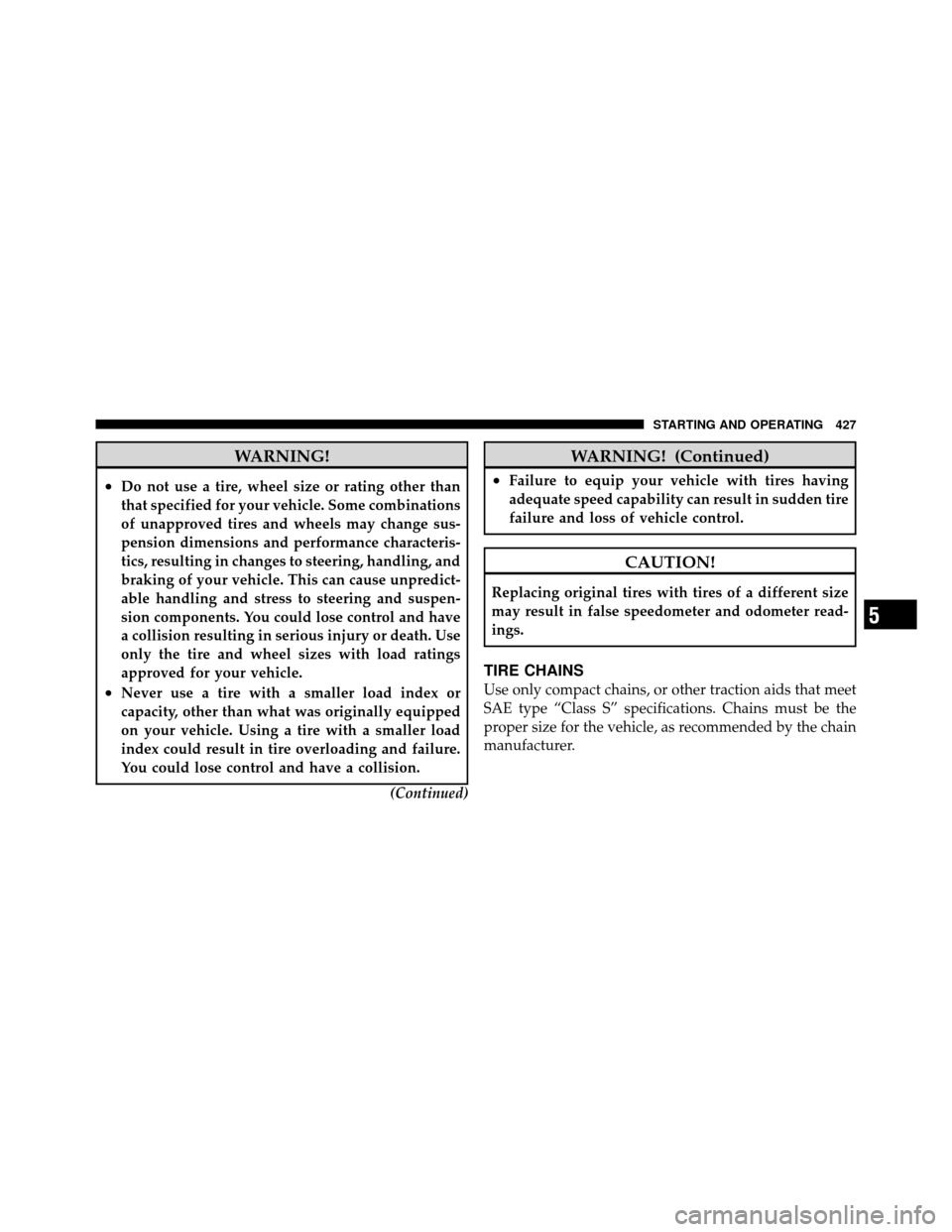
WARNING!
•Do not use a tire, wheel size or rating other than
that specified for your vehicle. Some combinations
of unapproved tires and wheels may change sus-
pension dimensions and performance characteris-
tics, resulting in changes to steering, handling, and
braking of your vehicle. This can cause unpredict-
able handling and stress to steering and suspen-
sion components. You could lose control and have
a collision resulting in serious injury or death. Use
only the tire and wheel sizes with load ratings
approved for your vehicle.
•Never use a tire with a smaller load index or
capacity, other than what was originally equipped
on your vehicle. Using a tire with a smaller load
index could result in tire overloading and failure.
You could lose control and have a collision.(Continued)
WARNING! (Continued)
•Failure to equip your vehicle with tires having
adequate speed capability can result in sudden tire
failure and loss of vehicle control.
CAUTION!
Replacing original tires with tires of a different size
may result in false speedometer and odometer read-
ings.
TIRE CHAINS
Use only compact chains, or other traction aids that meet
SAE type “Class S” specifications. Chains must be the
proper size for the vehicle, as recommended by the chain
manufacturer.
5
STARTING AND OPERATING 427
Page 462 of 603

WARNING! (Continued)
•Make certain that the load is secured in the trailer
and that it will not shift during travel. When
trailering cargo that is not fully secured, dynamic
load shifts can occur that may be difficult for the
driver to control. You could lose control of your
vehicle and have a collision.
•When hauling cargo or towing a trailer, do not
overload your vehicle or trailer. Overloading can
cause a loss of control, poor performance, or dam-
age to brakes, axle, engine, transmission, steering,
suspension, chassis structure, or tires.
•Safety chains must always be used between your
vehicle and trailer. Always connect the chains to
the frame or hook retainers of the vehicle hitch.
Cross the chains under the trailer tongue and
allow enough slack for turning corners.(Continued)
WARNING! (Continued)
•Vehicles with trailers should not be parked on a
grade. When parking, apply the parking brake on
the tow vehicle. Put the tow vehicle automatic
transmission in PARK. Always, block or �chock�
the trailer wheels.
•GCWR must not be exceeded.
•Total weight must be distributed between the tow
vehicle and the trailer such that the following four
ratings are not exceeded:
1. GVWR
2. GTW
3. GAWR
4. Tongue weight rating for the trailer hitch uti-
lized. (This requirement may limit the ability to
always achieve the 10% to 15% range of tongue
weight as a percentage of total trailer weight.)
460 STARTING AND OPERATING
Page 489 of 603

If frequent jump-starting is required to start your vehicle,
you should have the battery and charging system in-
spected at your authorized dealer.
CAUTION!
Accessories that can be plugged into the vehicle
power outlets draw power from the vehicle’s battery,
even when not in use (i.e., cellular phones, etc.).
Eventually, if plugged in long enough, the vehicle’s
battery will discharge sufficiently to degrade battery
life and/or prevent the engine from starting.
FREEING A STUCK VEHICLE
If your vehicle becomes stuck in mud, sand, or snow, it
can often be moved by a rocking motion. Turn your
steering wheel right and left to clear the area around the
front wheels. Then shift back and forth between DRIVE
and REVERSE. Using the least accelerator pedal pressureto maintain the rocking motion without spinning the
wheels is most effective.
CAUTION!
Racing the engine or spinning the wheels may lead to
transmission overheating and failure. Allow the en-
gine to idle with the shift lever in NEUTRAL for at
least one minute after every five rocking-motion
cycles. This will minimize overheating and reduce
the risk of transmission failure during prolonged
efforts to free a stuck vehicle.
NOTE: If your vehicle is equipped with Traction Con-
trol, turn the system OFF before attempting to
“rock” the vehicle. Refer to “Electronic Stability
Program (ESP)” in “Starting and Operating”
for further information.
6
WHAT TO DO IN EMERGENCIES 487
Page 493 of 603

If the vehicle’s battery is discharged, see “Shift Lever
Override” in “What To Do In Emergencies” for instruc-
tions on shifting the automatic transmission out of the
PARK position for towing.
CAUTION!
•Do not attempt to use sling type equipment when
towing. When securing the vehicle to a flat bed
truck, do not attach to front or rear suspension
components. Damage to your vehicle may result
from improper towing.
•Do not push or tow this vehicle with another
vehicle as damage to the bumper fascia and trans-
mission may result.
•If the vehicle being towed requires steering, the
ignition switch must be in the ON/RUN position,
not the LOCK/OFF or ACC positions.
All-Wheel Drive (AWD)
The manufacturer requires towing with all four wheels
OFF the ground. Acceptable methods are to tow the
vehicle on a flatbed, or with one end of vehicle raised and
the opposite end on a towing dolly.
CAUTION!
Failure to follow these towing methods could result
in damage to the transmission and/or transfer case.
Such damage is not covered by the New Vehicle
Limited Warranty.
6
WHAT TO DO IN EMERGENCIES 491
Page 509 of 603

WARNING!
The air induction system (air cleaner, hoses, etc.) can
provide a measure of protection in the case of engine
backfire. Do not remove the air induction system (air
cleaner, hoses, etc.) unless such removal is necessary
for repair or maintenance. Make sure that no one is
near the engine compartment before starting the
vehicle with the air induction system (air cleaner,
hoses, etc.) removed. Failure to do so can result in
serious personal injury.
Engine Air Cleaner Filter Selection
The quality of replacement engine air cleaner filters
varies considerably. Only high quality filters should be
used to assure most efficient service. MOPAR�engine air
cleaner filters are a high quality filter and are
recommended.
Maintenance-Free Battery
Your vehicle is equipped with a maintenance-free battery.
You will never have to add water, nor is periodic main-
tenance required.
NOTE: The battery is stored in a compartment that is
located behind the left front fender and is accessible
through the wheel well. The wheel and tire assemble do
not need to be removed to access the compartment.
Remote battery terminals are located in the engine com-
partment for jump-starting. Refer to “Jump-Starting Pro-
cedures” in “What To Do In Emergencies” for further
information.
To access the battery, turn the steering wheel fully to the
right and remove the access panel from the inner fender
shield.
7
MAINTAINING YOUR VEHICLE 507
Page 538 of 603
CavityCartridge
Fuse Mini-
Fuse Description
F115 20 Amp
Yellow Rear Wiper Motor
F116 30 Amp
Pink Rear Defroster (EBL)
F117 10 Amp
Red Heated Mirrors
F118 10 Amp
Red Occupant Restraint
Controller
F119 10 Amp
Red Steering Column
Control Module
F120 10 Amp
Red All Wheel Drive – If
Equipped
F121 15 Amp
Blue Wireless Ignition
Node
F122 25 Amp
Natural Driver Door ModuleCavity
Cartridge
Fuse Mini-
Fuse Description
F123 25 Amp
Natural Passenger Door
Module
F124 10 Amp
Red Mirrors
F125 10 Amp
Red Steering Column
Control Module
F126 10 Amp
Red Audio Amplifier
F127 20 Amp
Yellow Trailer Tow – If
Equipped
F128 15 Amp
Blue Radio
F129 15 Amp
Blue Video/DVD – If
Equipped
F130 15 Amp
Blue Climate Control/
Instrument Panel
536 MAINTAINING YOUR VEHICLE
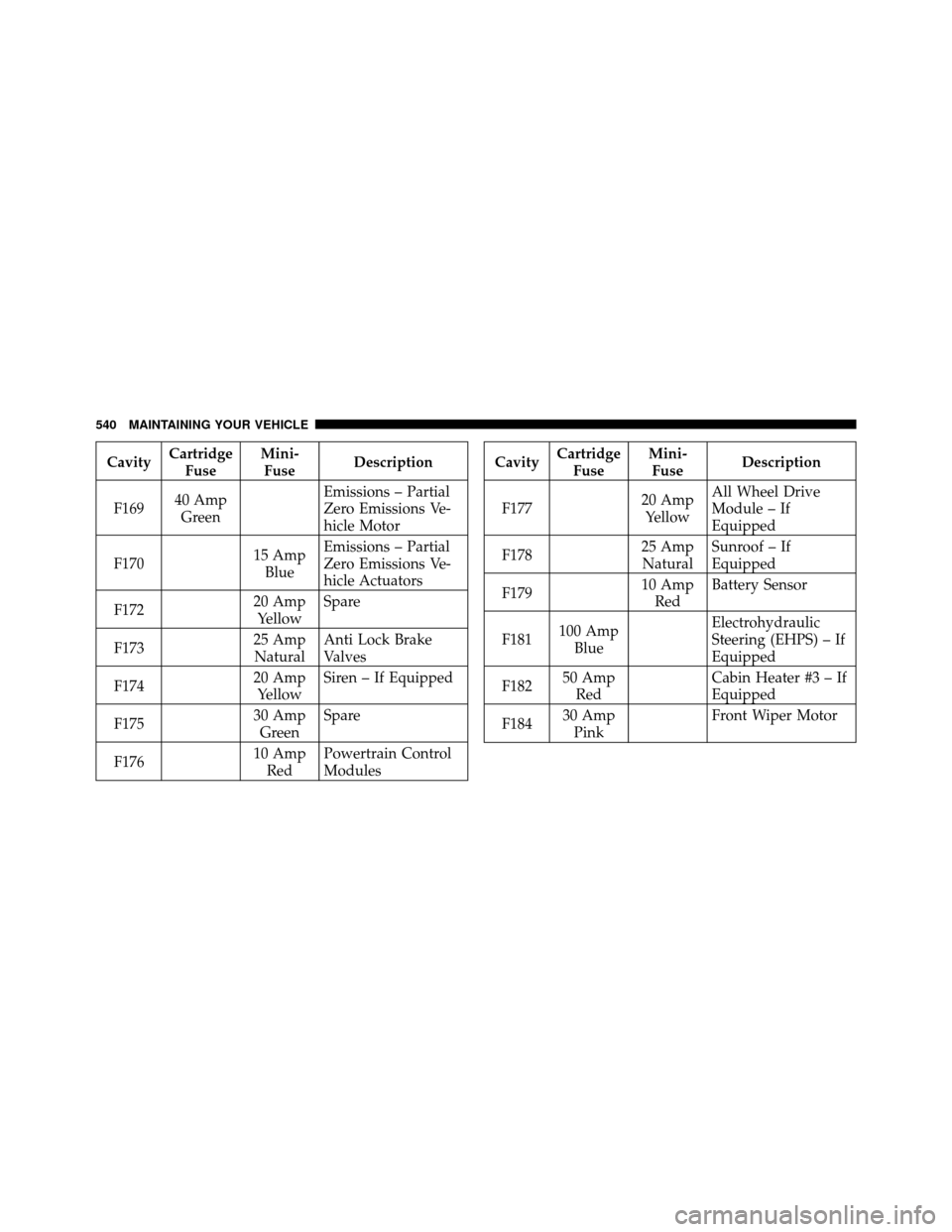
Page 542 of 603
CavityCartridge
Fuse Mini-
Fuse Description
F169 40 Amp
Green Emissions – Partial
Zero Emissions Ve-
hicle Motor
F170 15 Amp
Blue Emissions – Partial
Zero Emissions Ve-
hicle Actuators
F172 20 Amp
Yellow Spare
F173 25 Amp
Natural Anti Lock Brake
Valves
F174 20 Amp
Yellow Siren – If Equipped
F175 30 Amp
Green Spare
F176 10 Amp
Red Powertrain Control
ModulesCavity
Cartridge
Fuse Mini-
Fuse Description
F177 20 Amp
Yellow All Wheel Drive
Module – If
Equipped
F178 25 Amp
Natural Sunroof – If
Equipped
F179 10 Amp
Red Battery Sensor
F181 100 Amp
Blue Electrohydraulic
Steering (EHPS) – If
Equipped
F182 50 Amp
Red Cabin Heater #3 – If
Equipped
F184 30 Amp
Pink Front Wiper Motor
540 MAINTAINING YOUR VEHICLE
Page 545 of 603
CAUTION!
Do not touch the new bulb with your fingers. Oil
contamination will severely shorten bulb life. If the
bulb comes in contact with any oily surface, clean the
bulb with rubbing alcohol.
4. Install the bulb and connector assembly into the
headlamp housing and rotate it
14turn clockwise to lock
it in place.
Front Fog Lamp
NOTE: Turn the steering wheel to the right if replacing
the left front fog lamp or to the left if replacing the right
front fog lamp to allow for easier access to the front of the
wheel well.
1. Remove the fasteners retaining the front lower wheel
well access panel and remove the access panel. 2. Remove the electrical connector from the fog lamp
housing.
3. Squeeze the two tabs on the side of the bulb socket and
pull straight out from the fog lamp.
7
MAINTAINING YOUR VEHICLE 543