2012 DODGE CHARGER SRT check engine
[x] Cancel search: check enginePage 464 of 546
Cooling System
WARNING!
•When working near the radiator cooling fan, dis-
connect the fan motor lead or turn the ignition
switch to the LOCK position. The fan is tempera-
ture controlled and can start at any time the
ignition switch is in the ON position.
•You or others can be badly burned by hot engine
coolant (antifreeze) or steam from your radiator. If
you see or hear steam coming from under the
hood, do not open the hood until the radiator has
had time to cool. Never try to open a cooling
system pressure cap when the radiator is hot.
Coolant Checks
Check engine coolant (antifreeze) protection every
12 months (before the onset of freezing weather, where
applicable). If the engine coolant (antifreeze) is dirty orrusty in appearance, the system should be drained,
flushed, and refilled with fresh coolant. Check the front
of the radiator for any accumulation of bugs, leaves, etc.
If dirty, clean by gently spraying water from a garden
hose vertically down the face of the condenser.
Check the coolant recovery bottle tubing for brittle rub-
ber, cracking, tears, cuts, and tightness of the connection
at the bottle and radiator. Inspect the entire system for
leaks.
With the engine at normal operating temperature (but
not running), check the cooling system pressure cap for
proper vacuum sealing by draining a small amount of
engine coolant (antifreeze) from the radiator drain cock.
If the cap is sealing properly, the engine coolant (anti-
freeze) will begin to drain from the coolant recovery
bottle. DO NOT REMOVE THE COOLANT PRESSURE
CAP WHEN THE COOLING SYSTEM IS HOT.
462 MAINTAINING YOUR VEHICLE
PAGE POSITION:462JOB:@zeta.tweddle.com/chry_pdm/CLS_chrysler/GRP_owners/JOB_918945-en-dsr-12D482-126-AA_DSR/DIV_og pubnum: 12D482-126-AB_DSR Cooling System
WARNING!
•When working near the radiator cooling fan, dis-
connect the fan motor lead or turn the ignition
switch to the LOCK position. The fan is tempera-
ture controlled and can start at any time the
ignition switch is in the ON position.
•You or others can be badly burned by hot engine
coolant (antifreeze) or steam from your radiator. If
you see or hear steam coming from under the
hood, do not open the hood until the radiator has
had time to cool. Never try to open a cooling
system pressure cap when the radiator is hot.
Coolant Checks
Check engine coolant (antifreeze) protection every
12 months (before the onset of freezing weather, where
applicable). If the engine coolant (antifreeze) is dirty orrusty in appearance, the system should be drained,
flushed, and refilled with fresh coolant. Check the front
of the radiator for any accumulation of bugs, leaves, etc.
If dirty, clean by gently spraying water from a garden
hose vertically down the face of the condenser.
Check the coolant recovery bottle tubing for brittle rub-
ber, cracking, tears, cuts, and tightness of the connection
at the bottle and radiator. Inspect the entire system for
leaks.
With the engine at normal operating temperature (but
not running), check the cooling system pressure cap for
proper vacuum sealing by draining a small amount of
engine coolant (antifreeze) from the radiator drain cock.
If the cap is sealing properly, the engine coolant (anti-
freeze) will begin to drain from the coolant recovery
bottle. DO NOT REMOVE THE COOLANT PRESSURE
CAP WHEN THE COOLING SYSTEM IS HOT.
462 MAINTAINING YOUR VEHICLE
PAGE POSITION:462JOB:@zeta.tweddle.com/chry_pdm/CLS_chrysler/GRP_owners/JOB_918945-en-dsr-12D482-126-AA_DSR/DIV_og pubnum: 12D482-126-AB_DSR
Page 468 of 546
Disposal Of Used Coolant
Used ethylene glycol-based engine coolant (antifreeze) is
a regulated substance requiring proper disposal. Check
with your local authorities to determine the disposal
rules for your community. To prevent ingestion by ani-
mals or children, do not store ethylene glycol-based
engine coolant (antifreeze) in open containers or allow it
to remain in puddles on the ground. If ingested by a child
or pet, seek emergency assistance immediately. Clean up
any ground spills immediately.
Coolant Level
The coolant bottle provides a quick visual method for
determining that the coolant level is adequate. With the
engine OFF and cold, the level of the engine coolant
(antifreeze) in the bottle should be between the ranges
indicated on the bottle.The radiator normally remains completely full, so there is
no need to remove the radiator cap unless checking for
engine coolant (antifreeze) freeze point or replacing cool-
ant. Advise your service attendant of this. As long as the
engine operating temperature is satisfactory, the coolant
bottle need only be checked once a month.
When additional engine coolant (antifreeze) is needed to
maintain the proper level, it should be added to the
coolant bottle. Do not overfill.
Points To Remember
NOTE:When the vehicle is stopped after a few miles
(kilometers) of operation, you may observe vapor coming
from the front of the engine compartment. This is nor-
mally a result of moisture from rain, snow, or high
humidity accumulating on the radiator and being vapor-
ized when the thermostat opens, allowing hot engine
coolant (antifreeze) to enter the radiator.
466 MAINTAINING YOUR VEHICLE
PAGE POSITION:466JOB:@zeta.tweddle.com/chry_pdm/CLS_chrysler/GRP_owners/JOB_918945-en-dsr-12D482-126-AA_DSR/DIV_og pubnum: 12D482-126-AB_DSR Disposal Of Used Coolant
Used ethylene glycol-based engine coolant (antifreeze) is
a regulated substance requiring proper disposal. Check
with your local authorities to determine the disposal
rules for your community. To prevent ingestion by ani-
mals or children, do not store ethylene glycol-based
engine coolant (antifreeze) in open containers or allow it
to remain in puddles on the ground. If ingested by a child
or pet, seek emergency assistance immediately. Clean up
any ground spills immediately.
Coolant Level
The coolant bottle provides a quick visual method for
determining that the coolant level is adequate. With the
engine OFF and cold, the level of the engine coolant
(antifreeze) in the bottle should be between the ranges
indicated on the bottle.The radiator normally remains completely full, so there is
no need to remove the radiator cap unless checking for
engine coolant (antifreeze) freeze point or replacing cool-
ant. Advise your service attendant of this. As long as the
engine operating temperature is satisfactory, the coolant
bottle need only be checked once a month.
When additional engine coolant (antifreeze) is needed to
maintain the proper level, it should be added to the
coolant bottle. Do not overfill.
Points To Remember
NOTE:When the vehicle is stopped after a few miles
(kilometers) of operation, you may observe vapor coming
from the front of the engine compartment. This is nor-
mally a result of moisture from rain, snow, or high
humidity accumulating on the radiator and being vapor-
ized when the thermostat opens, allowing hot engine
coolant (antifreeze) to enter the radiator.
466 MAINTAINING YOUR VEHICLE
PAGE POSITION:466JOB:@zeta.tweddle.com/chry_pdm/CLS_chrysler/GRP_owners/JOB_918945-en-dsr-12D482-126-AA_DSR/DIV_og pubnum: 12D482-126-AB_DSR
Page 469 of 546
If an examination of your engine compartment shows no
evidence of radiator or hose leaks, the vehicle may be
safely driven. The vapor will soon dissipate.
•Do not overfill the coolant recovery bottle.
•Check engine coolant (antifreeze) freeze point in the
radiator and in the coolant recovery bottle. If engine
coolant (antifreeze) needs to be added, contents of
coolant recovery bottle must also be protected against
freezing.
•If frequent engine coolant (antifreeze) additions are
required, or if the level in the coolant recovery bottle
does not drop when the engine cools, the cooling
system should be pressure tested for leaks.
•Maintain coolant concentration at 50% HOAT engine
coolant (antifreeze) (minimum) and distilled water for
proper corrosion protection of your engine, which
contains aluminum components.
•Make sure that the radiator and coolant recovery
bottle overflow hoses are not kinked or obstructed.
•Keep the front of the radiator clean. If your vehicle is
equipped with air conditioning, keep the front of the
condenser clean.
•Do not change the thermostat for Summer or Winter
operation. If replacement is ever necessary, install
ONLY the correct type thermostat. Other designs may
result in unsatisfactory coolant performance, poor gas
mileage, and increased emissions.
Brake System
In order to assure brake system performance, all brake
system components should be inspected periodically.
Refer to the “Maintenance Schedule” for the proper
maintenance intervals.7
MAINTAINING YOUR VEHICLE 467
PAGE POSITION:467JOB:@zeta.tweddle.com/chry_pdm/CLS_chrysler/GRP_owners/JOB_918945-en-dsr-12D482-126-AA_DSR/DIV_og pubnum: 12D482-126-AB_DSR If an examination of your engine compartment shows no
evidence of radiator or hose leaks, the vehicle may be
safely driven. The vapor will soon dissipate.
•Do not overfill the coolant recovery bottle.
•Check engine coolant (antifreeze) freeze point in the
radiator and in the coolant recovery bottle. If engine
coolant (antifreeze) needs to be added, contents of
coolant recovery bottle must also be protected against
freezing.
•If frequent engine coolant (antifreeze) additions are
required, or if the level in the coolant recovery bottle
does not drop when the engine cools, the cooling
system should be pressure tested for leaks.
•Maintain coolant concentration at 50% HOAT engine
coolant (antifreeze) (minimum) and distilled water for
proper corrosion protection of your engine, which
contains aluminum components.
•Make sure that the radiator and coolant recovery
bottle overflow hoses are not kinked or obstructed.
•Keep the front of the radiator clean. If your vehicle is
equipped with air conditioning, keep the front of the
condenser clean.
•Do not change the thermostat for Summer or Winter
operation. If replacement is ever necessary, install
ONLY the correct type thermostat. Other designs may
result in unsatisfactory coolant performance, poor gas
mileage, and increased emissions.
Brake System
In order to assure brake system performance, all brake
system components should be inspected periodically.
Refer to the “Maintenance Schedule” for the proper
maintenance intervals.7
MAINTAINING YOUR VEHICLE 467
PAGE POSITION:467JOB:@zeta.tweddle.com/chry_pdm/CLS_chrysler/GRP_owners/JOB_918945-en-dsr-12D482-126-AA_DSR/DIV_og pubnum: 12D482-126-AB_DSR
Page 497 of 546
•Under no circumstances should oil change intervals
exceed 6,000 miles (10 000 km) or six months, which-
ever comes first.
Your authorized dealer will reset the oil change indicator
message after completing the scheduled oil change. If a
scheduled oil change is performed by someone other
than your authorized dealer, the message can be reset by
referring to the steps described under “Electronic Vehicle
Information Center (EVIC)/Oil Change Required” in
“Understanding Your Instrument Panel” or under “In-
strument Cluster Description/Odometer/Trip Odom-
eter” in “Understanding Your Instrument Panel” for
further information.At Each Stop for Fuel
•Check the engine oil level. Refer to “Maintenance
Procedures/Engine Oil” in “Maintaining Your Ve-
hicle” for further information.
•Check the windshield washer solvent and add if
required.
8
M
A
I
N
T
E
N
A
N
C
E
S
C
H
E
D
U
L
E
SMAINTENANCE SCHEDULES 495
PAGE POSITION:495JOB:@zeta.tweddle.com/chry_pdm/CLS_chrysler/GRP_owners/JOB_918945-en-dsr-12D482-126-AA_DSR/DIV_og pubnum: 12D482-126-AB_DSR •Under no circumstances should oil change intervals
exceed 6,000 miles (10 000 km) or six months, which-
ever comes first.
Your authorized dealer will reset the oil change indicator
message after completing the scheduled oil change. If a
scheduled oil change is performed by someone other
than your authorized dealer, the message can be reset by
referring to the steps described under “Electronic Vehicle
Information Center (EVIC)/Oil Change Required” in
“Understanding Your Instrument Panel” or under “In-
strument Cluster Description/Odometer/Trip Odom-
eter” in “Understanding Your Instrument Panel” for
further information.At Each Stop for Fuel
•Check the engine oil level. Refer to “Maintenance
Procedures/Engine Oil” in “Maintaining Your Ve-
hicle” for further information.
•Check the windshield washer solvent and add if
required.
8
M
A
I
N
T
E
N
A
N
C
E
S
C
H
E
D
U
L
E
SMAINTENANCE SCHEDULES 495
PAGE POSITION:495JOB:@zeta.tweddle.com/chry_pdm/CLS_chrysler/GRP_owners/JOB_918945-en-dsr-12D482-126-AA_DSR/DIV_og pubnum: 12D482-126-AB_DSR
Page 498 of 546
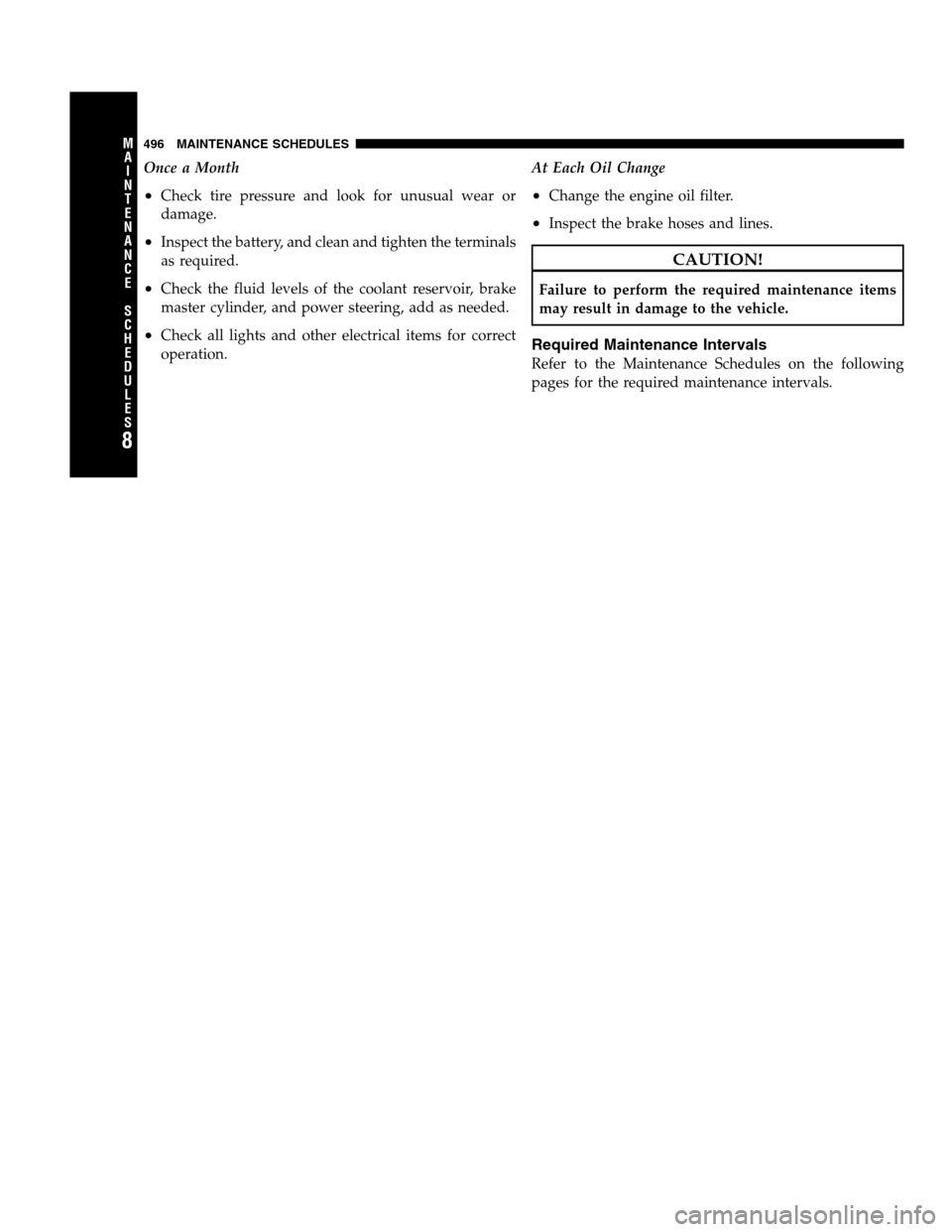
Once a Month
•Check tire pressure and look for unusual wear or
damage.
•Inspect the battery, and clean and tighten the terminals
as required.
•Check the fluid levels of the coolant reservoir, brake
master cylinder, and power steering, add as needed.
•Check all lights and other electrical items for correct
operation.At Each Oil Change
•Change the engine oil filter.
•Inspect the brake hoses and lines.
CAUTION!
Failure to perform the required maintenance items
may result in damage to the vehicle.
Required Maintenance Intervals
Refer to the Maintenance Schedules on the following
pages for the required maintenance intervals.
8
M
A
I
N
T
E
N
A
N
C
E
S
C
H
E
D
U
L
E
S496 MAINTENANCE SCHEDULES
PAGE POSITION:496JOB:@zeta.tweddle.com/chry_pdm/CLS_chrysler/GRP_owners/JOB_918945-en-dsr-12D482-126-AA_DSR/DIV_og pubnum: 12D482-126-AB_DSR Once a Month
•Check tire pressure and look for unusual wear or
damage.
•Inspect the battery, and clean and tighten the terminals
as required.
•Check the fluid levels of the coolant reservoir, brake
master cylinder, and power steering, add as needed.
•Check all lights and other electrical items for correct
operation.At Each Oil Change
•Change the engine oil filter.
•Inspect the brake hoses and lines.
CAUTION!
Failure to perform the required maintenance items
may result in damage to the vehicle.
Required Maintenance Intervals
Refer to the Maintenance Schedules on the following
pages for the required maintenance intervals.
8
M
A
I
N
T
E
N
A
N
C
E
S
C
H
E
D
U
L
E
S496 MAINTENANCE SCHEDULES
PAGE POSITION:496JOB:@zeta.tweddle.com/chry_pdm/CLS_chrysler/GRP_owners/JOB_918945-en-dsr-12D482-126-AA_DSR/DIV_og pubnum: 12D482-126-AB_DSR
Page 526 of 546
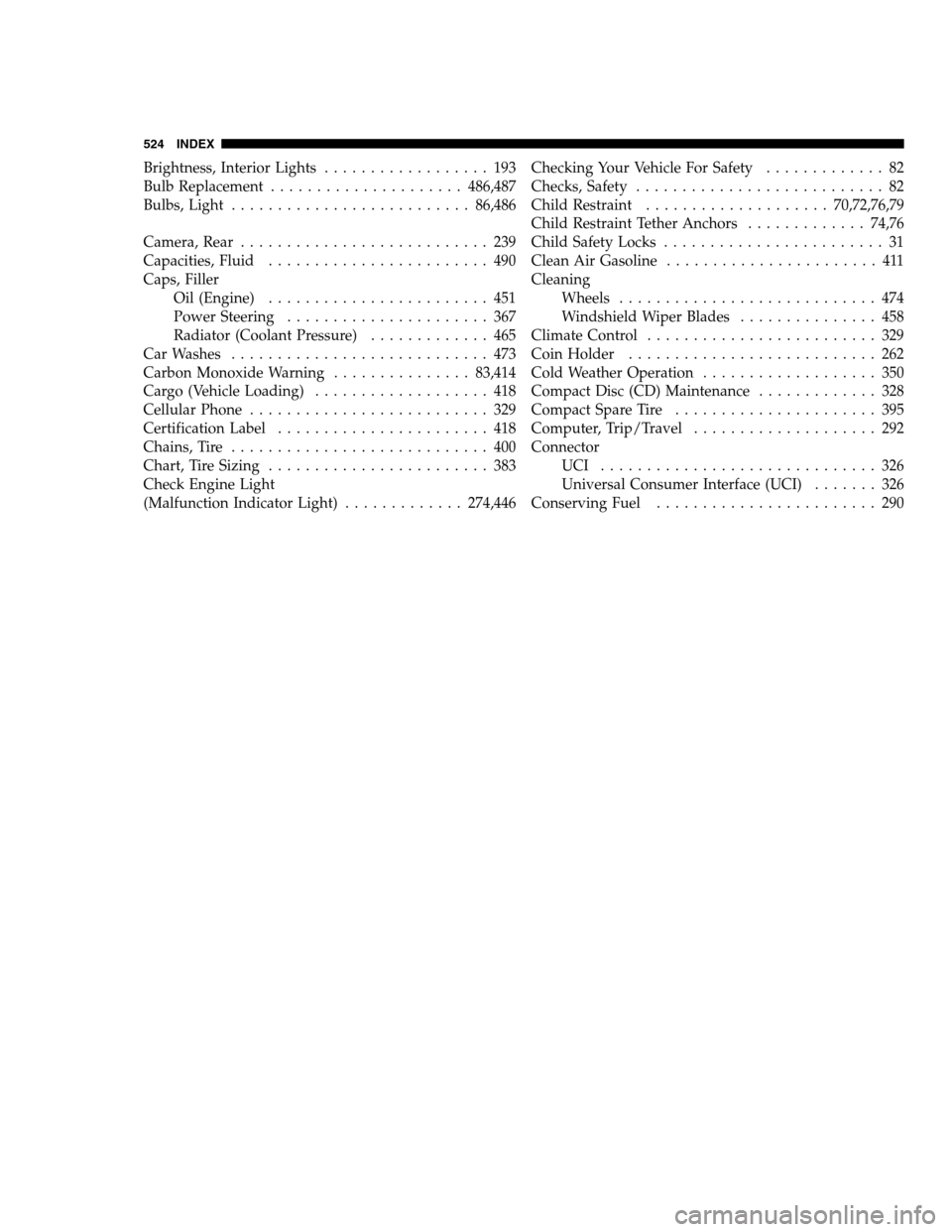
Brightness, Interior Lights.................. 193
Bulb Replacement.....................486,487
Bulbs, Light..........................86,486
Camera, Rear........................... 239
Capacities, Fluid........................ 490
Caps, Filler
Oil (Engine)........................ 451
Power Steering...................... 367
Radiator (Coolant Pressure)............. 465
Car Washes............................ 473
Carbon Monoxide Warning...............83,414
Cargo (Vehicle Loading)................... 418
Cellular Phone.......................... 329
Certification Label....................... 418
Chains, Tire............................ 400
Chart, Tire Sizing........................ 383
Check Engine Light
(Malfunction Indicator Light).............274,446Checking Your Vehicle For Safety............. 82
Checks, Safety........................... 82
Child Restraint....................70,72,76,79
Child Restraint Tether Anchors.............74,76
Child Safety Locks........................ 31
Clean Air Gasoline....................... 411
Cleaning
Wheels............................ 474
Windshield Wiper Blades............... 458
Climate Control......................... 329
Coin Holder........................... 262
Cold Weather Operation................... 350
Compact Disc (CD) Maintenance............. 328
Compact Spare Tire...................... 395
Computer, Trip/Travel.................... 292
Connector
UCI .............................. 326
Universal Consumer Interface (UCI)....... 326
Conserving Fuel........................ 290
524 INDEX
PAGE POSITION:524JOB:@zeta.tweddle.com/chry_pdm/CLS_chrysler/GRP_owners/JOB_918945-en-dsr-12D482-126-AA_DSR/DIV_og pubnum: 12D482-126-AB_DSR Brightness, Interior Lights.................. 193
Bulb Replacement.....................486,487
Bulbs, Light..........................86,486
Camera, Rear........................... 239
Capacities, Fluid........................ 490
Caps, Filler
Oil (Engine)........................ 451
Power Steering...................... 367
Radiator (Coolant Pressure)............. 465
Car Washes............................ 473
Carbon Monoxide Warning...............83,414
Cargo (Vehicle Loading)................... 418
Cellular Phone.......................... 329
Certification Label....................... 418
Chains, Tire............................ 400
Chart, Tire Sizing........................ 383
Check Engine Light
(Malfunction Indicator Light).............274,446Checking Your Vehicle For Safety............. 82
Checks, Safety........................... 82
Child Restraint....................70,72,76,79
Child Restraint Tether Anchors.............74,76
Child Safety Locks........................ 31
Clean Air Gasoline....................... 411
Cleaning
Wheels............................ 474
Windshield Wiper Blades............... 458
Climate Control......................... 329
Coin Holder........................... 262
Cold Weather Operation................... 350
Compact Disc (CD) Maintenance............. 328
Compact Spare Tire...................... 395
Computer, Trip/Travel.................... 292
Connector
UCI .............................. 326
Universal Consumer Interface (UCI)....... 326
Conserving Fuel........................ 290
524 INDEX
PAGE POSITION:524JOB:@zeta.tweddle.com/chry_pdm/CLS_chrysler/GRP_owners/JOB_918945-en-dsr-12D482-126-AA_DSR/DIV_og pubnum: 12D482-126-AB_DSR
Page 528 of 546
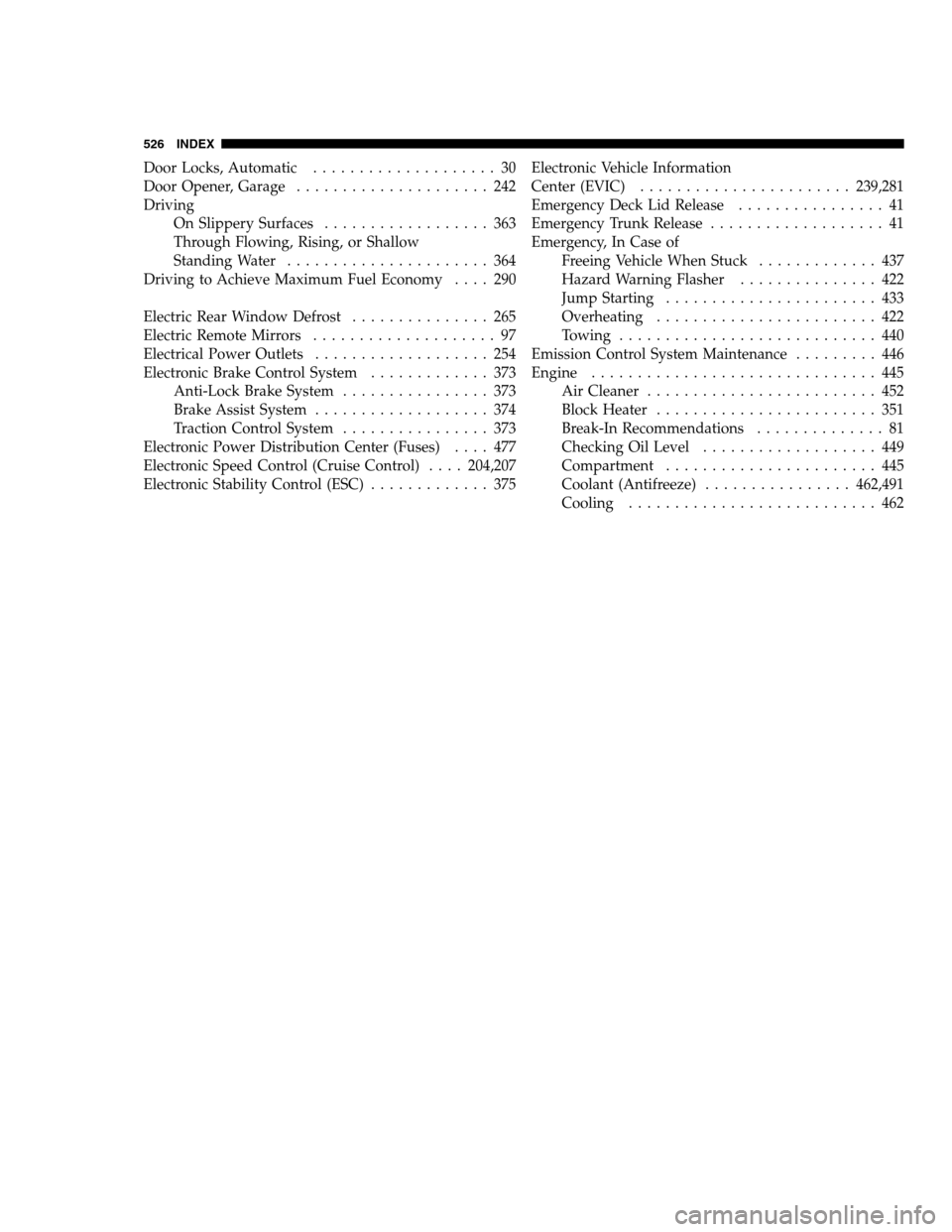
Door Locks, Automatic.................... 30
Door Opener, Garage..................... 242
Driving
On Slippery Surfaces.................. 363
Through Flowing, Rising, or Shallow
Standing Water...................... 364
Driving to Achieve Maximum Fuel Economy.... 290
Electric Rear Window Defrost............... 265
Electric Remote Mirrors.................... 97
Electrical Power Outlets................... 254
Electronic Brake Control System............. 373
Anti-Lock Brake System................ 373
Brake Assist System................... 374
Traction Control System................ 373
Electronic Power Distribution Center (Fuses).... 477
Electronic Speed Control (Cruise Control)....204,207
Electronic Stability Control (ESC)............. 375Electronic Vehicle Information
Center (EVIC).......................239,281
Emergency Deck Lid Release................ 41
Emergency Trunk Release................... 41
Emergency, In Case of
Freeing Vehicle When Stuck............. 437
Hazard Warning Flasher............... 422
Jump Starting....................... 433
Overheating........................ 422
Towing............................ 440
Emission Control System Maintenance......... 446
Engine............................... 445
Air Cleaner......................... 452
Block Heater........................ 351
Break-In Recommendations.............. 81
Checking Oil Level................... 449
Compartment....................... 445
Coolant (Antifreeze)................462,491
Cooling........................... 462
526 INDEX
PAGE POSITION:526JOB:@zeta.tweddle.com/chry_pdm/CLS_chrysler/GRP_owners/JOB_918945-en-dsr-12D482-126-AA_DSR/DIV_og pubnum: 12D482-126-AB_DSR Door Locks, Automatic.................... 30
Door Opener, Garage..................... 242
Driving
On Slippery Surfaces.................. 363
Through Flowing, Rising, or Shallow
Standing Water...................... 364
Driving to Achieve Maximum Fuel Economy.... 290
Electric Rear Window Defrost............... 265
Electric Remote Mirrors.................... 97
Electrical Power Outlets................... 254
Electronic Brake Control System............. 373
Anti-Lock Brake System................ 373
Brake Assist System................... 374
Traction Control System................ 373
Electronic Power Distribution Center (Fuses).... 477
Electronic Speed Control (Cruise Control)....204,207
Electronic Stability Control (ESC)............. 375Electronic Vehicle Information
Center (EVIC).......................239,281
Emergency Deck Lid Release................ 41
Emergency Trunk Release................... 41
Emergency, In Case of
Freeing Vehicle When Stuck............. 437
Hazard Warning Flasher............... 422
Jump Starting....................... 433
Overheating........................ 422
Towing............................ 440
Emission Control System Maintenance......... 446
Engine............................... 445
Air Cleaner......................... 452
Block Heater........................ 351
Break-In Recommendations.............. 81
Checking Oil Level................... 449
Compartment....................... 445
Coolant (Antifreeze)................462,491
Cooling........................... 462
526 INDEX
PAGE POSITION:526JOB:@zeta.tweddle.com/chry_pdm/CLS_chrysler/GRP_owners/JOB_918945-en-dsr-12D482-126-AA_DSR/DIV_og pubnum: 12D482-126-AB_DSR
Page 530 of 546
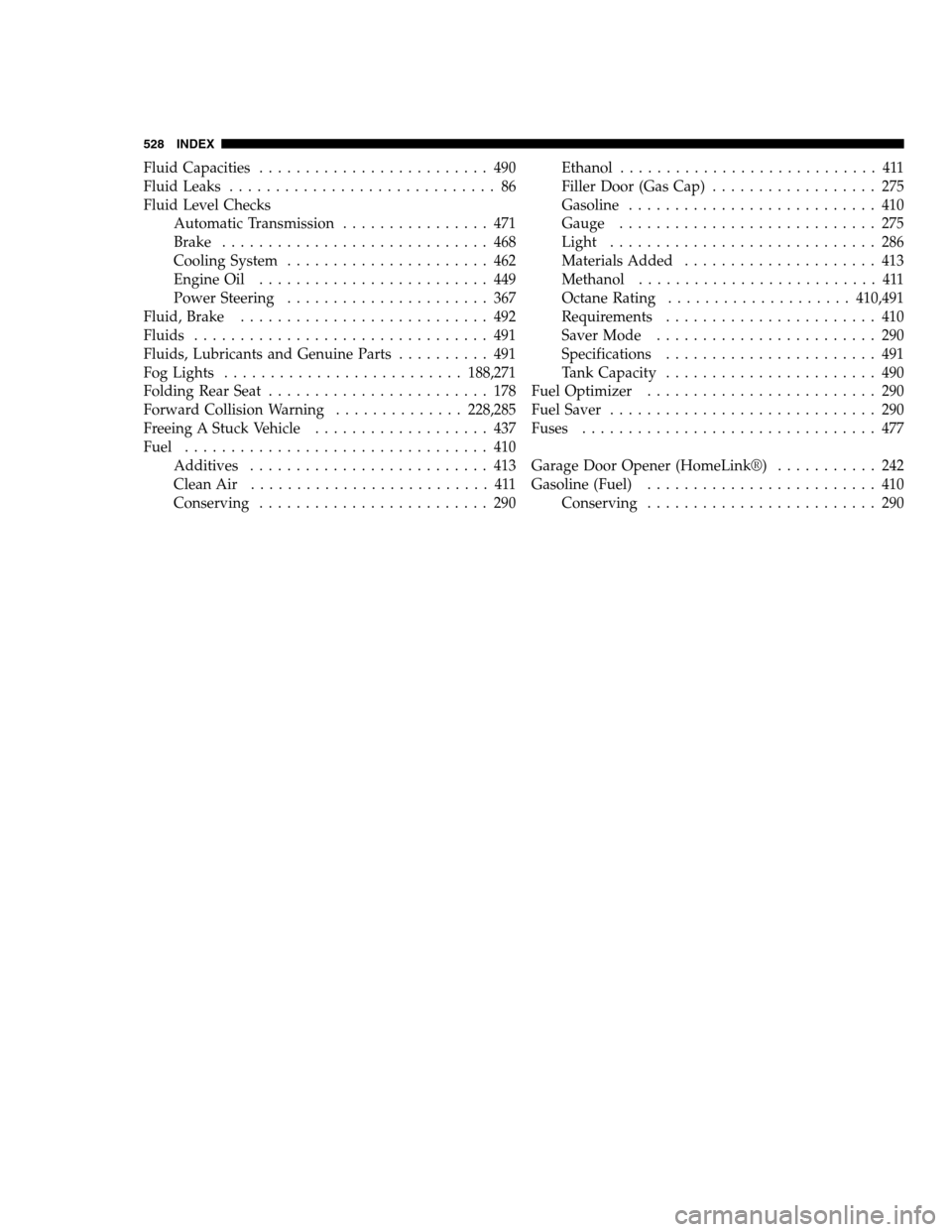
Fluid Capacities......................... 490
Fluid Leaks............................. 86
Fluid Level Checks
Automatic Transmission................ 471
Brake............................. 468
Cooling System...................... 462
Engine Oil......................... 449
Power Steering...................... 367
Fluid, Brake........................... 492
Fluids................................ 491
Fluids, Lubricants and Genuine Parts.......... 491
Fog Lights..........................188,271
Folding Rear Seat........................ 178
Forward Collision Warning..............228,285
Freeing A Stuck Vehicle................... 437
Fuel................................. 410
Additives.......................... 413
Clean Air.......................... 411
Conserving......................... 290Ethanol............................ 411
Filler Door (Gas Cap).................. 275
Gasoline........................... 410
Gauge............................ 275
Light............................. 286
Materials Added..................... 413
Methanol.......................... 411
Octane Rating....................410,491
Requirements....................... 410
Saver Mode........................ 290
Specifications....................... 491
Tank Capacity....................... 490
Fuel Optimizer......................... 290
Fuel Saver............................. 290
Fuses................................ 477
Garage Door Opener (HomeLink®)........... 242
Gasoline (Fuel)......................... 410
Conserving......................... 290
528 INDEX
PAGE POSITION:528JOB:@zeta.tweddle.com/chry_pdm/CLS_chrysler/GRP_owners/JOB_918945-en-dsr-12D482-126-AA_DSR/DIV_og pubnum: 12D482-126-AB_DSR Fluid Capacities......................... 490
Fluid Leaks............................. 86
Fluid Level Checks
Automatic Transmission................ 471
Brake............................. 468
Cooling System...................... 462
Engine Oil......................... 449
Power Steering...................... 367
Fluid, Brake........................... 492
Fluids................................ 491
Fluids, Lubricants and Genuine Parts.......... 491
Fog Lights..........................188,271
Folding Rear Seat........................ 178
Forward Collision Warning..............228,285
Freeing A Stuck Vehicle................... 437
Fuel................................. 410
Additives.......................... 413
Clean Air.......................... 411
Conserving......................... 290Ethanol............................ 411
Filler Door (Gas Cap).................. 275
Gasoline........................... 410
Gauge............................ 275
Light............................. 286
Materials Added..................... 413
Methanol.......................... 411
Octane Rating....................410,491
Requirements....................... 410
Saver Mode........................ 290
Specifications....................... 491
Tank Capacity....................... 490
Fuel Optimizer......................... 290
Fuel Saver............................. 290
Fuses................................ 477
Garage Door Opener (HomeLink®)........... 242
Gasoline (Fuel)......................... 410
Conserving......................... 290
528 INDEX
PAGE POSITION:528JOB:@zeta.tweddle.com/chry_pdm/CLS_chrysler/GRP_owners/JOB_918945-en-dsr-12D482-126-AA_DSR/DIV_og pubnum: 12D482-126-AB_DSR