Page 486 of 594
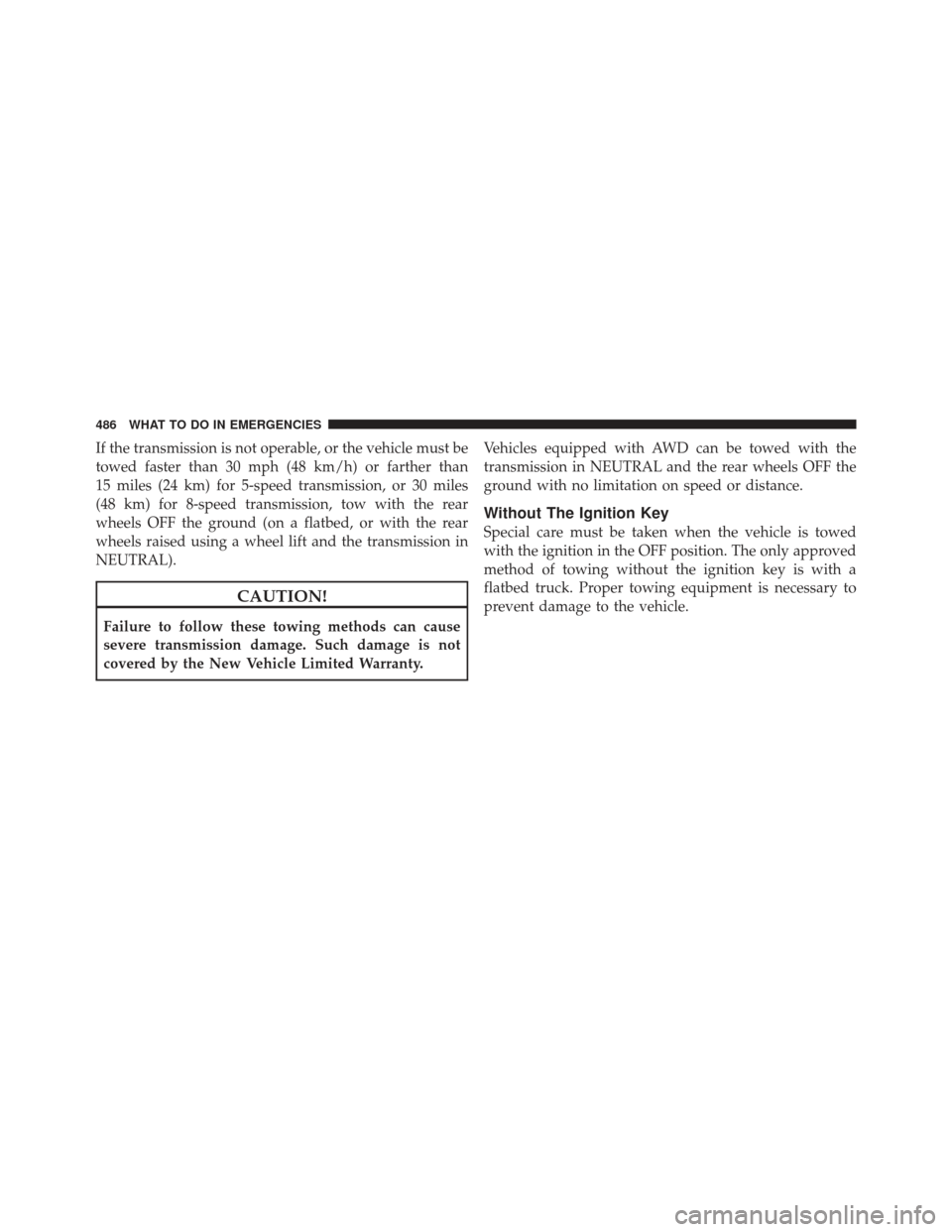
TOWING A DISABLED VEHICLE
Towing ConditionWheels OFF the
Ground RWD MODELS AWD MODELS
Flat Tow NONEIF Transmission is operable:
•
Transmission in NEUTRAL
• 30 mph (48 km/h)max speed
• 15 mi (24 km) maxdistance
(5-speed trans)
• 30 mi (48 km) max distance
(8-speed trans) NOT ALLOWED
Wheel Lift Front
NOT ALLOWED
Rear OKTrans inNEUTRAL
Flatbed ALLBEST METHOD BEST METHOD
Proper towing or lifting equipment is required to prevent
damage to your vehicle. Use only tow bars and other
equipment designed for the purpose, following equip-
ment manufacturer ’s instructions. Use of safety chains is
mandatory. Attach a tow bar or other towing device to main structural members of the vehicle, not to bumpers
or associated brackets. State and local laws applying to
vehicles under tow must be observed.
If you must use the accessories (wipers, defrosters, etc.)
while being towed, the ignition must be in the ON/RUN
position, not the ACC position.
484 WHAT TO DO IN EMERGENCIES
Page 487 of 594
If the vehicle’s battery is discharged, see “Shift Lever
Override” in “What To Do In Emergencies” for instruc-
tions on shifting the automatic transmission out of the
PARK position for towing.
CAUTION!
•Do not use sling type equipment when towing.
Damage to the fascia will occur.
•When securing the vehicle to a flatbed truck, do
not attach to the front or rear suspension compo-
nents. Damage to your vehicle may result from
improper towing.
•Do not push or tow this vehicle with another
vehicle as damage to the bumper fascia and trans-
mission may result.
•The manufacturer does not recommend that you
tow this vehicle on a tow dolly. Vehicle damage
may occur.Flatbed towing is recommended.
DO NOTtow an AWD
vehicle with the rear wheels on the ground.
If the transmission is operable, vehicles WITHOUT AWD
may be towed (with rear wheels on the ground) under
the following conditions:
•The shift lever must be in NEUTRAL.
•The vehicle towing speed must not exceed 30 mph
(48 km/h).
•The towing distance must not exceed 15 miles (24 km)
for 5-speed transmission, or 30 miles (48 km) for
8-speed transmission.
6
WHAT TO DO IN EMERGENCIES 485
Page 488 of 594
If the transmission is not operable, or the vehicle must be
towed faster than 30 mph (48 km/h) or farther than
15 miles (24 km) for 5-speed transmission, or 30 miles
(48 km) for 8-speed transmission, tow with the rear
wheels OFF the ground (on a flatbed, or with the rear
wheels raised using a wheel lift and the transmission in
NEUTRAL).
CAUTION!
Failure to follow these towing methods can cause
severe transmission damage. Such damage is not
covered by the New Vehicle Limited Warranty.Vehicles equipped with AWD can be towed with the
transmission in NEUTRAL and the rear wheels OFF the
ground with no limitation on speed or distance.
Without The Ignition Key
Special care must be taken when the vehicle is towed
with the ignition in the OFF position. The only approved
method of towing without the ignition key is with a
flatbed truck. Proper towing equipment is necessary to
prevent damage to the vehicle.
486 WHAT TO DO IN EMERGENCIES
Page 490 of 594
▫Cooling System ..................... 508
▫ Brake System ....................... 514
▫ Automatic Transmission ............... 516
▫ All Wheel Drive (AWD) – If Equipped ..... 518
▫ Rear Axle .......................... 518
▫ Appearance Care And Protection From
Corrosion .......................... 519
� Fuses .............................. 524
▫ Integrated Power Module .............. 524
▫ Rear Power Distribution Center .......... 528
� Vehicle Storage ....................... 533
� Replacement Bulbs .................... 533 �
Bulb Replacement ..................... 534
▫ Front Low Beam Headlamp, High Beam
Headlamp, Park/Turn Lamp, And Side
Marker Lamp — Models With Halogen
Headlamps ......................... 534
▫ Front Low Beam Headlamp And Park/Turn
Lamp — Models With High Intensity
Discharge Headlamps (HID) ............ 535
▫ Backup Lamps ...................... 536
▫ License Lamp ....................... 537
� Fluid Capacities ...................... 538
� Fluids, Lubricants, And Genuine Parts ....... 539
▫ Engine ............................ 539
▫ Chassis ........................... 540
488 MAINTAINING YOUR VEHICLE
Page 493 of 594

ONBOARD DIAGNOSTIC SYSTEM — OBD II
Your vehicle is equipped with a sophisticated onboard
diagnostic system called OBD II. This system monitors
the performance of the emissions, engine, and automatic
transmission control systems. When these systems are
operating properly, your vehicle will provide excellent
performance and fuel economy, as well as engine emis-
sions well within current government regulations.
If any of these systems require service, the OBD II system
will turn on the “Malfunction Indicator Light (MIL).” It
will also store diagnostic codes and other information to
assist your service technician in making repairs. Al-
though your vehicle will usually be drivable and not
need towing, see your authorized dealer for service as
soon as possible.CAUTION!
•Prolonged driving with the MIL on could cause
further damage to the emissions control system. It
could also affect fuel economy and driveability.
The vehicle must be serviced before any emissions
tests can be performed.
•If the MIL is flashing while the engine is running,
severe catalytic converter damage and power loss
will soon occur. Immediate service is required.
EMISSIONS INSPECTION AND MAINTENANCE
PROGRAMS
In some localities, it may be a legal requirement to pass
an inspection of your vehicle’s emissions control system.
Failure to pass could prevent vehicle registration.7
MAINTAINING YOUR VEHICLE 491
Page 496 of 594
WARNING!
You can be badly injured working on or around a
motor vehicle. Only do service work for which you
have the knowledge and the proper equipment. If
you have any doubt about your ability to perform a
service job, take your vehicle to a competent me-
chanic.
MAINTENANCE PROCEDURES
The pages that follow contain therequiredmaintenance
services determined by the engineers who designed your
vehicle.
Besides those maintenance items specified in the fixed
maintenance schedule, there are other components which
may require servicing or replacement in the future.
CAUTION!
•Failure to properly maintain your vehicle or per-
form repairs and service when necessary could
result in more costly repairs, damage to other
components or negatively impact vehicle perfor-
mance. Immediately have potential malfunctions
examined by an authorized Chrysler Group LLC
dealership or qualified repair center.
•Your vehicle has been built with improved fluids
that protect the performance and durability of
your vehicle and also allow extended maintenance
intervals. Do not use chemical flushes in these
components as the chemicals can damage your
engine, transmission, power steering or air condi-
tioning. Such damage is not covered by the New
Vehicle Limited Warranty. If a flush is needed
because of component malfunction, use only the
specified fluid for the flushing procedure.
494 MAINTAINING YOUR VEHICLE
Page 510 of 594
To minimize the possibility of catalytic converter dam-
age:
•Do not shut off the engine or interrupt the ignition,
when the transmission is in gear and the vehicle is in
motion.
•Do not try to start the engine by pushing or towing the
vehicle.
•Do not idle the engine with any spark plug wires
disconnected or removed, such as when diagnostic
testing, or for prolonged periods during very rough
idle or malfunctioning operating conditions.
Cooling System
WARNING!
•When working near the radiator cooling fan, dis-
connect the fan motor lead or turn the ignition
switch to the LOCK position. The fan is tempera-
ture controlled and can start at any time the
ignition switch is in the ON position.
•You or others can be badly burned by hot engine
coolant (antifreeze) or steam from your radiator. If
you see or hear steam coming from under the
hood, do not open the hood until the radiator has
had time to cool. Never try to open a cooling
system pressure cap when the radiator is hot.
508 MAINTAINING YOUR VEHICLE
Page 518 of 594
WARNING! (Continued)
•Do not allow petroleum based fluid to contami-
nate the brake fluid. Brake seal components could
be damaged, causing partial or complete brake
failure. This could result in a collision.
Use only brake fluid that has been in a tightly closed
container to avoid contamination from foreign matter or
moisture.
Automatic Transmission
Selection Of Lubricant
It is important that the proper lubricant is used in the
transmission to assure optimum transmission perfor-
mance. Use only manufacturer ’s recommended transmis-
sion fluid. Refer to “Fluids, Lubricants, and Genuine
Parts” in “Maintaining Your Vehicle” for further informa-
tion. It is important that the transmission fluid be main-
tained at the prescribed level using the recommended fluid. No chemical flushes should be used in any trans-
mission; only the approved lubricant may be used.
Special Additives
Automatic Transmission Fluid (ATF) is an engineered
product and its performance may be impaired by supple-
mental additives. Therefore, do not add any fluid addi-
tives to the transmission. The only exception to this
policy is the use of special dyes to aid in detecting fluid
leaks. In addition, avoid using transmission sealers as
they may adversely affect seals.
CAUTION!
Do not use chemical flushes in your transmission as
the chemicals can damage your transmission compo-
nents. Such damage is not covered by the New
Vehicle Limited Warranty.
516 MAINTAINING YOUR VEHICLE