Page 73 of 594
WARNING!
In a collision, an unrestrained child, even a tiny baby,
can become a projectile inside the vehicle. The force
required to hold even an infant on your lap could
become so great that you could not hold the child, no
matter how strong you are. The child and others
could be badly injured. Any child riding in your
vehicle should be in a proper restraint for the child’s
size.
There are different sizes and types of restraints for
children from newborn size to the child almost large
enough for an adult safety belt. Always check the child
seat Owner’s Manual to ensure you have the correct seat
for your child. Use the restraint that is correct for your
child.
Infants And Child Restraints
Safety experts recommend that children ride rearward-
facing in the vehicle until they are two years old or until
they reach either the height or weight limit of their rear
facing child safety seat. Two types of child restraints can
be used rearward-facing: infant carriers and convertible
child seats.
The infant carrier is only used rearward-facing in the
vehicle. It is recommended for children from birth until
they reach the weight or height limit of the infant carrier.
Convertible child seats can be used either rearward-
facing or forward-facing in the vehicle. Convertible child
seats often have a higher weight limit in the rearward-
facing direction than infant carriers do, so they can be
used rearward-facing by children who have outgrown
their infant carrier but are still less than at least two years
old. Children should remain rearward-facing until they
reach the highest weight or height allowed by their
convertible child seat. Both types of child restraints are
2
THINGS TO KNOW BEFORE STARTING YOUR VEHICLE 71
Page 74 of 594
held in the vehicle by the lap/shoulder belt or the
LATCH child restraint anchor system. Refer to “Lower
Anchors and Tether for CHildren (LATCH)”.
WARNING!
Rearward-facing child seats must never be used in
the front seat of a vehicle with the front passenger air
bag unless the air bag is turned off. An air bag
deployment could cause severe injury or death to
infants in this position.
Older Children And Child Restraints
Children who are two years old or who have outgrown
their rear-facing convertible child seat can ride forward-
facing in the vehicle. Forward-facing child seats and
convertible child seats used in the forward-facing direc-
tion are for children who are over two years old or whohave outgrown the rear-facing weight or height limit of
their rear-facing convertible child seat. Children should
remain in a forward-facing child seat with a harness for
as long as possible, up to the highest weight or height
allowed by the child seat. These child seats are also held
in the vehicle by the lap/shoulder belt or the LATCH
child restraint anchorage system. Refer to “Lower An-
chors and Tether for CHildren (LATCH)”.
All children whose weight or height is above the
forward-facing limit for the child seat should use a
belt-positioning booster seat until the vehicle’s seat belts
fit properly. If the child cannot sit with knees bent over
the vehicle’s seat cushion while the child’s back is against
the seatback, they should use a belt-positioning booster
seat. The child and belt-positioning booster seat are held
in the vehicle by the lap/shoulder belt.
72 THINGS TO KNOW BEFORE STARTING YOUR VEHICLE
Page 75 of 594
Children Too Large For Booster Seats
Children who are large enough to wear the shoulder belt
comfortably and whose legs are long enough to bend
over the front of the seat when their back is against the
seatback should use the lap/shoulder belt in a rear seat.
•Make sure that the child is upright in the seat.
•The lap portion should be low on the hips and as snug
as possible.
•Check belt fit periodically. A child’s squirming or
slouching can move the belt out of position.
•If the shoulder belt contacts the face or neck, move the
child closer to the center of the vehicle. Never allow a
child to put the shoulder belt under an arm or behind
their back.NOTE: For additional information, refer to
www.seatcheck.org or call 1–866–SEATCHECK. Cana-
dian residents should refer to Transport Canada’s web-
site for additional information: http://www.tc.gc.ca/
roadsafety/safedrivers/childsafety/index.htm
WARNING!
•Improper installation can lead to failure of an
infant or child restraint. It could come loose in a
collision. The child could be badly injured or
killed. Follow the manufacturer’s directions ex-
actly when installing an infant or child restraint.
•A rearward-facing child restraint should only be
used in a rear seat. A rearward-facing child re-
straint in the front seat may be struck by a deploy-
ing passenger air bag, which may cause severe or
fatal injury to the infant.
2
THINGS TO KNOW BEFORE STARTING YOUR VEHICLE 73
Page 77 of 594
having attachments for those anchorages will continue to
have features for installation using the vehicle’s seat
belts. Child restraints having tether straps and hooks for
connection to the top tether anchorages have been avail-
able for some time. For some older child restraints, many
child restraint manufacturers offer add-on tether strap
kits or retrofit kits. You are urged to take advantage of all
the available attachments provided with your child re-
straint in any vehicle.
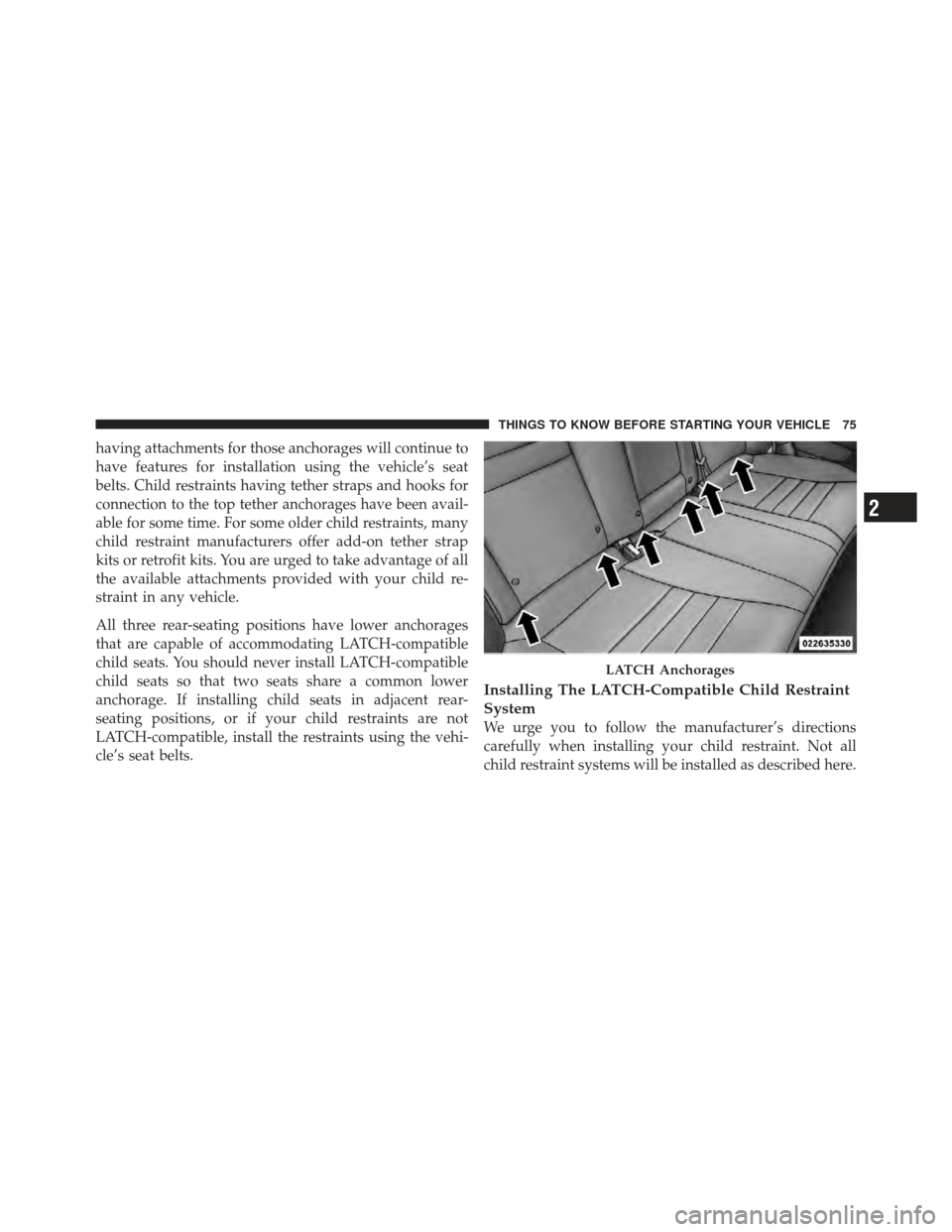
All three rear-seating positions have lower anchorages
that are capable of accommodating LATCH-compatible
child seats. You should never install LATCH-compatible
child seats so that two seats share a common lower
anchorage. If installing child seats in adjacent rear-
seating positions, or if your child restraints are not
LATCH-compatible, install the restraints using the vehi-
cle’s seat belts.
Installing The LATCH-Compatible Child Restraint
System
We urge you to follow the manufacturer’s directions
carefully when installing your child restraint. Not all
child restraint systems will be installed as described here.
LATCH Anchorages
2
THINGS TO KNOW BEFORE STARTING YOUR VEHICLE 75
Page 84 of 594
SAFETY TIPS
Transporting Passengers
NEVER TRANSPORT PASSENGERS IN THE CARGO
AREA.
WARNING!
•Do not leave children or animals inside parked
vehicles in hot weather. Interior heat build-up may
cause serious injury or death.
•It is extremely dangerous to ride in a cargo area,
inside or outside of a vehicle. In a collision, people
riding in these areas are more likely to be seri-
ously injured or killed.
•Do not allow people to ride in any area of your
vehicle that is not equipped with seats and seat
belts.
•Be sure everyone in your vehicle is in a seat and
using a seat belt properly.
Exhaust Gas
WARNING!
Exhaust gases can injure or kill. They contain carbon
monoxide (CO), which is colorless and odorless.
Breathing it can make you unconscious and can
eventually poison you. To avoid breathing (CO),
follow these safety tips:
•Do not run the engine in a closed garage or in
confined areas any longer than needed to move
your vehicle in or out of the area.
•If you are required to drive with the trunk/liftgate
open, make sure that all windows are closed and
the climate control BLOWER switch is set at high
speed. DO NOT use the recirculation mode.(Continued)
82 THINGS TO KNOW BEFORE STARTING YOUR VEHICLE
Page 90 of 594
�Uconnect™ Phone (4.3) ................. 108
▫ Uconnect Touch™ 4.3 ................. 108
▫ Operation ......................... 110
▫ Phone Call Features .................. 117
▫ Uconnect™ Phone Features ............. 121
▫ Advanced Phone Connectivity ........... 125
▫ Things You Should Know About Your
Uconnect™ Phone .................... 126
▫ General Information .................. 129
� Uconnect™ Phone (8.4/8.4N) ............. 130
▫ Uconnect Touch™ 8.4/8.4 NAV .......... 130
▫ Operation ......................... 133
▫ Phone Call Features .................. 143 ▫
Uconnect™ Phone Features ............. 148
▫ Advanced Phone Connectivity ........... 153
▫ Things You Should Know About Your
Uconnect™ Phone .................... 153
▫ General Information .................. 163
� Voice Command ...................... 164
▫ Uconnect Touch™ 8.4/8.4 NAV .......... 164
▫ Uconnect™ Voice Commands ........... 166
▫ Voice Tree ......................... 168
� Seats .............................. 179
▫ Power Seats — If Equipped ............. 179
▫ Power Lumbar — If Equipped ........... 182
▫ Heated Seats — If Equipped ............ 182
88 UNDERSTANDING THE FEATURES OF YOUR VEHICLE
Page 91 of 594
▫Ventilated Seats — If Equipped .......... 185
▫ Manual Seats — If Equipped ............ 187
▫ Head Restraints ..................... 189
▫ Folding Rear Seat .................... 191
� Driver Memory Seat — If Equipped ........ 193
▫ Programming The Memory Feature ....... 194
▫ Linking And Unlinking The Remote Keyless
Entry Transmitter To Memory ........... 195
▫ Memory Position Recall ................ 196
▫ Easy Entry/Exit Seat
(Available With Memory Seat Only) ....... 196
� To Open And Close The Hood ............ 198
� Lights ............................. 199
▫ Headlight Switch .................... 199 ▫
Automatic Headlights — If Equipped ...... 200
▫ Headlights On With Wipers (Available With
Automatic Headlights Only) ............ 200
▫ Smartbeam™ — If Equipped ............ 200
▫ Headlight Time Delay ................. 201
▫ Daytime Running Lights (DRL) — If
Equipped .......................... 202
▫ Lights-On Reminder .................. 202
▫ Fog Lights — If Equipped .............. 203
▫ Multifunction Lever .................. 204
▫ Turn Signals ........................ 204
▫ Lane Change Assist ................... 205
▫ High/Low Beam Switch ............... 205
▫ Flash-To-Pass ....................... 205
3
UNDERSTANDING THE FEATURES OF YOUR VEHICLE 89
Page 181 of 594
NOTE:Available Voice Commands are shown in bold
face and shaded grey.
SEATS
Seats are a part of the Occupant Restraint System of the
vehicle.
WARNING!
•It is dangerous to ride in a cargo area, inside or
outside of a vehicle. In a collision, people riding in
these areas are more likely to be seriously injured
or killed.
(Continued)
WARNING! (Continued)
•Do not allow people to ride in any area of your
vehicle that is not equipped with seats and seat
belts. In a collision, people riding in these areas
are more likely to be seriously injured or killed.
•Be sure everyone in your vehicle is in a seat and
using a seat belt properly.
Power Seats — If Equipped
On models equipped with power seats, the switch is
located on the outboard side of the seat near the floor.
Use this switch to move the driver’s seat up or down,
forward or rearward or to recline the seatback.
3
UNDERSTANDING THE FEATURES OF YOUR VEHICLE 179