Page 310 of 471
5. Determine the combined weight of luggage and cargo
being loaded on the vehicle. That weight may not safely
exceed the available cargo and luggage load capacity
calculated in Step 4.
6. If your vehicle will be towing a trailer, load from your
trailer will be transferred to your vehicle. Consult this
manual to determine how this reduces the available
cargo and luggage load capacity of your vehicle.NOTE:
•The following table shows examples on how to calcu-
late total load, cargo/luggage, and towing capacities
of your vehicle with varying seating configurations
and number and size of occupants. This table is for
illustration purposes only and may not be accurate for
the seating and load carry capacity of your vehicle.
•For the following example, the combined weight of
occupants and cargo should never exceed 865 lbs
(392 kg).
308 STARTING AND OPERATING
Page 339 of 471
Overloading
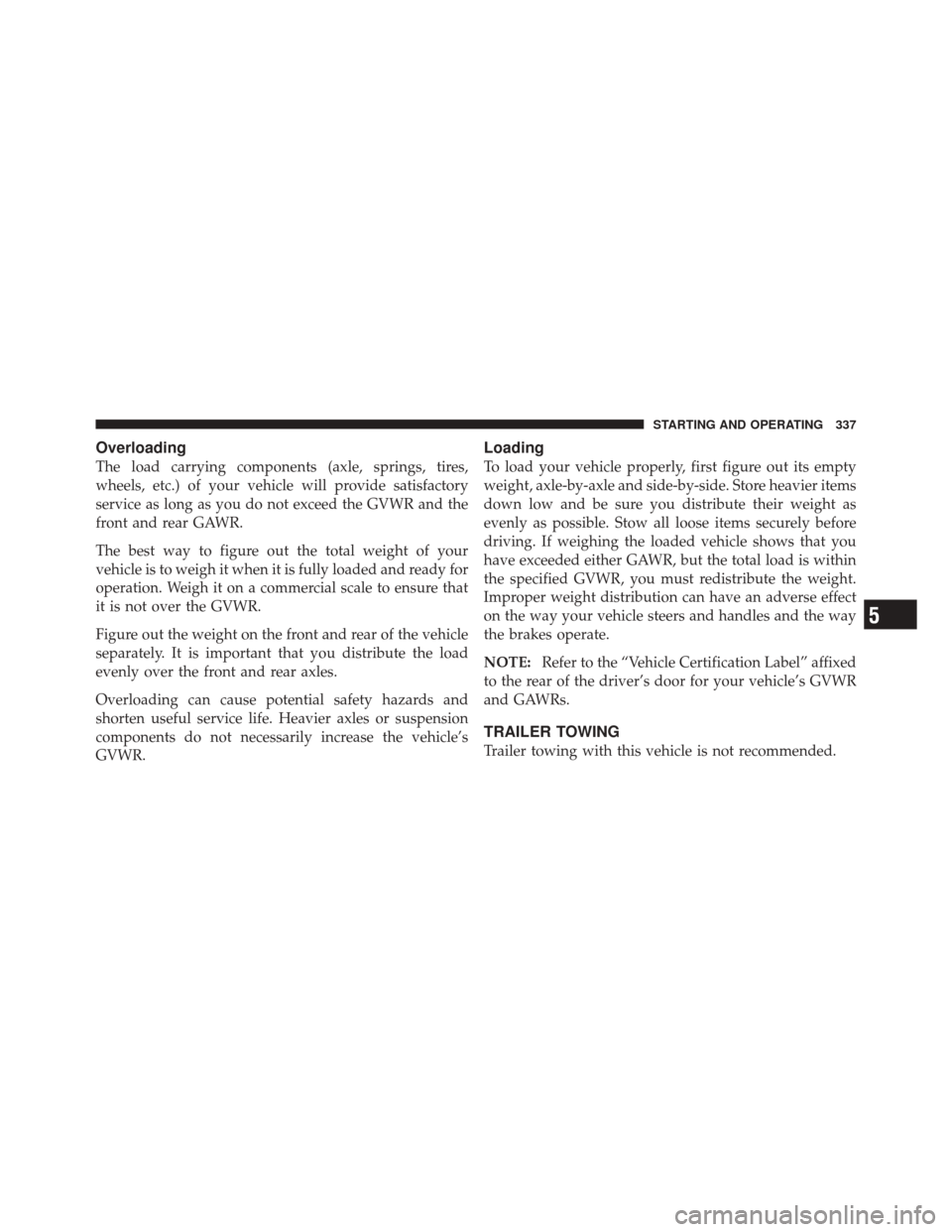
The load carrying components (axle, springs, tires,
wheels, etc.) of your vehicle will provide satisfactory
service as long as you do not exceed the GVWR and the
front and rear GAWR.
The best way to figure out the total weight of your
vehicle is to weigh it when it is fully loaded and ready for
operation. Weigh it on a commercial scale to ensure that
it is not over the GVWR.
Figure out the weight on the front and rear of the vehicle
separately. It is important that you distribute the load
evenly over the front and rear axles.
Overloading can cause potential safety hazards and
shorten useful service life. Heavier axles or suspension
components do not necessarily increase the vehicle’s
GVWR.
Loading
To load your vehicle properly, first figure out its empty
weight, axle-by-axle and side-by-side. Store heavier items
down low and be sure you distribute their weight as
evenly as possible. Stow all loose items securely before
driving. If weighing the loaded vehicle shows that you
have exceeded either GAWR, but the total load is within
the specified GVWR, you must redistribute the weight.
Improper weight distribution can have an adverse effect
on the way your vehicle steers and handles and the way
the brakes operate.
NOTE:Refer to the “Vehicle Certification Label” affixed
to the rear of the driver’s door for your vehicle’s GVWR
and GAWRs.
TRAILER TOWING
Trailer towing with this vehicle is not recommended.
5
STARTING AND OPERATING 337
Page 340 of 471
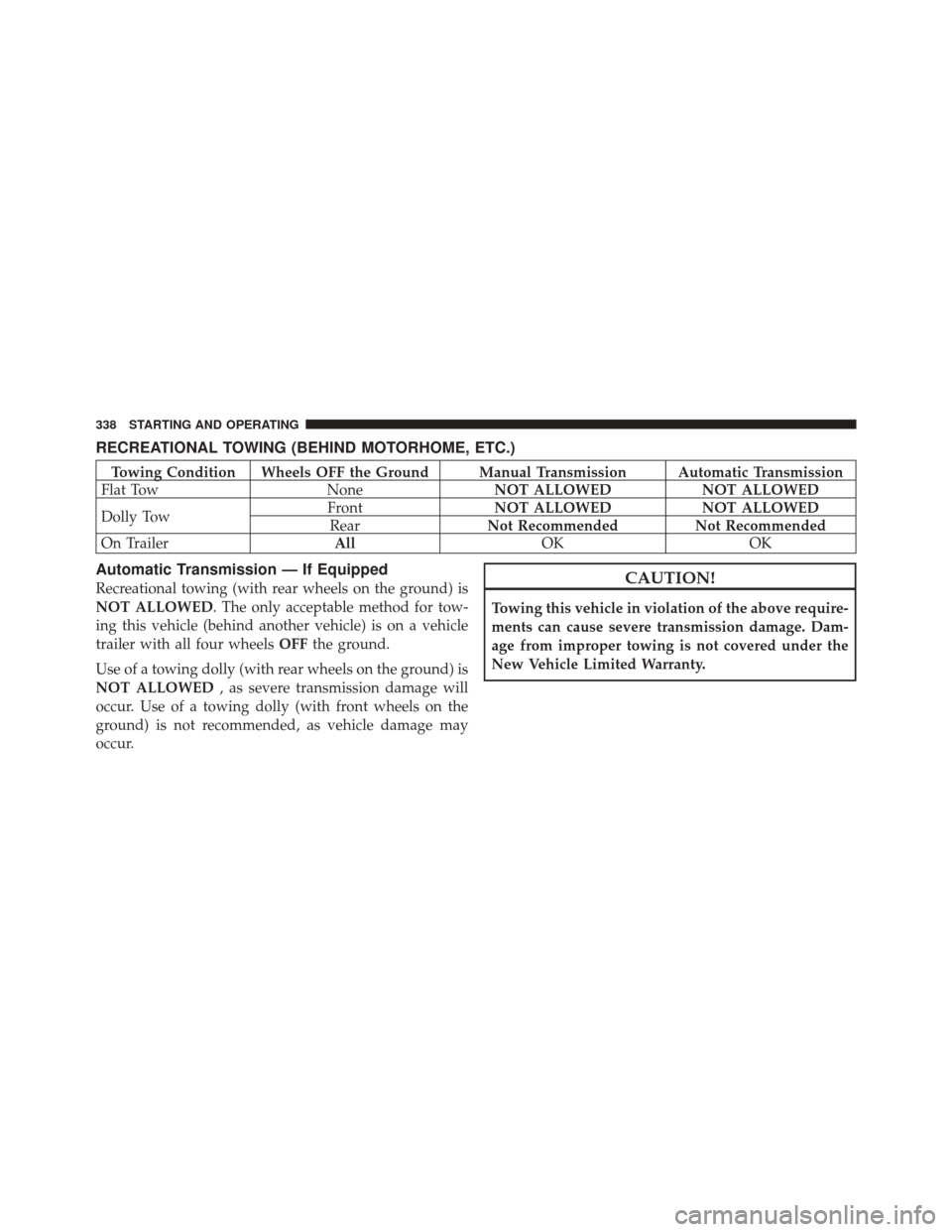
RECREATIONAL TOWING (BEHIND MOTORHOME, ETC.)
Towing Condition Wheels OFF the Ground Manual Transmission Automatic Transmission
Flat Tow NoneNOT ALLOWED NOT ALLOWED
Dolly Tow Front
NOT ALLOWED NOT ALLOWED
Rear Not Recommended Not Recommended
On Trailer AllOK OK
Automatic Transmission — If Equipped
Recreational towing (with rear wheels on the ground) is
NOT ALLOWED. The only acceptable method for tow-
ing this vehicle (behind another vehicle) is on a vehicle
trailer with all four wheelsOFFthe ground.
Use of a towing dolly (with rear wheels on the ground) is
NOT ALLOWED , as severe transmission damage will
occur. Use of a towing dolly (with front wheels on the
ground) is not recommended, as vehicle damage may
occur.CAUTION!
Towing this vehicle in violation of the above require-
ments can cause severe transmission damage. Dam-
age from improper towing is not covered under the
New Vehicle Limited Warranty.
338 STARTING AND OPERATING
Page 341 of 471
Manual Transmission — If Equipped
Recreational towing (with rear wheels on the ground) is
NOT ALLOWED. The only acceptable method for tow-
ing this vehicle (behind another vehicle) is on a vehicle
trailer with all four wheelsOFFthe ground.
Use of a towing dolly (with rear wheels on the ground) is
NOT ALLOWED , as severe transmission damage will
occur. Use of a towing dolly (with front wheels on the
ground) is not recommended, as vehicle damage may
occur.CAUTION!
Towing this vehicle in violation of the above require-
ments can cause severe engine or transmission dam-
age. Damage from improper towing is not covered
under the New Vehicle Limited Warranty.
5
STARTING AND OPERATING 339
Page 343 of 471
WHAT TO DO IN EMERGENCIES
CONTENTS
�Hazard Warning Flashers ................ 342
� If Your Engine Overheats ................ 342
� TIREFIT Kit ......................... 343
▫ TIREFIT Storage ..................... 344
▫ TIREFIT Kit Components And Operation . . . 344
▫ TIREFIT Usage Precautions ............. 346
▫ Sealing A Tire With TIREFIT ............ 348
� Jump-Starting Procedures ................ 353
▫ Preparations For Jump-Start ............. 354▫
Jump-Starting Procedure ............... 355
� Freeing A Stuck Vehicle ................. 357
� Shift Lever Override ................... 359
� Towing A Disabled Vehicle ............... 360
▫ Automatic Transmission ............... 361
▫ Manual Transmission ................. 362
▫ Without The Key Fob ................. 362
6
Page 362 of 471
TOWING A DISABLED VEHICLE
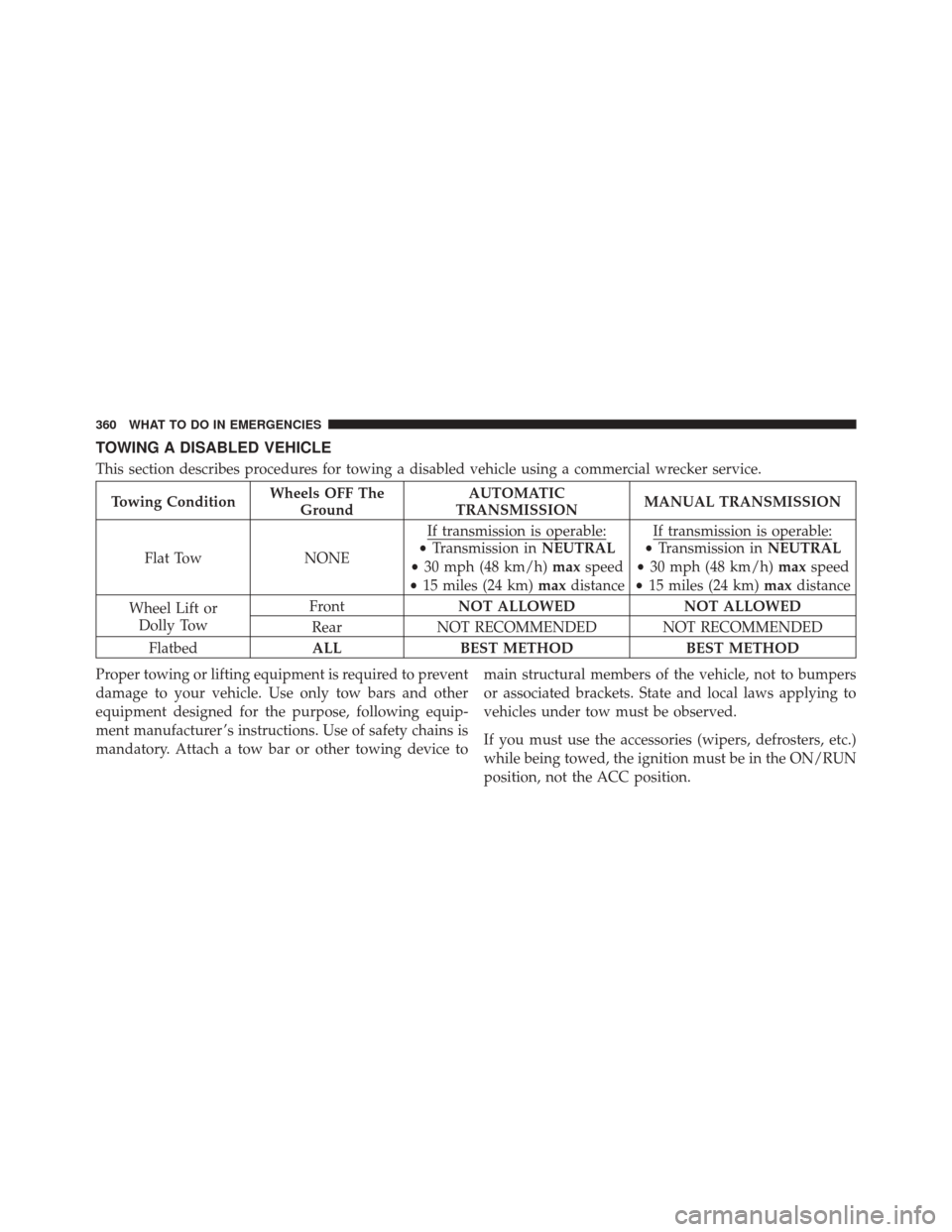
This section describes procedures for towing a disabled vehicle using a commercial wrecker service.
Towing ConditionWheels OFF The
Ground AUTOMATIC
TRANSMISSION MANUAL TRANSMISSION
Flat Tow NONE If transmission is operable:
•
Transmission in NEUTRAL
• 30 mph (48 km/h) maxspeed
• 15 miles (24 km) maxdistance If transmission is operable:•
Transmission in NEUTRAL
• 30 mph (48 km/h) maxspeed
• 15 miles (24 km) maxdistance
Wheel Lift or Dolly Tow Front
NOT ALLOWED NOT ALLOWED
Rear NOT RECOMMENDED NOT RECOMMENDED
Flatbed ALLBEST METHOD BEST METHOD
Proper towing or lifting equipment is required to prevent
damage to your vehicle. Use only tow bars and other
equipment designed for the purpose, following equip-
ment manufacturer ’s instructions. Use of safety chains is
mandatory. Attach a tow bar or other towing device to main structural members of the vehicle, not to bumpers
or associated brackets. State and local laws applying to
vehicles under tow must be observed.
If you must use the accessories (wipers, defrosters, etc.)
while being towed, the ignition must be in the ON/RUN
position, not the ACC position.
360 WHAT TO DO IN EMERGENCIES
Page 363 of 471
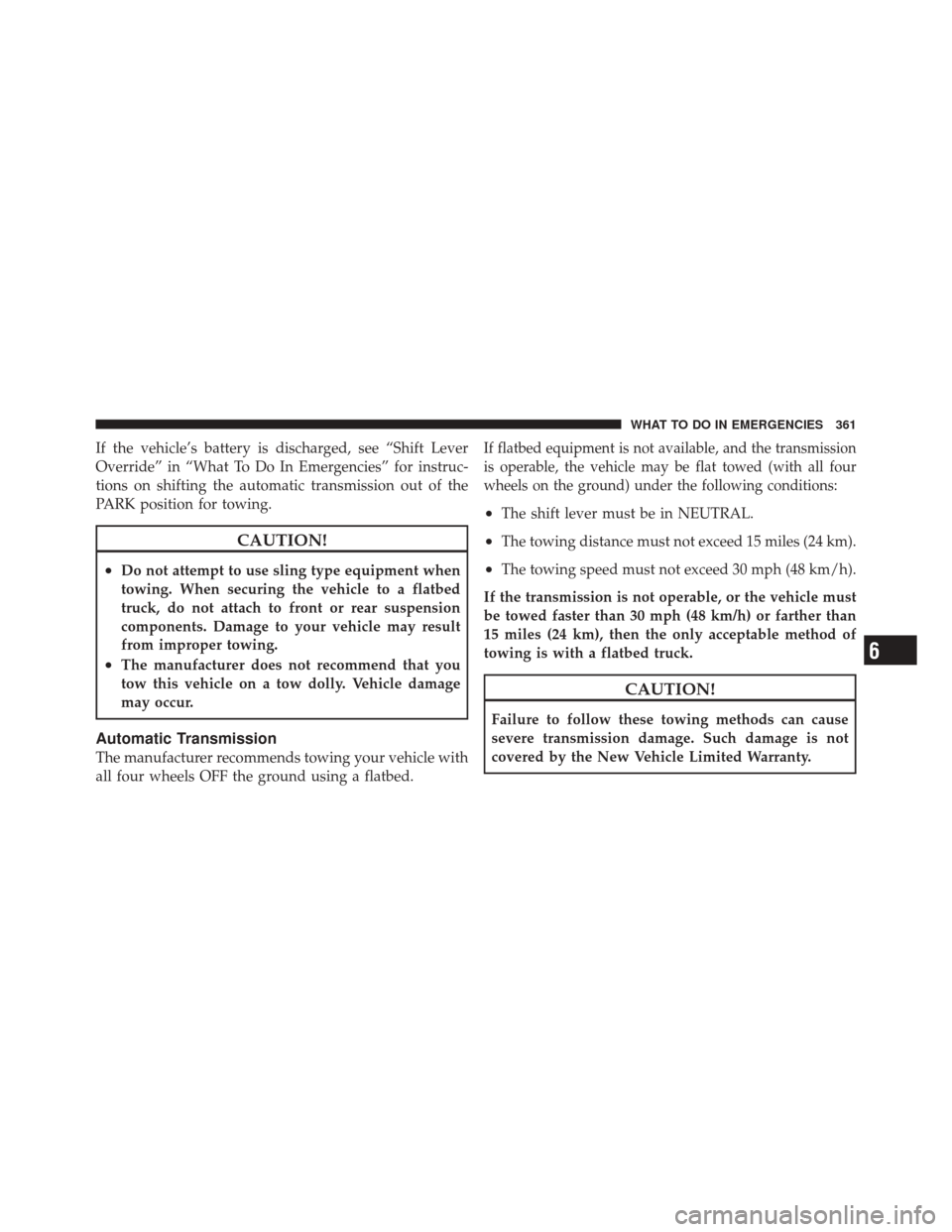
If the vehicle’s battery is discharged, see “Shift Lever
Override” in “What To Do In Emergencies” for instruc-
tions on shifting the automatic transmission out of the
PARK position for towing.
CAUTION!
•Do not attempt to use sling type equipment when
towing. When securing the vehicle to a flatbed
truck, do not attach to front or rear suspension
components. Damage to your vehicle may result
from improper towing.
•The manufacturer does not recommend that you
tow this vehicle on a tow dolly. Vehicle damage
may occur.
Automatic Transmission
The manufacturer recommends towing your vehicle with
all four wheels OFF the ground using a flatbed.
If flatbed equipment is not available, and the transmission
is operable, the vehicle may be flat towed (with all four
wheels on the ground) under the following conditions:
•The shift lever must be in NEUTRAL.
•The towing distance must not exceed 15 miles (24 km).
•The towing speed must not exceed 30 mph (48 km/h).
If the transmission is not operable, or the vehicle must
be towed faster than 30 mph (48 km/h) or farther than
15 miles (24 km), then the only acceptable method of
towing is with a flatbed truck.
CAUTION!
Failure to follow these towing methods can cause
severe transmission damage. Such damage is not
covered by the New Vehicle Limited Warranty.
6
WHAT TO DO IN EMERGENCIES 361
Page 364 of 471
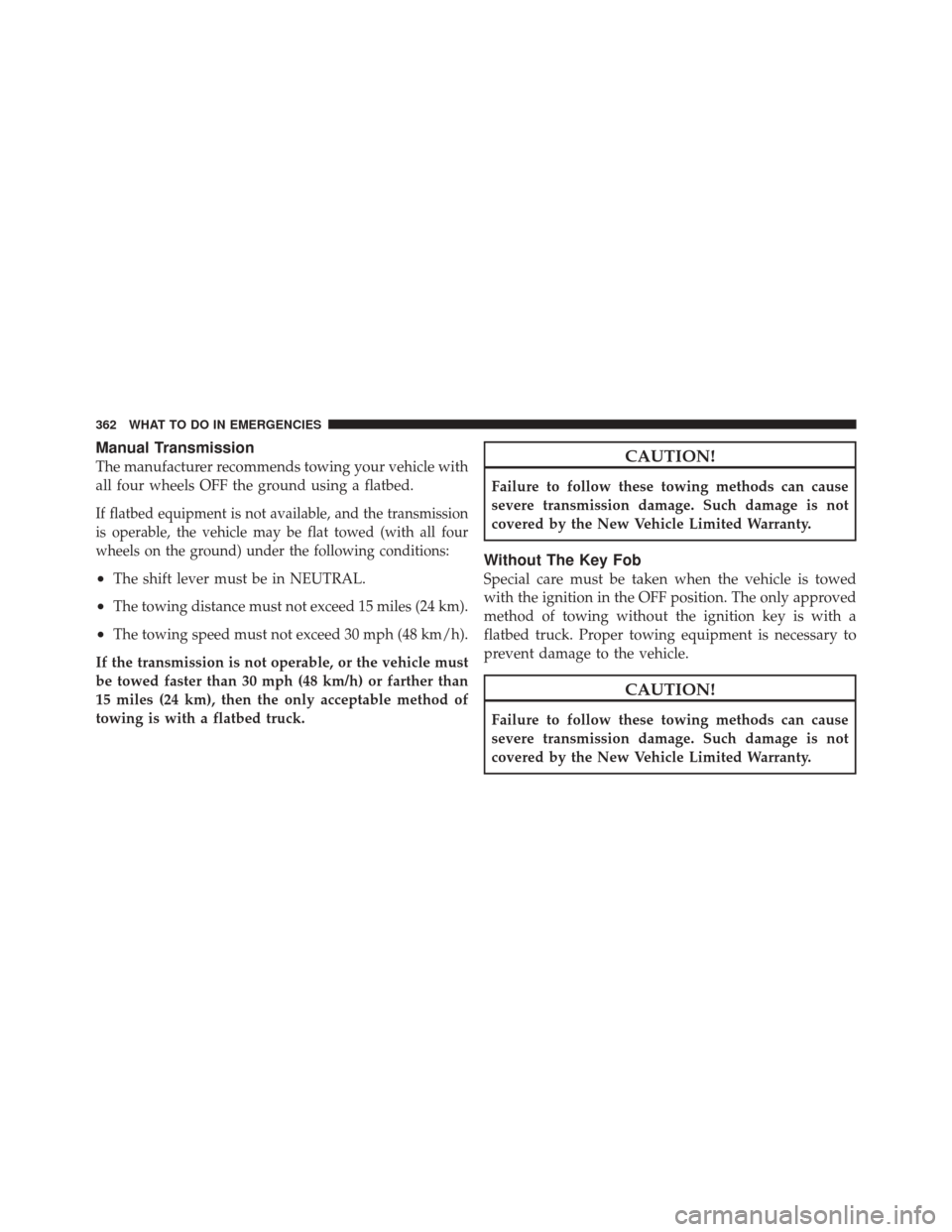
Manual Transmission
The manufacturer recommends towing your vehicle with
all four wheels OFF the ground using a flatbed.
If flatbed equipment is not available, and the transmission
is operable, the vehicle may be flat towed (with all four
wheels on the ground) under the following conditions:
•The shift lever must be in NEUTRAL.
•The towing distance must not exceed 15 miles (24 km).
•The towing speed must not exceed 30 mph (48 km/h).
If the transmission is not operable, or the vehicle must
be towed faster than 30 mph (48 km/h) or farther than
15 miles (24 km), then the only acceptable method of
towing is with a flatbed truck.
CAUTION!
Failure to follow these towing methods can cause
severe transmission damage. Such damage is not
covered by the New Vehicle Limited Warranty.
Without The Key Fob
Special care must be taken when the vehicle is towed
with the ignition in the OFF position. The only approved
method of towing without the ignition key is with a
flatbed truck. Proper towing equipment is necessary to
prevent damage to the vehicle.
CAUTION!
Failure to follow these towing methods can cause
severe transmission damage. Such damage is not
covered by the New Vehicle Limited Warranty.
362 WHAT TO DO IN EMERGENCIES