Page 385 of 471
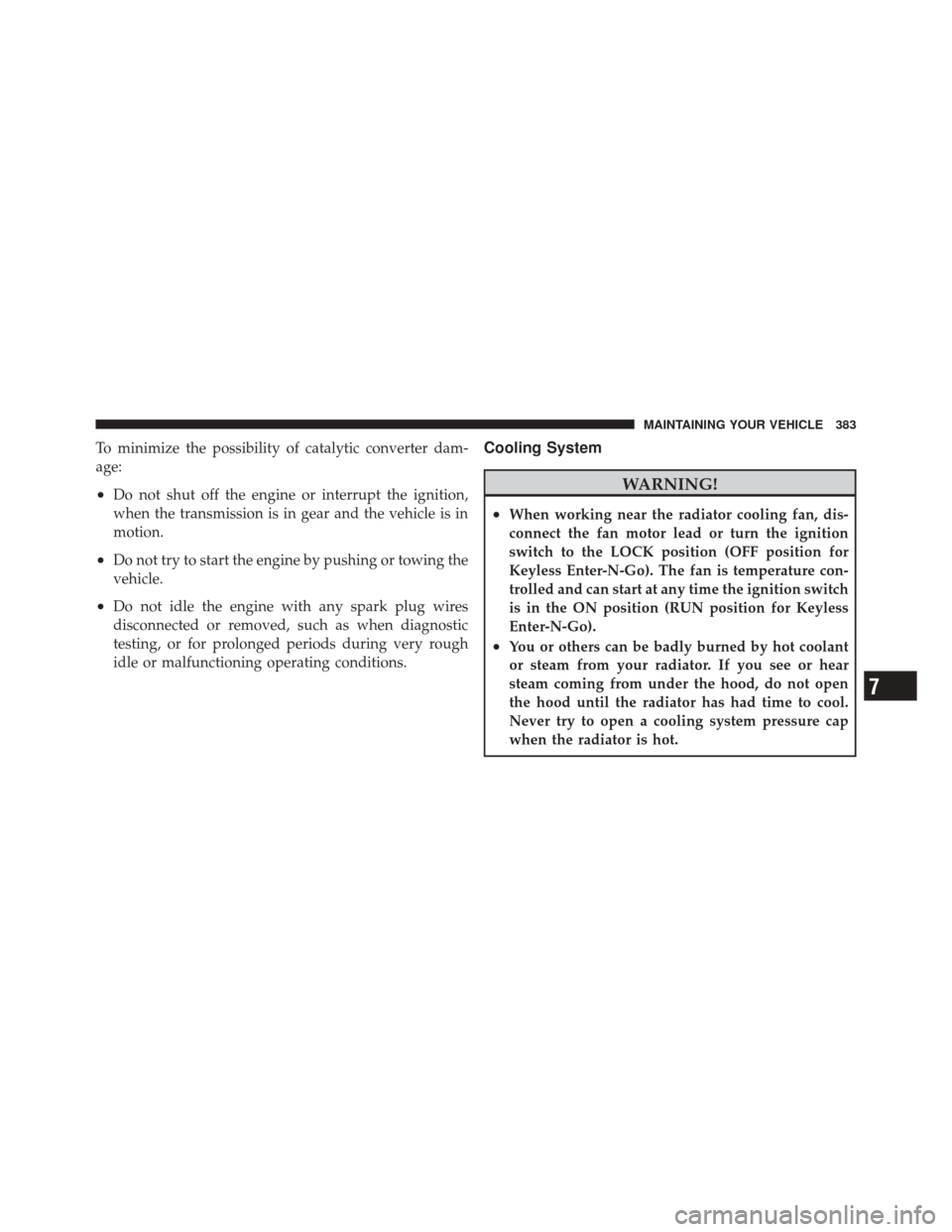
To minimize the possibility of catalytic converter dam-
age:
•Do not shut off the engine or interrupt the ignition,
when the transmission is in gear and the vehicle is in
motion.
•Do not try to start the engine by pushing or towing the
vehicle.
•Do not idle the engine with any spark plug wires
disconnected or removed, such as when diagnostic
testing, or for prolonged periods during very rough
idle or malfunctioning operating conditions.
Cooling System
WARNING!
•When working near the radiator cooling fan, dis-
connect the fan motor lead or turn the ignition
switch to the LOCK position (OFF position for
Keyless Enter-N-Go). The fan is temperature con-
trolled and can start at any time the ignition switch
is in the ON position (RUN position for Keyless
Enter-N-Go).
•You or others can be badly burned by hot coolant
or steam from your radiator. If you see or hear
steam coming from under the hood, do not open
the hood until the radiator has had time to cool.
Never try to open a cooling system pressure cap
when the radiator is hot.
7
MAINTAINING YOUR VEHICLE 383
Page 386 of 471

Coolant Checks
Check the engine coolant (antifreeze) protection every
12 months (before the onset of freezing weather, where
applicable). If coolant is dirty or rusty in appearance, the
system should be drained, flushed, and refilled with
fresh coolant. Check the front of the A/C condenser for
any accumulation of bugs, leaves, etc. If dirty, clean by
gently spraying water from a garden hose vertically
down the face of the condenser.
Check the coolant recovery bottle tubing for brittle rub-
ber, cracking, tears, cuts, and tightness of the connection
at the bottle and radiator. Inspect the entire system for
leaks.
With the engine at normal operating temperature (but
not running), check the cooling system pressure cap for
proper vacuum sealing by draining a small amount of
coolant from the radiator drain cock. If the cap is sealing
properly, the engine coolant (antifreeze) will begin todrain from the coolant recovery bottle. DO NOT RE-
MOVE THE COOLANT PRESSURE CAP WHEN THE
COOLING SYSTEM IS HOT.
Cooling System – Drain, Flush, And Refill
If the solution is dirty or contains a considerable amount
of sediment, clean and flush with a reliable cooling
system cleaner. Follow with a thorough rinsing to remove
all deposits and chemicals. Properly dispose of the old
antifreeze solution.
Refer to the “Maintenance Schedule” for the proper
maintenance intervals.
Selection Of Coolant
Use only the manufacturer’s recommended coolant.
Refer to “Fluids, Lubricants, and Genuine Parts” in
“Maintaining Your Vehicle” for further information.
384 MAINTAINING YOUR VEHICLE
Page 387 of 471
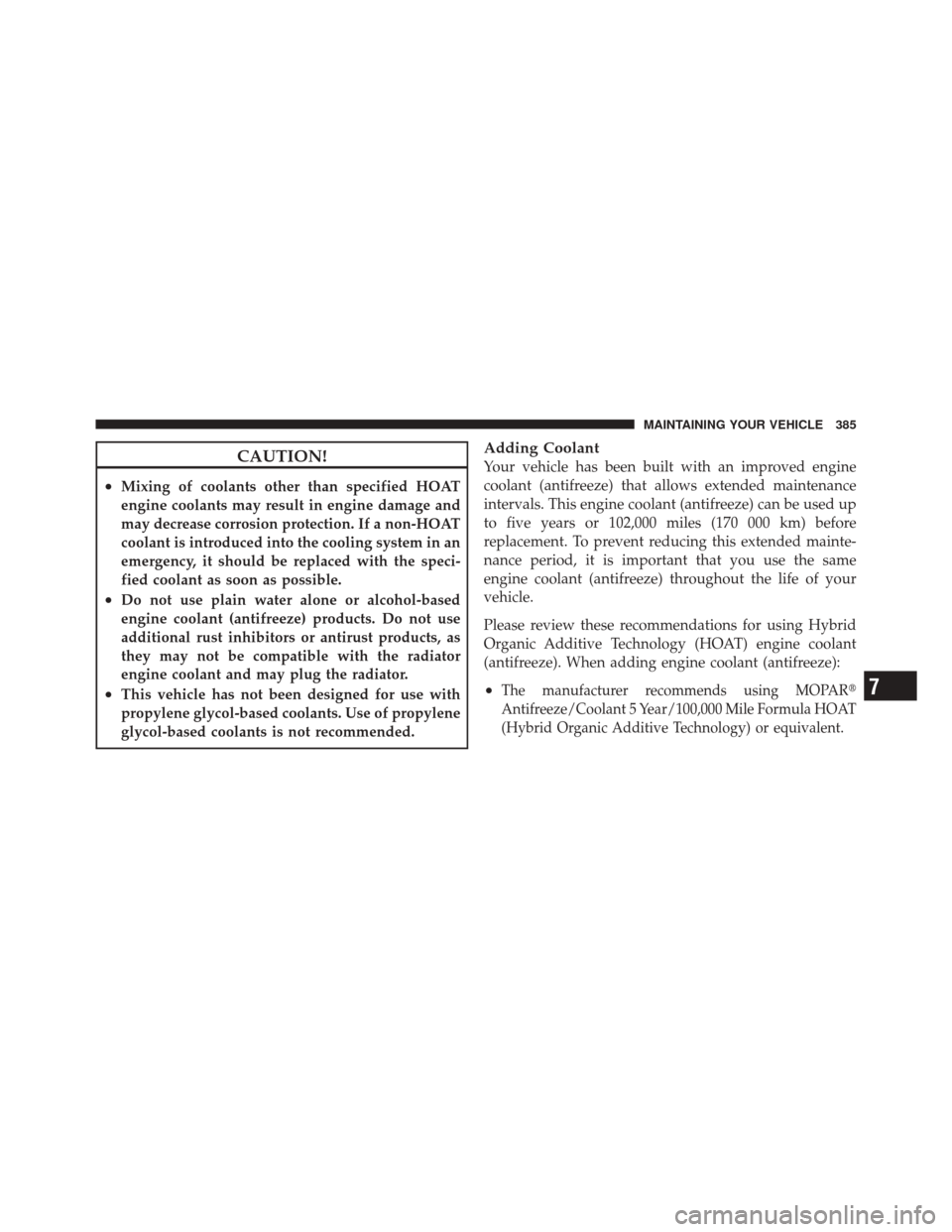
CAUTION!
•Mixing of coolants other than specified HOAT
engine coolants may result in engine damage and
may decrease corrosion protection. If a non-HOAT
coolant is introduced into the cooling system in an
emergency, it should be replaced with the speci-
fied coolant as soon as possible.
•Do not use plain water alone or alcohol-based
engine coolant (antifreeze) products. Do not use
additional rust inhibitors or antirust products, as
they may not be compatible with the radiator
engine coolant and may plug the radiator.
•This vehicle has not been designed for use with
propylene glycol-based coolants. Use of propylene
glycol-based coolants is not recommended.
Adding Coolant
Your vehicle has been built with an improved engine
coolant (antifreeze) that allows extended maintenance
intervals. This engine coolant (antifreeze) can be used up
to five years or 102,000 miles (170 000 km) before
replacement. To prevent reducing this extended mainte-
nance period, it is important that you use the same
engine coolant (antifreeze) throughout the life of your
vehicle.
Please review these recommendations for using Hybrid
Organic Additive Technology (HOAT) engine coolant
(antifreeze). When adding engine coolant (antifreeze):
•The manufacturer recommends using MOPAR�
Antifreeze/Coolant 5 Year/100,000 Mile Formula HOAT
(Hybrid Organic Additive Technology) or equivalent.7
MAINTAINING YOUR VEHICLE 385
Page 388 of 471
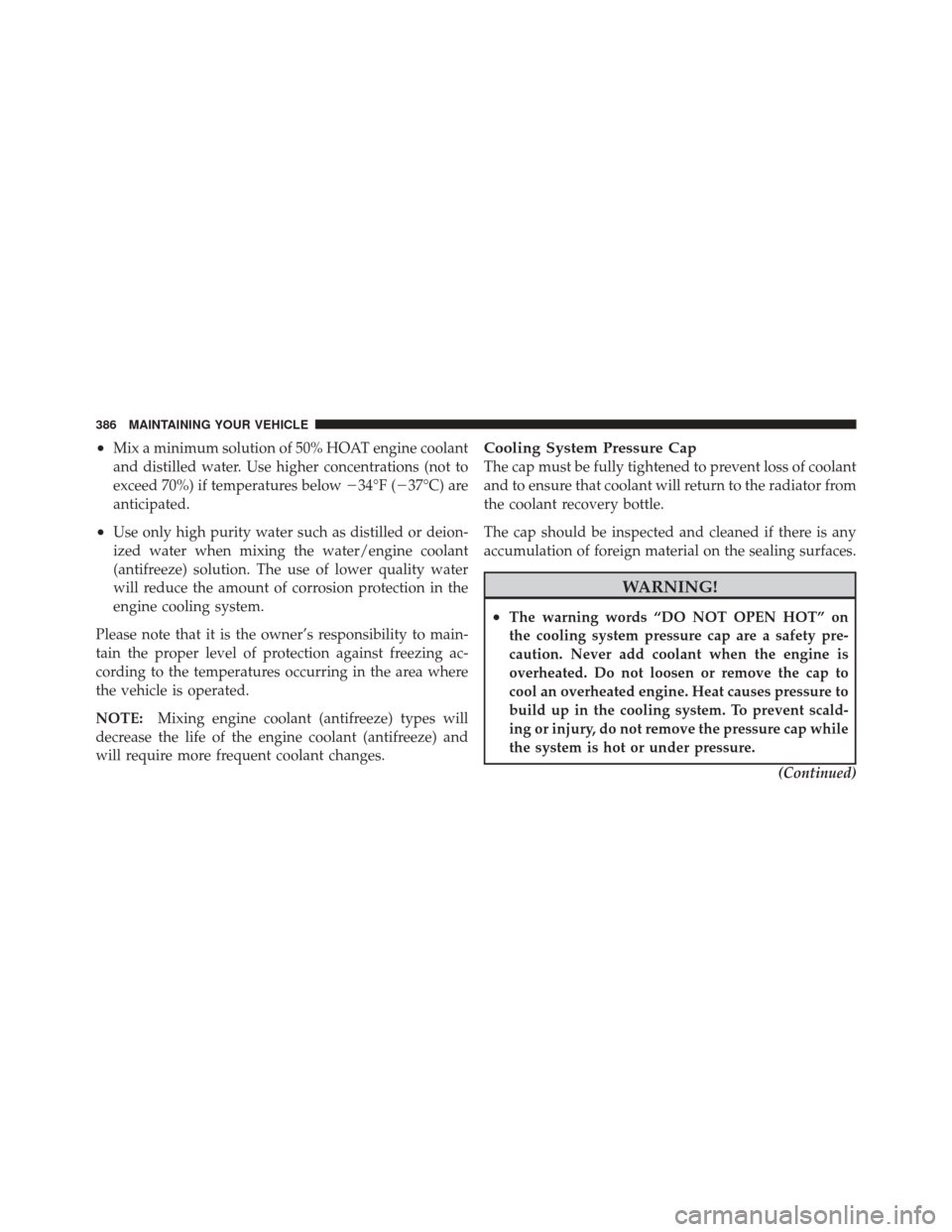
•Mix a minimum solution of 50% HOAT engine coolant
and distilled water. Use higher concentrations (not to
exceed 70%) if temperatures below�34°F (�37°C) are
anticipated.
•Use only high purity water such as distilled or deion-
ized water when mixing the water/engine coolant
(antifreeze) solution. The use of lower quality water
will reduce the amount of corrosion protection in the
engine cooling system.
Please note that it is the owner’s responsibility to main-
tain the proper level of protection against freezing ac-
cording to the temperatures occurring in the area where
the vehicle is operated.
NOTE: Mixing engine coolant (antifreeze) types will
decrease the life of the engine coolant (antifreeze) and
will require more frequent coolant changes.
Cooling System Pressure Cap
The cap must be fully tightened to prevent loss of coolant
and to ensure that coolant will return to the radiator from
the coolant recovery bottle.
The cap should be inspected and cleaned if there is any
accumulation of foreign material on the sealing surfaces.
WARNING!
•The warning words “DO NOT OPEN HOT” on
the cooling system pressure cap are a safety pre-
caution. Never add coolant when the engine is
overheated. Do not loosen or remove the cap to
cool an overheated engine. Heat causes pressure to
build up in the cooling system. To prevent scald-
ing or injury, do not remove the pressure cap while
the system is hot or under pressure.
(Continued)
386 MAINTAINING YOUR VEHICLE
Page 390 of 471

humidity accumulating on the radiator and being vapor-
ized when the thermostat opens, allowing hot coolant to
enter the radiator.
If an examination of your engine compartment shows no
evidence of radiator or hose leaks, the vehicle may be
safely driven. The vapor will soon dissipate.
•Do not overfill the coolant recovery bottle.
•Check the coolant freeze point in the radiator and in
the coolant recovery bottle. If antifreeze needs to be
added, the contents of the coolant recovery bottle must
also be protected against freezing.
•If frequent coolant additions are required, or if the
level in the coolant recovery bottle does not drop when
the engine cools, the cooling system should be pres-
sure tested for leaks.
•Maintain coolant concentration at 50% HOAT engine
coolant (minimum) and distilled water for proper
corrosion protection of your engine, which contains
aluminum components.
•Make sure that the radiator and coolant recovery
bottle overflow hoses are not kinked or obstructed.
•Keep the front of the radiator clean. If your vehicle is
equipped with air conditioning, keep the front of the
condenser clean.
•Do not change the thermostat for Summer or Winter
operation. If replacement is ever necessary, install
ONLY the correct type thermostat. Other designs may
result in unsatisfactory coolant performance, poor gas
mileage, and increased emissions.
388 MAINTAINING YOUR VEHICLE
Page 415 of 471
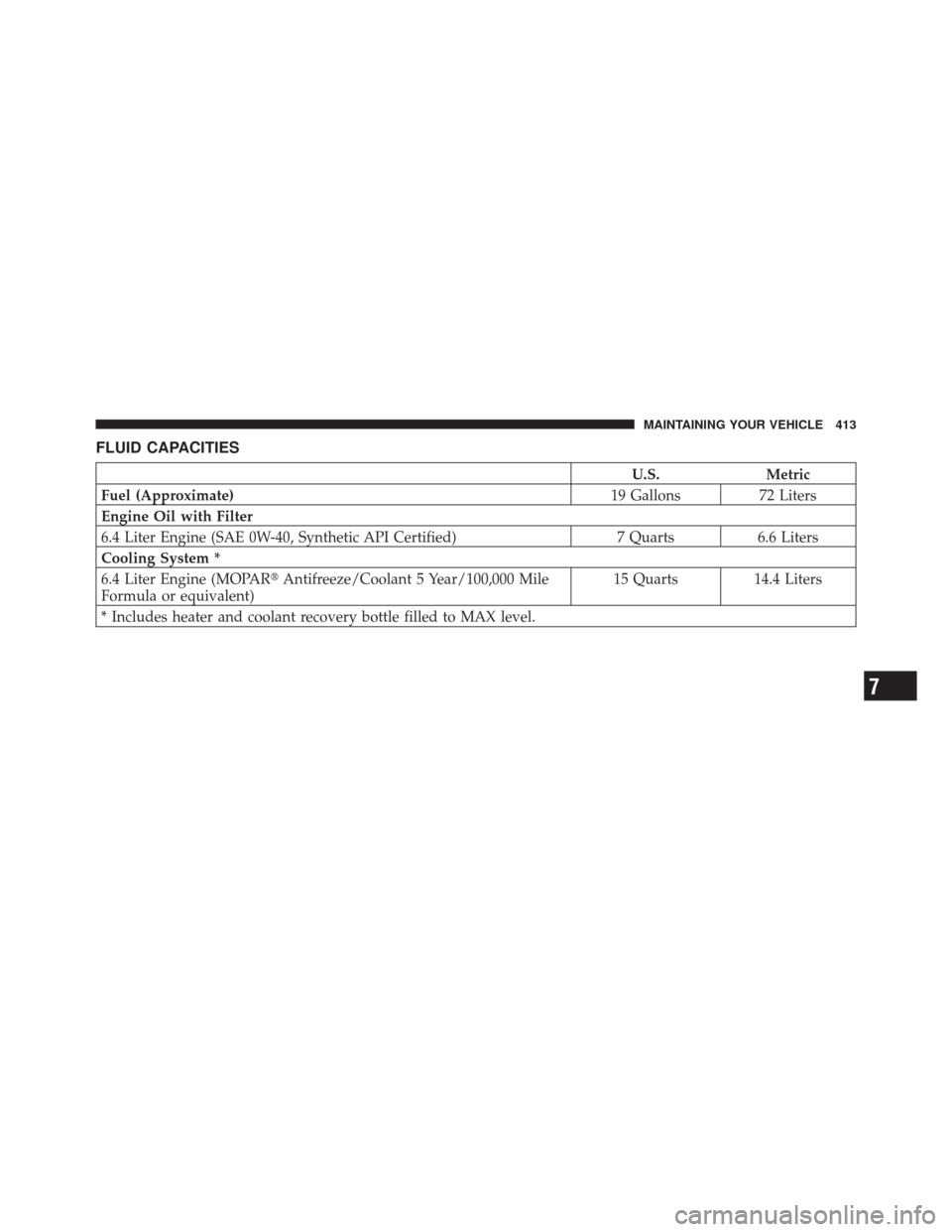
FLUID CAPACITIES
U.S.Metric
Fuel (Approximate) 19 Gallons72 Liters
Engine Oil with Filter
6.4 Liter Engine (SAE 0W-40, Synthetic API Certified) 7 Quarts6.6 Liters
Cooling System *
6.4 Liter Engine (MOPAR� Antifreeze/Coolant 5 Year/100,000 Mile
Formula or equivalent) 15 Quarts
14.4 Liters
* Includes heater and coolant recovery bottle filled to MAX level.
7
MAINTAINING YOUR VEHICLE 413
Page 453 of 471
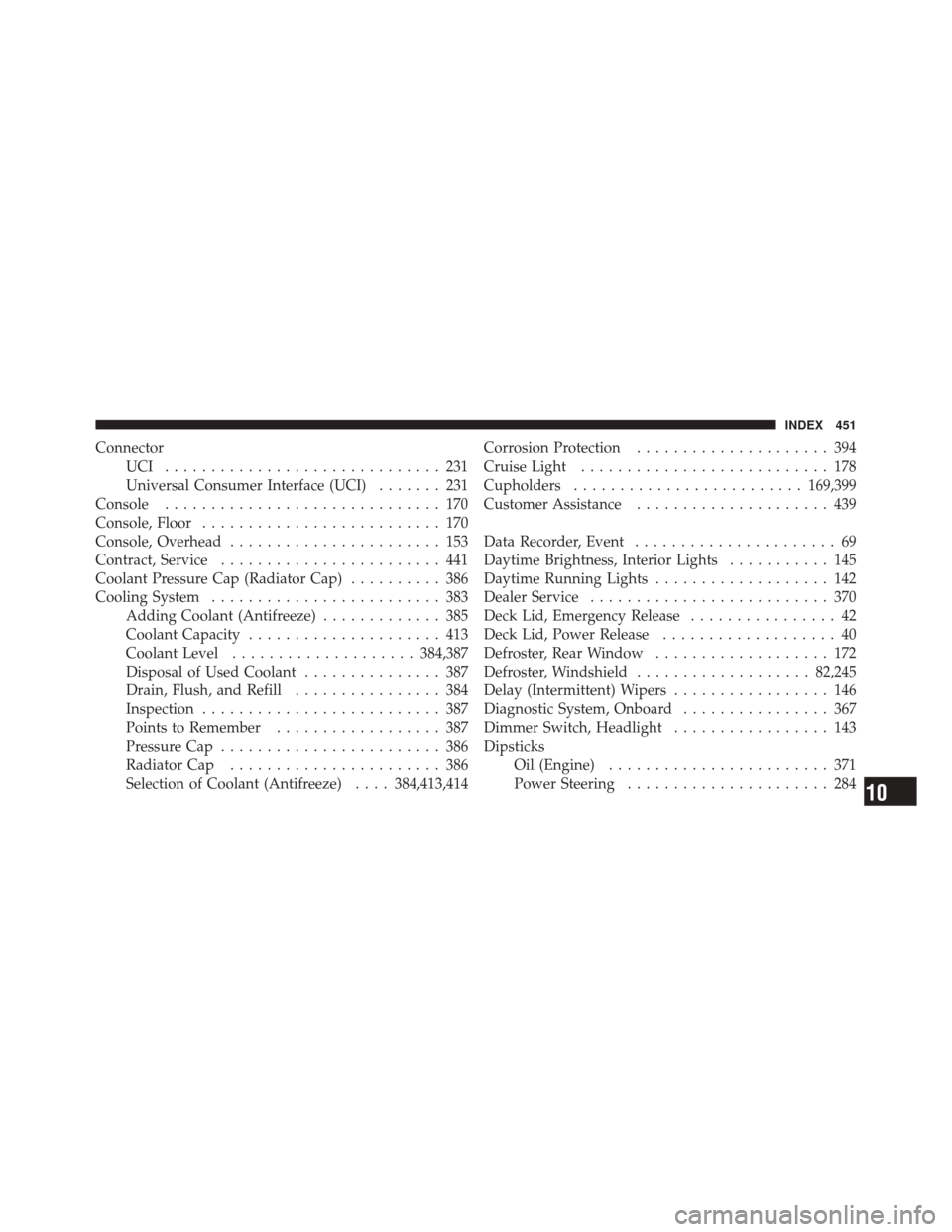
ConnectorUCI .............................. 231
Universal Consumer Interface (UCI) ....... 231
Console .............................. 170
Console, Floor .......................... 170
Console, Overhead ....................... 153
Contract, Service ........................ 441
Coolant Pressure Cap (Radiator Cap) .......... 386
Cooling System ......................... 383
Adding Coolant (Antifreeze) ............. 385
Coolant Capacity ..................... 413
Coolant Level .................... 384,387
Disposal of Used Coolant ............... 387
Drain, Flush, and Refill ................ 384
Inspection .......................... 387
Points to Remember .................. 387
Pressure Cap ........................ 386
Radiator Cap ....................... 386
Selection of Coolant (Antifreeze) ....384,413,414 Corrosion Protection
..................... 394
Cruise Light ........................... 178
Cupholders ......................... 169,399
Customer Assistance ..................... 439
Data Recorder, Event ...................... 69
Daytime Brightness, Interior Lights ........... 145
Daytime Running Lights ................... 142
Dealer Service .......................... 370
Deck Lid, Emergency Release ................ 42
Deck Lid, Power Release ................... 40
Defroster, Rear Window ................... 172
Defroster, Windshield ................... 82,245
Delay (Intermittent) Wipers ................. 146
Diagnostic System, Onboard ................ 367
Dimmer Switch, Headlight ................. 143
Dipsticks Oil (Engine) ........................ 371
Power Steering ...................... 284
10
INDEX 451
Page 454 of 471

Disabled Vehicle Towing................... 360
Disposal Antifreeze (Engine Coolant) ............. 387
Engine Oil ......................... 373
Door Locks ............................. 31
Door Locks, Automatic .................... 33
Door Opener, Garage ..................... 154
Driving On Slippery Surfaces .................. 279
Through Flowing, Rising, or Shallow
Standing Water ...................... 281
Electric Remote Mirrors .................... 91
Electrical Power Outlets ................... 165
Electronic Brake Control System ............. 291
Electronic Power Distribution Center (Fuses) .... 402
Electronic Speed Control (Cruise Control) ...... 150
Electronic Stability Control (ESC) ............. 295
Electronic Throttle Control Warning Light ...... 179Electronic Vehicle Information Center (EVIC)
.... 188
Emergency Deck Lid Release ................ 42
Emergency Trunk Release ................... 42
Emergency, In Case of Freeing Vehicle When Stuck ............. 357
Hazard Warning Flasher ............... 342
Jump Starting ....................... 353
Overheating ........................ 342
Towing ............................ 360
Emission Control System Maintenance ......... 368
Engine ............................... 366
Air Cleaner ......................... 373
Block Heater ........................ 263
Break-In Recommendations .............. 79
Checking Oil Level ................... 371
Compartment ....................... 366
Coolant (Antifreeze) ................ 384,414
Cooling ........................... 383
Exhaust Gas Caution ................81,333
452 INDEX