Page 93 of 643

Installing The LATCH-Compatible Child Restraint
System
Each vehicle, except commercial cargo vehicles,
is equipped with the child restraint anchorage
system called LATCH, which stands for Lower
Anchors and Tether for CHildren. Two LATCH
child restraint anchorage systems are installed on all
second-row seats and in the center position on all third
row fold-in-floor seats. Second-row seats also feature
tether strap anchorages, located in the rear surface of the
seatback. In addition, all third row fold-in-floor seats are
equipped with a child restraint tether anchor at the center
seating position. NOTE:
•When using the LATCH attaching system to install a
child restraint, please ensure that all seat belts not
being used for occupant restraints are stowed and out
of reach of children. It is recommended that before
installing the child restraint, buckle the seat belt so the
seat belt is tucked behind the child restraint and out of
reach. If the buckled seat belt interferes with the child
restraint installation, instead of tucking the seat belt
behind the child restraint, route the seat belt through
the child restraint belt path and then buckle it. This
should stow the seat belt out of the reach of an
inquisitive child. Remind all children in the vehicle
that the seat belts are not toys and should not be
played with, and never leave your child unattended in
the vehicle.
•If your child restraint seat is not LATCH-compatible,
install the restraint using the vehicle seat belts.
90 THINGS TO KNOW BEFORE STARTING YOUR VEHICLE
ProCarManuals.com
Page 98 of 643
then allow the belt to retract into the retractor. As the belt
retracts, you will hear a ratcheting sound. This indicates
the safety belt is now in the Automatic Locking mode.
2. Finally, pull on any excess webbing to tighten the lap
portion around the child restraint. Any seat belt system
will loosen with time, so check the belt occasionally, and
pull it tight if necessary.
Installing a Child Restraint with a Cinching Latch Plate:
1. To install a child restraint with a cinching latch plate,
first, pull enough of the seat belt webbing from the
retractor to route it through the belt path of the child
restraint. Slide the latch plate into the buckle until you
hear a “click.”
2. Finally, pull on any excess webbing to tighten the lap
portion around the child restraint. Any seat belt system
will loosen with time, so check the belt occasionally, and
pull it tight if necessary.Transporting Pets
Air Bags deploying in the front seat could harm your pet.
An unrestrained pet could be thrown about and possibly
injured, or injure a passenger during panic braking or in
a collision.
Pets should be restrained in the rear seat in pet harnesses
or pet carriers that are secured by seat belts.
COMMERCIAL CARGO VEHICLES (NO FACTORY
INSTALLED REAR SEATS) — IF EQUIPPED
Commercial cargo vehicles are not designed for use as a
family vehicle and are not intended for carrying children
in the front passenger seat. However, if you must carry a
child in a vehicle without a rear seat, the passenger seat
should be moved to the full rearward position and the
child must be in a proper restraint system based on its
age, size and weight.
2
THINGS TO KNOW BEFORE STARTING YOUR VEHICLE 95
ProCarManuals.com
Page 99 of 643
WARNING!
NEVER carry a child in a rear facing infant carrier in
a vehicle without rear seats. In an accident, serious
injury or death may occur from the deploying pas-
senger airbag.This vehicle is equipped with a child restraint tether
anchor located on the lower rear of the front passenger
seat.
Use this tether anchor to secure only forward-
facing child restraints equipped with an upper tether
strap.
WARNING!
Rearward-facing infant restraints must never be se-
cured in the passenger seat of a vehicle with a
passenger airbag. In an accident, a passenger airbag
may deploy causing severe injury or death to infants
riding in rearward-facing infant restraints.
Commercial Child Restraint Tether Anchor
96 THINGS TO KNOW BEFORE STARTING YOUR VEHICLE
ProCarManuals.com
Page 100 of 643
Restraining Infants And Small Children In
Commercial Cargo Vehicles
There are different sizes and types of restraints for
children from newborn size to the child almost large
enough for an adult safety belt. Use the restraint that is
correct for your child:
•The forward-facing child seat is for children from
about 20 to 40 lbs (9 to 18 kg), and more than one year
old.
•A convertible child seat, one that is designed to be
used for children who are too heavy for a rearward-
facing infant seat, may be used IN THE FORWARD
FACING POSITION ONLY, IT MUST NEVER BE
INSTALLED FACING TO THE REAR IN A COMMER-
CIAL CARGO VEHICLE. When a convertible seat is
properly installed facing forward, the vehicle seat
should be adjusted to therear most position.
•Children more than 40 lbs (18 kg) should be secured in
the passenger seat in a child restraint or belt-
positioning booster seat with the seat adjusted to the
rear most position. Older children who do not use
child restraints or belt-positioning booster seats
should ride properly buckled in the passenger seat
with the seat adjusted to the rearmost position. Never
allow children to slide the shoulder belt behind them
or under their arm.
Tether Installation For Commercial Cargo Vehicles
To secure the child restraint upper tether strap to the
vehicle, follow the instructions shown:
1. Locate the child restraint tether anchor on the lower
rear of the front passenger seat.
2. Follow the child restraint manufacturer’s directions
for proper use of connecting the child restraint to the
extended tether strap.
2
THINGS TO KNOW BEFORE STARTING YOUR VEHICLE 97
ProCarManuals.com
Page 103 of 643

WARNING! (Continued)
•Do not allow people to ride in any area of your
vehicle that is not equipped with seats and seat
belts.
•Be sure everyone in your vehicle is in a seat and
using a seat belt properly.
Exhaust Gas
WARNING!
Exhaust gases can injure or kill. They contain carbon
monoxide (CO), which is colorless and odorless.
Breathing it can make you unconscious and can
eventually poison you. To avoid breathing (CO),
follow these safety tips:(Continued)
WARNING! (Continued)
•Do not run the engine in a closed garage or in
confined areas any longer than needed to move
your vehicle in or out of the area.
•If you are required to drive with the trunk/liftgate
open, make sure that all windows are closed and
the climate control BLOWER switch is set at high
speed. DO NOT use the recirculation mode.
•If it is necessary to sit in a parked vehicle with the
engine running, adjust your heating or cooling
controls to force outside air into the vehicle. Set
the blower at high speed.
The best protection against carbon monoxide entry into
the vehicle body is a properly maintained engine exhaust
system.
100 THINGS TO KNOW BEFORE STARTING YOUR VEHICLE
ProCarManuals.com
Page 109 of 643

▫Phone Call Features .................. 135
▫ Uconnect™ Phone Features ............. 138
▫ Advanced Phone Connectivity ........... 142
▫ Things You Should Know About Your
Uconnect™ Phone .................... 144
▫ General Information .................. 155
� Voice Command — If Equipped ........... 155
▫ Voice Command System Operation ........ 155
▫ Commands ........................ 156
▫ Voice Training ...................... 160
� Seats .............................. 160
▫ Power Seats — If Equipped ............. 160
▫ Power Lumbar — If Equipped ........... 162▫
Heated Seats — If Equipped ............ 163
▫ Manual Front/Second Row Seat Adjuster . . . 166
▫ Manual Reclining Seats — If Equipped ..... 167
▫ Head Restraints ..................... 167
▫ Stow ’n Go� Seating — If Equipped ....... 172
▫ Quad Seats — If Equipped ............. 178
▫ Second Row Bench Seat — If Equipped .... 184
▫ Third Row Power Recline — If Equipped . . . 186
▫ Third Row Power Folding Seat — If
Equipped .......................... 186
▫ Manually Folding Third Row Seats — If
Equipped .......................... 188
▫ Plastic Grocery Bag Retainer Hooks ....... 191
106 UNDERSTANDING THE FEATURES OF YOUR VEHICLE
ProCarManuals.com
Page 163 of 643
Voice Training
For users experiencing difficulty with the system recog-
nizing their voice commands or numbers the Uconnect™
Voice “Voice Training” feature may be used.
1. Press the Voice Command
button, say “System
Setup” and once you are in that menu then say “Voice
Training.” This will train your own voice to the system
and will improve recognition.
2. Repeat the words and phrases when prompted by
Uconnect™ Voice. For best results, the “Voice Training”
session should be completed when the vehicle is parked,
engine running, all windows closed, and the blower fan
switched off. This procedure may be repeated with a new
user. The system will adapt to the last trained voice only.
SEATS
Seats are a part of the Occupant Restraint System of the
vehicle.
WARNING!
•It is dangerous to ride in a cargo area, inside or
outside of a vehicle. In a collision, people riding in
these areas are more likely to be seriously injured
or killed.
•Do not allow people to ride in any area of your
vehicle that is not equipped with seats and seat
belts. In a collision, people riding in these areas
are more likely to be seriously injured or killed.
•Be sure everyone in your vehicle is in a seat and
using a seat belt properly.
Power Seats — If Equipped
Some models may be equipped with eight-way power
seats for the driver and front passenger. The power seat
switches are located on the outboard side of the seat. The
switches control the movement of the seat cushion and
the seatback.
160 UNDERSTANDING THE FEATURES OF YOUR VEHICLE
ProCarManuals.com
Page 164 of 643
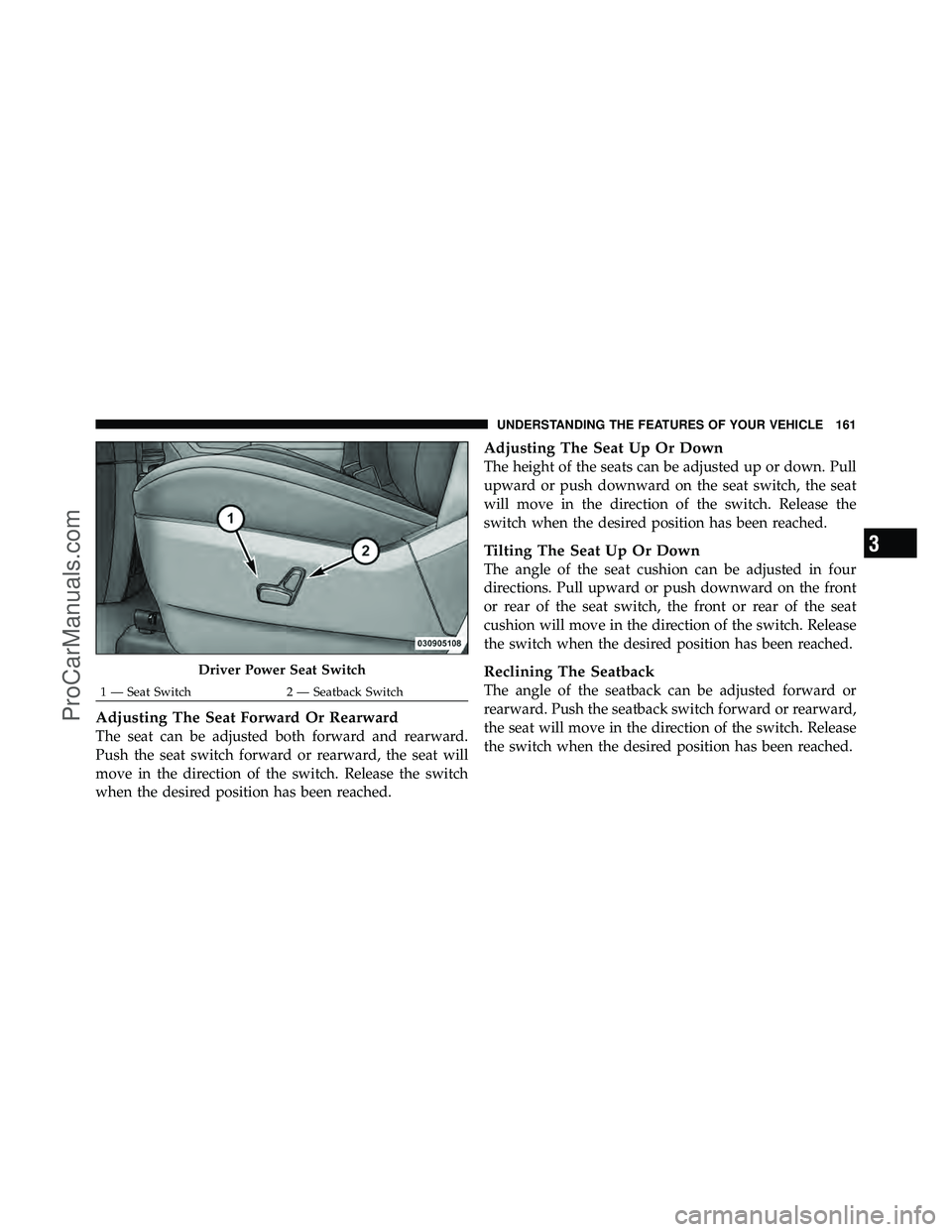
Adjusting The Seat Forward Or Rearward
The seat can be adjusted both forward and rearward.
Push the seat switch forward or rearward, the seat will
move in the direction of the switch. Release the switch
when the desired position has been reached.
Adjusting The Seat Up Or Down
The height of the seats can be adjusted up or down. Pull
upward or push downward on the seat switch, the seat
will move in the direction of the switch. Release the
switch when the desired position has been reached.
Tilting The Seat Up Or Down
The angle of the seat cushion can be adjusted in four
directions. Pull upward or push downward on the front
or rear of the seat switch, the front or rear of the seat
cushion will move in the direction of the switch. Release
the switch when the desired position has been reached.
Reclining The Seatback
The angle of the seatback can be adjusted forward or
rearward. Push the seatback switch forward or rearward,
the seat will move in the direction of the switch. Release
the switch when the desired position has been reached.
Driver Power Seat Switch
1 — Seat Switch2 — Seatback Switch
3
UNDERSTANDING THE FEATURES OF YOUR VEHICLE 161
ProCarManuals.com