Page 518 of 643
WARNING! (Continued)
•The jack is designed to be used as a tool for
changing tires only. The jack should not be used to
lift the vehicle for service purposes. The vehicle
should be jacked on a firm level surface only.
Avoid ice or slippery areas.
Jack Location
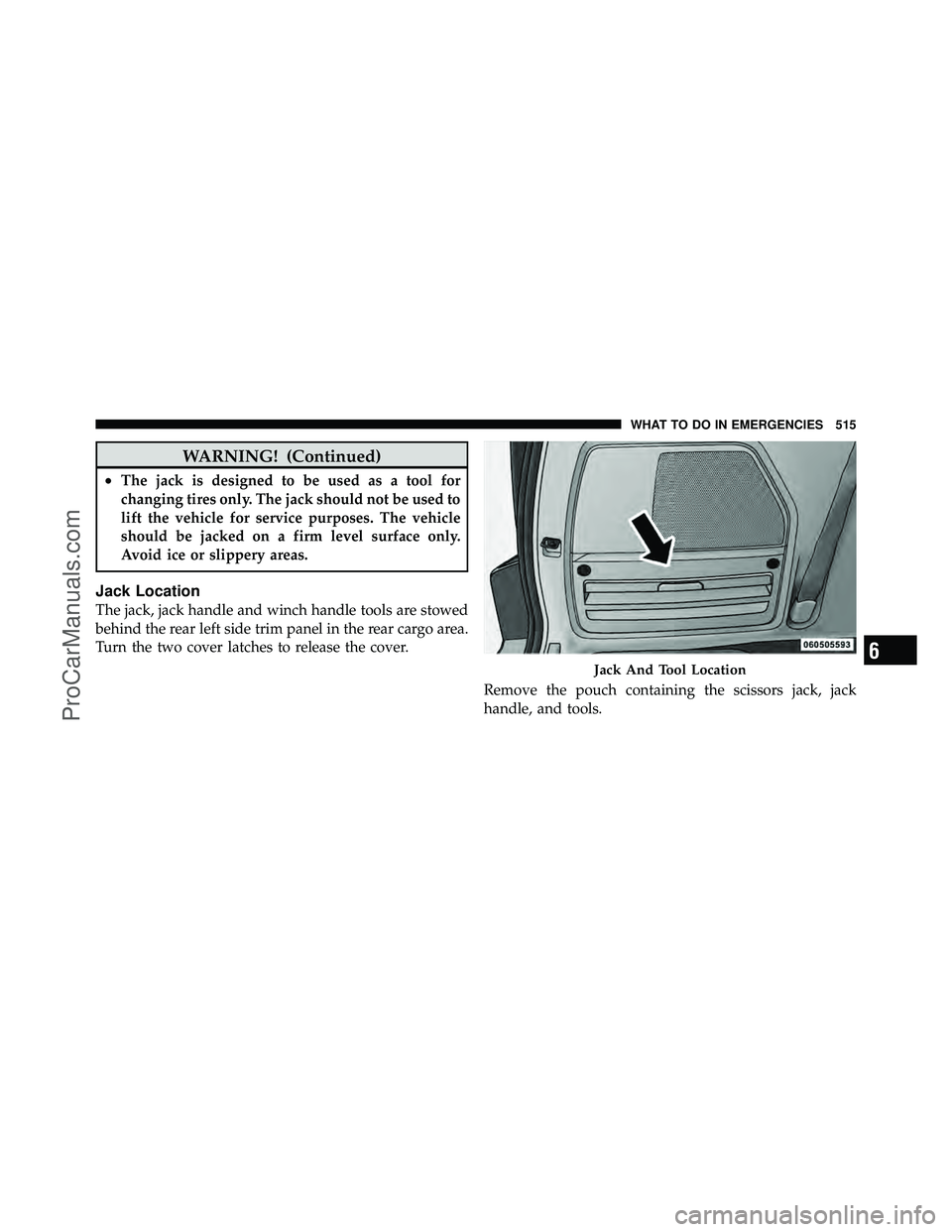
The jack, jack handle and winch handle tools are stowed
behind the rear left side trim panel in the rear cargo area.
Turn the two cover latches to release the cover.Remove the pouch containing the scissors jack, jack
handle, and tools.
Jack And Tool Location6
WHAT TO DO IN EMERGENCIES 515
ProCarManuals.com
Page 541 of 643
2. Remove the shift lever override access cover located
near the top right of the shift lever in the instrument
panel.3. Turn the ignition switch to the ON/RUN position
without starting the engine.
4. Press and maintain firm pressure on the brake pedal.
5. Using a small screwdriver or similar small, push and
hold the override release lever forward.
6. Move the shift lever to the NEUTRAL position.
7. The vehicle may then be started in NEUTRAL.
8. Reinstall the shift lever override access cover.
Shift Lever Override Access Cover
538 WHAT TO DO IN EMERGENCIES
ProCarManuals.com
Page 547 of 643
▫Automatic Transmission ............... 569
▫ Appearance Care And Protection From
Corrosion .......................... 571
▫ Cleaning The Instrument Panel Cupholders . . 577
� Fuses .............................. 578
▫ Totally Integrated Power Module ......... 578
� Vehicle Storage ....................... 585
� Replacement Bulbs .................... 585
� Bulb Replacement ..................... 586
▫ Headlamps ........................ 586
▫ Front Park/Turn Signal Lamps ........... 587▫
Fog Lamps ......................... 587
▫ Rear Tail, Stop, Turn Signal, Side Marker
And Backup Lamps ................... 588
▫ Center High-Mounted Stop Lamp
(CHMSL) .......................... 588
▫ License Lamp ....................... 589
� Fluid Capacities ...................... 589
� Fluids, Lubricants And Genuine Parts ....... 590
▫ Engine ............................ 590
▫ Chassis ........................... 591
544 MAINTAINING YOUR VEHICLE
ProCarManuals.com
Page 550 of 643

“Electronic Vehicle Information Center (EVIC)” in ”Un-
derstanding Your Instrument Panel” for further informa-
tion. Tighten the gas cap until a�clicking�sound is heard.
This is an indication that the gas cap is properly tight-
ened.
Press the odometer reset button to turn the message off.
If the problem persists, the message will appear the next
time the vehicle is started. This might indicate a damaged
cap. If the problem is detected twice in a row, the system
will turn on the MIL. Resolving the problem will turn the
MIL light off.
EMISSIONS INSPECTION AND MAINTENANCE
PROGRAMS
In some localities, it may be a legal requirement to pass
an inspection of your vehicle’s emissions control system.
Failure to pass could prevent vehicle registration. For states that require an Inspection and Mainte-
nance (I/M), this check verifies the “Malfunction
Indicator Light (MIL)” is functioning and is not
on when the engine is running, and that the OBD II
system is ready for testing.
Normally, the OBD II system will be ready. The OBD II
system may notbe ready if your vehicle was recently
serviced, recently had a dead battery or a battery replace-
ment. If the OBD II system should be determined not
ready for the I/M test, your vehicle may fail the test.
Your vehicle has a simple ignition key-actuated test,
which you can use prior to going to the test station. To
check if your vehicle’s OBD II system is ready, you must
do the following:
1. Turn the ignition switch to the ON position, but do not
crank or start the engine.
7
MAINTAINING YOUR VEHICLE 547
ProCarManuals.com
Page 575 of 643
The most common causes are:
•Road salt, dirt and moisture accumulation
•Stone and gravel impact
•Insects, tree sap and tar
•Salt in the air near seacoast localities
•Atmospheric fallout/industrial pollutants
Washing
•
Wash your vehicle regularly. Always wash your ve-
hicle in the shade using MOPAR�Car Wash or equiva-
lent, or a mild car wash soap, and rinse the panels
completely with clear water.
•If insects, tar or other similar deposits have accumu-
lated on your vehicle, use MOPAR� Super Kleen Bug
and Tar Remover or equivalent to remove.
•Use a high quality cleaner wax, such as MOPAR�
Cleaner Wax or equivalent to remove road film, stains
and to protect your paint finish. Take care never to
scratch the paint.
•Avoid using abrasive compounds and power buffing
that may diminish the gloss or thin out the paint
finish.
CAUTION!
•Do not use abrasive or strong cleaning materials
such as steel wool or scouring powder, which will
scratch metal and painted surfaces.
•Use of power washers exceeding 1,200 psi
(8 274 kPa) can result in damage or removal of
paint and decals.
572 MAINTAINING YOUR VEHICLE
ProCarManuals.com
Page 576 of 643

Special Care
•
If you drive on salted or dusty roads or if you drive
near the ocean, hose off the undercarriage at least once
a month.
•It is important that the drain holes in the lower edges
of the doors and rocker panels be kept clear and open.
•If you detect any stone chips or scratches in the paint,
touch them up immediately. The cost of such repairs is
considered the responsibility of the owner.
•If your vehicle is damaged due to a collision or similar
cause which destroys the paint and protective coating,
have your vehicle repaired as soon as possible. The
cost of such repairs is considered the responsibility of
the owner.
•If you carry special cargo such as chemicals, fertilizers,
de-icer salt, etc., be sure that such materials are well
packaged and sealed.
•If a lot of driving is done on gravel roads, consider
mud or stone shields behind each wheel.
•Use MOPAR�Touch Up Paint or equivalent on
scratches as soon as possible. Your authorized dealer
has touch up paint to match the color of your vehicle.
Wheel And Wheel Trim Care
All wheels and wheel trim, especially aluminum and
chrome plated wheels, should be cleaned regularly with
a mild soap and water to prevent corrosion.
To remove heavy soil and/or excessive brake dust the
following MOPAR� wheel cleaners are recommended or
select a non-abrasive, non acidic cleaner.
•For chrome wheels, use MOPAR� Chrome Cleaner
(Part# 04318013) or equivalent.
•For aluminum wheels, use MOPAR� Wheel Cleaner
(Part# 04796239AB) or equivalent.
7
MAINTAINING YOUR VEHICLE 573
ProCarManuals.com
Page 577 of 643
CAUTION!
Do not use scouring pads, steel wool, a bristle brush,
or metal polishes. Do not use oven cleaner. These
products may damage the wheel’s protective finish.
Avoid automatic car washes that use acidic solutions
or harsh brushes that may damage the wheel’s pro-
tective finish. Use only the approved MOPAR�
Wheel Cleaners or equivalent.
Stain Repel Fabric Cleaning Procedure – If
Equipped
Stain Repel seats may be cleaned in the following man-
ner:
•Remove as much of the stain as possible by blotting
with a clean, dry towel.
•Blot any remaining stain with a clean, damp towel.
•For tough stains, apply MOPAR�Total Clean or
equivalent, or a mild soap solution to a clean, damp
cloth and remove the stain. Use a fresh, damp towel to
remove soap residue.
•For grease stains, apply MOPAR� Multi-Purpose
Cleaner or a equivalent high quality cleaner to a clean,
damp cloth and remove the stain. Use a fresh, damp
towel to remove soap residue.
•Do not use any harsh solvents or any other form of
protectants on Stain Repel products.
Interior Care
Instrument Panel Surfaces
The instrument panel cover has a low glare surface,
which minimizes reflections in the windshield. Do not
use protectants or other products which may cause
undesirable reflections. Use soap and warm water to
restore the low glare surface.
574 MAINTAINING YOUR VEHICLE
ProCarManuals.com
Page 580 of 643
Replace the seat belts if they appear frayed or worn, or if
the buckles do not work properly.
Cleaning The Instrument Panel Cupholders
Removal
Pull the flexible liner from the cupholder drawer starting
at one edge to ease removal.
Cleaning
The liner is top shelf dishwasher safe, or you may follow
the cleaning procedure below.
Soak the liner in a mixture of medium hot tap water and
one teaspoon of mild liquid dish soap. Let soak forapproximately 30 minutes. After 30 minutes, pull the
liner from the water and dip it back into the water about
six times. This will loosen any remaining debris. Rinse
the liner thoroughly under warm running water. Shake
the excess water from the liner and dry the outer surfaces
with a clean soft cloth.
Installation
Place the liner into the cupholder drawer and press the
liner into place so that the retention tabs seat into the
corresponding openings in the drawer.
7
MAINTAINING YOUR VEHICLE 577
ProCarManuals.com