Page 397 of 506
Do not raise the vehicle until you are sure the jack is
securely engaged.
3. Turn the jack screw to the left until the jack can be
placed under the jacking location. Once the jack is
Front Jacking LocationRear Jacking Location6
WHAT TO DO IN EMERGENCIES 395
Page 399 of 506
WARNING!
To avoid possible personal injury, handle the wheel
covers with care to avoid contact with any sharp
edges.NOTE:
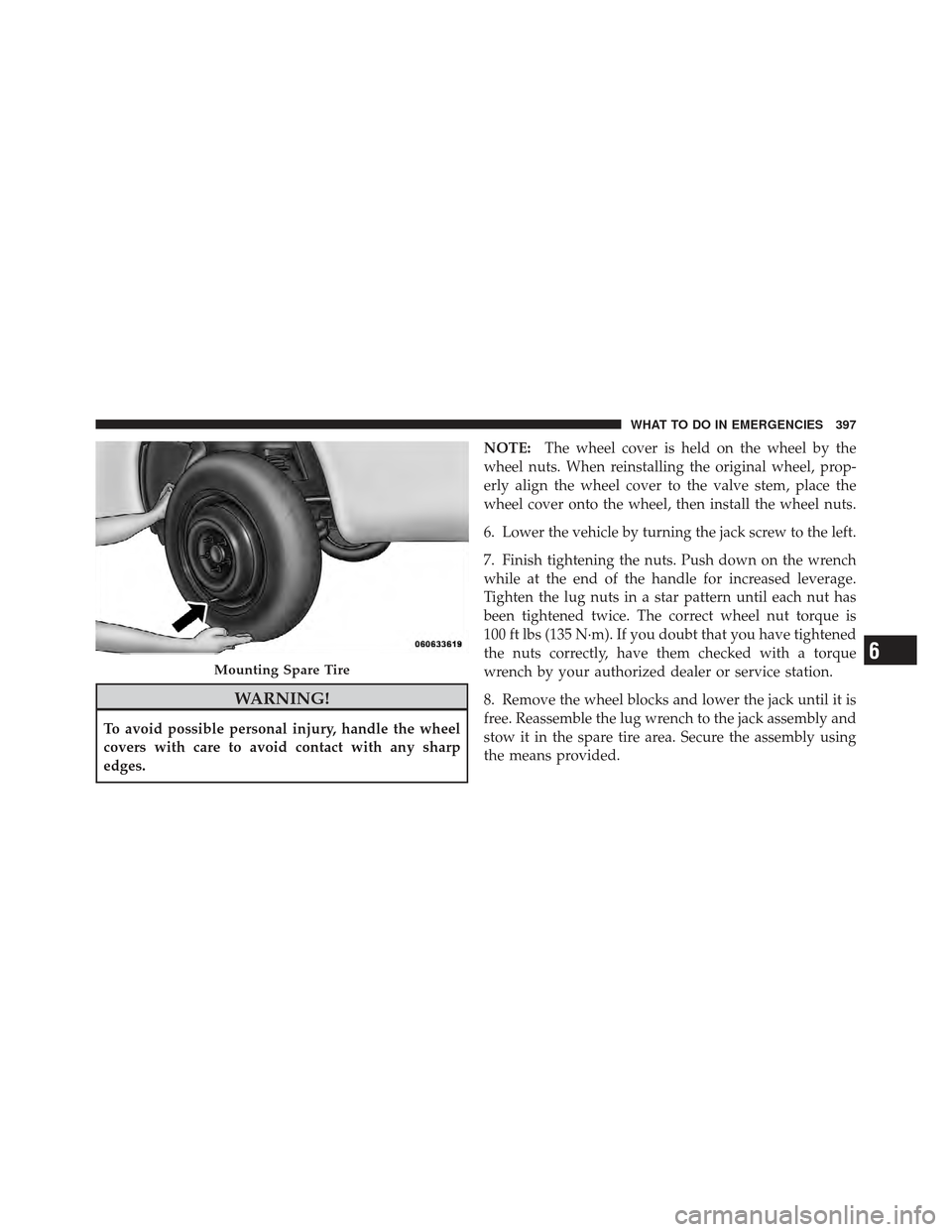
The wheel cover is held on the wheel by the
wheel nuts. When reinstalling the original wheel, prop-
erly align the wheel cover to the valve stem, place the
wheel cover onto the wheel, then install the wheel nuts.
6. Lower the vehicle by turning the jack screw to the left.
7. Finish tightening the nuts. Push down on the wrench
while at the end of the handle for increased leverage.
Tighten the lug nuts in a star pattern until each nut has
been tightened twice. The correct wheel nut torque is
100 ft lbs (135 N·m). If you doubt that you have tightened
the nuts correctly, have them checked with a torque
wrench by your authorized dealer or service station.
8. Remove the wheel blocks and lower the jack until it is
free. Reassemble the lug wrench to the jack assembly and
stow it in the spare tire area. Secure the assembly using
the means provided.
Mounting Spare Tire6
WHAT TO DO IN EMERGENCIES 397
Page 412 of 506
CAUTION!
Do not attempt to use sling-type equipment when
towing. When securing the vehicle to a flatbed truck,
do not attach to front or rear suspension components.
Damage to your vehicle may result from improper
towing.
Without The Ignition Key
Special care must be taken when the vehicle is towed
with the ignition in the LOCK position. The only ap-
proved method of towing without the ignition key is
with a flatbed truck. Proper towing equipment is neces-
sary to prevent damage to the vehicle.
410 WHAT TO DO IN EMERGENCIES
Page 439 of 506

WARNING! (Continued)
•To avoid contamination from foreign matter or
moisture, use only new brake fluid or fluid that
has been in a tightly closed container. Keep the
master cylinder reservoir cap secured at all times.
Brake fluid in a open container absorbs moisture
from the air resulting in a lower boiling point.
This may cause it to boil unexpectedly during hard
or prolonged braking, resulting in sudden brake
failure. This could result in a collision.
•Overfilling the brake fluid reservoir can result in
spilling brake fluid on hot engine parts, causing
the brake fluid to catch fire. Brake fluid can also
damage painted and vinyl surfaces, care should be
taken to avoid its contact with these surfaces.(Continued)
WARNING! (Continued)
•Do not allow petroleum based fluid to contami-
nate the brake fluid. Brake seal components could
be damaged, causing partial or complete brake
failure. This could result in a collision.
CAUTION!
Use of improper brake fluids will affect overall
clutch system performance. Improper brake fluids
may damage the clutch system resulting in loss of
clutch function and the ability to shift the transmis-
sion.
7
MAINTAINING YOUR VEHICLE 437
Page 452 of 506

BULB REPLACEMENT
Front Headlamps, Parking, and Turn Signal
Lamps
NOTE:The headlamp bulb can be accessed from under
the hood without the removal of the inner fender well. It
will be necessary to remove the inner fender well to
service the park/turn signal bulb that is located toward
the outboard side of the head lamp unit.
1. Disconnect and isolate the negative battery cable.
2. Working in the appropriate wheel well, loosen the
front of the splash shield, but do not fully remove it.
3. Looking up through the front wheel well, locate the
bulb which needs replacing. The headlamp bulb is the
inboard bulb and the park/turn signal bulb is the out-
board bulb.
4. Disconnect the bulb electrical connector. 5. Grasp the bulb, twist 1/4 turn counterclockwise and
pull straight out of front lamp unit.
Fog Lamps
CAUTION!
Do not contaminate the bulb glass by touching it
with your fingers or by allowing it to contact other
oily surfaces. Shortened bulb life will result.
1. Disconnect and isolate the negative battery cable.
2. Remove the front wheel and tire on the same side of
the vehicle as the fog lamp being serviced. Refer to
“Jacking and Tire Changing” in “What To Do In Emer-
gencies” for further information.
3. Remove the three screws that secure the outboard side
of the front wheel house splash shield to the front fascia.
450 MAINTAINING YOUR VEHICLE
Page 453 of 506
4. Remove the push pin fastener that secures the inboard
side of the splash shield to the front end sheet metal.
5. Remove the two push pin fasteners that secure the
forward edge of the splash shield to the front fascia
closure panel.
6. Fold the front of the splash shield rearward far enough
to access the back of the front fascia.
7. From behind the front fascia disconnect the engine
compartment wire harness connector from the front fog
lamp bulb connector receptacle.
8. Firmly grasp the bulb by the two latch features and
squeeze them together to unlock the bulb from the back
of the front fog lamp housing.
9. Pull the bulb straight out from the keyed opening in
the housing.Rear Tail, Turn Signal, and Backup Lamps
1. Remove the two push-pins from the tail lamp housing.
7
MAINTAINING YOUR VEHICLE 451
Page 488 of 506

ABS (Anti-Lock Brake System).............. 322
Adding Engine Coolant (Antifreeze) .......... 431
Adding Fuel ........................... 367
Adding Washer Fluid ..................... 426
Additives, Fuel ......................... 365
Air Cleaner, Engine (Engine Air Cleaner Filter) . . . 422
Air Conditioner Maintenance ............... 424
Air Conditioning ........................ 280
Air Conditioning Controls ................. 280
Air Conditioning Filter .................... 292
Air Conditioning Refrigerant .............424,425
Air Conditioning System .............280,284,424
Air Conditioning, Operating Tips ............ 293
Air Pressure, Tires ....................... 342
Airbag .............................. 61,71
Airbag Deployment ....................... 72
Airbag Light ..................... 69,75,89,203
Airbag Maintenance ....................... 74
Airbag, Side ........................ 65,68,71Airbag, Window (Side Curtain)
...........66,68,71
Alarm Light ........................... 210
Alarm System (Security Alarm) ............... 18
Alterations/Modifications, Vehicle ............. 7
Antenna, Satellite Radio ................242,267
Anti-Lock Brake System (ABS) .............. 322
Anti-Lock Warning Light .................. 213
Anti-Theft Security Alarm (Theft Alarm) ........ 18
Antifreeze (Engine Coolant) ...........431,455,456
Capacities .......................... 455
Disposal ........................... 433
Appearance Care ........................ 439
Assistance Towing ....................... 114
Automatic Dimming Mirror ................. 97
Automatic Door Locks ................... 31,32
Automatic Temperature Control (ATC) ......... 284
Automatic Transaxle ................. 12,299,389
Overheating ........................ 389
Automatic Transmission ................304,438
486 INDEX
Page 496 of 506

Liftgate (Sedan).......................... 37
Liftgate Window Wiper/Washer ............. 190
Light Bulbs .......................... 91,449
Lights .............................. 91,152
Airbag ...................... 69,75,89,203
Alarm ............................ 210
Anti-Lock .......................... 213
Back-Up ........................... 451
Brake Assist Warning .................. 330
Brake Warning ...................... 204
Bulb Replacement .................... 450
Cargo ............................. 185
Center Mounted Stop .................. 454
Dimmer Switch, Headlight .............. 152
Electronic Stability Program (ESP) Indicator . . 330
Engine Temperature Warning ............ 203
Exterior ............................ 91
Fog ......................... 154,210,450
Headlight Switch ..................... 153 Headlights
......................... 153
High Beam Indicator .................. 214
Instrument Cluster ................... 153
License ............................ 453
Lights On Reminder .................. 154
Low Fuel .......................... 202
Malfunction Indicator (Check Engine) ...... 212
Map Reading ....................... 157
Oil Pressure ........................ 203
Seat Belt Reminder ................... 203
Security Alarm (Theft Alarm) ..........18,210
Service Engine Soon (Malfunction
Indicator) .......................... 212
Theft Alarm (Security Alarm) ............ 210
Tire Pressure Monitoring (TPMS) ......... 211
Traction Control ..................... 330
Turn Signal ................. 91,152,155,451
Voltage ............................ 202
Warning (Instrument Cluster Description) . . . 201
494 INDEX


