Page 38 of 506

•For vehicles equipped with the EVIC, the power
window switches will remain active for up to 10 min-
utes after the ignition switch is turned to the LOCK
position. Opening either front door will cancel this
feature. The time for this feature is programmable.
Refer to “Electronic Vehicle Information Center
(EVIC)/Personal Settings (Customer-Programmable
Features)” in “Understanding Your Instrument Panel”
for further information.
WARNING!
Never leave children in a vehicle with the key in the
ignition switch. Occupants, particularly unattended
children, can become entrapped by the windows
while operating the power window switches. Such
entrapment may result in serious injury or death.
Auto-Down
The driver’s door window switch has an Auto-Down
feature. Push the window switch past the first detent,
release, and the window will go down automatically. To
cancel the Auto-Down movement, operate the switch in
either the up or down direction and release the switch.
Power Window Switch Location
36 THINGS TO KNOW BEFORE STARTING YOUR VEHICLE
Page 39 of 506
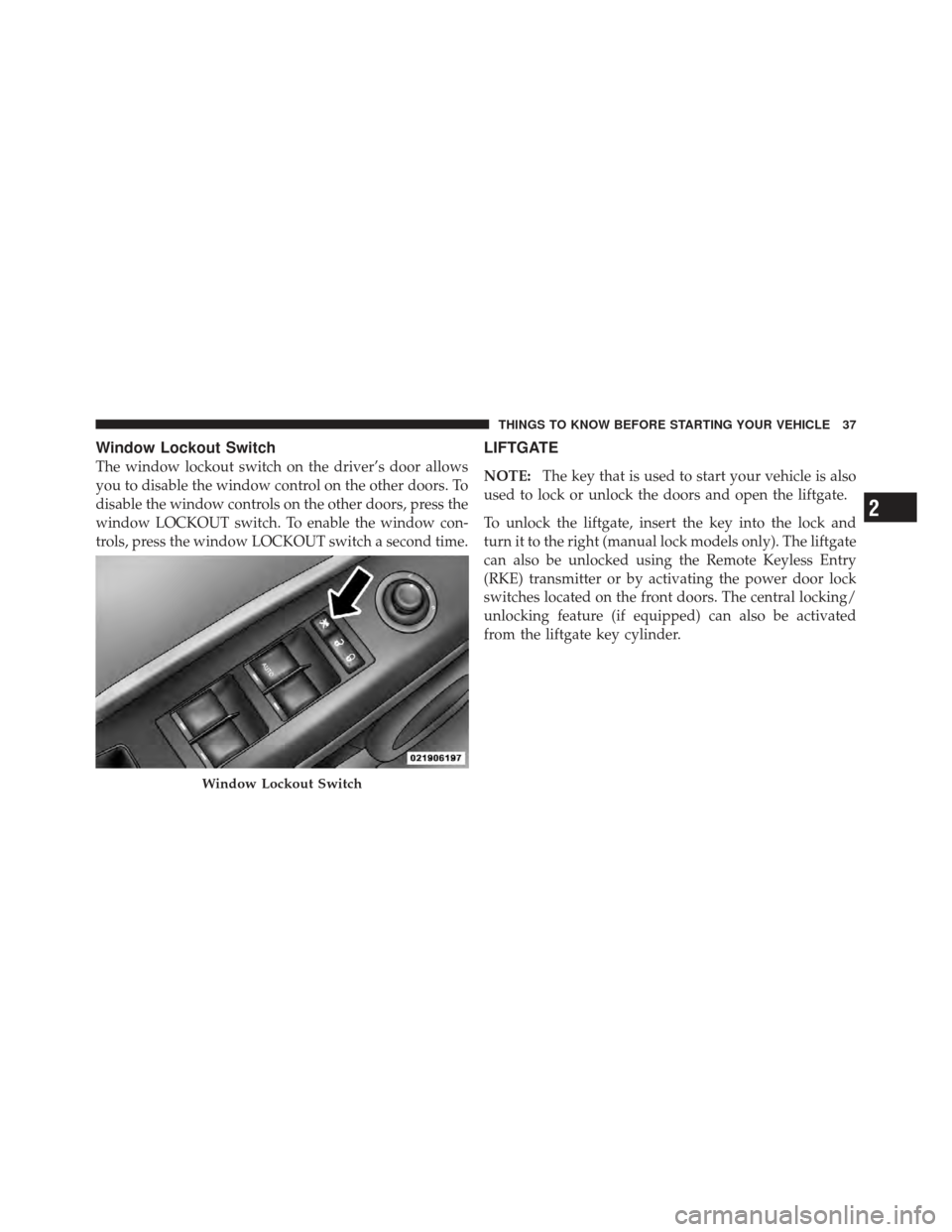
Window Lockout Switch
The window lockout switch on the driver’s door allows
you to disable the window control on the other doors. To
disable the window controls on the other doors, press the
window LOCKOUT switch. To enable the window con-
trols, press the window LOCKOUT switch a second time.
LIFTGATE
NOTE:The key that is used to start your vehicle is also
used to lock or unlock the doors and open the liftgate.
To unlock the liftgate, insert the key into the lock and
turn it to the right (manual lock models only). The liftgate
can also be unlocked using the Remote Keyless Entry
(RKE) transmitter or by activating the power door lock
switches located on the front doors. The central locking/
unlocking feature (if equipped) can also be activated
from the liftgate key cylinder.
Window Lockout Switch
2
THINGS TO KNOW BEFORE STARTING YOUR VEHICLE 37
Page 40 of 506
Once unlocked, the liftgate can be opened or closed
without using the key. To open the liftgate, squeeze the
liftgate release and pull the liftgate open with one fluid
motion.NOTE:
•In the event of a power malfunction, or the RKE
transmitter is inoperative, insert the key into the
liftgate lock cylinder and turn it to the right (manual
lock models only). Using the liftgate handle, pull the
liftgate open with one fluid motion.
•Although the liftgate has no inside release mechanism,
the liftgate trim panel includes an opening with a
snap-in cap that provides access to release the latch in
the event of an electrical system malfunction.
WARNING!
•Driving with the liftgate open can allow poison-
ous exhaust gases into your vehicle. You and your
passengers could be injured by these fumes. Keep
the liftgate closed when you are operating the
vehicle.
(Continued)
Liftgate Handle
38 THINGS TO KNOW BEFORE STARTING YOUR VEHICLE
Page 41 of 506

WARNING! (Continued)
•If you are required to drive with the liftgate open,
make sure that all windows are closed, and the
climate control blower switch is set at high speed.
Do not use the recirculation mode.
Gas props support the liftgate in the open position.
However, because the gas pressure drops with tempera-
ture, it may be necessary to assist the props when
opening the liftgate in cold weather.
OCCUPANT RESTRAINTS
Some of the most important safety features in your
vehicle are the restraint systems:
•Three-point lap and shoulder belts for all seating
positions
•Advanced Front Air Bags for driver and front passen-
ger
•Supplemental Active Head Restraints (AHR) located
on top of the front seats (integrated into the head
restraint) — if equipped
•Supplemental Driver Side Knee Air Bag
•Supplemental Side Air Bag Inflatable Curtains
(SABIC) for the driver and passengers seated next to a
window
•Supplemental Seat-Mounted Side Air Bags (SAB) — if
equipped
•An energy-absorbing steering column and steering
wheel
•Knee bolsters/blockers for front seat occupant
•Front seat belts incorporate pretensioners that may
enhance occupant protection by managing occupant
energy during an impact event — if equipped
2
THINGS TO KNOW BEFORE STARTING YOUR VEHICLE 39
Page 42 of 506

•All seat belt systems (except the driver’s) include
Automatic Locking Retractors (ALRs), which lock the
seat belt webbing into position by extending the belt
all the way out and then adjusting the belt to the
desired length to restrain a child seat or secure a large
item in a seat
Please pay close attention to the information in this
section. It tells you how to use your restraint system
properly, to keep you and your passengers as safe as
possible.
If you will be carrying children too small for adult-sized
seat belts, the seat belts or the Lower Anchors and Tether
for CHildren (LATCH) feature also can be used to hold
infant and child restraint systems. For more information
on LATCH, refer to Lower Anchors and Tether for
CHildren (LATCH). Here are some simple steps you can take to minimize the
risk of harm from a deploying air bag:
1.
Children 12 years old and under should always ride
buckled up in a rear seat.
WARNING!
Infants in rear facing child restraints should never
ride in the front seat of a vehicle with a passenger
Advanced Front Air Bag. An air bag deployment can
cause severe injury or death to infants in that posi-
tion.
Children that are not big enough to wear the vehicle seat
belt properly (see section on Child Restraints) should be
secured in the rear seat in child restraints or belt-
positioning booster seats. Older children who do not use
child restraints or belt-positioning booster seats should
40 THINGS TO KNOW BEFORE STARTING YOUR VEHICLE
Page 44 of 506

WARNING! (Continued)
•Being too close to the steering wheel or instrument
panel during Advanced Front Air Bag deployment
could cause serious injury, including death. Air
Bags need room to inflate. Sit back, comfortably
extending your arms to reach the steering wheel or
instrument panel.
•Supplemental Side Air Bag Inflatable Curtain
(SABIC) and Seat-Mounted Side Air Bags (SAB)
also need room to inflate. Do not lean against the
door or window. Sit upright in the center of the
seat.
•In a collision, you and your passengers can suffer
much greater injuries if you are not properly
buckled up. You can strike the interior of your
vehicle or other passengers, or you can be thrown
out of the vehicle. Always be sure you and others
in your vehicle are buckled up properly.Buckle up even though you are an excellent driver, even
on short trips. Someone on the road may be a poor driver
and cause a collision that includes you. This can happen
far away from home or on your own street.
Research has shown that seat belts save lives, and they
can reduce the seriousness of injuries in a collision. Some
of the worst injuries happen when people are thrown
from the vehicle. Seat belts reduce the possibility of
ejection and the risk of injury caused by striking the
inside of the vehicle. Everyone in a motor vehicle should
be belted at all times.
Lap/Shoulder Belts
All the seating positions in your vehicle are equipped
with combination lap/shoulder belts.
The belt webbing retractor is designed to lock during
very sudden stops or accidents. This feature allows the
shoulder part of the belt to move freely with you under
42 THINGS TO KNOW BEFORE STARTING YOUR VEHICLE
Page 45 of 506

normal conditions. However in a collision, the belt will
lock and reduce the risk of you striking the inside of the
vehicle or being thrown out.
WARNING!
•It is dangerous to ride in a cargo area, inside or
outside of a vehicle. In a collision, people riding in
these areas are more likely to be seriously injured
or killed.
•Do not allow people to ride in any area of your
vehicle that is not equipped with seats and seat
belts.
•Be sure everyone in your vehicle is in a seat and
using a seat belt properly.(Continued)
WARNING! (Continued)
•Wearing a seat belt incorrectly is dangerous. Seat
belts are designed to go around the large bones of
your body. These are the strongest parts of your
body and can take the forces of a collision the best.
•Wearing your belt in the wrong place could make
your injuries in a collision much worse. You might
suffer internal injuries, or you could even slide out
of part of the belt. Follow these instructions to
wear your seat belt safely and to keep your pas-
sengers safe, too.
•Two people should never be belted into a single
seat belt. People belted together can crash into one
another in a collision, hurting one another badly.
Never use a lap/shoulder belt or lap belt for more
than one person, no matter what their size.
2
THINGS TO KNOW BEFORE STARTING YOUR VEHICLE 43
Page 50 of 506
Adjustable Upper Shoulder Belt Anchorage
In the driver and front passenger seat, the shoulder belt
can be adjusted upward or downward to position the belt
away from your neck. Push the anchorage button to
release the anchorage, and move it up or down to the
position that fits you best.
NOTE:The adjustable upper shoulder belt anchorage is
equipped with an Easy Up feature. This feature allows
the shoulder belt anchorage to be adjusted in the upward
position without pressing the release button. To verify
the shoulder belt anchorage is latched, pull downward
on the shoulder belt anchorage until it is locked into
position. As a guide, if you are shorter than average, you will
prefer a lower position, and if you are taller than average,
you will prefer a higher position. When you release the
anchorage, try to move it down to make sure that it is
Adjustable Anchorage
48 THINGS TO KNOW BEFORE STARTING YOUR VEHICLE