Page 373 of 506

Curb Weight
The curb weight of a vehicle is defined as the total weight
of the vehicle with all fluids, including vehicle fuel, at full
capacity conditions, and with no occupants or cargo
loaded into the vehicle. The front and rear curb weight
values are determined by weighing your vehicle on a
commercial scale before any occupants or cargo are
added.
Overloading
The load carrying components (springs, tires, wheels,
etc.) of your vehicle will provide satisfactory service as
long as you do not exceed the GVWR.
The best way to figure out the total weight of your
vehicle is to weigh it when it is fully loaded and ready for
operation. Weigh it on a commercial scale to ensure that
it is not over the GVWR.Overloading can cause potential safety hazards and
shorten useful service life. Heavier suspension compo-
nents do not necessarily increase the vehicle’s GVWR.
Loading
To load your vehicle properly, first figure out its empty
weight. Store heavier items down low and be sure you
distribute their weight as evenly as possible. Stow all
loose items securely before driving. Improper weight
distribution can have an adverse effect on the way your
vehicle steers and handles, and the way the brakes
operate.
CAUTION!
Do not load your vehicle any heavier than the
GVWR. If you do, parts on your vehicle can break, or
it can change the way your vehicle handles. This
could cause you to lose control. Also, overloading can
shorten the life of your vehicle.
5
STARTING AND OPERATING 371
Page 385 of 506
Towing Tips
Before setting out on a trip, practice turning, stopping
and backing the trailer in an area away from heavy
traffic.
Manual Transmission – If Equipped
If using a manual transmission vehicle for trailer towing,
all starts must be in first gear to avoid excessive clutch
slippage.
Automatic Transmission – If Equipped
The automatic transmission fluid and filter should be
changed if you REGULARLY tow a trailer for more than
45 minutes of continuous operation. Refer to the “Main-
tenance Schedule” for the proper maintenance intervals.
Seven-Pin Connector
1 — Battery5 — Ground
2 — Backup Lamps 6 — Left Stop/Turn
3 — Right Stop/Turn 7 — Running Lamps
4 — Electric Brakes
5
STARTING AND OPERATING 383
Page 414 of 506
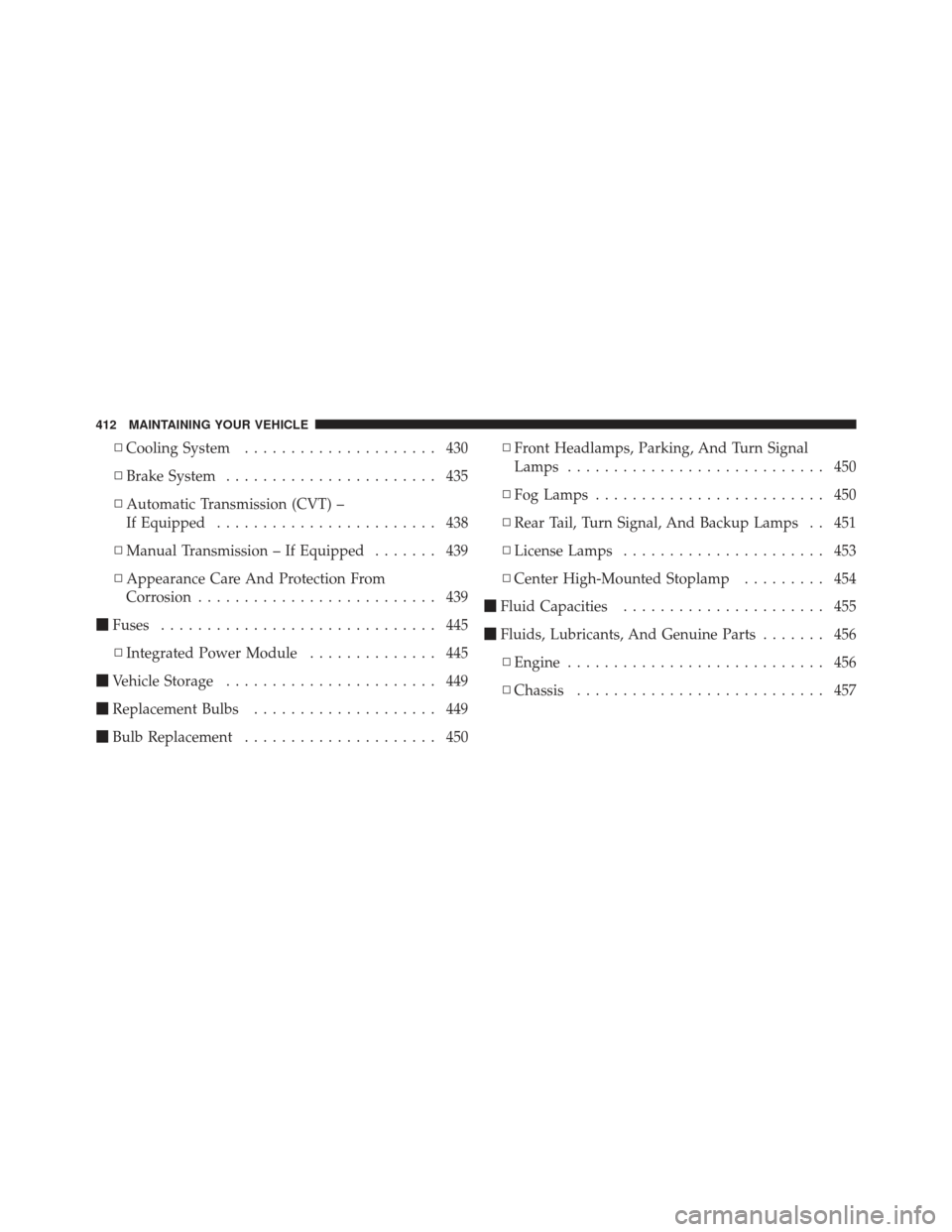
▫Cooling System ..................... 430
▫ Brake System ....................... 435
▫ Automatic Transmission (CVT) –
If Equipped ........................ 438
▫ Manual Transmission – If Equipped ....... 439
▫ Appearance Care And Protection From
Corrosion .......................... 439
� Fuses .............................. 445
▫ Integrated Power Module .............. 445
� Vehicle Storage ....................... 449
� Replacement Bulbs .................... 449
� Bulb Replacement ..................... 450 ▫
Front Headlamps, Parking, And Turn Signal
Lamps ............................ 450
▫ Fog Lamps ......................... 450
▫ Rear Tail, Turn Signal, And Backup Lamps . . 451
▫ License Lamps ...................... 453
▫ Center High-Mounted Stoplamp ......... 454
� Fluid Capacities ...................... 455
� Fluids, Lubricants, And Genuine Parts ....... 456
▫ Engine ............................ 456
▫ Chassis ........................... 457
412 MAINTAINING YOUR VEHICLE
Page 415 of 506
ENGINE COMPARTMENT — 2.0L
1 — Washer Fluid Reservoir6 — Air Cleaner Filter
2 — Power Steering Fluid Reservoir 7 — Coolant Pressure Cap
3 — Engine Oil Fill 8 — Engine Oil Dipstick
4 — Brake Fluid Reservoir 9 — Engine Coolant Reservoir
5 — Integrated Power Module (Fuses)
7
MAINTAINING YOUR VEHICLE 413
Page 416 of 506
ENGINE COMPARTMENT — 2.4L
1 — Washer Fluid Reservoir6 — Air Cleaner Filter
2 — Power Steering Fluid Reservoir 7 — Coolant Pressure Cap
3 — Engine Oil Fill 8 — Engine Oil Dipstick
4 — Brake Fluid Reservoir 9 — Engine Coolant Reservoir
5 — Integrated Power Module (Fuses)
414 MAINTAINING YOUR VEHICLE
Page 437 of 506

•Keep the front of the radiator clean. If your vehicle is
equipped with air conditioning, keep the front of the
condenser clean.
•Do not change the thermostat for Summer or Winter
operation. If replacement is ever necessary, install
ONLY the correct type thermostat. Other designs may
result in unsatisfactory engine coolant (antifreeze)
performance, poor gas mileage, and increased
emissions.
Brake System
In order to assure brake system performance, all brake
system components should be inspected periodically.
Refer to the “Maintenance Schedule” for the proper
maintenance intervals.
WARNING!
Riding the brakes can lead to brake failure and
possibly a collision. Driving with your foot resting or
riding on the brake pedal can result in abnormally
high brake temperatures, excessive lining wear, and
possible brake damage. You would not have your full
braking capacity in an emergency.
Brake Master Cylinder
The fluid level in the master cylinder should be checked
when performing under hood services, or immediately if
the “Brake Warning Light” is on.
Be sure to clean the top of the master cylinder area before
removing the cap. If necessary, add fluid to bring the
fluid level up to the requirements described on the brake
fluid reservoir. Fluid level can be expected to fall as the
brake pads wear. The brake fluid level should be checked
7
MAINTAINING YOUR VEHICLE 435
Page 438 of 506

when the pads are replaced. However, low fluid level
may be caused by a leak and a checkup may be needed.
NOTE:If your vehicle is equipped with a manual
transmission , the brake fluid reservoir supplies fluid to
both the brake system and the clutch release system. The
two systems are separated in the reservoir, and a leak in
one system will not affect the other system. The manual
transmission clutch release system should not require
fluid replacement during the life of the vehicle. If the
brake fluid reservoir is low and the brake system does
not indicate any leaks or other problems, it may be a
result of a leak in the hydraulic clutch release system. See
your local authorized dealer for service.
Use only manufacturer’s recommended brake fluid. Re-
fer to “Fluids, Lubricants, and Genuine Parts” in “Main-
taining Your Vehicle” for further information.WARNING!
•Use only manufacturer’s recommended brake
fluid. Refer to “Fluids, Lubricants, and Genuine
Parts” in “Maintaining Your Vehicle” for further
information. Using the wrong type of brake fluid
can severely damage your brake system and/or
impair its performance. The proper type of brake
fluid for your vehicle is also identified on the
original factory installed hydraulic master cylin-
der reservoir.
(Continued)
436 MAINTAINING YOUR VEHICLE
Page 439 of 506

WARNING! (Continued)
•To avoid contamination from foreign matter or
moisture, use only new brake fluid or fluid that
has been in a tightly closed container. Keep the
master cylinder reservoir cap secured at all times.
Brake fluid in a open container absorbs moisture
from the air resulting in a lower boiling point.
This may cause it to boil unexpectedly during hard
or prolonged braking, resulting in sudden brake
failure. This could result in a collision.
•Overfilling the brake fluid reservoir can result in
spilling brake fluid on hot engine parts, causing
the brake fluid to catch fire. Brake fluid can also
damage painted and vinyl surfaces, care should be
taken to avoid its contact with these surfaces.(Continued)
WARNING! (Continued)
•Do not allow petroleum based fluid to contami-
nate the brake fluid. Brake seal components could
be damaged, causing partial or complete brake
failure. This could result in a collision.
CAUTION!
Use of improper brake fluids will affect overall
clutch system performance. Improper brake fluids
may damage the clutch system resulting in loss of
clutch function and the ability to shift the transmis-
sion.
7
MAINTAINING YOUR VEHICLE 437