2012 DODGE AVENGER ECU
[x] Cancel search: ECUPage 432 of 514
Refrigerant Recovery And Recycling
R-134a air conditioning refrigerant is a hydrofluoro-
carbon (HFC) that is endorsed by the Environmental
Protection Agency and is an ozone-saving product. How-
ever, the manufacturer recommends that air conditioning
service be performed by authorized dealers or other
service facilities using recovery and recycling equipment.
NOTE:Use only manufacturer approved A/C System
Sealers, Stop Leak Products, Seal Conditioners, Compres-
sor Oil, and Refrigerants.
A/C Air Filter – If Equipped
Refer to the “Maintenance Schedule” for the proper
maintenance intervals.
WARNING!
Do not remove the A/C Air Filter while the blower is
operating or personal injury may result. The A/C Air Filter is located in the fresh air inlet behind
the glove box. Perform the following procedure to re-
place the filter:
1. Open the glove box and remove all contents.
2. Push in on the sides of the glove box and lower the
door.
3. Disconnect the glove box door dampener from the slot
on the side of the box. This is done by grasping the
dampener connector (on the outside of the box) and the
end of the connector pin (on the inside of the box) with
your thumb and forefinger and pulling outward while
lightly lifting upward on the door with your other hand.
Once disconnected, the dampener will retract under-
neath the instrument panel if you release it.
4. Pivot the glove box downward.
5. Disengage the two retaining tabs that secure the filter
cover to the HVAC housing and remove the cover.
430 MAINTAINING YOUR VEHICLE
Page 445 of 514

WARNING! (Continued)
•To avoid contamination from foreign matter or
moisture, use only new brake fluid or fluid that
has been in a tightly closed container. Keep the
master cylinder reservoir cap secured at all times.
Brake fluid in a open container absorbs moisture
from the air resulting in a lower boiling point.
This may cause it to boil unexpectedly during hard
or prolonged braking, resulting in sudden brake
failure. This could result in a collision.
•Overfilling the brake fluid reservoir can result in
spilling brake fluid on hot engine parts, causing
the brake fluid to catch fire. Brake fluid can also
damage painted and vinyl surfaces, care should be
taken to avoid its contact with these surfaces.(Continued)
WARNING! (Continued)
•Do not allow petroleum based fluid to contami-
nate the brake fluid. Brake seal components could
be damaged, causing partial or complete brake
failure. This could result in a collision.
Automatic Transmission
The automatic transmission and differential assembly are
contained within a single housing.
The fluid level in the automatic transmission should be
checked whenever the vehicle is serviced. Operation with
an improper fluid level will greatly reduce the life of the
transmission and the fluid.
Selection Of Lubricant
It is important that the proper lubricant is used in the
transmission to assure optimum transmission perfor-
mance. Use only the manufacturer’s recommended trans-
mission fluid. Refer to “Fluids, Lubricants, and Genuine
7
MAINTAINING YOUR VEHICLE 443
Page 462 of 514
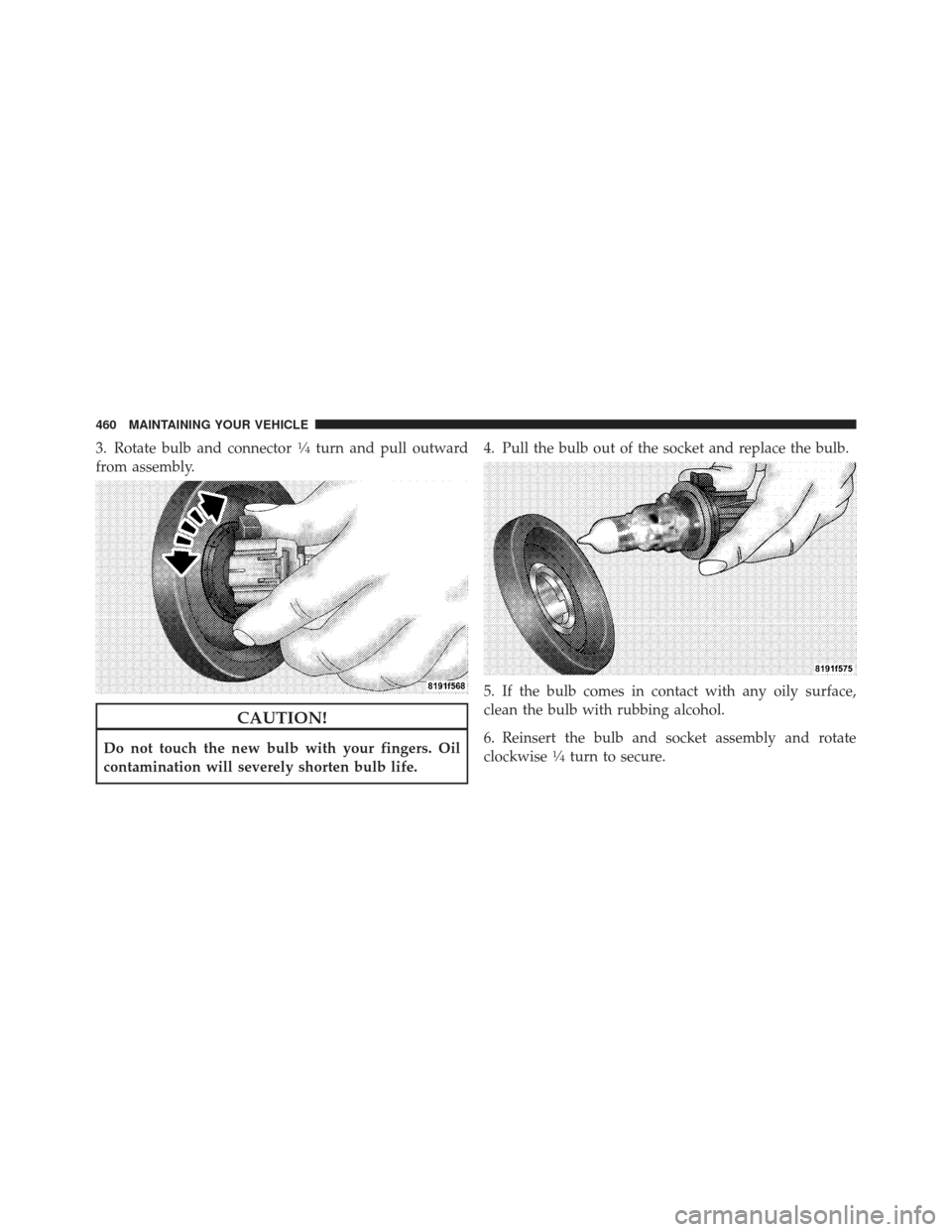
3. Rotate bulb and connector14turn and pull outward
from assembly.
CAUTION!
Do not touch the new bulb with your fingers. Oil
contamination will severely shorten bulb life. 4. Pull the bulb out of the socket and replace the bulb.
5. If the bulb comes in contact with any oily surface,
clean the bulb with rubbing alcohol.
6. Reinsert the bulb and socket assembly and rotate
clockwise14turn to secure.
460 MAINTAINING YOUR VEHICLE
Page 494 of 514

About Your Brakes....................... 326
ABS (Anti-Lock Brake System) .............. 328
Adding Engine Coolant (Antifreeze) .......... 437
Adding Fuel ........................... 373
Adding Washer Fluid ..................... 433
Additives, Fuel ......................... 367
Air Cleaner, Engine (Engine Air Cleaner Filter) . . . 427
Air Conditioner Maintenance ............... 429
Air Conditioning ........................ 279
Air Conditioning Controls ................. 279
Air Conditioning Filter .................290,430
Air Conditioning Refrigerant .............429,430
Air Conditioning System .............279,283,429
Air Conditioning, Operating Tips ............ 291
Air Pressure, Tires ....................... 346
Airbag .............................. 58,67
Airbag Deployment ....................... 68
Airbag Light ................... 65,66,71,87,197
Airbag Maintenance ....................... 70 Airbag, Side
...................... 61,64,66,67
Airbag, Window (Side Curtain) ...........62,64,67
Alarm System (Security Alarm) ............19,204
Alterations/Modifications, Vehicle ............. 7
Antenna, Satellite Radio ................240,266
Anti-Lock Brake System (ABS) .............. 328
Anti-Lock Warning Light .................. 328
Anti-Theft Security Alarm (Theft Alarm) ........ 19
Antifreeze (Engine Coolant) ..............437,463
Disposal ........................... 439
Appearance Care ........................ 446
Ashtray ............................... 180
Assistance Towing ....................... 113
Auto Down Power Windows ................ 36
Auto Unlock, Doors ....................... 32
Auto Up Power Windows .................. 37
Automatic Dimming Mirror ................. 95
Automatic Door Locks ..................... 32
Automatic Oil Change Indicator ..........202,215
492 INDEX
Page 503 of 514
Lights.............................. 89,150
Airbag .................... 65,66,71,87,197
Back-Up ........................... 461
Brake Assist Warning .................. 335
Brake Warning ...................... 199
Bulb Replacement .................... 459
Daytime Running .................... 154
Electronic Stability Program (ESP) Indicator . . 335
Engine Temperature Warning ............ 198
Exterior ............................ 89
Fog ......................... 153,205,461
Headlight Switch ..................... 150
Headlights ......................... 150
Headlights On With Wipers ............. 159
High Beam Indicator .................. 209
Illuminated Entry ..................... 21
Instrument Cluster ................... 150
Interior ............................ 155
License ............................ 462 Lights On Reminder
.................. 154
Low Fuel .......................... 197
Malfunction Indicator (Check Engine) ...... 207
Map Reading ....................... 155
Oil Pressure ........................ 198
Passing ............................ 153
Seat Belt Reminder ................... 197
Security Alarm (Theft Alarm) ............. 19
Theft Alarm (Security Alarm) ............ 204
Tire Pressure Monitoring (TPMS) .......205,356
Traction Control ..................... 335
Turn Signal ................. 89,152,204,461
Voltage ............................ 197
Warning (Instrument Cluster Description) . . . 196
Loading Vehicle ...................... 376,377
Capacities .......................... 377
Tires .............................. 341
Locks Auto Unlock ......................... 32
10
INDEX 501
Page 506 of 514
Sunroof........................... 173
Windows ........................... 35
Pregnant Women and Seat Belts .............. 57
Preparation for Jacking .................... 395
Pretensioners Seat Belts ........................... 52
Programmable Electronic Features ............ 221
Programming Transmitters
(Remote Keyless Entry) .................... 26
Radial Ply Tires ......................... 348
Radiator Cap (Coolant Pressure Cap) .......... 438
Radio Operation ........................ 278
Radio Remote Controls .................... 276
Rear Cupholder ......................... 181
Rear Seat, Folding .................... 146,147
Rear Window Defroster ................... 186
Rear Window Features .................... 186
Rearview Mirrors ........................ 95 Recorder, Event Data
...................... 71
Recreational Towing ...................... 388
Reformulated Gasoline .................... 365
Refrigerant ............................ 430
Reminder, Seat Belt ....................... 56
Remote Control Door Locks ......................... 21
Security Alarm ....................... 19
Remote Keyless Entry (RKE) ................. 21
Remote Keyless Entry (Sedan) ............... 21
Remote Sound System (Radio) Controls ........ 276
Remote Starting System .................... 27
Remote Trunk Release ..................... 39
Replacement Bulbs ....................... 458
Replacement Keys ........................ 17
Replacement Parts ....................... 421
Replacement Tires ....................... 353
Reporting Safety Defects ................... 486
Resetting Oil Change Indicator ...........202,215
504 INDEX
Page 507 of 514
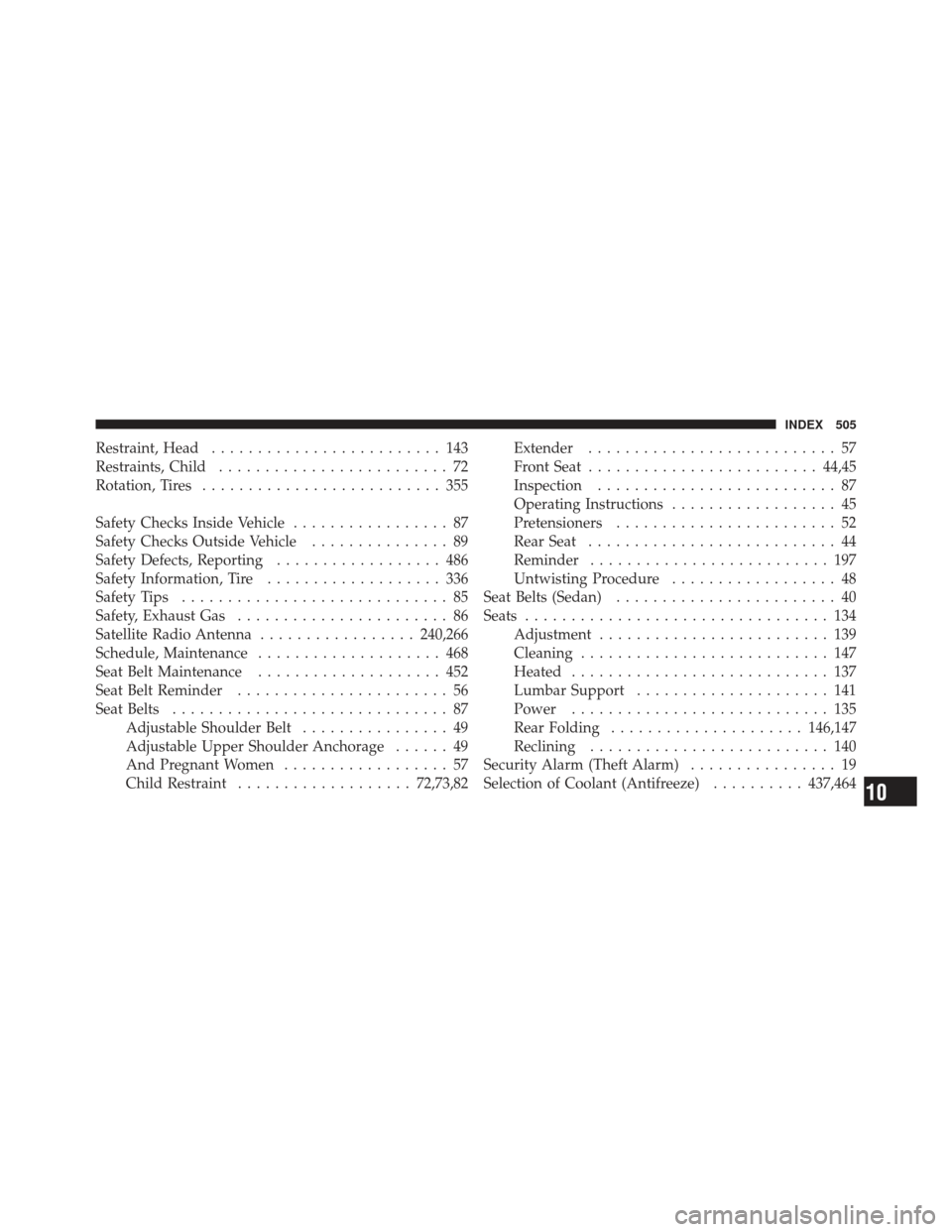
Restraint, Head......................... 143
Restraints, Child ......................... 72
Rotation, Tires .......................... 355
Safety Checks Inside Vehicle ................. 87
Safety Checks Outside Vehicle ............... 89
Safety Defects, Reporting .................. 486
Safety Information, Tire ................... 336
Safety Tips ............................. 85
Safety, Exhaust Gas ....................... 86
Satellite Radio Antenna .................240,266
Schedule, Maintenance .................... 468
Seat Belt Maintenance .................... 452
Seat Belt Reminder ....................... 56
Seat Belts .............................. 87
Adjustable Shoulder Belt ................ 49
Adjustable Upper Shoulder Anchorage ...... 49
And Pregnant Women .................. 57
Child Restraint ................... 72,73,82Extender
........................... 57
Front Seat ......................... 44,45
Inspection .......................... 87
Operating Instructions .................. 45
Pretensioners ........................ 52
Rear Seat ........................... 44
Reminder .......................... 197
Untwisting Procedure .................. 48
Seat Belts (Sedan) ........................ 40
Seats ................................. 134
Adjustment ......................... 139
Cleaning ........................... 147
Heated ............................ 137
Lumbar Support ..................... 141
Power ............................ 135
Rear Folding ..................... 146,147
Reclining .......................... 140
Security Alarm (Theft Alarm) ................ 19
Selection of Coolant (Antifreeze) ..........437,464
10
INDEX 505
Page 509 of 514
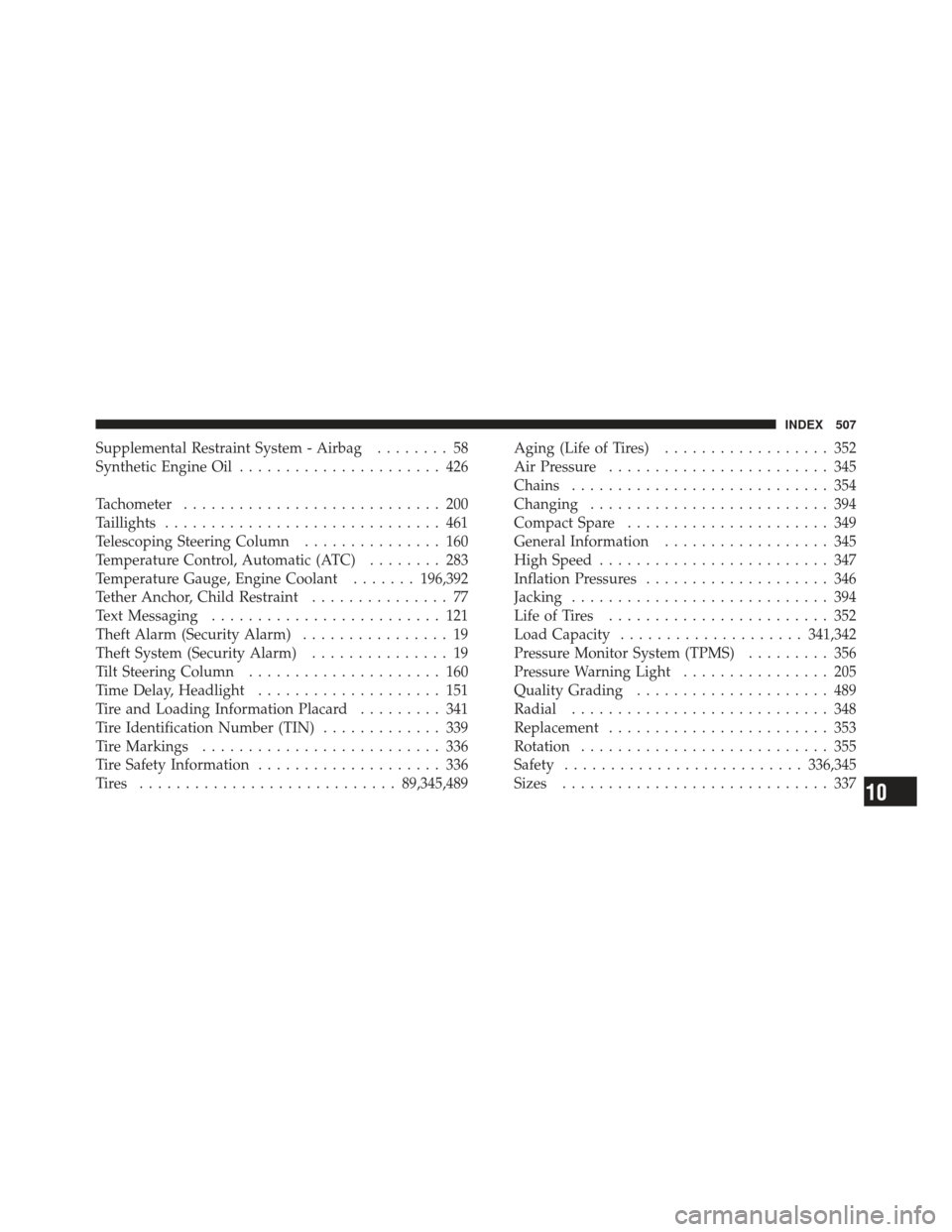
Supplemental Restraint System - Airbag........ 58
Synthetic Engine Oil ...................... 426
Tachometer ............................ 200
Taillights .............................. 461
Telescoping Steering Column ............... 160
Temperature Control, Automatic (ATC) ........ 283
Temperature Gauge, Engine Coolant .......196,392
Tether Anchor, Child Restraint ............... 77
Text Messaging ......................... 121
Theft Alarm (Security Alarm) ................ 19
Theft System (Security Alarm) ............... 19
Tilt Steering Column ..................... 160
Time Delay, Headlight .................... 151
Tire and Loading Information Placard ......... 341
Tire Identification Number (TIN) ............. 339
Tire Markings .......................... 336
Tire Safety Information .................... 336
Tires ............................ 89,345,489Aging (Life of Tires)
.................. 352
Air Pressure ........................ 345
Chains ............................ 354
Changing .......................... 394
Compact Spare ...................... 349
General Information .................. 345
High Speed ......................... 347
Inflation Pressures .................... 346
Jacking ............................ 394
Life of Tires ........................ 352
Load Capacity .................... 341,342
Pressure Monitor System (TPMS) ......... 356
Pressure Warning Light ................ 205
Quality Grading ..................... 489
Radial ............................ 348
Replacement ........................ 353
Rotation ........................... 355
Safety .......................... 336,345
Sizes ............................. 337
10
INDEX 507