Page 372 of 514
the other sections of this manual for information on
features that are common between Flexible Fuel and
gasoline-only powered vehicles.CAUTION!
Only vehicles with the E-85 fuel filler door label can
operate on E-85.
Ethanol Fuel (E-85)
E-85 is a mixture of approximately 85% fuel ethanol and
15% unleaded gasoline.
WARNING!
Ethanol vapors are extremely flammable and could
cause serious personal injury. Never have any smok-
ing materials lit in or near the vehicle when remov-
ing the fuel filler tube cap (gas cap) or filling the
tank. Do not use E-85 as a cleaning agent and never
use it near an open flame.
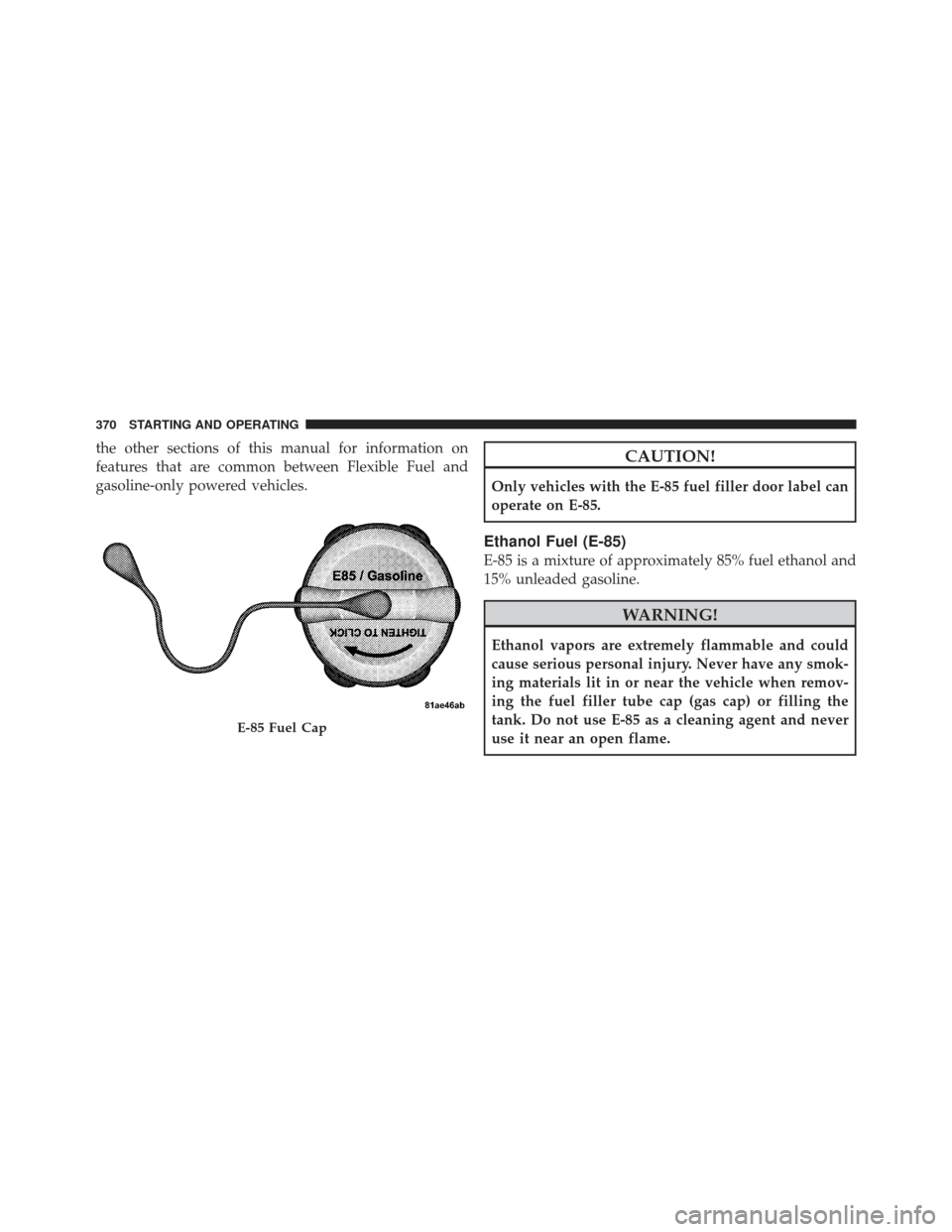
E-85 Fuel Cap
370 STARTING AND OPERATING
Page 373 of 514
Fuel Requirements
Your vehicle will operate on both unleaded gasoline with
an octane rating of 87, or E-85 fuel, or any mixture of
these two. For best results, a refueling pattern that
alternates between E-85 and unleaded gasoline should be
avoided.
When you do switch fuel types it is recommended that:
•you do not switch when the fuel gauge indicates less
than 1/4 full
•you do not add less than 5 gallons (19 Liters) when
refueling
•you operate the vehicle immediately after refueling for
a period of at least 5 minutes
Observing these precautions will avoid possible hard
starting and/or significant deterioration in driveability
during warm up. NOTE:
•When the ambient temperature is above 90° F (32° C),
you may experience hard starting and rough idle
following start up even if the above recommendations
are followed.
•Some additives used in regular gasoline are not fully
compatible with E-85 and may form deposits in your
engine. To eliminate driveability issues that may be
caused by these deposits, a supplemental gasoline
additive, such as MOPAR�
Injector Cleanup or
Techron may be used.
Selection Of Engine Oil For Flexible Fuel Vehicles
(E-85) And Gasoline Vehicles
FFV vehicles operated on E-85 require specially formu-
lated engine oils. These special requirements are included
in MOPAR� engine oils, and in equivalent oils meeting
Chrysler Specification MS-6395. The manufacturer re-
quires engine oils that are API Certified and meet the
5
STARTING AND OPERATING 371
Page 374 of 514
requirements of Material Standard MS-6395. MS-6395
contains additional requirements, developed during ex-
tensive fleet testing, to provide additional protection to
Chrysler Group LLC engines. Use MOPAR�or an
equivalent oil meeting the specification MS-6395.
Starting
The characteristics of E-85 fuel make it unsuitable for use
when ambient temperatures fall below 0°F (-18°C). In the
range of 0°F (-18°C) to 32°F (0°C), you may experience an
increase in the time it takes for your engine to start, and
a deterioration in driveability (sags and/or hesitations)
until the engine is fully warmed up.
NOTE: Use of the engine block heater (if equipped) is
beneficial for E-85 startability when the ambient tempera-
ture is less than 32°F (0°C).
Cruising Range
Because E-85 fuel contains less energy per gallon/liter
than gasoline, you will experience an increase in fuel
consumption. You can expect your miles per gallon
(mpg)/miles per liter and your driving range to decrease
by about 30%, compared to gasoline operation.
Replacement Parts
Many components in your Flexible Fuel Vehicle (FFV) are
designed to be compatible with ethanol. Always be sure
that your vehicle is serviced with correct ethanol com-
patible parts.
CAUTION!
Replacing fuel system components with non-ethanol
compatible components can damage your vehicle.
372 STARTING AND OPERATING
Page 375 of 514
Maintenance
CAUTION!
Do not use ethanol mixture greater than 85% in your
vehicle. It will cause difficulty in cold starting and
may affect driveability.
ADDING FUEL
Fuel Filler Cap (Gas Cap)
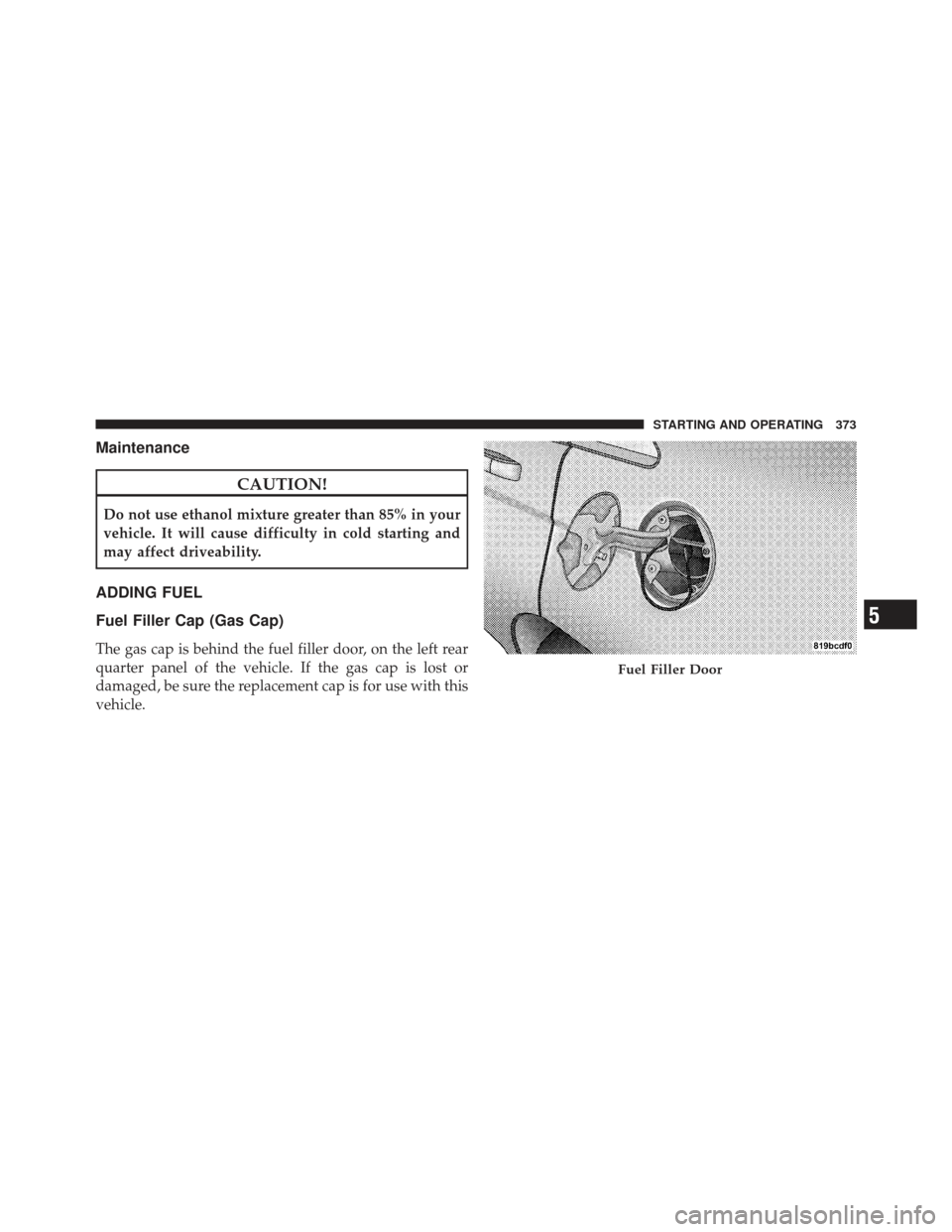
The gas cap is behind the fuel filler door, on the left rear
quarter panel of the vehicle. If the gas cap is lost or
damaged, be sure the replacement cap is for use with this
vehicle.
Fuel Filler Door
5
STARTING AND OPERATING 373
Page 376 of 514
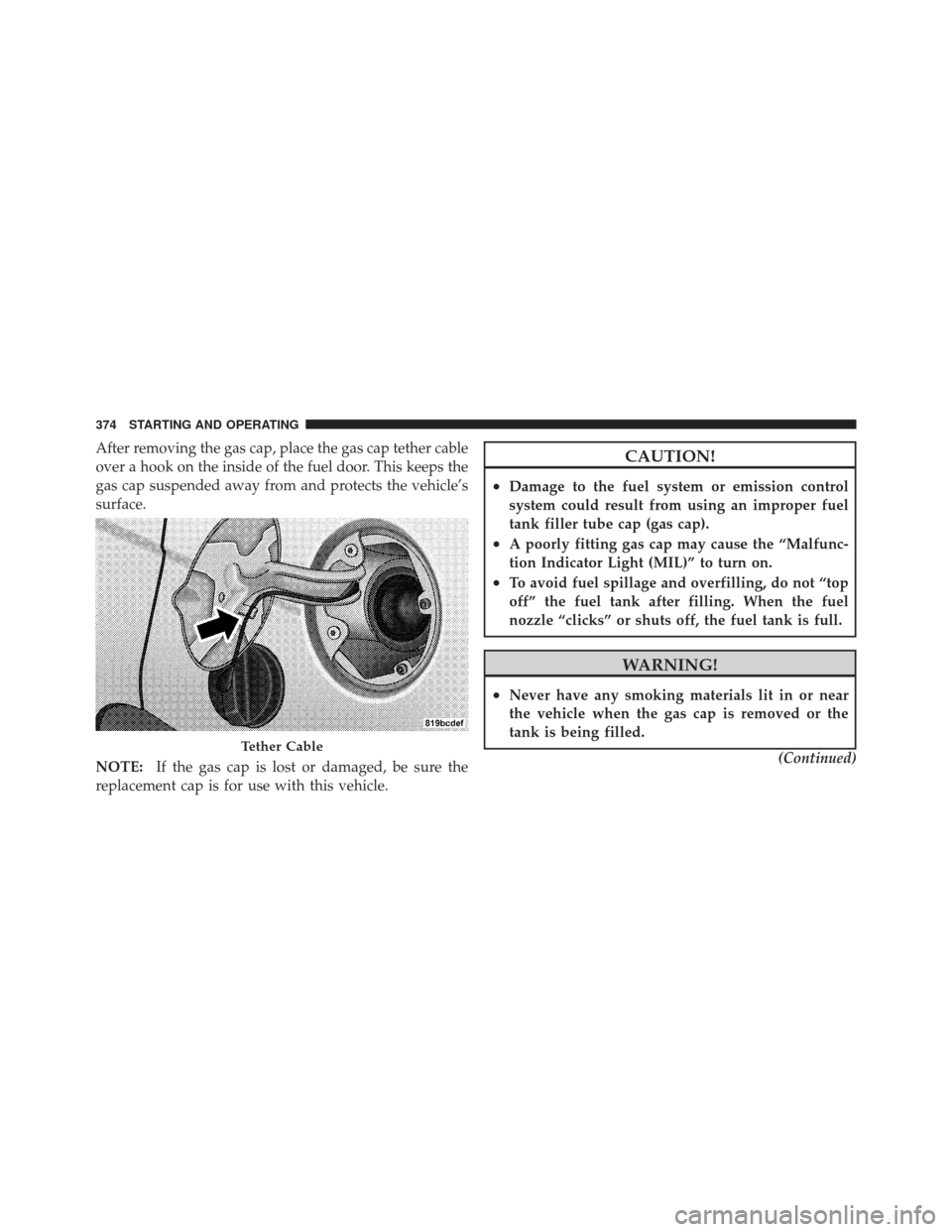
After removing the gas cap, place the gas cap tether cable
over a hook on the inside of the fuel door. This keeps the
gas cap suspended away from and protects the vehicle’s
surface.
NOTE:If the gas cap is lost or damaged, be sure the
replacement cap is for use with this vehicle.CAUTION!
•Damage to the fuel system or emission control
system could result from using an improper fuel
tank filler tube cap (gas cap).
•A poorly fitting gas cap may cause the “Malfunc-
tion Indicator Light (MIL)” to turn on.
•To avoid fuel spillage and overfilling, do not “top
off” the fuel tank after filling. When the fuel
nozzle “clicks” or shuts off, the fuel tank is full.
WARNING!
•Never have any smoking materials lit in or near
the vehicle when the gas cap is removed or the
tank is being filled.
(Continued)
Tether Cable
374 STARTING AND OPERATING
Page 377 of 514
WARNING! (Continued)
•Never add fuel when the engine is running. This is
in violation of most state and federal fire regula-
tions and doing so may cause the MIL to turn on.
•A fire may result if gasoline is pumped into a
portable container that is inside of a vehicle. You
could be burned. Always place gas containers on
the ground while filling.
NOTE:
•Tighten the gas cap until you hear a “clicking” sound.
This is an indication that the gas cap is tightened
properly. The MIL in the instrument cluster may turn
on if the gas cap is not secured properly. Make sure
that the gas cap is tightened each time the vehicle is
refueled.
•When the fuel nozzle “clicks” or shuts off, the fuel
tank is full.
Loose Filler Cap Message
If the vehicles diagnostic system determines that the fuel
filler cap in loose, improperly installed, or damaged, a
“gASCAP” message will be displayed in the instrument
cluster. Tighten the gas cap until a “clicking” sound is
heard. This is an indication that the gas cap is properly
tightened. Press the trip odometer reset button to turn off
the message. If the problem persists, the message will
appear the next time the vehicle is started. This might
indicate a damaged cap. If the problem is detected twice
in a row, the system will turn on the MIL. Resolving the
problem will turn the MIL off.
5
STARTING AND OPERATING 375
Page 389 of 514

Towing Tips
Before setting out on a trip, practice turning, stopping,
and backing the trailer in an area located away from
heavy traffic.
Make sure all trailer and vehicle lights are working
properly — including hazard flashers.
Automatic Transmission
The DRIVE range can be selected when towing. How-
ever, if frequent shifting occurs, select the�3�range (for a
four-speed automatic) or select a lower gear using the
AutoStick� shift control.
NOTE: Using a lower gear while operating the vehicle
under heavy operating conditions, will improve perfor-
mance and extend transmission life by reducing exces-
sive shifting and heat build-up. This action will also
provide better engine braking. If you
REGULARLY TOW a trailer for more than 45 min-
utes of continuous operation, then change the automatic
transmission fluid and filter according to the interval
specified for “police, taxi, fleet, or frequent trailer tow-
ing.” Refer to the “Maintenance Schedule” for the proper
maintenance intervals.
NOTE: Check the four-speed automatic transmission
fluid level before towing. Six-speed transmissions do not
require a fluid level check before towing. If, however, you
notice fluid leakage or transmission malfunction, see
your authorized dealership service center for assistance.
Electronic Speed Control – If Equipped
•
Do not use in hilly terrain or with heavy loads.
•When using the speed control, if you experience speed
drops greater than 10 mph (16 km/h), disengage until
you can get back to cruising speed.
•Use speed control in flat terrain and with light loads to
maximize fuel efficiency.
5
STARTING AND OPERATING 387
Page 417 of 514
MAINTAINING YOUR VEHICLE
CONTENTS
�Engine Compartment — 2.4L ............. 417
� Engine Compartment — 3.6L ............. 418
� Onboard Diagnostic System — OBD II ...... 419
▫ Loose Fuel Filler Cap Message ........... 419
� Emissions Inspection And Maintenance
Programs ............................ 420
� Replacement Parts ..................... 421
� Dealer Service ........................ 421
� Maintenance Procedures ................. 422 ▫
Engine Oil ......................... 423
▫ Engine Oil Filter ..................... 426
▫ Engine Air Cleaner Filter ............... 427
▫ Maintenance-Free Battery .............. 427
▫ Air Conditioner Maintenance ............ 429
▫ A/C Air Filter – If Equipped ............ 430
▫ Body Lubrication .................... 431
▫ Windshield Wiper Blades ............... 432
▫ Adding Washer Fluid ................. 433
7